Office action response checklist for U.S. patent practitioners
January 14, 2026
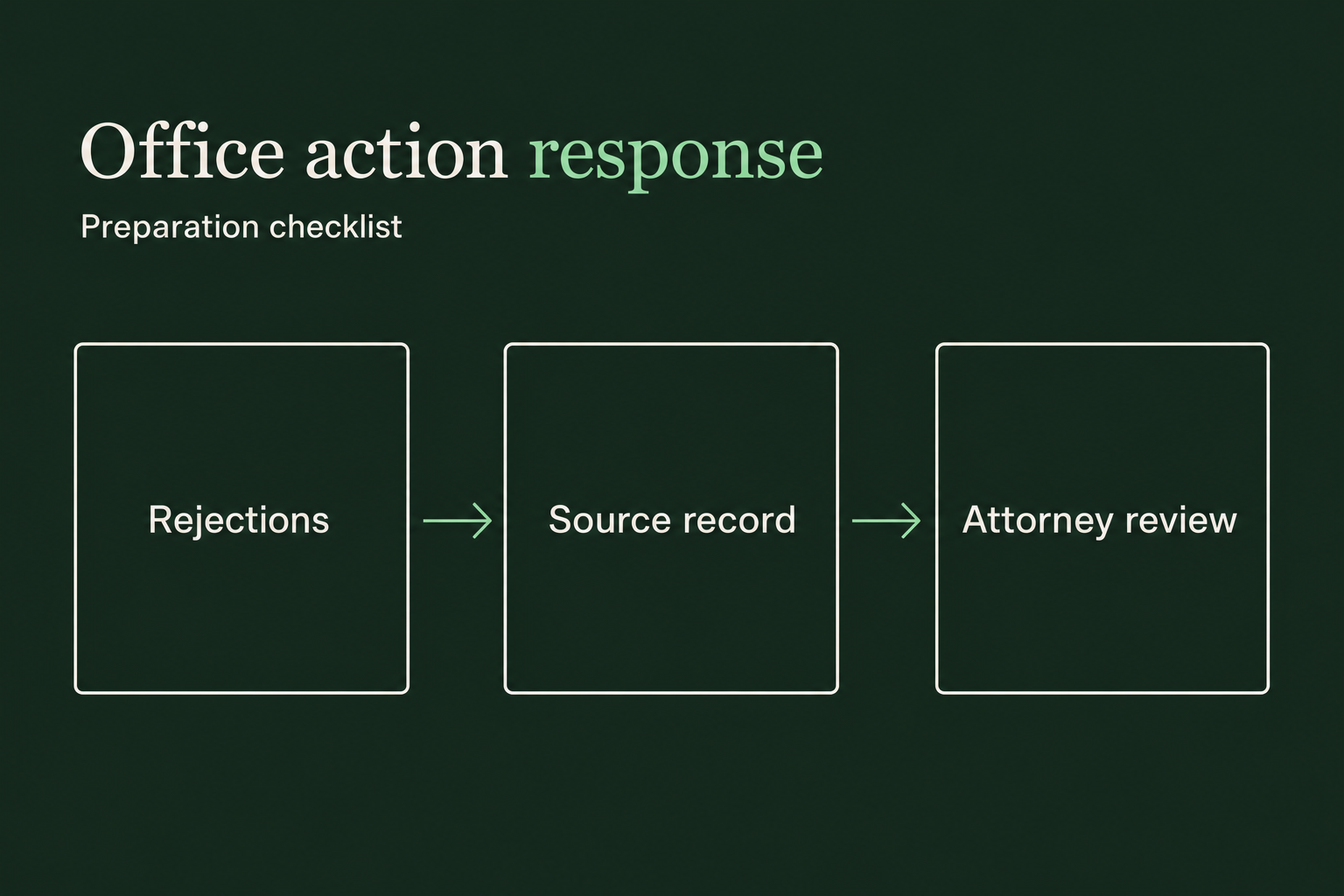
An Office Action response can go off track before the first paragraph of remarks is written. A superseded claim, incomplete reference, or unsupported amendment can undermine an otherwise sound argument. You need a preparation record that connects every examiner issue to the claims, evidence, proposed response, and reviewing attorney. Use this checklist to build that record, carry it through review, and reconcile the final response package.
Scope: U.S. utility patent applications before the United States Patent and Trademark Office (USPTO), primarily ordinary non-final prosecution. This is an educational preparation framework, not matter-specific legal advice. The responsible attorney controls strategy, legal sufficiency, and filing decisions.
1. Triage the action and docket the response
Start with the complete Office Action, including its cover sheet, attachments, and cited-reference list. Record the application number, examiner, mailing date, action type, and period for reply. Distinguish a non-final action on the merits from a restriction requirement, final action, or notice of a procedural deficiency.
For an ordinary non-final action on the merits, the shortened statutory period is generally 3 months. Extensions may be available, subject to applicable requirements and fees, but the statutory period generally cannot exceed 6 months from mailing. The specific action and applicable rules control. USPTO reply-period guidance distinguishes shortened statutory periods, specified time limits, and extension practice.
Your intake record should identify:
- The original reply deadline, any available extension periods, and the statutory limit.
- The preparer, technical reviewer, supervising attorney, and filing owner.
- Internal dates for strategy approval, client instructions, and final review.
- Missing attachments, unreadable pages, or discrepancies between the received action and the application record.
Resolve deadline discrepancies through the docketing owner and responsible attorney before relying on a working date. A completed draft is still working material until the attorney authorizes submission.
2. Assemble a source-controlled preparation record
The application's prosecution history records which papers were filed, what the examiner considered, and whether earlier amendments were entered. Keep source documents separate from working summaries.
| Material | Record to retain | Preparation issue it resolves |
|---|---|---|
| Office Action and attachments | Complete official copy, mailing date, and document identifier | Exact grounds, affected claims, and response period |
| Claims | As-filed claims, latest entered claim listing, and intervening amendments with entry status | Correct baseline for analysis and amendment markings |
| Original disclosure | As-filed specification, drawings, and other applicable disclosure materials | Support for proposed claim language |
| Cited art | Exact cited publication or patent, figures, and any cited non-patent literature | Examiner mapping and reference context |
| Prosecution history | Earlier actions, responses, interview records, and relevant notices | Prior positions, unresolved issues, and amendment history |
For each source, retain its origin, filing or mailing date, document identifier, and page or paragraph locators. A later publication or issued patent may contain changes. Preserve the as-filed disclosure separately rather than treating a convenient later copy as the support record.
3. Build a rejection-to-limitation matrix
A claim limitation is a requirement expressed in the claim. Map the examiner's reasoning to the exact pending language, including relationships between elements and limitations inherited through claim dependency.
Record the statutory ground and subsection exactly. Sections 101, 102, 103, and 112 refer to title 35 of the United States Code.
The response must address every ground of objection and rejection and identify the specific distinctions relied on for patentability. A general assertion that the invention is patentable is insufficient under non-final reply requirements.
Use one row for each ground and material limitation. Repeat rows when a claim faces multiple grounds or different reference combinations. Maintain separate issue rows for objections, formal requirements, and other matters that do not fit a prior-art mapping.
Reusable matrix
| Issue ID | Ground and action locator | Claims and exact limitation | Examiner mapping | Source review and unresolved issue | Proposed route and support | Owner and reviewer | Status |
|---|---|---|---|---|---|---|---|
| R-01 | Statute, subsection, action page | Claim numbers, dependency, quoted limitation | Reference identifier, passage, and stated rationale | Relevant disclosure, context, and specific gap or question | Argument, amendment, evidence, or other route; support locator if amended | Named preparer and attorney | Open, reviewed, or approved for drafting |
Keep the examiner's position and your assessment in separate cells. A missing express statement in a cited passage is an issue for analysis, not an automatic conclusion that the rejection fails. The examiner may rely on inherency, another disclosure, or a stated combination rationale.
Add a claim-status inventory alongside the matrix: rejected, objected to, allowable, withdrawn, canceled, or otherwise identified in the record. Reconcile that inventory to the complete claim listing. A dependent claim's additional limitation deserves its own analysis when you intend to rely on it.
4. Review cited art in context
For each applied reference, review:
- Identity: The publication number, kind code, document version, and dates correspond to the examiner's citation.
- Completeness: The cited pages, figures, tables, and non-patent literature are present and legible.
- Context: The surrounding disclosure supports the proposed reading, including embodiment boundaries and qualifications.
- Claim mapping: The passage addresses the actual limitation and its claimed relationships.
- Legal applicability: The attorney resolves the governing statutory regime, relevant dates, and any asserted prior-art exceptions.
For a § 102 anticipation rejection, focus on whether a single reference discloses the claimed elements, expressly or inherently, arranged as required. The USPTO anticipation framework explains why matching terminology alone is insufficient.
For a § 103 obviousness rejection, record each reference's role and the examiner's reason for the proposed modification or combination. Address the claimed invention as a whole. The USPTO obviousness framework and updated obviousness guidance require more than finding isolated elements across documents.
Eligibility under § 101 and disclosure or definiteness issues under § 112 need different analysis. Preserve the examiner's specific theory in dedicated rows rather than forcing those grounds into a prior-art comparison.
5. Trace every proposed amendment to the as-filed disclosure
An amendment proposal needs two separate explanations: how it addresses the examiner's issue and where the resulting claimed subject matter is supported.
Under the written-description examination guidance, amended claims must have support in the application as filed. Support need not use identical wording. The relevant inquiry concerns the disclosed invention with the claimed limitations, not whether a search returns a similar phrase.

For each proposed change, capture a support record:
| Support field | What to record |
|---|---|
| Proposed language | Exact addition, deletion, or changed relationship |
| Original disclosure | As-filed document and paragraph, page, claim, or figure locator |
| Support explanation | Why the disclosure supports the resulting combination and scope |
| Effect on the claim set | Dependencies, terminology, antecedent basis, and affected claims |
| Attorney decision | Accepted language, rejected alternative, or unresolved support issue |
Review the resulting claim as a whole. Combining passages from different embodiments, deleting a condition, or generalizing a disclosed example can create a support question even when every proposed noun appears somewhere in the specification.
Keep the current application's support analysis separate from any earlier-application benefit or priority analysis. If the proposed scope raises an earlier-filing-date issue, the attorney evaluates that issue against the relevant earlier disclosure and procedural record.
The inventor or technical reviewer can explain how an embodiment works. That explanation informs technical review; it does not substitute for the application's original disclosure. Unresolved support stays visible in the matrix rather than disappearing into a draft amendment.
6. Work through a hypothetical preparation example
Hypothetical example; all details are invented.
Assume a non-final action rejects claims 1–3 under § 103 over Reference A in view of Reference B. Claim 1 recites a temperature sensor and a controller that adjusts sampling frequency based on detected temperature change. Claim 2 adds a threshold condition. Claim 3 adds a storage requirement.
The fictional action cites A, paragraph 18, for the sensor and controller, and B, paragraph 32, for adjusting sampling frequency. Its stated rationale is reducing power consumption.
| Issue | Examiner position | Preparation finding | Response route for attorney review |
|---|---|---|---|
| R-01: Claim 1, adaptive sampling | A supplies the sensor; B supplies the sampling adjustment | B's cited passage describes adjustment on a fixed schedule. Its remaining disclosure and the combination rationale still need analysis. | Evaluate an argument directed to the claimed temperature-change relationship and the stated combination. |
| R-02: Claim 2, threshold | The action applies the same combination to the dependent claim | The cited passages do not expressly address the threshold. Inherency and the complete rationale remain open issues. | Evaluate the dependent limitation separately; retain the unresolved issue. |
| R-03: Claim 3, storage | A, paragraph 24, supplies storage | The fictional passage supports this mapping. | Address the rejection without claiming a storage distinction the record does not support. |
A possible amendment adds that sampling frequency increases when temperature change exceeds a threshold. The fictional as-filed paragraph 27 and Figure 3 disclose that relationship in the same sensor-controller embodiment. The support record preserves those locators and explains the relationship.
The technical reviewer confirms the proposed language describes that embodiment. The attorney then decides whether its support and scope are acceptable, whether argument alone is preferable, and what client instructions are needed. Only the approved route moves into the draft. The unanswered questions about B remain assigned until resolved.
7. Approve the strategy and make review handoffs explicit
Choose the response route before expanding the matrix into prose. The attorney evaluates argument, supported amendment, evidence, and examiner-interview options against the claim scope the client wants to pursue. Record the selected route and the reasons for rejecting material alternatives.
Draft remarks around the actual ground, claim language, examiner position, and supporting record. Explain how a proposed amendment responds to the issue. Address dependent claims and each additional ground separately where their treatment differs. Remove technical assertions that lack record support and broad characterizations of the invention that the argument does not need.
An examiner interview can clarify a disputed mapping or proposed amendment. Preserve the substance and any resulting instructions. An interview does not eliminate the written-response obligation; USPTO interview practice sets out the recordation requirements.
| Handoff | Required work product | Decision authority |
|---|---|---|
| Preparer to technical reviewer | Exact disputed passages, proposed language, and focused technical questions | Technical reviewer addresses operation and terminology |
| Preparer to attorney | Completed matrix, source set, support record, draft, and unresolved issues | Attorney controls legal analysis and response strategy |
| Attorney to client or in-house counsel | Proposed scope changes and their prosecution implications | Client instructions follow the engagement and approval process |
| Attorney to filing owner | Approved document version, signature instructions, attachments, fees, and deadline | Attorney authorizes release; filing owner executes the approved submission |
The sign-off record should name the approving attorney, approval date, exact document version, approved claim changes, and resolved review comments. Keep internal analysis separate from the papers selected for submission. A later substantive edit returns to attorney review.
8. Treat a final action as a different procedural gate
The evidence and support records remain useful after final rejection. Amendment entry and the response path change.
After final, amendment entry is restricted and is not a matter of right. Filing an after-final amendment alone does not save an application from abandonment. After-final amendment rules govern that boundary.
The attorney selects among available after-final practice, a request for continued examination (RCE) where available, appeal, or other appropriate action. RCE practice has its own eligibility, submission, and fee requirements under continued-examination guidance.
Maintain the original final-action deadline and monitor amendment entry and advisory actions. An advisory action is not a general reset of the response clock. The filing plan must identify the action required to keep prosecution moving within the applicable period.
9. Reconcile the final response package
Conduct the last review against the actual submission files, not an earlier working draft. The response must be properly signed and address the examiner's grounds. The USPTO response instructions identify the submission routes, including Patent Center.
Claim amendments require a complete listing of all claims ever presented, appropriate status identifiers, and markings relative to the immediate prior version for currently amended claims. Additions use underlining; deletions generally use strike-through, with the specified double-bracket exceptions. Newly added claims are presented clean with the status “New.” These distinctions follow the claim-amendment requirements.
| Final review | Completion record |
|---|---|
| Coverage | Every rejection, objection, and requirement is addressed; any permitted deferral is expressly requested and attorney-approved |
| Claim baseline | Claim numbers, dependencies, statuses, and amendment markings reconcile to the record |
| Evidence | Quotations, locators, figures, and legal authorities match their sources; generated statements have been reviewed |
| Amendment support | Every substantive change has a reviewed support explanation; date-entitlement issues are separately resolved |
| Consistency | Remarks discuss the submitted claim language and contain no superseded proposals or unresolved comments |
| Authorization | Client instructions and attorney sign-off cover the exact submission version |
| Filing package | Application identifiers, signature, attachments, document descriptions, fees, and reply period are reconciled |
| Submission record | Filing owner retains the receipt, submitted documents, and payment confirmation, and reports discrepancies promptly |
Where Patlytics fits
The Patlytics platform's Office Actions module assists with uploaded actions, pending claims, and specifications. It parses the documents, retrieves cited patent references, and provides artificial intelligence (AI) rejection analysis alongside source materials. Missing references can be uploaded directly. Retrieval is a starting point; the preparer still reconciles the document set against the action and prosecution history.
- Rejection Mapping: Identifies what the examiner cited, which claims each rejection affects, and the prior art relied on, with citations. This builds the rejection-to-limitation matrix in step 3 for source review.
- Claim amendments: The Agent proposes amendments that you accept or reject by prompt. Accepted changes propagate across dependent claims, supporting step 5's claim-set review. The attorney reviews the resulting claims and their as-filed disclosure support.
- Response strategy: Customizable strategy provides multiple amendment options or a primary and backup approach, supporting step 7's strategy decision. The attorney selects the route in line with client instructions.
The module also supports questions about rejections and claims, side-by-side source review, and direct editing of arguments and amendments. The attorney retains control of the source assessment, strategy, final wording, and release decision.
If you are selecting a platform for this work, the separate platform evaluation guide addresses that decision.
See how Patlytics maps every rejection to your claims and drafts supported amendments for attorney review. Book a demo tailored to your team's preparation and review workflow.

Office action response checklist for U.S. patent practitioners
An Office Action response can go off track before the first paragraph of remarks is written. A superseded claim, incomplete reference, or unsupported amendment can undermine an otherwise sound argument. You need a preparation record that connects every examiner issue to the claims, evidence, proposed response, and reviewing attorney. Use this checklist to build that record, carry it through review, and reconcile the final response package.
Scope: U.S. utility patent applications before the United States Patent and Trademark Office (USPTO), primarily ordinary non-final prosecution. This is an educational preparation framework, not matter-specific legal advice. The responsible attorney controls strategy, legal sufficiency, and filing decisions.
1. Triage the action and docket the response
Start with the complete Office Action, including its cover sheet, attachments, and cited-reference list. Record the application number, examiner, mailing date, action type, and period for reply. Distinguish a non-final action on the merits from a restriction requirement, final action, or notice of a procedural deficiency.
For an ordinary non-final action on the merits, the shortened statutory period is generally 3 months. Extensions may be available, subject to applicable requirements and fees, but the statutory period generally cannot exceed 6 months from mailing. The specific action and applicable rules control. USPTO reply-period guidance distinguishes shortened statutory periods, specified time limits, and extension practice.
Your intake record should identify:
- The original reply deadline, any available extension periods, and the statutory limit.
- The preparer, technical reviewer, supervising attorney, and filing owner.
- Internal dates for strategy approval, client instructions, and final review.
- Missing attachments, unreadable pages, or discrepancies between the received action and the application record.
Resolve deadline discrepancies through the docketing owner and responsible attorney before relying on a working date. A completed draft is still working material until the attorney authorizes submission.
2. Assemble a source-controlled preparation record
The application's prosecution history records which papers were filed, what the examiner considered, and whether earlier amendments were entered. Keep source documents separate from working summaries.
| Material | Record to retain | Preparation issue it resolves |
|---|---|---|
| Office Action and attachments | Complete official copy, mailing date, and document identifier | Exact grounds, affected claims, and response period |
| Claims | As-filed claims, latest entered claim listing, and intervening amendments with entry status | Correct baseline for analysis and amendment markings |
| Original disclosure | As-filed specification, drawings, and other applicable disclosure materials | Support for proposed claim language |
| Cited art | Exact cited publication or patent, figures, and any cited non-patent literature | Examiner mapping and reference context |
| Prosecution history | Earlier actions, responses, interview records, and relevant notices | Prior positions, unresolved issues, and amendment history |
For each source, retain its origin, filing or mailing date, document identifier, and page or paragraph locators. A later publication or issued patent may contain changes. Preserve the as-filed disclosure separately rather than treating a convenient later copy as the support record.
3. Build a rejection-to-limitation matrix
A claim limitation is a requirement expressed in the claim. Map the examiner's reasoning to the exact pending language, including relationships between elements and limitations inherited through claim dependency.
Record the statutory ground and subsection exactly. Sections 101, 102, 103, and 112 refer to title 35 of the United States Code.
The response must address every ground of objection and rejection and identify the specific distinctions relied on for patentability. A general assertion that the invention is patentable is insufficient under non-final reply requirements.
Use one row for each ground and material limitation. Repeat rows when a claim faces multiple grounds or different reference combinations. Maintain separate issue rows for objections, formal requirements, and other matters that do not fit a prior-art mapping.
Reusable matrix
| Issue ID | Ground and action locator | Claims and exact limitation | Examiner mapping | Source review and unresolved issue | Proposed route and support | Owner and reviewer | Status |
|---|---|---|---|---|---|---|---|
| R-01 | Statute, subsection, action page | Claim numbers, dependency, quoted limitation | Reference identifier, passage, and stated rationale | Relevant disclosure, context, and specific gap or question | Argument, amendment, evidence, or other route; support locator if amended | Named preparer and attorney | Open, reviewed, or approved for drafting |
Keep the examiner's position and your assessment in separate cells. A missing express statement in a cited passage is an issue for analysis, not an automatic conclusion that the rejection fails. The examiner may rely on inherency, another disclosure, or a stated combination rationale.
Add a claim-status inventory alongside the matrix: rejected, objected to, allowable, withdrawn, canceled, or otherwise identified in the record. Reconcile that inventory to the complete claim listing. A dependent claim's additional limitation deserves its own analysis when you intend to rely on it.
4. Review cited art in context
For each applied reference, review:
- Identity: The publication number, kind code, document version, and dates correspond to the examiner's citation.
- Completeness: The cited pages, figures, tables, and non-patent literature are present and legible.
- Context: The surrounding disclosure supports the proposed reading, including embodiment boundaries and qualifications.
- Claim mapping: The passage addresses the actual limitation and its claimed relationships.
- Legal applicability: The attorney resolves the governing statutory regime, relevant dates, and any asserted prior-art exceptions.
For a § 102 anticipation rejection, focus on whether a single reference discloses the claimed elements, expressly or inherently, arranged as required. The USPTO anticipation framework explains why matching terminology alone is insufficient.
For a § 103 obviousness rejection, record each reference's role and the examiner's reason for the proposed modification or combination. Address the claimed invention as a whole. The USPTO obviousness framework and updated obviousness guidance require more than finding isolated elements across documents.
Eligibility under § 101 and disclosure or definiteness issues under § 112 need different analysis. Preserve the examiner's specific theory in dedicated rows rather than forcing those grounds into a prior-art comparison.
5. Trace every proposed amendment to the as-filed disclosure
An amendment proposal needs two separate explanations: how it addresses the examiner's issue and where the resulting claimed subject matter is supported.
Under the written-description examination guidance, amended claims must have support in the application as filed. Support need not use identical wording. The relevant inquiry concerns the disclosed invention with the claimed limitations, not whether a search returns a similar phrase.
For each proposed change, capture a support record:
| Support field | What to record |
|---|---|
| Proposed language | Exact addition, deletion, or changed relationship |
| Original disclosure | As-filed document and paragraph, page, claim, or figure locator |
| Support explanation | Why the disclosure supports the resulting combination and scope |
| Effect on the claim set | Dependencies, terminology, antecedent basis, and affected claims |
| Attorney decision | Accepted language, rejected alternative, or unresolved support issue |
Review the resulting claim as a whole. Combining passages from different embodiments, deleting a condition, or generalizing a disclosed example can create a support question even when every proposed noun appears somewhere in the specification.
Keep the current application's support analysis separate from any earlier-application benefit or priority analysis. If the proposed scope raises an earlier-filing-date issue, the attorney evaluates that issue against the relevant earlier disclosure and procedural record.
The inventor or technical reviewer can explain how an embodiment works. That explanation informs technical review; it does not substitute for the application's original disclosure. Unresolved support stays visible in the matrix rather than disappearing into a draft amendment.
6. Work through a hypothetical preparation example
Hypothetical example; all details are invented.
Assume a non-final action rejects claims 1–3 under § 103 over Reference A in view of Reference B. Claim 1 recites a temperature sensor and a controller that adjusts sampling frequency based on detected temperature change. Claim 2 adds a threshold condition. Claim 3 adds a storage requirement.
The fictional action cites A, paragraph 18, for the sensor and controller, and B, paragraph 32, for adjusting sampling frequency. Its stated rationale is reducing power consumption.
| Issue | Examiner position | Preparation finding | Response route for attorney review |
|---|---|---|---|
| R-01: Claim 1, adaptive sampling | A supplies the sensor; B supplies the sampling adjustment | B's cited passage describes adjustment on a fixed schedule. Its remaining disclosure and the combination rationale still need analysis. | Evaluate an argument directed to the claimed temperature-change relationship and the stated combination. |
| R-02: Claim 2, threshold | The action applies the same combination to the dependent claim | The cited passages do not expressly address the threshold. Inherency and the complete rationale remain open issues. | Evaluate the dependent limitation separately; retain the unresolved issue. |
| R-03: Claim 3, storage | A, paragraph 24, supplies storage | The fictional passage supports this mapping. | Address the rejection without claiming a storage distinction the record does not support. |
A possible amendment adds that sampling frequency increases when temperature change exceeds a threshold. The fictional as-filed paragraph 27 and Figure 3 disclose that relationship in the same sensor-controller embodiment. The support record preserves those locators and explains the relationship.
The technical reviewer confirms the proposed language describes that embodiment. The attorney then decides whether its support and scope are acceptable, whether argument alone is preferable, and what client instructions are needed. Only the approved route moves into the draft. The unanswered questions about B remain assigned until resolved.
7. Approve the strategy and make review handoffs explicit
Choose the response route before expanding the matrix into prose. The attorney evaluates argument, supported amendment, evidence, and examiner-interview options against the claim scope the client wants to pursue. Record the selected route and the reasons for rejecting material alternatives.
Draft remarks around the actual ground, claim language, examiner position, and supporting record. Explain how a proposed amendment responds to the issue. Address dependent claims and each additional ground separately where their treatment differs. Remove technical assertions that lack record support and broad characterizations of the invention that the argument does not need.
An examiner interview can clarify a disputed mapping or proposed amendment. Preserve the substance and any resulting instructions. An interview does not eliminate the written-response obligation; USPTO interview practice sets out the recordation requirements.
| Handoff | Required work product | Decision authority |
|---|---|---|
| Preparer to technical reviewer | Exact disputed passages, proposed language, and focused technical questions | Technical reviewer addresses operation and terminology |
| Preparer to attorney | Completed matrix, source set, support record, draft, and unresolved issues | Attorney controls legal analysis and response strategy |
| Attorney to client or in-house counsel | Proposed scope changes and their prosecution implications | Client instructions follow the engagement and approval process |
| Attorney to filing owner | Approved document version, signature instructions, attachments, fees, and deadline | Attorney authorizes release; filing owner executes the approved submission |
The sign-off record should name the approving attorney, approval date, exact document version, approved claim changes, and resolved review comments. Keep internal analysis separate from the papers selected for submission. A later substantive edit returns to attorney review.
8. Treat a final action as a different procedural gate
The evidence and support records remain useful after final rejection. Amendment entry and the response path change.
After final, amendment entry is restricted and is not a matter of right. Filing an after-final amendment alone does not save an application from abandonment. After-final amendment rules govern that boundary.
The attorney selects among available after-final practice, a request for continued examination (RCE) where available, appeal, or other appropriate action. RCE practice has its own eligibility, submission, and fee requirements under continued-examination guidance.
Maintain the original final-action deadline and monitor amendment entry and advisory actions. An advisory action is not a general reset of the response clock. The filing plan must identify the action required to keep prosecution moving within the applicable period.
9. Reconcile the final response package
Conduct the last review against the actual submission files, not an earlier working draft. The response must be properly signed and address the examiner's grounds. The USPTO response instructions identify the submission routes, including Patent Center.
Claim amendments require a complete listing of all claims ever presented, appropriate status identifiers, and markings relative to the immediate prior version for currently amended claims. Additions use underlining; deletions generally use strike-through, with the specified double-bracket exceptions. Newly added claims are presented clean with the status “New.” These distinctions follow the claim-amendment requirements.
| Final review | Completion record |
|---|---|
| Coverage | Every rejection, objection, and requirement is addressed; any permitted deferral is expressly requested and attorney-approved |
| Claim baseline | Claim numbers, dependencies, statuses, and amendment markings reconcile to the record |
| Evidence | Quotations, locators, figures, and legal authorities match their sources; generated statements have been reviewed |
| Amendment support | Every substantive change has a reviewed support explanation; date-entitlement issues are separately resolved |
| Consistency | Remarks discuss the submitted claim language and contain no superseded proposals or unresolved comments |
| Authorization | Client instructions and attorney sign-off cover the exact submission version |
| Filing package | Application identifiers, signature, attachments, document descriptions, fees, and reply period are reconciled |
| Submission record | Filing owner retains the receipt, submitted documents, and payment confirmation, and reports discrepancies promptly |
Where Patlytics fits
The Patlytics platform's Office Actions module assists with uploaded actions, pending claims, and specifications. It parses the documents, retrieves cited patent references, and provides artificial intelligence (AI) rejection analysis alongside source materials. Missing references can be uploaded directly. Retrieval is a starting point; the preparer still reconciles the document set against the action and prosecution history.
- Rejection Mapping: Identifies what the examiner cited, which claims each rejection affects, and the prior art relied on, with citations. This builds the rejection-to-limitation matrix in step 3 for source review.
- Claim amendments: The Agent proposes amendments that you accept or reject by prompt. Accepted changes propagate across dependent claims, supporting step 5's claim-set review. The attorney reviews the resulting claims and their as-filed disclosure support.
- Response strategy: Customizable strategy provides multiple amendment options or a primary and backup approach, supporting step 7's strategy decision. The attorney selects the route in line with client instructions.
The module also supports questions about rejections and claims, side-by-side source review, and direct editing of arguments and amendments. The attorney retains control of the source assessment, strategy, final wording, and release decision.
If you are selecting a platform for this work, the separate platform evaluation guide addresses that decision.
See how Patlytics maps every rejection to your claims and drafts supported amendments for attorney review. Book a demo tailored to your team's preparation and review workflow.
The Premier AI-Powered Patent Platform
Reduce cycle times. Increase margins. Deliver winning IP outcomes.
Book a DemoThe Premier AI-Powered
Patent Platform
Reduce cycle times. Increase margins. Deliver winning IP outcomes.