Patent portfolio management software: choose by workflow
June 8, 2026
An annual portfolio review starts with a business question: which patent assets deserve closer attention? Your in-house intellectual property (IP) team needs organized records, relevant source material, and clear responsibility for the next decision. Choosing patent portfolio management software means matching the system to that work, from organizing assets around your business to preparing them for substantive review.
AI assists classification and analysis; attorneys retain legal review authority, and authorized IP and business owners approve portfolio actions.
Separate portfolio intelligence from administration
Patent portfolio management software is a broad category. It can include record keeping, docketing, renewal administration, and analytical work. Those jobs have different requirements, even when they share asset records.
Portfolio intelligence organizes and analyzes patent information to support substantive review. Docketing manages deadlines and associated tasks. Renewal administration handles maintenance instructions and payments. Classification identifies groups for review; docketing and renewal administration carry out their respective operational responsibilities.
Patlytics is built for classification-led portfolio work. Bring-your-own taxonomy is the foundation: the platform's Patent Vault and Classification modules organize assets using your team's established category labels, then carry reviewed groups into connected analysis workflows.
| Job | Work product your team needs | Accountable owner |
|---|---|---|
| Portfolio intelligence | Organized asset groups and material for substantive legal, technical, and business review | In-house IP lead, with designated attorney and technical reviewers |
| Docketing and case administration | Deadline records, task assignments, and prosecution instructions | Legal operations or outside counsel responsible for the docket |
| Renewal administration | Approved maintenance instructions, payment handling, and completion records | Authorized decision-maker and the team or provider executing renewals |
If outside counsel owns your docket and a renewal provider executes payments, a portfolio intelligence layer addresses a different gap. Replacing those administrative systems is a separate buying decision, with its own requirements for deadline management and payment execution.
For heads of IP, an organized portfolio connects maintenance spend to business relevance and makes roadmap alignment visible by technology group. It also speeds diligence preparation: reviewers start with a consistent asset map and defined review sets instead of rebuilding categories for each request. Those are practical reasons to make classification part of the portfolio operating process.
Evaluate workflow fit before breadth
A useful selection brief names the portfolio question, the expected work product, and the person who will use it. “Organize the energy-storage portfolio for a technology review” is a more specific requirement than “add AI to portfolio management.”
Use the same workflow-fit criteria across patent-specific platforms, point solutions, and legacy databases. Match each requirement to the work your team owns.
| Selection criterion | Evidence of fit |
|---|---|
| Inputs and coverage | Asset types, jurisdictions, languages, document versions, metadata, and import formats match the review set |
| Asset and family identity | Records retain identifiers, asset status, and the family definition used in any grouping |
| Classification controls | Your team's taxonomy, understandable category proposals, and practitioner approval, editing, or removal |
| Inspectable work product | Reviewers can identify the underlying asset and inspect the source material relevant to the analysis |
| Review ownership | A defined route for technical review, attorney review, escalation, and authorized approval |
| Operational handoff | Import, export, or integration paths preserve asset identity and identify the receiving owner |
| Enterprise operation | Access controls, collaboration scope, data handling, security evidence, and workload support match the intended deployment |
Record each requirement in your buying brief as a documented capability, contractual commitment, or unresolved requirement. This gives procurement and the IP team a shared basis for the purchase decision.
Preserve asset identity and family context
A patent family groups related applications through their priority relationships. The European Patent Office (EPO) distinguishes simple families covering the same technical content from extended families covering similar content. It also notes that databases use different patent family definitions.
State the counting unit for your review set: individual documents, applications, granted patents, or families. Retain access to individual family members and document the rules used to group them. This keeps portfolio counts and substantive review aligned.
Separate subject matter from claim coverage
A label such as “thermal control” identifies a technical topic. Claim analysis addresses whether a patent covers a particular battery assembly. For US patents, the United States Patent and Trademark Office (USPTO) explains that claims define the scope of protection.
Keep technical classification, business assignment, and legal conclusions distinct. “Thermal control” identifies a review group. “Battery product line” records a business association. A maintenance recommendation belongs in an approved decision process, with its own rationale.
This distinction matters when a portfolio contains granted patents, pending applications, and unpublished drafts. Similar technical language can place them in the same subject-matter group. Their legal status and the claims requiring attorney review remain separate.
Make enterprise requirements specific
Your procurement brief should identify who can access unpublished material, which records outside counsel can receive, how information leaves the platform, and who owns corrections. Define data retention, model-training terms, access restrictions, and the scope of security evidence separately.
Organize the portfolio with your own taxonomy
Bring your own taxonomy into Patent Vault and Classification. A taxonomy is a controlled vocabulary of category labels. Applying the vocabulary your team already uses preserves consistent naming across matters and gives reviewers a familiar structure for portfolio work.
- Add assets. Patent Vault supports issued patents, published patent applications, and unpublished draft applications. Assets can be added individually or through a comma-separated values (CSV) file for bulk import. Newly added patents land in an unclassified bucket.
- Set classification inputs. Use your controlled taxonomy and optional include/exclude terms to guide the categories.
- Review proposed categories. AI proposes categories from claims and specifications. Practitioners approve, edit, or remove the proposals, then assign patents to the appropriate classification group.
- Save claim-limitation groupings. Define how claim limitations, the individual requirements of a claim, are grouped for charting. Those groupings persist across analyses.
- Launch the next analysis. Filter by applied labels and send selected assets or an entire classified group into downstream modules with a one-click handoff, without re-entering the assets.
The work product is a reviewed asset group, organized in your vocabulary and ready for the next patent task.
Use portfolio clustering and heatmaps by classification
For infringement landscaping, portfolio clustering groups patents into technology areas before product search. Practitioners refine the proposed groups by moving patents between classification groups. Run a dedicated product search and Portfolio Heatmap for each classification group to keep the comparison tied to the relevant technology and product materials.
A heatmap summarizes analysis across a patent set for triage. Grouping by classification makes the result easier to interpret: a thermal-control group is evaluated against relevant product documentation rather than the same broad product set used for unrelated technologies. Attorneys then inspect the underlying analysis and claim-level evidence for the assets selected for deeper review.
Prepare IP due diligence for mergers and acquisitions
For IP due diligence in mergers and acquisitions (M&A), apply a consistent taxonomy across the target portfolio and your existing assets. This creates comparable technology groups for reviewing strategic fit and assigning substantive work. Selected groups move into Infringement for product mapping or Invalidity for analysis of potential challenges to patent claims. The diligence team combines attorney-reviewed analysis with ownership, licensing, encumbrance, and business records to assess the transaction.
Example: one category, different review routes
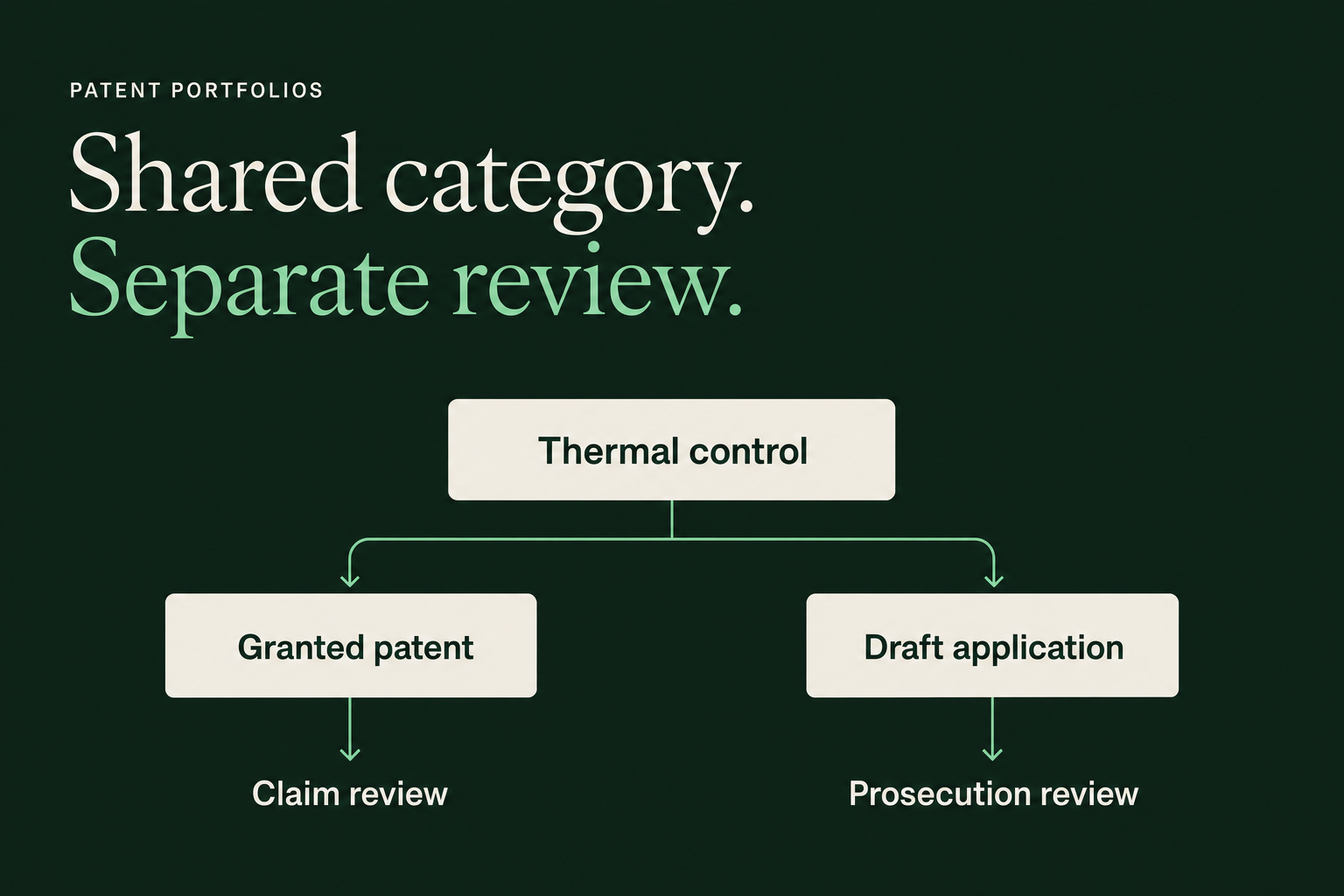
Consider a hypothetical in-house team preparing an energy-storage portfolio for a product-roadmap discussion. Its review set includes an issued patent and an unpublished draft application. Both discuss thermal control, so the practitioner approves the same subject-matter label for each.
That common label brings the documents into one technical discussion, with distinct review routes:
- The issued patent goes to counsel for review of its granted claims in relation to the relevant product architecture.
- The draft application goes to the prosecution reviewer for assessment of its proposed claims and disclosure.
- The business owner supplies the current product context and explains why the technology matters to the roadmap.
The label answers “which group should receive attention?” The reviewers address claim scope, prosecution strategy, and roadmap relevance for each asset. Their findings support the portfolio recommendation.
From reviewed group to approved decision
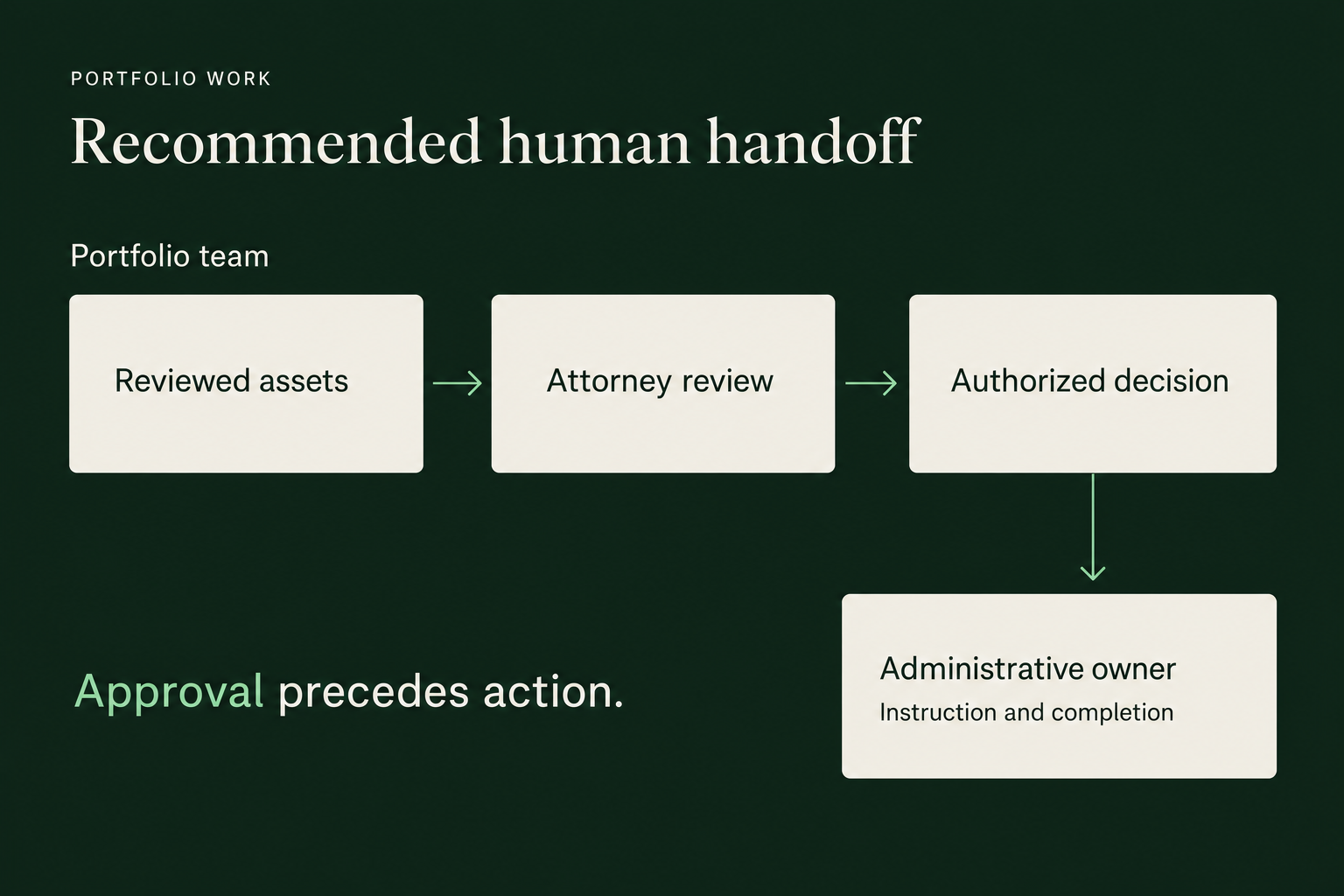
Turn the reviewed asset group into an assigned question, supporting analysis, and an approved decision. Use your team's record system and administrative process for the following handoff.
1. Define the question and prepare the review
Assign a specific question to the selected group, such as relevance to a product roadmap or readiness for a broader portfolio audit. Name the attorney responsible for legal review and the technical or business owner responsible for product context. Include a date or product version when it affects the question.
The responsible reviewer assembles the relevant asset identifiers, individual family members, source documents, claim versions, current legal status, and business context. Record missing information as an unresolved item and assign an owner to resolve it.
2. Complete substantive review and record approval
A broader patent portfolio review addresses the audit method and the portfolio questions requiring deeper analysis. A maintenance-investment question belongs in the separate process for portfolio pruning decisions.
Use the classified group as the input to those methods. The audit or maintenance decision rests on the resulting legal, technical, and business review.
Use your team's approved record system to capture the question, assets reviewed, supporting material, reviewer, rationale, unresolved issues, and proposed next action. The authorized IP or business owner records the decision after the required attorney review.
Record the recommendation and approval separately. Where further work is required, assign the open question and its owner before the decision proceeds.
3. Send an explicit administrative instruction
When an approved decision requires operational action, the receiving docket or renewal owner needs the exact asset, jurisdiction, instruction, and responsible approver. The administrative owner handles execution and records completion through the established process.
This handoff preserves responsibility on both sides. The portfolio team owns the recommendation and approval. The administrative team owns the instructed action and its completion record.
Choose for the work your IP team owns
Choose the platform or system that addresses the gap in your current process. Deadline management, reviewed classification, substantive analysis, and renewal execution each require a defined owner and work product. For classification-led work, your taxonomy should carry from asset organization into the analyses your team performs.
A reviewed portfolio organized by your own taxonomy gives your IP team a concrete starting point for maintenance, roadmap, and diligence decisions. Book a demo focused on that workflow, from Patent Vault and Classification through the handoff into downstream analysis.

Patent portfolio management software: choose by workflow
An annual portfolio review starts with a business question: which patent assets deserve closer attention? Your in-house intellectual property (IP) team needs organized records, relevant source material, and clear responsibility for the next decision. Choosing patent portfolio management software means matching the system to that work, from organizing assets around your business to preparing them for substantive review.
AI assists classification and analysis; attorneys retain legal review authority, and authorized IP and business owners approve portfolio actions.
Separate portfolio intelligence from administration
Patent portfolio management software is a broad category. It can include record keeping, docketing, renewal administration, and analytical work. Those jobs have different requirements, even when they share asset records.
Portfolio intelligence organizes and analyzes patent information to support substantive review. Docketing manages deadlines and associated tasks. Renewal administration handles maintenance instructions and payments. Classification identifies groups for review; docketing and renewal administration carry out their respective operational responsibilities.
Patlytics is built for classification-led portfolio work. Bring-your-own taxonomy is the foundation: the platform's Patent Vault and Classification modules organize assets using your team's established category labels, then carry reviewed groups into connected analysis workflows.
| Job | Work product your team needs | Accountable owner |
|---|---|---|
| Portfolio intelligence | Organized asset groups and material for substantive legal, technical, and business review | In-house IP lead, with designated attorney and technical reviewers |
| Docketing and case administration | Deadline records, task assignments, and prosecution instructions | Legal operations or outside counsel responsible for the docket |
| Renewal administration | Approved maintenance instructions, payment handling, and completion records | Authorized decision-maker and the team or provider executing renewals |
If outside counsel owns your docket and a renewal provider executes payments, a portfolio intelligence layer addresses a different gap. Replacing those administrative systems is a separate buying decision, with its own requirements for deadline management and payment execution.
For heads of IP, an organized portfolio connects maintenance spend to business relevance and makes roadmap alignment visible by technology group. It also speeds diligence preparation: reviewers start with a consistent asset map and defined review sets instead of rebuilding categories for each request. Those are practical reasons to make classification part of the portfolio operating process.
Evaluate workflow fit before breadth
A useful selection brief names the portfolio question, the expected work product, and the person who will use it. “Organize the energy-storage portfolio for a technology review” is a more specific requirement than “add AI to portfolio management.”
Use the same workflow-fit criteria across patent-specific platforms, point solutions, and legacy databases. Match each requirement to the work your team owns.
| Selection criterion | Evidence of fit |
|---|---|
| Inputs and coverage | Asset types, jurisdictions, languages, document versions, metadata, and import formats match the review set |
| Asset and family identity | Records retain identifiers, asset status, and the family definition used in any grouping |
| Classification controls | Your team's taxonomy, understandable category proposals, and practitioner approval, editing, or removal |
| Inspectable work product | Reviewers can identify the underlying asset and inspect the source material relevant to the analysis |
| Review ownership | A defined route for technical review, attorney review, escalation, and authorized approval |
| Operational handoff | Import, export, or integration paths preserve asset identity and identify the receiving owner |
| Enterprise operation | Access controls, collaboration scope, data handling, security evidence, and workload support match the intended deployment |
Record each requirement in your buying brief as a documented capability, contractual commitment, or unresolved requirement. This gives procurement and the IP team a shared basis for the purchase decision.
Preserve asset identity and family context
A patent family groups related applications through their priority relationships. The European Patent Office (EPO) distinguishes simple families covering the same technical content from extended families covering similar content. It also notes that databases use different patent family definitions.
State the counting unit for your review set: individual documents, applications, granted patents, or families. Retain access to individual family members and document the rules used to group them. This keeps portfolio counts and substantive review aligned.
Separate subject matter from claim coverage
A label such as “thermal control” identifies a technical topic. Claim analysis addresses whether a patent covers a particular battery assembly. For US patents, the United States Patent and Trademark Office (USPTO) explains that claims define the scope of protection.
Keep technical classification, business assignment, and legal conclusions distinct. “Thermal control” identifies a review group. “Battery product line” records a business association. A maintenance recommendation belongs in an approved decision process, with its own rationale.
This distinction matters when a portfolio contains granted patents, pending applications, and unpublished drafts. Similar technical language can place them in the same subject-matter group. Their legal status and the claims requiring attorney review remain separate.
Make enterprise requirements specific
Your procurement brief should identify who can access unpublished material, which records outside counsel can receive, how information leaves the platform, and who owns corrections. Define data retention, model-training terms, access restrictions, and the scope of security evidence separately.
Organize the portfolio with your own taxonomy
Bring your own taxonomy into Patent Vault and Classification. A taxonomy is a controlled vocabulary of category labels. Applying the vocabulary your team already uses preserves consistent naming across matters and gives reviewers a familiar structure for portfolio work.
- Add assets. Patent Vault supports issued patents, published patent applications, and unpublished draft applications. Assets can be added individually or through a comma-separated values (CSV) file for bulk import. Newly added patents land in an unclassified bucket.
- Set classification inputs. Use your controlled taxonomy and optional include/exclude terms to guide the categories.
- Review proposed categories. AI proposes categories from claims and specifications. Practitioners approve, edit, or remove the proposals, then assign patents to the appropriate classification group.
- Save claim-limitation groupings. Define how claim limitations, the individual requirements of a claim, are grouped for charting. Those groupings persist across analyses.
- Launch the next analysis. Filter by applied labels and send selected assets or an entire classified group into downstream modules with a one-click handoff, without re-entering the assets.
The work product is a reviewed asset group, organized in your vocabulary and ready for the next patent task.
Use portfolio clustering and heatmaps by classification
For infringement landscaping, portfolio clustering groups patents into technology areas before product search. Practitioners refine the proposed groups by moving patents between classification groups. Run a dedicated product search and Portfolio Heatmap for each classification group to keep the comparison tied to the relevant technology and product materials.
A heatmap summarizes analysis across a patent set for triage. Grouping by classification makes the result easier to interpret: a thermal-control group is evaluated against relevant product documentation rather than the same broad product set used for unrelated technologies. Attorneys then inspect the underlying analysis and claim-level evidence for the assets selected for deeper review.
Prepare IP due diligence for mergers and acquisitions
For IP due diligence in mergers and acquisitions (M&A), apply a consistent taxonomy across the target portfolio and your existing assets. This creates comparable technology groups for reviewing strategic fit and assigning substantive work. Selected groups move into Infringement for product mapping or Invalidity for analysis of potential challenges to patent claims. The diligence team combines attorney-reviewed analysis with ownership, licensing, encumbrance, and business records to assess the transaction.
Example: one category, different review routes
Consider a hypothetical in-house team preparing an energy-storage portfolio for a product-roadmap discussion. Its review set includes an issued patent and an unpublished draft application. Both discuss thermal control, so the practitioner approves the same subject-matter label for each.
That common label brings the documents into one technical discussion, with distinct review routes:
- The issued patent goes to counsel for review of its granted claims in relation to the relevant product architecture.
- The draft application goes to the prosecution reviewer for assessment of its proposed claims and disclosure.
- The business owner supplies the current product context and explains why the technology matters to the roadmap.
The label answers “which group should receive attention?” The reviewers address claim scope, prosecution strategy, and roadmap relevance for each asset. Their findings support the portfolio recommendation.
From reviewed group to approved decision
Turn the reviewed asset group into an assigned question, supporting analysis, and an approved decision. Use your team's record system and administrative process for the following handoff.
1. Define the question and prepare the review
Assign a specific question to the selected group, such as relevance to a product roadmap or readiness for a broader portfolio audit. Name the attorney responsible for legal review and the technical or business owner responsible for product context. Include a date or product version when it affects the question.
The responsible reviewer assembles the relevant asset identifiers, individual family members, source documents, claim versions, current legal status, and business context. Record missing information as an unresolved item and assign an owner to resolve it.
2. Complete substantive review and record approval
A broader patent portfolio review addresses the audit method and the portfolio questions requiring deeper analysis. A maintenance-investment question belongs in the separate process for portfolio pruning decisions.
Use the classified group as the input to those methods. The audit or maintenance decision rests on the resulting legal, technical, and business review.
Use your team's approved record system to capture the question, assets reviewed, supporting material, reviewer, rationale, unresolved issues, and proposed next action. The authorized IP or business owner records the decision after the required attorney review.
Record the recommendation and approval separately. Where further work is required, assign the open question and its owner before the decision proceeds.
3. Send an explicit administrative instruction
When an approved decision requires operational action, the receiving docket or renewal owner needs the exact asset, jurisdiction, instruction, and responsible approver. The administrative owner handles execution and records completion through the established process.
This handoff preserves responsibility on both sides. The portfolio team owns the recommendation and approval. The administrative team owns the instructed action and its completion record.
Choose for the work your IP team owns
Choose the platform or system that addresses the gap in your current process. Deadline management, reviewed classification, substantive analysis, and renewal execution each require a defined owner and work product. For classification-led work, your taxonomy should carry from asset organization into the analyses your team performs.
A reviewed portfolio organized by your own taxonomy gives your IP team a concrete starting point for maintenance, roadmap, and diligence decisions. Book a demo focused on that workflow, from Patent Vault and Classification through the handoff into downstream analysis.
The Premier AI-Powered Patent Platform
Reduce cycle times. Increase margins. Deliver winning IP outcomes.
Book a DemoThe Premier AI-Powered
Patent Platform
Reduce cycle times. Increase margins. Deliver winning IP outcomes.