AI patent platforms for in-house teams: choose by workflow
February 12, 2026
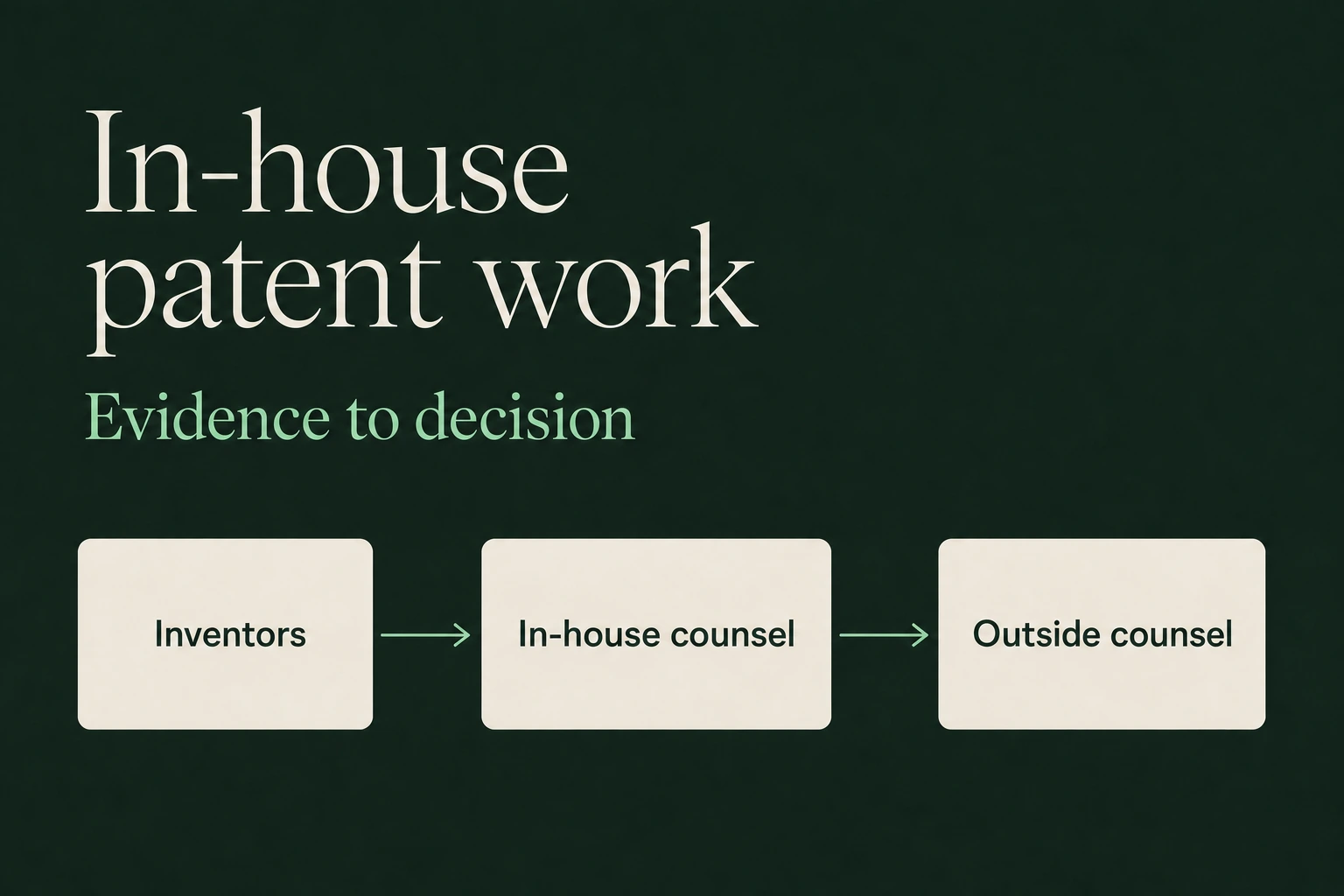
Which patent assignment should your in-house team bring to AI first? An invention awaiting a filing discussion, a portfolio tied to a changing roadmap, and a product approaching launch need different inputs and different work products. Choosing the right workflow starts with what research and development (R&D), intellectual property (IP) leadership, and patent counsel need to do next.
Scope: AI-assisted preparation and analysis for corporate patent teams, with attorneys retaining review and decision authority over drafts, evidence, and legal conclusions.
Choose the work product before the platform
Start with a recurring assignment and its required output. A structured disclosure supports a filing discussion. A source-linked application draft supports claim development. A patent-to-product mapping supports portfolio review. A limitation-level chart supports a specific claim investigation.
Give greatest weight to these qualities when selecting patent AI:
- Source-linked analysis. Each substantive statement connects to the document, claim, passage, figure, or product material that supports it.
- Usable work product. The receiving practitioner gets an editable draft, organized asset group, or evidence chart that can carry the assignment forward without rebuilding its factual foundation.
- Defined coverage. The output accounts for the specified task, sources, jurisdictions, relevant dates, retrieval date, and asset set. Excluded records, unsupported mappings, and missing evidence remain visible.
Keep source evidence, analysis, and open questions distinct. A polished summary is useful when its recommendations lead back to the underlying record and its unresolved questions point to a specific next action.

A narrow drafting capability fits a drafting assignment; a search database fits evidence discovery; a connected patent platform fits teams that need several related work products. Select for the substantive work your department needs now and the next assignment that work will feed.
Broader governance, decision rights, and outside-counsel engagement belong in your in-house IP operating model.
Specify the inputs and outputs each role needs
Use the same technical record across roles while changing the level of detail each receives. Engineering needs a precise question about implementation. An IP leader needs the affected assets, roadmap connection, options, and dependencies.
| Role | Required inputs | Usable output |
|---|---|---|
| Inventor or R&D lead | Design slides, laboratory notes, process diagrams, implementation details, alternatives, contributors, and planned public disclosures | Structured invention record and focused questions about missing technical facts |
| In-house patent counsel | Business question, selected assets or claims, product version, markets, relevant dates, and requested deliverable | Source-linked disclosure, draft, search record, or claim chart with assumptions and gaps identified |
| Portfolio or IP leader | Defined asset set, company taxonomy, product materials, roadmap priorities, and budget constraints | Classified asset groups, patent-to-product evidence, and a brief separating current relevance from future-roadmap assumptions |
| Outside counsel | Scoped disclosure or analysis package, source documents, selected claims, jurisdictions, and unresolved questions | Editable application draft, claim interpretation, or focused legal analysis that extends the supplied record |
Scroll horizontally to view all columns.
The useful output changes with the assignment. A disclosure can support a filing discussion while carrying an unanswered question about an alternative process. A claim chart can support deeper investigation when it identifies the exact limitation for which evidence remains missing.
Match the workflow to the pending decision
1. Prepare an invention for a filing discussion or first draft
Choose invention-intake preparation when technical material is scattered across slides, notes, diagrams, or conversations. AI can organize those materials into an invention disclosure form (IDF) and surface focused questions for the inventor.
The disclosure needs the technical problem, proposed implementation, alternatives, contributors, and sources behind the description. Keep documented facts separate from generated wording. Include planned publications, demonstrations, and other disclosure events so timing reaches the filing discussion.
Choose drafting when the technical record is ready to support proposed claims and a description. The useful output includes a claim tree showing proposed claim relationships, draft sections, and links to supporting material. Missing technical detail should stay visible rather than becoming invented implementation language.
If the question concerns what earlier publications disclose, choose a focused patentability search. Its output needs relevant patent and non-patent references, publication dates, supporting passages, and a clear connection to the proposed invention. That evidence can inform the filing discussion and claim development.
2. Connect portfolio review to a roadmap question
Choose portfolio organization when inconsistent labels make it hard to find the right asset group. Supply your company's taxonomy and the defined patent set. The output should identify proposed classifications and the records included in each group.
Choose patent-to-product analysis when the question is relevance to a product line, planned change, or acquisition target. Supply the asset group and specific product materials. The output needs the patent or application, proposed product association, supporting evidence, and claims needing closer analysis.
For retention review, separate weak current-product associations from future-roadmap assumptions. An asset may warrant continued attention for a future program, licensing purpose, or another documented strategic reason. The same distinction helps IP due diligence for mergers and acquisitions: category labels organize the target portfolio, while claim-level evidence supports the substantive assessment.
The portfolio management workflow develops these review routes in detail.
3. Scope a launch review around the actual product or process
Choose freedom to operate (FTO) analysis for potential third-party patent exposure arising from specified activities in specified markets. Supply the product or process version, intended countries, activities such as manufacture or sale, and decision deadline.
Engineering's input needs implementation-level detail, including optional configurations, suppliers, interfaces, process sequences, and planned changes. The useful output identifies candidate patents and claims, status questions, limitation-level technical mappings, and unresolved issues. The FTO analysis guide covers the full review process.
Fictional example, September 2026: Aster Vale Semiconductor is preparing a U.S. pilot line for an advanced packaging process. Its initial brief places underfill dispensing before thermal compression bonding. Process revision C moves dispensing after bonding and adds a plasma-treatment step, but the patent assignment still uses revision B.
The corrected input package contains the revision C process flow, equipment notes, and the planned sequence for each package variant. The process engineer identifies the changed steps and answers the open question about when plasma treatment occurs. The resulting analysis maps the relevant claims to revision C and identifies which earlier mappings need fresh evidence. The IP lead receives the affected claim-process pairs and the unresolved questions for the pilot-line decision.
4. Investigate selected claims against a defined target
For an investigation involving your own patent, supply the selected claims and a defined target product or process. A claim limitation is a requirement within the claim; the output needs evidence organized against each selected limitation.
Each mapping should identify its source, relevant passage or image, product version, and interpretation assumptions. Keep explicit disclosures, inferences, and unanswered questions separate. For a process claim, the sequence of steps can be the decisive technical question.
A high-priority gap gives the receiving specialist a focused assignment. Public documentation may describe package performance while leaving the bonding sequence unclear. The output should identify the missing sequence evidence and the technical question to resolve before further claim analysis.
For a challenge to a third-party patent, choose invalidity analysis instead. Supply the exact claims, relevant dates, and retained prior-art references. The required output maps the references to claim limitations and identifies the basis and remaining gaps in the proposed challenge.
Where Patlytics fits
Organize patents against your roadmap, turn inventor materials into drafts, and build source-linked claim analysis in Patlytics through these connected workflows:
- Portfolio organization: Classification in Patlytics applies your team's own taxonomy. Clustering groups patents into technology areas, and Portfolio Heatmap summarizes patent-to-product results by classification for targeted portfolio review.
- Product relevance and retention: Portfolio Analysis supports patent-to-product mapping across the portfolio. Patent Pruning uses portfolio-level mapping to surface assets with weak or no current product coverage, supplying evidence for claim-relevance and retention assessment.
- Invention intake and drafting: Invention Disclosures (IDF) turns inventor materials, slides, and spoken input into a reviewable disclosure, with targeted follow-up questions and Word document export. Patent Drafting develops claim trees and descriptions from invention materials. §112 Check analyzes terms and phrases for written-description, enablement, and indefiniteness issues.
- Specialized drafting inputs: Patent Drafting supports a structure editor, image-to-SMILES (Simplified Molecular Input Line Entry System) conversion, ChemDraw input, Markush/R-group generation for chemical alternatives, and sequence uploads with complementarity-determining-region (CDR) detection for chemistry and biologics work.
- Search, patent challenges, and launch analysis: Patent & NPL Search covers patents and non-patent literature (NPL), including PubMed. Invalidity generates citation-backed claim charts against prior-art references. FTO starts from product materials to support search, screening, and claim analysis for the defined launch assignment.
- Claim investigations: Infringement and Detection Report surface public product evidence and generate limitation-by-limitation charts. Exhaustive mode provides deeper coverage on selected priority claims. Claim Construction proposes interpretations with pin cites to the specification; those constructions are editable, and charts can be re-run with the revised construction. Claim Charting supports infringement and invalidity charts, with Word, Excel, and PDF export.
Attorneys retain review and decision authority over all drafts, charts, evidence, and legal conclusions.
Turn your team's inventor materials, portfolio questions, and product evidence into the disclosure, draft, or claim analysis the next decision requires. Book a demo for a walkthrough of those work products in Patlytics.
The Premier AI-Powered
Patent Platform
Reduce cycle times. Increase margins. Deliver winning IP outcomes.