AI Tools for Patent Attorneys: A Practical Guide to Modern IP Workflows
June 8, 2026

Introduction
Most AI tools for patent attorneys optimize a single task: drafting, search, or analytics. But patent work rarely happens in isolation. Prior art informs drafting, prosecution shapes claim strategy, and litigation analysis feeds portfolio decisions. When those workflows live in separate systems, attorneys spend time rebuilding context instead of advancing the work.
AI can reduce that friction when it supports the workflow, not just isolated tasks. In fact, according to Thomson Reuters, AI could free up four hours per week for lawyers in the near term, and up to 12 hours per week within five years. For patent teams, that time matters most when it reduces repetitive review, drafting setup, and manual movement of information between systems.
This guide explains how AI fits across the patent lifecycle and why more teams are moving toward connected, patent-specific platforms.
Key takeaways:
- AI tools can support prior art search, drafting, prosecution, claim analysis, and portfolio review.
- Disconnected tools create handoffs, duplicated work, and lost context across the patent lifecycle.
- Stronger platforms connect workflows with citation-backed outputs, claim-level mapping, and reviewable analysis.
- General-purpose AI can help with early drafting and summarization, but it lacks patent-specific structure and traceability.
What are AI Tools for Patent Attorneys?
AI tools for patent attorneys support core patent tasks such as prior art search, drafting, claim analysis, prosecution, and portfolio review.
They can analyze patent data, technical documents, office actions, and claim language to surface relevant references, generate draft text, compare claims, and identify potential gaps.
The output is a starting point. Attorneys still control legal judgment, claim scope, strategy, and final work product.
How AI Supports the Patent Workflow (and the Tools Behind It)
AI in patent practice is best understood not as a collection of standalone features, but as support across a connected workflow. From early-stage discovery through prosecution and portfolio strategy, different tools address different stages of the lifecycle. The real challenge is that these stages are often handled in separate systems, which breaks continuity and forces attorneys to repeatedly rebuild context.
Below is a practical view of how AI maps to each stage of patent work, along with the types of tools typically used at each step.
1. Discovery & Prior Art Search
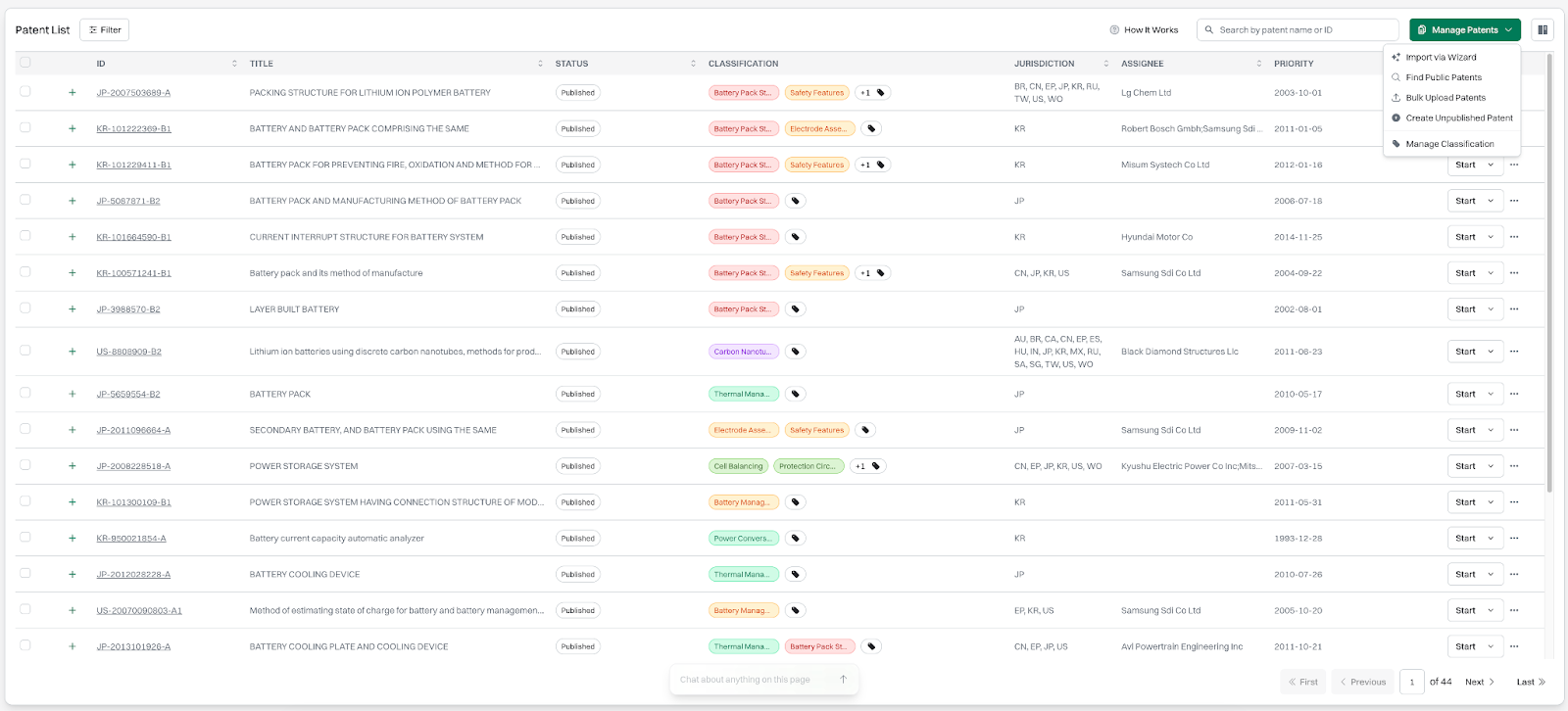
At the earliest stage of the workflow, prior art search helps attorneys identify relevant patents and non-patent literature before drafting, during prosecution, or for FTO and invalidity work. Stronger tools support semantic search, classification filters, citation tracking, family review, legal status data, and jurisdictional coverage.
Typical tools in this stage: AI search platforms, patent analytics tools, landscape analysis systems
However, most tools in this category focus primarily on retrieval and ranking. The output often still needs to be reinterpreted or manually carried into drafting, claim analysis, or prosecution workflows.
Rather than treating prior art search as a one-off task, patent attorneys benefit from having a platform that captures the entire patent lifecycle from invention intake to litigation. Look for tools that support:
- Semantic and claim-based searching
- Global patent coverage
- Non-patent literature (NPL)
- Relevance ranking and evidence tracking
Patlytics can help your team through every stage of the patent process, even after prior art search has concluded.
2. Patent Drafting and Application Prepartion
AI drafting tools support the creation of early patent application content, including specifications, summaries, and embodiments. Inputs such as invention disclosures, technical notes, or preliminary claims can be transformed into structured draft material.
This accelerates the early drafting process and improves consistency in format and structure.
Typical tools in this stage: Patent drafting assistants, general-purpose LLMs, document generation tools
Used carefully, it helps attorneys test scope, flag inconsistencies, and identify potential weaknesses earlier. The attorney still decides what claim language preserves the right balance of breadth, support, and defensibility.
3. Claim Analysis and Validation
Once claims are developed, AI can help break them down into elements, compare them against prior art or products, and highlight potential gaps or inconsistencies. AI prosecution tools can parse office actions, identify rejection grounds, link issues to affected claims and cited references, and generate editable response drafts.
Typical tools in this stage: Claim charting tools, infringement/invalidity analysis platforms, semantic comparison systems
In many cases, claim analysis is still performed in isolation from drafting and prosecution data, requiring manual coordination across tools and documents.
Stronger platforms tie arguments back to source materials so attorneys can verify the basis for each response.
When you’re evaluating AI patent validity search tools, consider these key factors:
- Data Coverage: The breadth, depth, and recency of patent and non-patent literature on the platform.
- AI Sophistication: The quality of semantic search capabilities and the specialization of models for patent analysis.
- Usability and Workflow Integration: How seamlessly the tool fits into existing processes and complements human expertise
- Reporting Capabilities: Flexibility and clarity of generated reports and analytics
- Provider Expertise: The vendor's understanding of patent law nuances and technical domain knowledge.
The ideal solution combines advanced AI technology with deep patent expertise to deliver actionable insights that enhance decision-making.
4. Prosecution Support
AI tools can assist with office action analysis by identifying rejection grounds, linking cited prior art to specific claim elements, and generating draft responses for attorney review. This reduces the time required to structure arguments and organize supporting materials.
Typical tools in this stage: Prosecution support platforms, office action analysis tools, legal drafting assistants
The key limitation is that prosecution insights often remain disconnected from earlier search and drafting work, making it harder to maintain continuity in claim strategy over time.
5. Portfolio and Strategic Intelligence
At the portfolio level, AI is used to analyze large patent sets to identify coverage gaps, competitive activity, licensing opportunities, and maintenance decisions. These insights support long-term IP strategy and business alignment.
Typical tools in this stage: Patent analytics platforms, portfolio management systems, competitive intelligence tools
These systems are strongest at aggregation and visualization, but often operate separately from the underlying claim, prosecution, and drafting context that produced the patents in the first place.
6. FTO Analysis
AI supports Freedom-to-Operate (FTO) analysis by identifying patents that may be relevant to a product or feature and mapping their claims against technical descriptions or product components. This helps attorneys quickly surface potential risk areas and organize large volumes of patent data into structured comparisons.
Typical tools in this stage: AI patent search platforms (i.e. prior art databases), claim charting tools, patent analytics platforms, spreadsheet-based tracking, document review tools, and general-purpose LLMs for summarization and drafting
Used effectively, AI can accelerate the early stages of FTO by linking search results to claim-level breakdowns and highlighting areas of possible overlap between existing patents and a proposed product.
Platforms like Patlytics support this by keeping prior art, claim analysis, and product mappings connected in a single workflow, so FTO analysis can evolve without rebuilding charts from scratch at each stage.
An End-to-End AI-Native Platform That Does it All
Most AI tools in the patent space are built around individual tasks—search, drafting, prosecution, or analytics. While each solves a specific problem, they rarely share context with one another. This forces attorneys to move data manually between systems and rebuild analysis at every stage of the workflow.
End-to-end AI-native platforms take a different approach. Instead of optimizing a single step in isolation, they connect the entire patent lifecycle into a continuous workflow where search, drafting, prosecution, and analysis are linked through shared data, claims, and citations. Claims stay tied to supporting evidence. Prosecution insights can carry into invalidity, FTO, infringement, and portfolio workflows.
Patlytics is an example of this approach. It supports the full patent lifecycle in one platform, from invention disclosure and drafting to infringement analysis and portfolio decisions. Patlytics is designed for patent practitioners, with connected workflows, configurable outputs, and enterprise-grade security.
See how Patlytics supports end-to-end patent workflows in a single system.
Best Practices for Using AI in Patent Work
AI can support patent work across the lifecycle, but results depend on how it’s used. Most teams follow a few consistent practices to get value while keeping control.
- Keep a human-in-the-loop at all stages: Maintains legal judgment, oversight, and accountability across every step
- Use AI for first drafts, not final outputs: Allows faster early-stage work while keeping final decisions with the attorney
- Validate prior art results manually: Reduces the risk of missed references or incomplete search results
- Protect sensitive data: Keeps client and invention information secure when using AI tools
- Develop internal AI workflows: Creates consistency across teams and standardizes how AI is used
When Should Patent Attorneys Use AI (and When Not To)?
AI works best when it supports structured, repeatable tasks. Patent attorneys often use it to review large datasets, organize information, and generate early drafts.
Use AI when:
- Reviewing prior art at scale: Helps surface relevant references across large datasets
- Drafting initial content: Generates early versions of specifications, claims, or summaries
- Summarizing complex material: Breaks down technical documents or office actions into key points
- Comparing claims and references: Assists with identifying overlaps, gaps, or risks
Avoid relying on AI when:
- Making final legal judgments: Decisions on patentability, claim scope, and strategy require attorney oversight
- Finalizing application language: Drafts need review for accuracy, clarity, and legal strength
- Assessing nuanced technical distinctions: AI may miss context that affects claim interpretation
- Handling highly sensitive information without safeguards: Data security and confidentiality must be verified before use
AI supports the workflow, but it doesn’t replace legal expertise. Attorneys remain responsible for strategy, interpretation, and final outputs.
AI Tools for Patent Attorneys Are Shifting Toward Unified Workflows
Patent attorneys rarely rely on one tool. Search, drafting, claim analysis, prosecution, and portfolio work often happen across separate systems. Each tool may solve a specific problem, but the handoffs create friction: information gets copied, outputs are reformatted, and context from earlier work does not always carry forward.
That is why more teams are moving toward unified patent workflows. In an end-to-end platform, prior art search can feed drafting, claims can stay tied to supporting evidence, office action analysis can connect back to cited art, and prosecution insights can carry into portfolio review.
The value is not AI for its own sake. It is less duplicated work, fewer manual handoffs, and more reviewable analysis across the patent lifecycle.
Patlytics connects invention disclosure, drafting, prosecution, invalidity, infringement, FTO, claim charting, and portfolio analysis in one patent-specific platform, with citation-backed outputs, configurable workflows, and enterprise-grade security.
Explore how Patlytics supports unified patent workflows in a single platform.
FAQs about AI tools for patent attorneys
Can AI draft a patent application?
AI can draft parts of a patent application, including specifications, summaries, and even early claim structures. It works best when starting with structured inputs such as invention disclosures or prior art.
Attorneys still review and refine everything before filing. AI can produce a first draft, but attorneys remain responsible for the argument, claim scope, and prosecution strategy.
Do patent attorneys need AI tools?
Patent attorneys don’t need AI tools to do their work, but many use them to handle growing workloads and reduce repetitive tasks. AI supports research, drafting, and analysis, especially when managing multiple applications at once.
According to the American Bar Association, 54% of legal professionals already use AI to draft correspondence.
Some teams still rely on traditional workflows. Others use AI at specific points, such as prior art search or early drafting. The choice depends on workload, team structure, and how work is managed.
Is AI reliable for prior art searches?
AI can support prior art searches by scanning large datasets and identifying relevant references based on concepts, not just keywords. It helps surface documents quickly and refine search direction early in the process.
Results still need review. AI may miss context, misinterpret technical language, or return less relevant documents. Attorneys check results, adjust queries, and confirm what’s relevant before relying on the output.
What are the risks of using AI in patent law?
AI introduces risk when outputs are treated as final or used without verification. Common risks include incorrect citations, incomplete prior art analysis, unsupported claim language, unintended claim narrowing, and exposure of confidential invention or client data.
Attorneys should use AI tools with citation-backed outputs, clear source links, strong security controls, and defined review workflows. Final responsibility for accuracy, strategy, and filing decisions remains with the practitioner.
AI Tools for Patent Attorneys: A Practical Guide to Modern IP Workflows
Introduction
Most AI tools for patent attorneys optimize a single task: drafting, search, or analytics. But patent work rarely happens in isolation. Prior art informs drafting, prosecution shapes claim strategy, and litigation analysis feeds portfolio decisions. When those workflows live in separate systems, attorneys spend time rebuilding context instead of advancing the work.
AI can reduce that friction when it supports the workflow, not just isolated tasks. In fact, according to Thomson Reuters, AI could free up four hours per week for lawyers in the near term, and up to 12 hours per week within five years. For patent teams, that time matters most when it reduces repetitive review, drafting setup, and manual movement of information between systems.
This guide explains how AI fits across the patent lifecycle and why more teams are moving toward connected, patent-specific platforms.
Key takeaways:
- AI tools can support prior art search, drafting, prosecution, claim analysis, and portfolio review.
- Disconnected tools create handoffs, duplicated work, and lost context across the patent lifecycle.
- Stronger platforms connect workflows with citation-backed outputs, claim-level mapping, and reviewable analysis.
- General-purpose AI can help with early drafting and summarization, but it lacks patent-specific structure and traceability.
What are AI Tools for Patent Attorneys?
AI tools for patent attorneys support core patent tasks such as prior art search, drafting, claim analysis, prosecution, and portfolio review.
They can analyze patent data, technical documents, office actions, and claim language to surface relevant references, generate draft text, compare claims, and identify potential gaps.
The output is a starting point. Attorneys still control legal judgment, claim scope, strategy, and final work product.
How AI Supports the Patent Workflow (and the Tools Behind It)
AI in patent practice is best understood not as a collection of standalone features, but as support across a connected workflow. From early-stage discovery through prosecution and portfolio strategy, different tools address different stages of the lifecycle. The real challenge is that these stages are often handled in separate systems, which breaks continuity and forces attorneys to repeatedly rebuild context.
Below is a practical view of how AI maps to each stage of patent work, along with the types of tools typically used at each step.
1. Discovery & Prior Art Search
At the earliest stage of the workflow, prior art search helps attorneys identify relevant patents and non-patent literature before drafting, during prosecution, or for FTO and invalidity work. Stronger tools support semantic search, classification filters, citation tracking, family review, legal status data, and jurisdictional coverage.
Typical tools in this stage: AI search platforms, patent analytics tools, landscape analysis systems
However, most tools in this category focus primarily on retrieval and ranking. The output often still needs to be reinterpreted or manually carried into drafting, claim analysis, or prosecution workflows.
Rather than treating prior art search as a one-off task, patent attorneys benefit from having a platform that captures the entire patent lifecycle from invention intake to litigation. Look for tools that support:
- Semantic and claim-based searching
- Global patent coverage
- Non-patent literature (NPL)
- Relevance ranking and evidence tracking
Patlytics can help your team through every stage of the patent process, even after prior art search has concluded.
2. Patent Drafting and Application Prepartion
AI drafting tools support the creation of early patent application content, including specifications, summaries, and embodiments. Inputs such as invention disclosures, technical notes, or preliminary claims can be transformed into structured draft material.
This accelerates the early drafting process and improves consistency in format and structure.
Typical tools in this stage: Patent drafting assistants, general-purpose LLMs, document generation tools
Used carefully, it helps attorneys test scope, flag inconsistencies, and identify potential weaknesses earlier. The attorney still decides what claim language preserves the right balance of breadth, support, and defensibility.
3. Claim Analysis and Validation
Once claims are developed, AI can help break them down into elements, compare them against prior art or products, and highlight potential gaps or inconsistencies. AI prosecution tools can parse office actions, identify rejection grounds, link issues to affected claims and cited references, and generate editable response drafts.
Typical tools in this stage: Claim charting tools, infringement/invalidity analysis platforms, semantic comparison systems
In many cases, claim analysis is still performed in isolation from drafting and prosecution data, requiring manual coordination across tools and documents.
Stronger platforms tie arguments back to source materials so attorneys can verify the basis for each response.
When you’re evaluating AI patent validity search tools, consider these key factors:
- Data Coverage: The breadth, depth, and recency of patent and non-patent literature on the platform.
- AI Sophistication: The quality of semantic search capabilities and the specialization of models for patent analysis.
- Usability and Workflow Integration: How seamlessly the tool fits into existing processes and complements human expertise
- Reporting Capabilities: Flexibility and clarity of generated reports and analytics
- Provider Expertise: The vendor's understanding of patent law nuances and technical domain knowledge.
The ideal solution combines advanced AI technology with deep patent expertise to deliver actionable insights that enhance decision-making.
4. Prosecution Support
AI tools can assist with office action analysis by identifying rejection grounds, linking cited prior art to specific claim elements, and generating draft responses for attorney review. This reduces the time required to structure arguments and organize supporting materials.
Typical tools in this stage: Prosecution support platforms, office action analysis tools, legal drafting assistants
The key limitation is that prosecution insights often remain disconnected from earlier search and drafting work, making it harder to maintain continuity in claim strategy over time.
5. Portfolio and Strategic Intelligence
At the portfolio level, AI is used to analyze large patent sets to identify coverage gaps, competitive activity, licensing opportunities, and maintenance decisions. These insights support long-term IP strategy and business alignment.
Typical tools in this stage: Patent analytics platforms, portfolio management systems, competitive intelligence tools
These systems are strongest at aggregation and visualization, but often operate separately from the underlying claim, prosecution, and drafting context that produced the patents in the first place.
6. FTO Analysis
AI supports Freedom-to-Operate (FTO) analysis by identifying patents that may be relevant to a product or feature and mapping their claims against technical descriptions or product components. This helps attorneys quickly surface potential risk areas and organize large volumes of patent data into structured comparisons.
Typical tools in this stage: AI patent search platforms (i.e. prior art databases), claim charting tools, patent analytics platforms, spreadsheet-based tracking, document review tools, and general-purpose LLMs for summarization and drafting
Used effectively, AI can accelerate the early stages of FTO by linking search results to claim-level breakdowns and highlighting areas of possible overlap between existing patents and a proposed product.
Platforms like Patlytics support this by keeping prior art, claim analysis, and product mappings connected in a single workflow, so FTO analysis can evolve without rebuilding charts from scratch at each stage.
An End-to-End AI-Native Platform That Does it All
Most AI tools in the patent space are built around individual tasks—search, drafting, prosecution, or analytics. While each solves a specific problem, they rarely share context with one another. This forces attorneys to move data manually between systems and rebuild analysis at every stage of the workflow.
End-to-end AI-native platforms take a different approach. Instead of optimizing a single step in isolation, they connect the entire patent lifecycle into a continuous workflow where search, drafting, prosecution, and analysis are linked through shared data, claims, and citations. Claims stay tied to supporting evidence. Prosecution insights can carry into invalidity, FTO, infringement, and portfolio workflows.
Patlytics is an example of this approach. It supports the full patent lifecycle in one platform, from invention disclosure and drafting to infringement analysis and portfolio decisions. Patlytics is designed for patent practitioners, with connected workflows, configurable outputs, and enterprise-grade security.
See how Patlytics supports end-to-end patent workflows in a single system.
Best Practices for Using AI in Patent Work
AI can support patent work across the lifecycle, but results depend on how it’s used. Most teams follow a few consistent practices to get value while keeping control.
- Keep a human-in-the-loop at all stages: Maintains legal judgment, oversight, and accountability across every step
- Use AI for first drafts, not final outputs: Allows faster early-stage work while keeping final decisions with the attorney
- Validate prior art results manually: Reduces the risk of missed references or incomplete search results
- Protect sensitive data: Keeps client and invention information secure when using AI tools
- Develop internal AI workflows: Creates consistency across teams and standardizes how AI is used
When Should Patent Attorneys Use AI (and When Not To)?
AI works best when it supports structured, repeatable tasks. Patent attorneys often use it to review large datasets, organize information, and generate early drafts.
Use AI when:
- Reviewing prior art at scale: Helps surface relevant references across large datasets
- Drafting initial content: Generates early versions of specifications, claims, or summaries
- Summarizing complex material: Breaks down technical documents or office actions into key points
- Comparing claims and references: Assists with identifying overlaps, gaps, or risks
Avoid relying on AI when:
- Making final legal judgments: Decisions on patentability, claim scope, and strategy require attorney oversight
- Finalizing application language: Drafts need review for accuracy, clarity, and legal strength
- Assessing nuanced technical distinctions: AI may miss context that affects claim interpretation
- Handling highly sensitive information without safeguards: Data security and confidentiality must be verified before use
AI supports the workflow, but it doesn’t replace legal expertise. Attorneys remain responsible for strategy, interpretation, and final outputs.
AI Tools for Patent Attorneys Are Shifting Toward Unified Workflows
Patent attorneys rarely rely on one tool. Search, drafting, claim analysis, prosecution, and portfolio work often happen across separate systems. Each tool may solve a specific problem, but the handoffs create friction: information gets copied, outputs are reformatted, and context from earlier work does not always carry forward.
That is why more teams are moving toward unified patent workflows. In an end-to-end platform, prior art search can feed drafting, claims can stay tied to supporting evidence, office action analysis can connect back to cited art, and prosecution insights can carry into portfolio review.
The value is not AI for its own sake. It is less duplicated work, fewer manual handoffs, and more reviewable analysis across the patent lifecycle.
Patlytics connects invention disclosure, drafting, prosecution, invalidity, infringement, FTO, claim charting, and portfolio analysis in one patent-specific platform, with citation-backed outputs, configurable workflows, and enterprise-grade security.
Explore how Patlytics supports unified patent workflows in a single platform.
FAQs about AI tools for patent attorneys
Can AI draft a patent application?
AI can draft parts of a patent application, including specifications, summaries, and even early claim structures. It works best when starting with structured inputs such as invention disclosures or prior art.
Attorneys still review and refine everything before filing. AI can produce a first draft, but attorneys remain responsible for the argument, claim scope, and prosecution strategy.
Do patent attorneys need AI tools?
Patent attorneys don’t need AI tools to do their work, but many use them to handle growing workloads and reduce repetitive tasks. AI supports research, drafting, and analysis, especially when managing multiple applications at once.
According to the American Bar Association, 54% of legal professionals already use AI to draft correspondence.
Some teams still rely on traditional workflows. Others use AI at specific points, such as prior art search or early drafting. The choice depends on workload, team structure, and how work is managed.
Is AI reliable for prior art searches?
AI can support prior art searches by scanning large datasets and identifying relevant references based on concepts, not just keywords. It helps surface documents quickly and refine search direction early in the process.
Results still need review. AI may miss context, misinterpret technical language, or return less relevant documents. Attorneys check results, adjust queries, and confirm what’s relevant before relying on the output.
What are the risks of using AI in patent law?
AI introduces risk when outputs are treated as final or used without verification. Common risks include incorrect citations, incomplete prior art analysis, unsupported claim language, unintended claim narrowing, and exposure of confidential invention or client data.
Attorneys should use AI tools with citation-backed outputs, clear source links, strong security controls, and defined review workflows. Final responsibility for accuracy, strategy, and filing decisions remains with the practitioner.
The Premier AI-Powered Patent Platform
Reduce cycle times. Increase margins. Deliver winning IP outcomes.
Book a DemoThe Premier AI-Powered
Patent Platform
Reduce cycle times. Increase margins. Deliver winning IP outcomes.