Best AI Patent Tools (2026)

Patent work is under growing pressure. Filing volume remains high, workflows are more complex, and teams are expected to move faster without compromising accuracy or defensibility. The best AI patent tools help reduce manual work across search, drafting, analysis, and portfolio management while keeping practitioners in control of the work product.
Global patent applications reached 3.7 million, according to the World Intellectual Property Organization. At that scale, reviewing patents, drafting applications, and managing portfolios manually creates real time and resource strain for law firms and in-house IP teams.
This guide reviews the leading AI patent tools available today, where each one fits, and the tradeoffs to consider when evaluating them. For a closer look at tools built specifically for patent research, see our guide on AI patent search.
Key takeaways:
- AI patent tools support different parts of the workflow, including search, drafting, analysis, and portfolio management.
- Some platforms are built for a single task, while others connect multiple stages of the patent lifecycle.
- Accuracy, traceability, and patent-specific functionality matter more than general-purpose AI capability.
- Integration with existing systems has a major impact on adoption, workflow fit, and long-term usefulness.
What Is an AI Patent Tool?
An AI patent tool is software built to support patent-specific work such as search, drafting, classification, and portfolio analysis. Its value is not just speed. It is the ability to help patent attorneys and IP teams work through large volumes of technical and legal material more efficiently, with greater consistency and less manual effort.
Demand for these tools is rising alongside filing volume and technical complexity. WIPO reports that more than 54,000 generative AI-related patent families were filed between 2014 and 2023, with more than a quarter filed in a single year. As the patent landscape becomes more crowded and more complex, AI tools are becoming a practical part of how many teams manage search, drafting, and review.
Best AI Patent Tools: Quick Comparison
AI patent tools differ in the problems they are built to solve. Some focus on prior art search and analysis, others on drafting, and others on portfolio-level visibility. Understanding those differences makes it easier to evaluate where each tool fits and which teams it is best suited to support.
Best AI Patent Tools in 2026
AI patent tools are built for different parts of the workflow. Some focus on prior art research, others on drafting, and others on portfolio-level analysis and decision-making. We selected the tools in this guide based on how well they support real patent work, including search, review, and drafting, along with the depth of patent-specific functionality, ease of adoption, workflow integration, and security readiness.
Each tool is evaluated based on what it does best and which teams it is best suited to support, so you can identify the right fit more quickly.
1. Patlytics: Best For End-To-End Patent Lifecycle Management
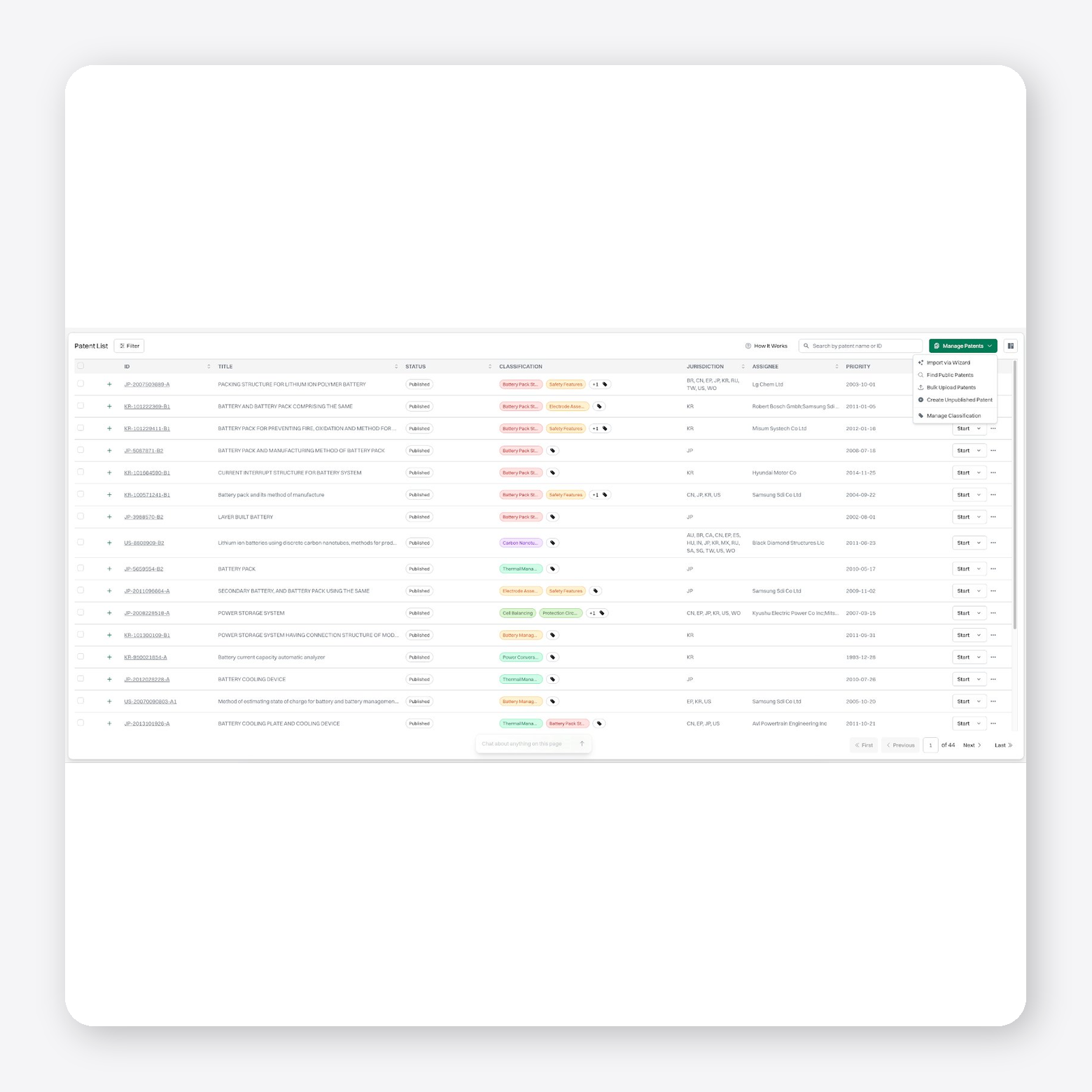
Patlytics is an AI-native patent platform built to support work across the patent lifecycle, from invention disclosure and drafting to analysis, infringement detection, and portfolio review. Instead of forcing teams to stitch together separate tools, it brings core IP workflows into a single platform designed for patent attorneys, IP teams, and enterprise organizations.
The platform is built to reduce repetitive work while improving the quality and usability of the output. Teams can move from source materials to structured drafts, analyze prior art, generate claim charts, and evaluate portfolio assets without switching systems or losing context. That makes it easier to move faster across high-volume work while keeping attorney review and judgment central.
Patlytics is trusted by large law firms and enterprise teams, including over 40% of Am Law 100 firms and Fortune 500. It is the only platform on the market combining drafting, prosecution, infringement, invalidity, FTO, SEP, and portfolio analysis in one system.
Key features:
- Patent application drafting: Supports AI-assisted patent drafting from source materials, including technical documents, figures, and invention disclosures
- Office action analysis and response: Automatically fetches OA materials, determines a response strategy, and drafts responses with a contextual AI agent
- Infringement detection: Crawls publicly available evidence of use and generates limitation-by-limitation claim charts; portfolio heatmaps cover up to 2000 patents at a time
- Invalidity analysis: Combines prior art search, § 102/§ 103/§ 112 analysis, and citation-backed claim charting in one workflow
- Cross-module integration: Drafts created in the platform can be run through prior art search, FTO, and § 112 review without leaving the system
- Security and compliance: SOC 2 Type 2, ISO 27001, ISO 42001, GDPR — the only patent AI platform with all four. Customer data is segregated, encrypted in transit and at rest, and never used to train models.
Pros:
- User-friendly interface that delivers accurate, reliable outputs across key patent categories
- Single platform that covers drafting, analysis, infringement detection, and portfolio management without switching tools
- Responsive customer support that users consistently describe as trustworthy and attentive
Cons:
- Built for teams whose work spans multiple IP workflows; solo practitioners with a single narrow focus may prefer a point tool
User testimonial:
"Patlytics is easy to use, understand, and helps our team see issues that they would normally miss. The Patlytics team and customer service is top notch and gives us the trust that we need in a product this important to our bottom line." — Verified user, G2
2. Edge: Best For Figure-Heavy Drafting
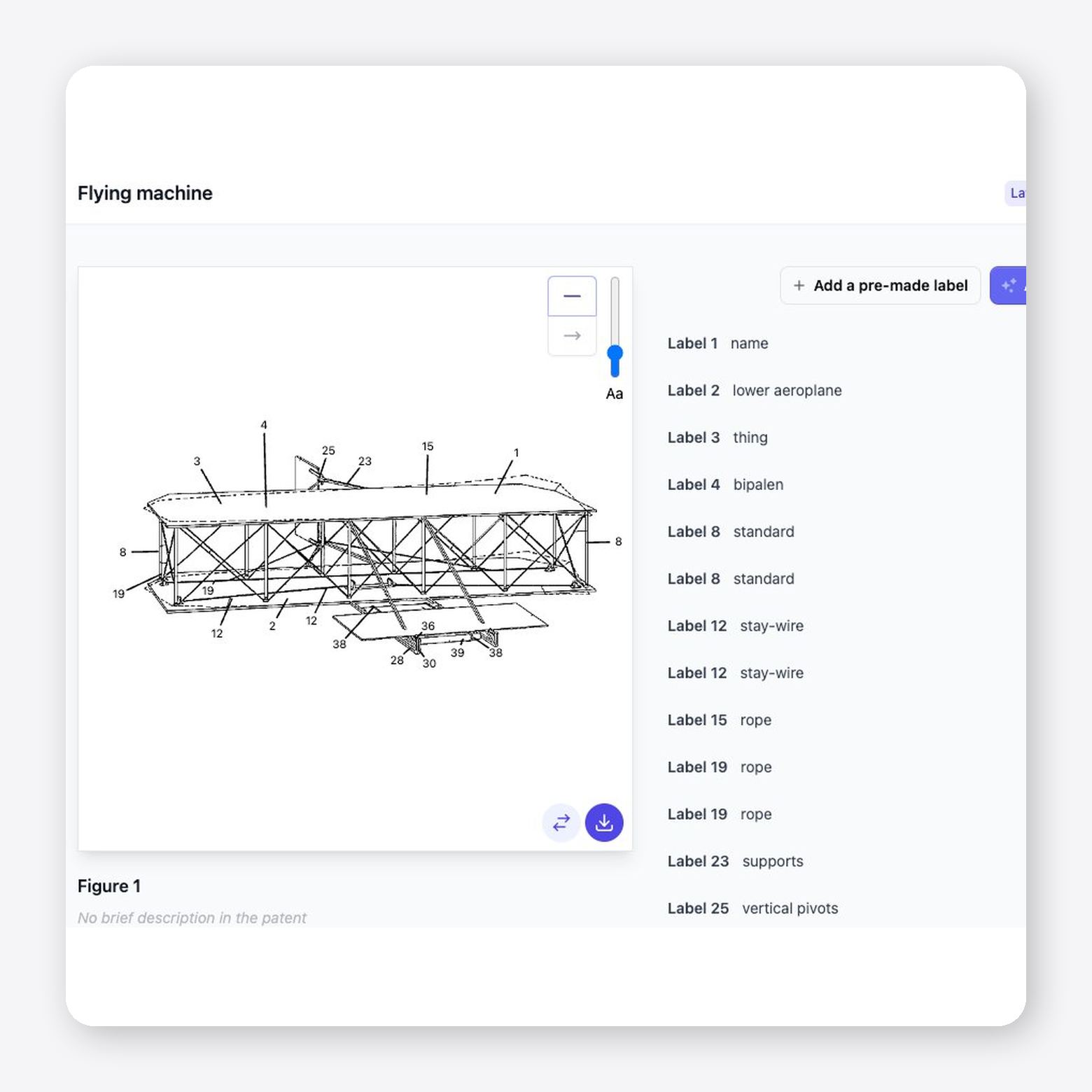
Edge is a task-based AI patent drafting platform designed to help attorneys and inventors generate patent applications. It focuses on core drafting tasks such as claims, descriptions, and invention disclosures. It also includes tools for parsing inventor materials into structured disclosures to support earlier stages of the drafting process.
Features:
- AI-assisted drafting: Generates claims, descriptions, and background sections
- Figure generation and editing: Creates and edits flow charts, diagrams, and reference elements
- Invention disclosure intake: Parses inventor materials into structured disclosures
- Template customization: Supports customizable drafting styles and templates
3. DeepIP: Best for Integrated Drafting and Patent Analysis Workflows
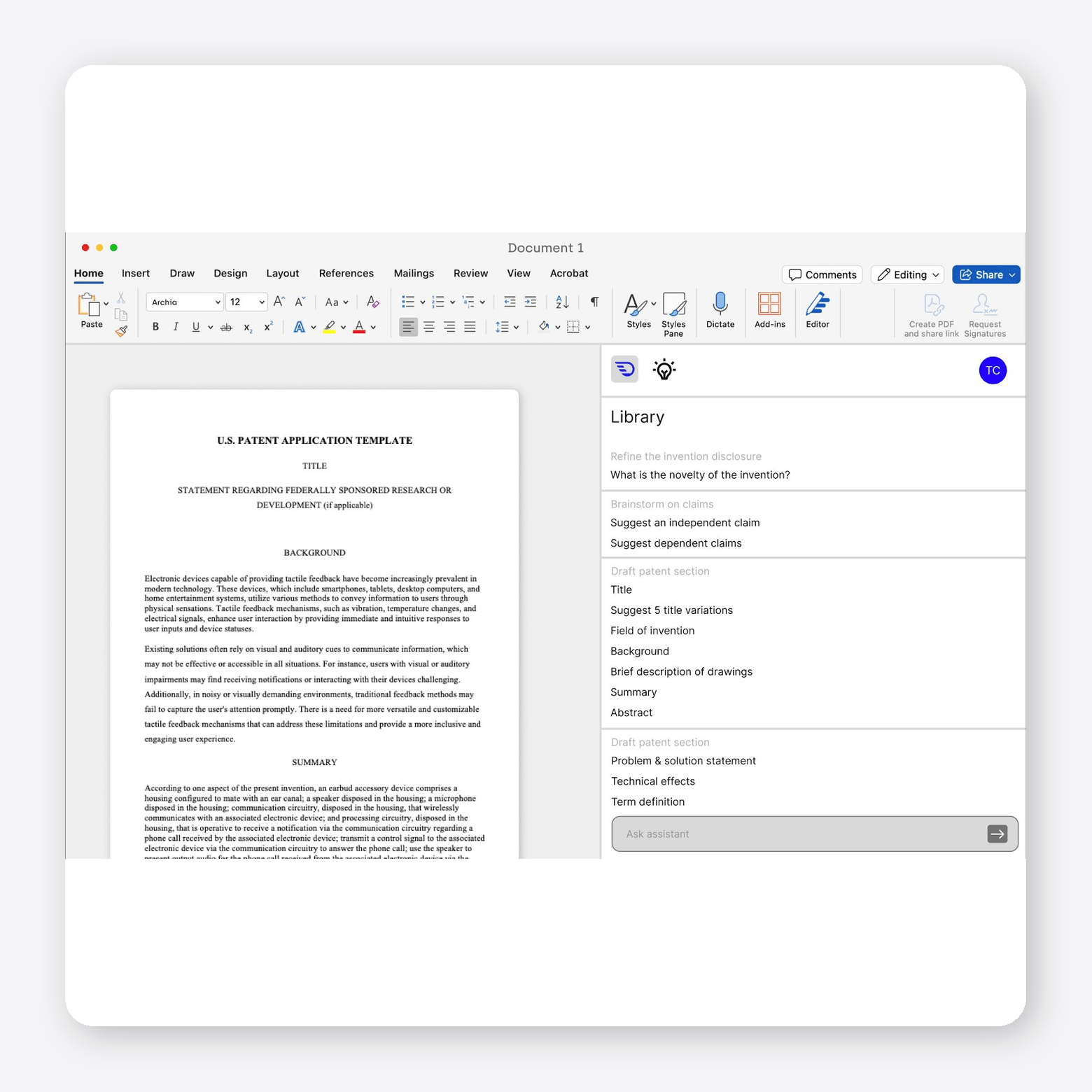
DeepIP is an AI platform designed to support patent work from early-stage idea capture through prosecution and portfolio analysis. It connects drafting, prior art analysis, and risk assessment into a single workflow, allowing teams to move between invention disclosures, claim development, and enforcement-related analysis without switching systems. DeepIP also integrates into tools like Microsoft Word and IP management systems, keeping work aligned with existing processes.
Key features:
- Preparation and prosecution: Supports invention capture, disclosure structuring, and prosecution workflows with connected data across each stage
- Patentability analysis: Evaluates novelty and maps claims to prior art with traceable, claim-level insights
- Patent drafting: Generates structured drafts with claims, descriptions, and supporting content based on source materials
Pros:
- Connects drafting, patentability analysis, and prosecution workflows in one system
Cons:
- Requires integration into existing workflows to realize full value
User testimonial: Not available publicly
4. Solve Intelligence: Best for Customizable Drafting and Prosecution Support
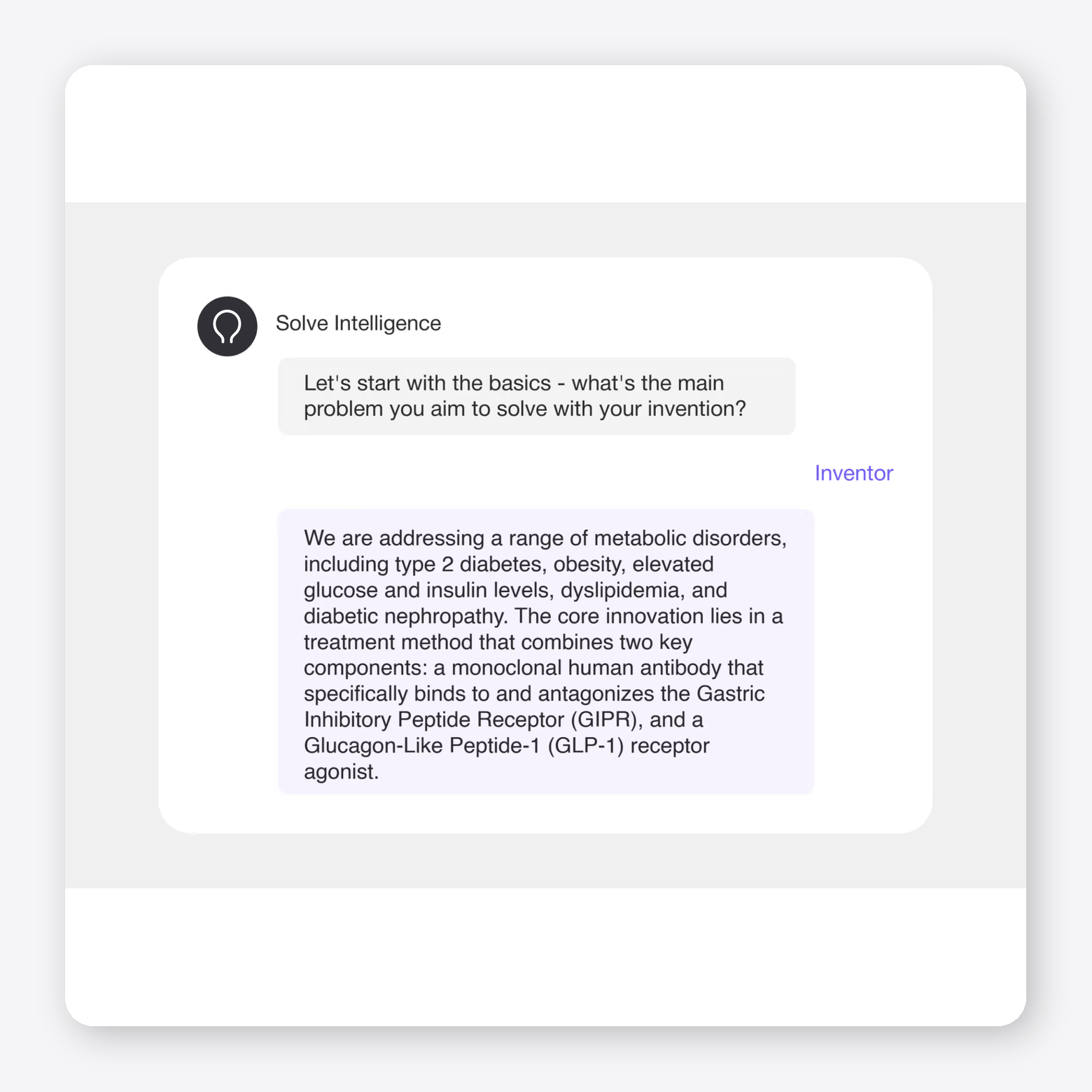
Solve Intelligence is an AI patent platform focused on drafting, prosecution, and structured patent analysis within a single environment. It supports invention disclosures, application drafting, office action responses, and claim chart generation while allowing attorneys to control outputs and adapt the system to their preferred styles. Solve intelligence also handles technical inputs, such as figures, chemical structures, and sequences, making it well-suited to complex patent domains.
Key features:
- Invention harvesting: Generates and manages invention disclosures with configurable intake forms and centralized tracking
- Patent application drafting: Produces full and partial applications with customizable styles across jurisdictions and technologies
- Patent prosecution: Drafts office action responses with suggested amendments, arguments, and supporting citations
- AI analysis and review: Evaluates rejections, prior art, and draft content to identify gaps and inconsistencies
Pros:
- Strong performance in life sciences and chemical arts that includes support for sequences and chemical structures
- Specification and flowchart generation that produces detailed outputs from minimal input
Cons:
- Chat-based prompting that can feel disjointed for practitioners who prefer more automated workflows
User testimonial:
"We used Solve Intelligence for about a month and found it to be a highly useful tool, especially for computer-related inventions. We found the software less efficient when working on mechanical inventions. Preparing mechanical patent specifications required much more manual input." — Verified user, G2
5. IPRally: Best for AI-driven Patent Search and Novelty Analysis
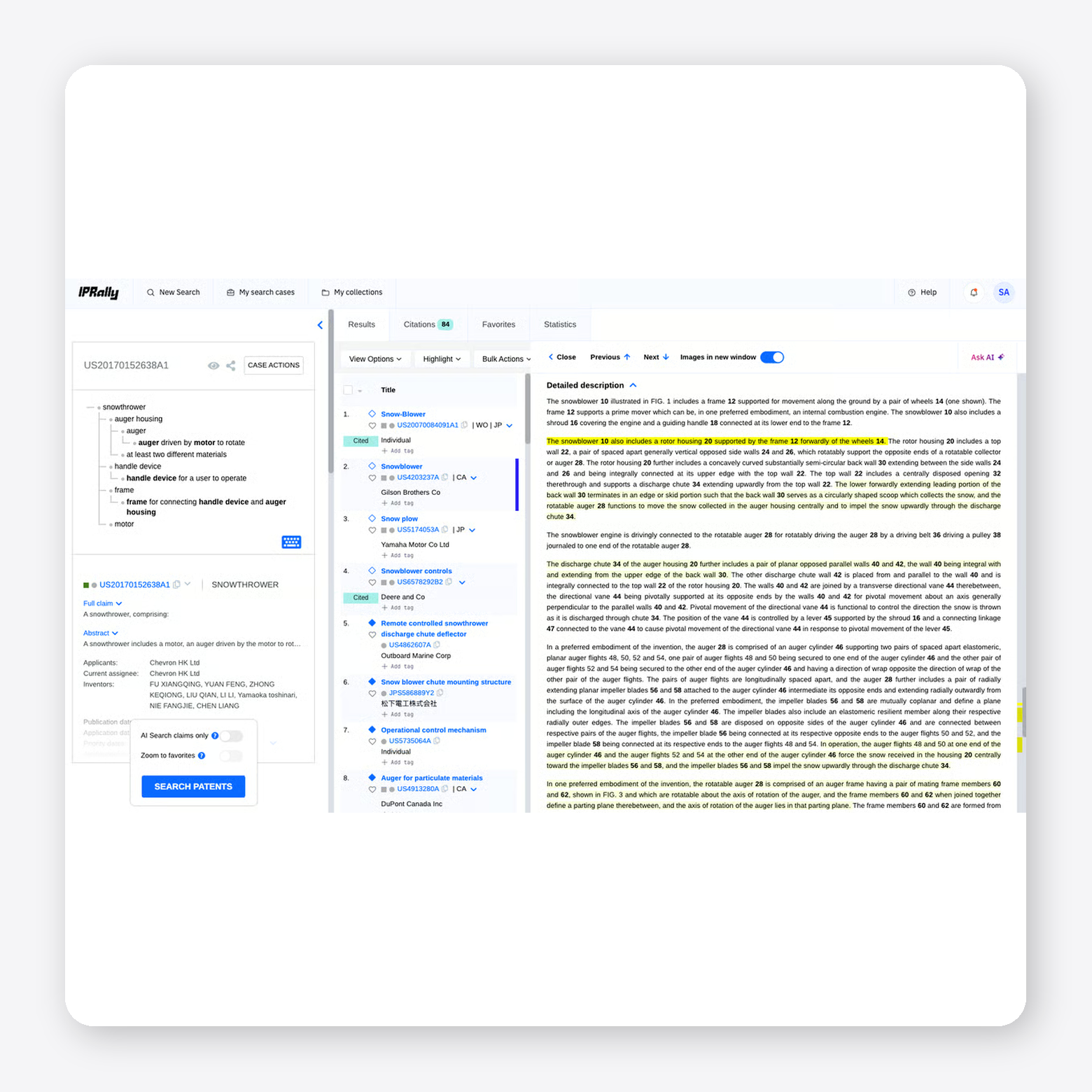
IPRally is an AI patent search platform focused on novelty, prior art, and portfolio analysis. It uses a graph-based AI approach trained on patent data and examiner citations to identify relevant prior art and map results to specific features within an invention. IPRally supports search, review, monitoring, and portfolio-level analysis within a single system, with outputs that remain traceable to source documents.
Key features:
- Patent search and novelty analysis: Runs structured searches across patent datasets and maps results to invention features
- Agent-based search workflows: Converts disclosures, PDFs, images, and documents into complete novelty reports without manual query building
- Transparent reasoning and citations: Provides traceable outputs with explainable steps and source-linked evidence
Pros:
- Multiple search approaches including text, image, and graph-based inputs that return precise, relevant results
Cons:
- User interface that can be confusing for practitioners accustomed to traditional Boolean database tools
User testimonial:
"I like that it provides multiple search methods like text, image and graph and I get very precise results. As a user, I still face a significant lack of guidance throughout the system — something traditional Boolean databases handle far better." — Verified user, G2
6. PatentPal: Best for Generating Specifications and Patent Drawings
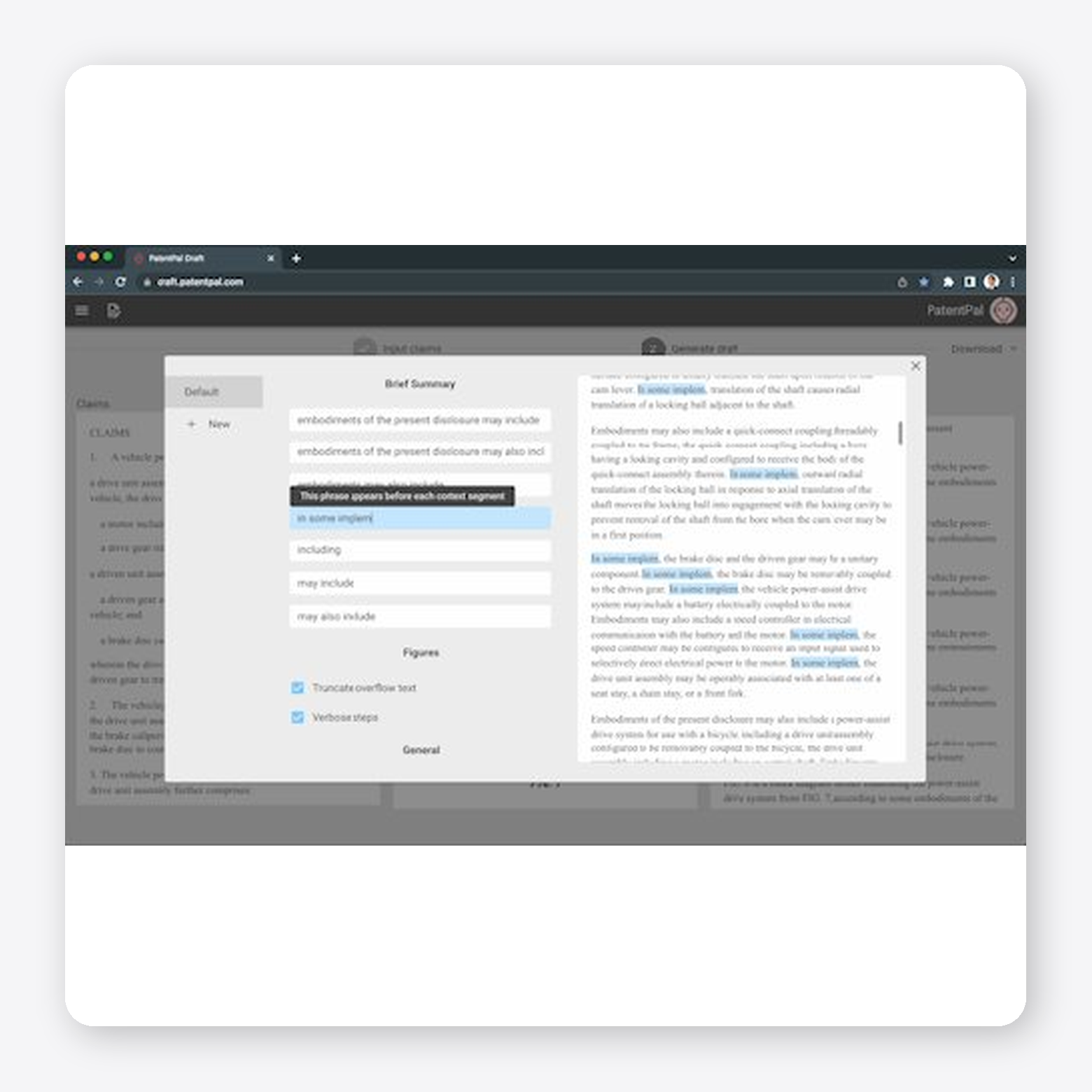
PatentPal is an AI tool focused on generating written content for patent applications from existing claims. It converts claim language into structured specifications, abstracts, and supporting descriptions, along with visual elements such as flowcharts and diagrams. PatentPal works directly in the browser, allowing users to enter claims, generate content, and export drafts in formats such as Word and Visio.
Key features:
- Patent specification generation: Converts claims into full written sections, including abstracts, summaries, and detailed descriptions
- Figure and diagram generation: Produces flowcharts for methods and block diagrams for systems and devices
- Phrase customization: Lets users adjust language preferences and update outputs in real time
Pros:
- Generates patent specifications directly from claims
Cons:
- Focuses on drafting support, not full patent workflows
User testimonial: Not available publicly
7. PatSeer: Best for Large-Scale Patent Data and Portfolio Analytics
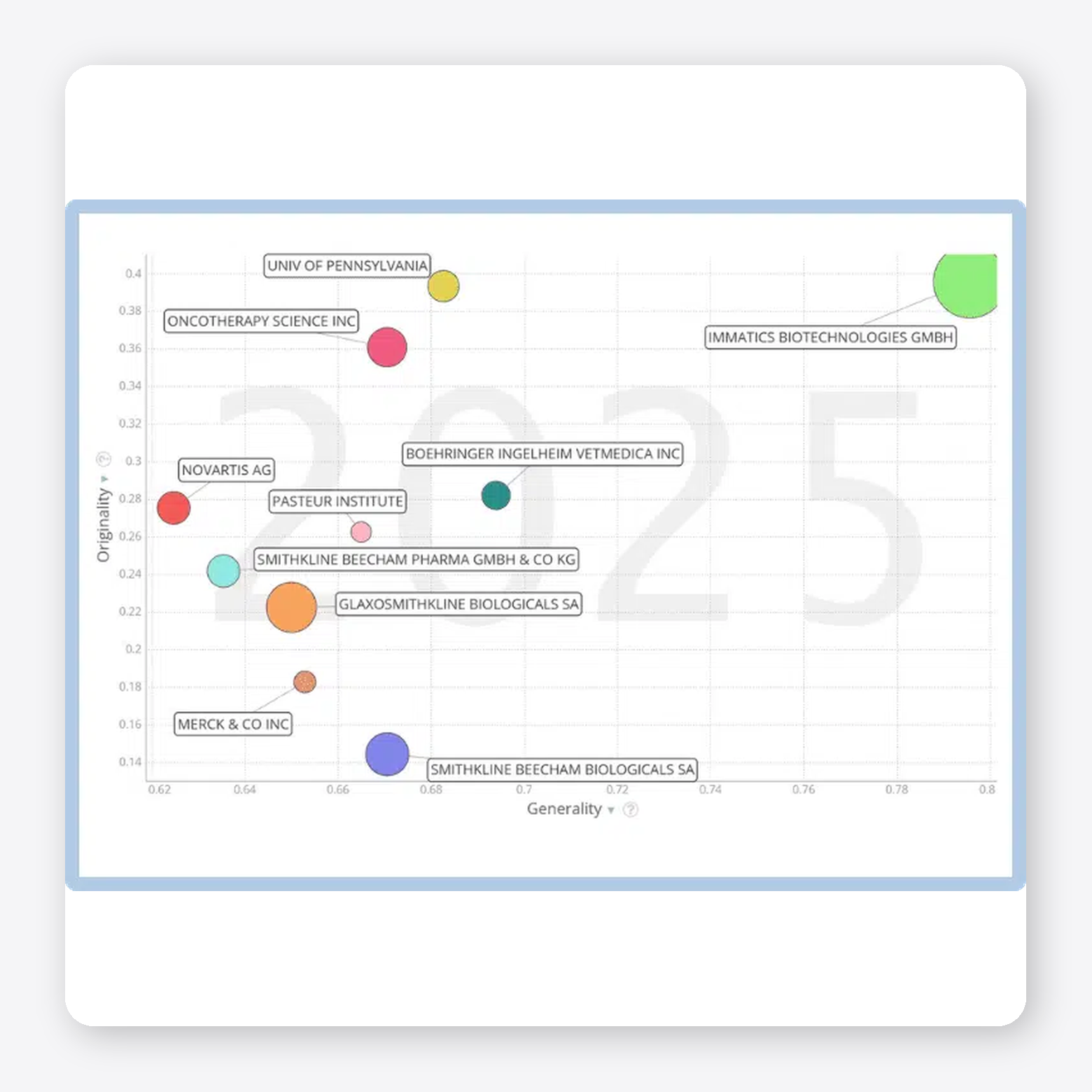
PatSeer is a patent search and analytics platform built around large-scale IP data aggregation and analysis. It combines patent, scientific, legal, and corporate data into a single system, allowing users to run searches, analyze portfolios, and track developments across jurisdictions. PatSeer uses AI-driven semantic search alongside traditional Boolean methods to refine results and support different stages of patent research and decision-making.
Key features:
- Global patent data coverage: Aggregates patent publications, families, legal status, and classifications across multiple authorities
- Hybrid search capabilities: Combines semantic AI search with Boolean queries for flexible research workflows
- Portfolio analytics: Provides multi-dimensional analysis, including quality metrics, citation data, and portfolio-level insights
Pros:
- Global patent coverage that includes high-quality translations for non-English patents across multiple jurisdictions
Cons:
- Interface that can slow down on large projects due to the volume of data being processed
User testimonial:
"The platform offers high-quality translations for non-English patents, which greatly simplifies global research. Although PatSeer provides a Non-Patent Literature search option, I have found that the results are frequently incomplete." — Verified user, G2
8. PatSnap: Best for Patent Intelligence Across R&D and Ip Teams
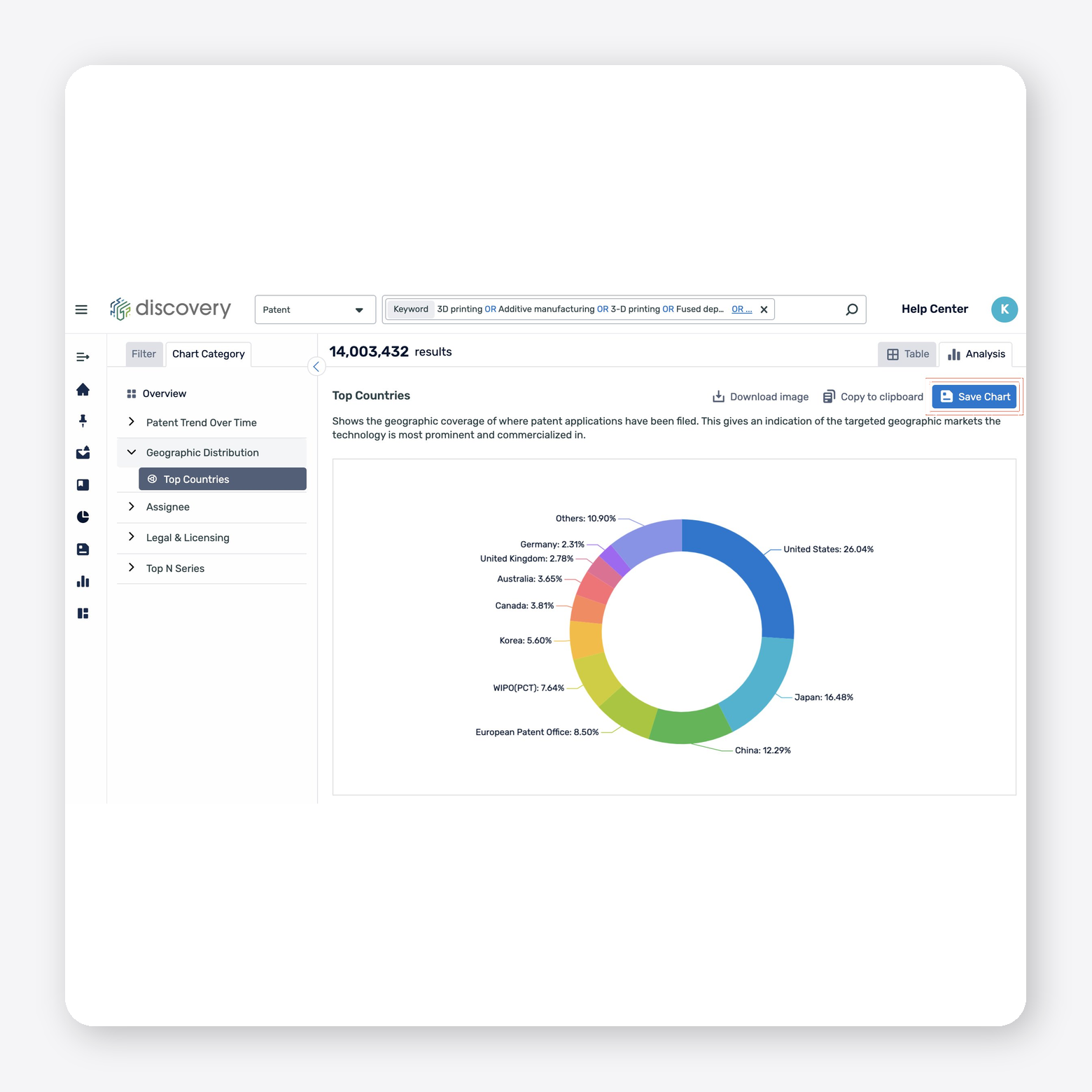
PatSnap is supports work from early-stage research through IP protection and commercialization. It combines patent data, non-patent literature, and technical datasets into a single system, enabling users to run searches, assess novelty, assess freedom-to-operate, and analyze competitive landscapes. PatSnap also includes AI agents and tools designed to support different technical domains and decision points across the innovation lifecycle.
Key features:
- Novelty and prior art search: Analyzes patents and technical literature to identify existing work and assess originality
- Freedom-to-operate (FTO) analysis: Evaluates potential risks and generates supporting charts for product and design clearance
- Patent drafting and disclosure: Supports invention disclosure and structured drafting workflows within the platform
Pros:
- Patent database that combines extensive global coverage with powerful filtering and AI-enabled semantic search
- Translation capabilities that handle foreign patents well and group results by similarity
Cons:
- Filter accessibility that creates friction for users running more advanced search workflows
User testimonial:
"Although there is room for improvement in the wildcard functionality within the Highlighters and in recalling previously performed complex searches, these are relatively minor points compared to the overall strengths of the platform." — Verified user, G2
Key Features of AI Patent Tools
AI patent tools support different parts of the patent workflow, but the most useful platforms usually focus on a few core capabilities:
- Improving patent search and prior art review by surfacing relevant patents, publications, and technical materials more quickly
- Generating structured draft content for claims, specifications, summaries, or related patent work product
- Classifying and organizing patent data so teams can analyze and manage portfolios more efficiently
- Analyzing patent landscapes and filing trends to support competitive intelligence and strategic decision-making
- Integrating with existing IP systems so teams can adopt the tool without adding unnecessary workflow friction
How to Choose the Best AI Patent Tool
The right AI patent tool depends on where your team is losing time today and what kind of work you need the platform to support. The strongest tools solve a clear problem, fit into existing workflows, and meet enterprise security requirements.
Identify the Bottleneck
Start with the work that slows your team down most. That may be prior art review, drafting, portfolio analysis, or another repeatable task. The goal is to find a tool that improves that workflow directly, rather than adopting a platform that tries to do everything without doing any one task well.
Evaluate Workflow Fit
A useful tool should fit into the systems and processes your team already uses. Look for clean integration, a clear interface, and outputs that are easy for attorneys and analysts to review and work from.
Review Security And Compliance
Patent data is sensitive, so security should be treated as a baseline requirement. Review how the platform handles data storage, access controls, and compliance with your organization’s internal standards.
Check User Feedback
Look for real-world feedback on accuracy, reliability, and day-to-day usability. Case examples, customer reviews, and consistent patterns in user sentiment can help surface issues that product pages will not.
Limitations of AI Patent Tools (What Practitioners Still Do Manually)
AI patent tools can remove a significant amount of manual work, but they do not replace legal judgment. Knowing where they fall short is what allows practitioners to use them effectively.
Accuracy Still Requires Human Review
AI outputs can miss context, misread claim scope, or produce language that appears sound but is substantively wrong. Stanford researchers reported that general-purpose AI chatbots showed hallucination rates of 58–88% on legal questions. Even when a tool is patent-specific, no draft, analysis, or recommendation should go to a client or into a filing without a qualified attorney reviewing it first.
Claim Drafting Still Needs an Expert Hand
AI can help generate a first draft, but claim scope, prior art positioning, and jurisdiction-specific requirements still require experienced patent judgment. The tool can accelerate the work. It does not make the call.
Strategic Portfolio Decisions Stay With Practitioners
Decisions about what to file, maintain, license, or abandon depend on business priorities, competitive context, and risk tolerance. Those are strategic decisions, not just data problems.
Data Privacy and IP Risk Still Need Scrutiny
Patent work often involves confidential disclosures, product plans, and proprietary R&D. McKinsey identifies IP infringement and data privacy as two of the most significant risks in enterprise AI use, and patent work is no exception. Teams need to understand how a platform stores, processes, and protects that information before using it in live matters.
Compliance Still Requires Ongoing Attention
The legal and regulatory framework around AI is still evolving. Gartner found that 70% of legal, compliance, and privacy leaders cited rapid GenAI adoption as a top concern, largely because the regulatory environment is still catching up. Practitioners need to stay current on how tool use intersects with filing obligations, professional responsibility, and data protection requirements across jurisdictions.
The limitations are real, but so are the gains. Teams that use AI patent tools thoughtfully, with proper oversight and clear workflows, consistently report faster research, stronger first drafts, and more time for the strategic work that actually requires legal expertise. The tools work best when they complement practitioner judgment rather than replace it.
Choosing an AI Patent Platform That Supports Real IP Decisions
The value of an AI patent platform comes down to workflow fit. The right tool should help your team move from raw inputs to usable outputs and from outputs to better decisions, with traceability, consistency, and clear room for practitioner review.
Look for platforms that align with how your team already works, integrate with existing systems, and meet your security requirements. For teams evaluating tools that span drafting, analysis, infringement detection, and portfolio decisions, Patlytics brings those workflows together in a single platform. It connects invention disclosures to structured drafts, links claims to supporting evidence, and maps patents to products for infringement and licensing analysis.
It also supports portfolio-level decision-making by helping teams classify assets, identify higher- and lower-potential patents, and surface opportunities for enforcement or pruning. That connection across drafting, analysis, and portfolio strategy can make it easier to move from individual tasks to broader IP decisions.
No matter what platform you evaluate, look for citation-backed outputs you can verify, configurability to your jurisdiction and style, enterprise-grade security (SOC 2 Type 2 and ISO 27001 should be table stakes; ISO 42001 for AI management is the emerging benchmark), and proof points from named customers in your industry — not anonymized testimonials.
Best AI Patent Tools FAQs
Who Offers the Best AI Patent Drafting Tools?
The right choice depends on how much of your workflow you want the platform to handle. Tools like DeepIP and Solve Intelligence focus narrowly on drafting. Patlytics takes a different approach: drafts are informed by live prior art search, claim construction, and prosecution history within the same system, with templates configurable by jurisdiction and technology.
What is the Best AI Tool for Patent Research?
It depends on whether you need search alone or search connected to downstream analysis. Legacy databases excel at broad data coverage. AI-native platforms differ in what they do with the results. Patlytics returns search results that already map to specific claim limitations and feed directly into invalidity claim charting, FTO analysis, and § 112 review, which is why Asahi Kasei was able to compress investigations from months down to hours.
Who Has the Best AI for Patent Management?
Patent management tools vary based on how much analysis and workflow support you need. Some, such as PatSnap and PatSeer, are commonly used for portfolio analytics, monitoring, and competitive intelligence. If your team needs to connect portfolio insights to drafting, enforcement, and classification work, an AI-native platform like Patlytics may be a better fit as it supports the full patent lifecycle.
Best AI Patent Tools (2026)
Patent work is under growing pressure. Filing volume remains high, workflows are more complex, and teams are expected to move faster without compromising accuracy or defensibility. The best AI patent tools help reduce manual work across search, drafting, analysis, and portfolio management while keeping practitioners in control of the work product.
Global patent applications reached 3.7 million, according to the World Intellectual Property Organization. At that scale, reviewing patents, drafting applications, and managing portfolios manually creates real time and resource strain for law firms and in-house IP teams.
This guide reviews the leading AI patent tools available today, where each one fits, and the tradeoffs to consider when evaluating them. For a closer look at tools built specifically for patent research, see our guide on AI patent search.
Key takeaways:
- AI patent tools support different parts of the workflow, including search, drafting, analysis, and portfolio management.
- Some platforms are built for a single task, while others connect multiple stages of the patent lifecycle.
- Accuracy, traceability, and patent-specific functionality matter more than general-purpose AI capability.
- Integration with existing systems has a major impact on adoption, workflow fit, and long-term usefulness.
What Is an AI Patent Tool?
An AI patent tool is software built to support patent-specific work such as search, drafting, classification, and portfolio analysis. Its value is not just speed. It is the ability to help patent attorneys and IP teams work through large volumes of technical and legal material more efficiently, with greater consistency and less manual effort.
Demand for these tools is rising alongside filing volume and technical complexity. WIPO reports that more than 54,000 generative AI-related patent families were filed between 2014 and 2023, with more than a quarter filed in a single year. As the patent landscape becomes more crowded and more complex, AI tools are becoming a practical part of how many teams manage search, drafting, and review.
Best AI Patent Tools: Quick Comparison
AI patent tools differ in the problems they are built to solve. Some focus on prior art search and analysis, others on drafting, and others on portfolio-level visibility. Understanding those differences makes it easier to evaluate where each tool fits and which teams it is best suited to support.
Best AI Patent Tools in 2026
AI patent tools are built for different parts of the workflow. Some focus on prior art research, others on drafting, and others on portfolio-level analysis and decision-making. We selected the tools in this guide based on how well they support real patent work, including search, review, and drafting, along with the depth of patent-specific functionality, ease of adoption, workflow integration, and security readiness.
Each tool is evaluated based on what it does best and which teams it is best suited to support, so you can identify the right fit more quickly.
1. Patlytics: Best For End-To-End Patent Lifecycle Management
Patlytics is an AI-native patent platform built to support work across the patent lifecycle, from invention disclosure and drafting to analysis, infringement detection, and portfolio review. Instead of forcing teams to stitch together separate tools, it brings core IP workflows into a single platform designed for patent attorneys, IP teams, and enterprise organizations.
The platform is built to reduce repetitive work while improving the quality and usability of the output. Teams can move from source materials to structured drafts, analyze prior art, generate claim charts, and evaluate portfolio assets without switching systems or losing context. That makes it easier to move faster across high-volume work while keeping attorney review and judgment central.
Patlytics is trusted by large law firms and enterprise teams, including over 40% of Am Law 100 firms and Fortune 500. It is the only platform on the market combining drafting, prosecution, infringement, invalidity, FTO, SEP, and portfolio analysis in one system.
Key features:
- Patent application drafting: Supports AI-assisted patent drafting from source materials, including technical documents, figures, and invention disclosures
- Office action analysis and response: Automatically fetches OA materials, determines a response strategy, and drafts responses with a contextual AI agent
- Infringement detection: Crawls publicly available evidence of use and generates limitation-by-limitation claim charts; portfolio heatmaps cover up to 2000 patents at a time
- Invalidity analysis: Combines prior art search, § 102/§ 103/§ 112 analysis, and citation-backed claim charting in one workflow
- Cross-module integration: Drafts created in the platform can be run through prior art search, FTO, and § 112 review without leaving the system
- Security and compliance: SOC 2 Type 2, ISO 27001, ISO 42001, GDPR — the only patent AI platform with all four. Customer data is segregated, encrypted in transit and at rest, and never used to train models.
Pros:
- User-friendly interface that delivers accurate, reliable outputs across key patent categories
- Single platform that covers drafting, analysis, infringement detection, and portfolio management without switching tools
- Responsive customer support that users consistently describe as trustworthy and attentive
Cons:
- Built for teams whose work spans multiple IP workflows; solo practitioners with a single narrow focus may prefer a point tool
User testimonial:
"Patlytics is easy to use, understand, and helps our team see issues that they would normally miss. The Patlytics team and customer service is top notch and gives us the trust that we need in a product this important to our bottom line." — Verified user, G2
2. Edge: Best For Figure-Heavy Drafting
Edge is a task-based AI patent drafting platform designed to help attorneys and inventors generate patent applications. It focuses on core drafting tasks such as claims, descriptions, and invention disclosures. It also includes tools for parsing inventor materials into structured disclosures to support earlier stages of the drafting process.
Features:
- AI-assisted drafting: Generates claims, descriptions, and background sections
- Figure generation and editing: Creates and edits flow charts, diagrams, and reference elements
- Invention disclosure intake: Parses inventor materials into structured disclosures
- Template customization: Supports customizable drafting styles and templates
3. DeepIP: Best for Integrated Drafting and Patent Analysis Workflows
DeepIP is an AI platform designed to support patent work from early-stage idea capture through prosecution and portfolio analysis. It connects drafting, prior art analysis, and risk assessment into a single workflow, allowing teams to move between invention disclosures, claim development, and enforcement-related analysis without switching systems. DeepIP also integrates into tools like Microsoft Word and IP management systems, keeping work aligned with existing processes.
Key features:
- Preparation and prosecution: Supports invention capture, disclosure structuring, and prosecution workflows with connected data across each stage
- Patentability analysis: Evaluates novelty and maps claims to prior art with traceable, claim-level insights
- Patent drafting: Generates structured drafts with claims, descriptions, and supporting content based on source materials
Pros:
- Connects drafting, patentability analysis, and prosecution workflows in one system
Cons:
- Requires integration into existing workflows to realize full value
User testimonial: Not available publicly
4. Solve Intelligence: Best for Customizable Drafting and Prosecution Support
Solve Intelligence is an AI patent platform focused on drafting, prosecution, and structured patent analysis within a single environment. It supports invention disclosures, application drafting, office action responses, and claim chart generation while allowing attorneys to control outputs and adapt the system to their preferred styles. Solve intelligence also handles technical inputs, such as figures, chemical structures, and sequences, making it well-suited to complex patent domains.
Key features:
- Invention harvesting: Generates and manages invention disclosures with configurable intake forms and centralized tracking
- Patent application drafting: Produces full and partial applications with customizable styles across jurisdictions and technologies
- Patent prosecution: Drafts office action responses with suggested amendments, arguments, and supporting citations
- AI analysis and review: Evaluates rejections, prior art, and draft content to identify gaps and inconsistencies
Pros:
- Strong performance in life sciences and chemical arts that includes support for sequences and chemical structures
- Specification and flowchart generation that produces detailed outputs from minimal input
Cons:
- Chat-based prompting that can feel disjointed for practitioners who prefer more automated workflows
User testimonial:
"We used Solve Intelligence for about a month and found it to be a highly useful tool, especially for computer-related inventions. We found the software less efficient when working on mechanical inventions. Preparing mechanical patent specifications required much more manual input." — Verified user, G2
5. IPRally: Best for AI-driven Patent Search and Novelty Analysis
IPRally is an AI patent search platform focused on novelty, prior art, and portfolio analysis. It uses a graph-based AI approach trained on patent data and examiner citations to identify relevant prior art and map results to specific features within an invention. IPRally supports search, review, monitoring, and portfolio-level analysis within a single system, with outputs that remain traceable to source documents.
Key features:
- Patent search and novelty analysis: Runs structured searches across patent datasets and maps results to invention features
- Agent-based search workflows: Converts disclosures, PDFs, images, and documents into complete novelty reports without manual query building
- Transparent reasoning and citations: Provides traceable outputs with explainable steps and source-linked evidence
Pros:
- Multiple search approaches including text, image, and graph-based inputs that return precise, relevant results
Cons:
- User interface that can be confusing for practitioners accustomed to traditional Boolean database tools
User testimonial:
"I like that it provides multiple search methods like text, image and graph and I get very precise results. As a user, I still face a significant lack of guidance throughout the system — something traditional Boolean databases handle far better." — Verified user, G2
6. PatentPal: Best for Generating Specifications and Patent Drawings
PatentPal is an AI tool focused on generating written content for patent applications from existing claims. It converts claim language into structured specifications, abstracts, and supporting descriptions, along with visual elements such as flowcharts and diagrams. PatentPal works directly in the browser, allowing users to enter claims, generate content, and export drafts in formats such as Word and Visio.
Key features:
- Patent specification generation: Converts claims into full written sections, including abstracts, summaries, and detailed descriptions
- Figure and diagram generation: Produces flowcharts for methods and block diagrams for systems and devices
- Phrase customization: Lets users adjust language preferences and update outputs in real time
Pros:
- Generates patent specifications directly from claims
Cons:
- Focuses on drafting support, not full patent workflows
User testimonial: Not available publicly
7. PatSeer: Best for Large-Scale Patent Data and Portfolio Analytics
PatSeer is a patent search and analytics platform built around large-scale IP data aggregation and analysis. It combines patent, scientific, legal, and corporate data into a single system, allowing users to run searches, analyze portfolios, and track developments across jurisdictions. PatSeer uses AI-driven semantic search alongside traditional Boolean methods to refine results and support different stages of patent research and decision-making.
Key features:
- Global patent data coverage: Aggregates patent publications, families, legal status, and classifications across multiple authorities
- Hybrid search capabilities: Combines semantic AI search with Boolean queries for flexible research workflows
- Portfolio analytics: Provides multi-dimensional analysis, including quality metrics, citation data, and portfolio-level insights
Pros:
- Global patent coverage that includes high-quality translations for non-English patents across multiple jurisdictions
Cons:
- Interface that can slow down on large projects due to the volume of data being processed
User testimonial:
"The platform offers high-quality translations for non-English patents, which greatly simplifies global research. Although PatSeer provides a Non-Patent Literature search option, I have found that the results are frequently incomplete." — Verified user, G2
8. PatSnap: Best for Patent Intelligence Across R&D and Ip Teams
PatSnap is supports work from early-stage research through IP protection and commercialization. It combines patent data, non-patent literature, and technical datasets into a single system, enabling users to run searches, assess novelty, assess freedom-to-operate, and analyze competitive landscapes. PatSnap also includes AI agents and tools designed to support different technical domains and decision points across the innovation lifecycle.
Key features:
- Novelty and prior art search: Analyzes patents and technical literature to identify existing work and assess originality
- Freedom-to-operate (FTO) analysis: Evaluates potential risks and generates supporting charts for product and design clearance
- Patent drafting and disclosure: Supports invention disclosure and structured drafting workflows within the platform
Pros:
- Patent database that combines extensive global coverage with powerful filtering and AI-enabled semantic search
- Translation capabilities that handle foreign patents well and group results by similarity
Cons:
- Filter accessibility that creates friction for users running more advanced search workflows
User testimonial:
"Although there is room for improvement in the wildcard functionality within the Highlighters and in recalling previously performed complex searches, these are relatively minor points compared to the overall strengths of the platform." — Verified user, G2
Key Features of AI Patent Tools
AI patent tools support different parts of the patent workflow, but the most useful platforms usually focus on a few core capabilities:
- Improving patent search and prior art review by surfacing relevant patents, publications, and technical materials more quickly
- Generating structured draft content for claims, specifications, summaries, or related patent work product
- Classifying and organizing patent data so teams can analyze and manage portfolios more efficiently
- Analyzing patent landscapes and filing trends to support competitive intelligence and strategic decision-making
- Integrating with existing IP systems so teams can adopt the tool without adding unnecessary workflow friction
How to Choose the Best AI Patent Tool
The right AI patent tool depends on where your team is losing time today and what kind of work you need the platform to support. The strongest tools solve a clear problem, fit into existing workflows, and meet enterprise security requirements.
Identify the Bottleneck
Start with the work that slows your team down most. That may be prior art review, drafting, portfolio analysis, or another repeatable task. The goal is to find a tool that improves that workflow directly, rather than adopting a platform that tries to do everything without doing any one task well.
Evaluate Workflow Fit
A useful tool should fit into the systems and processes your team already uses. Look for clean integration, a clear interface, and outputs that are easy for attorneys and analysts to review and work from.
Review Security And Compliance
Patent data is sensitive, so security should be treated as a baseline requirement. Review how the platform handles data storage, access controls, and compliance with your organization’s internal standards.
Check User Feedback
Look for real-world feedback on accuracy, reliability, and day-to-day usability. Case examples, customer reviews, and consistent patterns in user sentiment can help surface issues that product pages will not.
Limitations of AI Patent Tools (What Practitioners Still Do Manually)
AI patent tools can remove a significant amount of manual work, but they do not replace legal judgment. Knowing where they fall short is what allows practitioners to use them effectively.
Accuracy Still Requires Human Review
AI outputs can miss context, misread claim scope, or produce language that appears sound but is substantively wrong. Stanford researchers reported that general-purpose AI chatbots showed hallucination rates of 58–88% on legal questions. Even when a tool is patent-specific, no draft, analysis, or recommendation should go to a client or into a filing without a qualified attorney reviewing it first.
Claim Drafting Still Needs an Expert Hand
AI can help generate a first draft, but claim scope, prior art positioning, and jurisdiction-specific requirements still require experienced patent judgment. The tool can accelerate the work. It does not make the call.
Strategic Portfolio Decisions Stay With Practitioners
Decisions about what to file, maintain, license, or abandon depend on business priorities, competitive context, and risk tolerance. Those are strategic decisions, not just data problems.
Data Privacy and IP Risk Still Need Scrutiny
Patent work often involves confidential disclosures, product plans, and proprietary R&D. McKinsey identifies IP infringement and data privacy as two of the most significant risks in enterprise AI use, and patent work is no exception. Teams need to understand how a platform stores, processes, and protects that information before using it in live matters.
Compliance Still Requires Ongoing Attention
The legal and regulatory framework around AI is still evolving. Gartner found that 70% of legal, compliance, and privacy leaders cited rapid GenAI adoption as a top concern, largely because the regulatory environment is still catching up. Practitioners need to stay current on how tool use intersects with filing obligations, professional responsibility, and data protection requirements across jurisdictions.
The limitations are real, but so are the gains. Teams that use AI patent tools thoughtfully, with proper oversight and clear workflows, consistently report faster research, stronger first drafts, and more time for the strategic work that actually requires legal expertise. The tools work best when they complement practitioner judgment rather than replace it.
Choosing an AI Patent Platform That Supports Real IP Decisions
The value of an AI patent platform comes down to workflow fit. The right tool should help your team move from raw inputs to usable outputs and from outputs to better decisions, with traceability, consistency, and clear room for practitioner review.
Look for platforms that align with how your team already works, integrate with existing systems, and meet your security requirements. For teams evaluating tools that span drafting, analysis, infringement detection, and portfolio decisions, Patlytics brings those workflows together in a single platform. It connects invention disclosures to structured drafts, links claims to supporting evidence, and maps patents to products for infringement and licensing analysis.
It also supports portfolio-level decision-making by helping teams classify assets, identify higher- and lower-potential patents, and surface opportunities for enforcement or pruning. That connection across drafting, analysis, and portfolio strategy can make it easier to move from individual tasks to broader IP decisions.
No matter what platform you evaluate, look for citation-backed outputs you can verify, configurability to your jurisdiction and style, enterprise-grade security (SOC 2 Type 2 and ISO 27001 should be table stakes; ISO 42001 for AI management is the emerging benchmark), and proof points from named customers in your industry — not anonymized testimonials.
Best AI Patent Tools FAQs
Who Offers the Best AI Patent Drafting Tools?
The right choice depends on how much of your workflow you want the platform to handle. Tools like DeepIP and Solve Intelligence focus narrowly on drafting. Patlytics takes a different approach: drafts are informed by live prior art search, claim construction, and prosecution history within the same system, with templates configurable by jurisdiction and technology.
What is the Best AI Tool for Patent Research?
It depends on whether you need search alone or search connected to downstream analysis. Legacy databases excel at broad data coverage. AI-native platforms differ in what they do with the results. Patlytics returns search results that already map to specific claim limitations and feed directly into invalidity claim charting, FTO analysis, and § 112 review, which is why Asahi Kasei was able to compress investigations from months down to hours.
Who Has the Best AI for Patent Management?
Patent management tools vary based on how much analysis and workflow support you need. Some, such as PatSnap and PatSeer, are commonly used for portfolio analytics, monitoring, and competitive intelligence. If your team needs to connect portfolio insights to drafting, enforcement, and classification work, an AI-native platform like Patlytics may be a better fit as it supports the full patent lifecycle.
The Premier AI-Powered Patent Platform
Reduce cycle times. Increase margins. Deliver winning IP outcomes.
Book a DemoThe Premier AI-Powered
Patent Platform
Reduce cycle times. Increase margins. Deliver winning IP outcomes.