Best Patent Search Engine Software
May 18, 2026

The patent landscape is more crowded than ever. The USPTO’s backlog reached 800,000 unexamined applications and applicants are waiting nearly 20 months for a first office action. In that environment, prior art search is not just an early research step. It shapes filing strategy, product risk, and the quality of downstream IP decisions.
A missed reference can weaken patentability analysis. An overlooked competing claim can complicate product clearance or create avoidable exposure later. For patent attorneys, IP teams, and other organizations doing high-stakes patent work, the search platform matters because it affects not just what you find, but how well you can evaluate and use the results.
This guide covers the best patent search engine software options available today, what each does well, where each falls short, and how to find the right fit for your team.
Key takeaways:
- Patent search tools range from basic databases to platforms that support claim-level analysis and portfolio decision-making.
- AI-powered search can surface relevant prior art beyond exact keyword matching across technical and legal language.
- Tools that connect search to FTO, invalidity, and claim mapping can support stronger downstream IP decisions.
- The right platform depends on how your team searches, evaluates results, and uses patent data across the broader workflow.
What Is Patent Search Engine Software?
Patent search engine software helps teams find relevant prior art, competing claims, and related technical disclosures across large patent datasets. It is used to support filing decisions, product clearance, licensing, acquisition, and portfolio review.
With more than 2.1 million patents granted worldwide in 2024 alone, manual searching across government databases is increasingly inefficient. Patent search platforms help by surfacing relevant results based on technical concepts, claims language, and filing data. The strongest tools go further by supporting claim mapping, FTO analysis, scientific literature review, and competitor monitoring.
What to Look for in a Patent Search Platform
The right patent search platform should help your team find relevant prior art efficiently, assess risk earlier, and fit into the rest of the IP workflow. The most useful tools typically stand out in a few areas:
- AI-powered search: Surfaces relevant prior art beyond exact keyword matching by identifying similar concepts across different terminology.
- FTO and infringement support: Helps flag potential risk by analyzing claims against existing patents earlier in the process.
- Integration with IP systems: Connects search results to prosecution, portfolio management, and reporting workflows.
- Data security and confidentiality: Protects sensitive invention and matter data through secure environments and controlled access.
- Speed, traceability, and usability: Reduces manual review time while making it easier to understand why a result surfaced and how it connects to the analysis.
Best Patent Search Engine Software
Patent search tools serve different parts of the IP workflow. Some focus on fast prior art discovery, while others support deeper analysis, claim mapping, and portfolio insights. We selected these platforms based on how accurately they surface relevant results, the strength of their patent-specific features, ease of use for IP teams, integration with existing systems, and overall data security.
Each tool is evaluated based on what it does best and who it’s built for, so you can quickly find the right fit for your workflow.
1. Patlytics: Best for End-to-end Patent Lifecycle Management

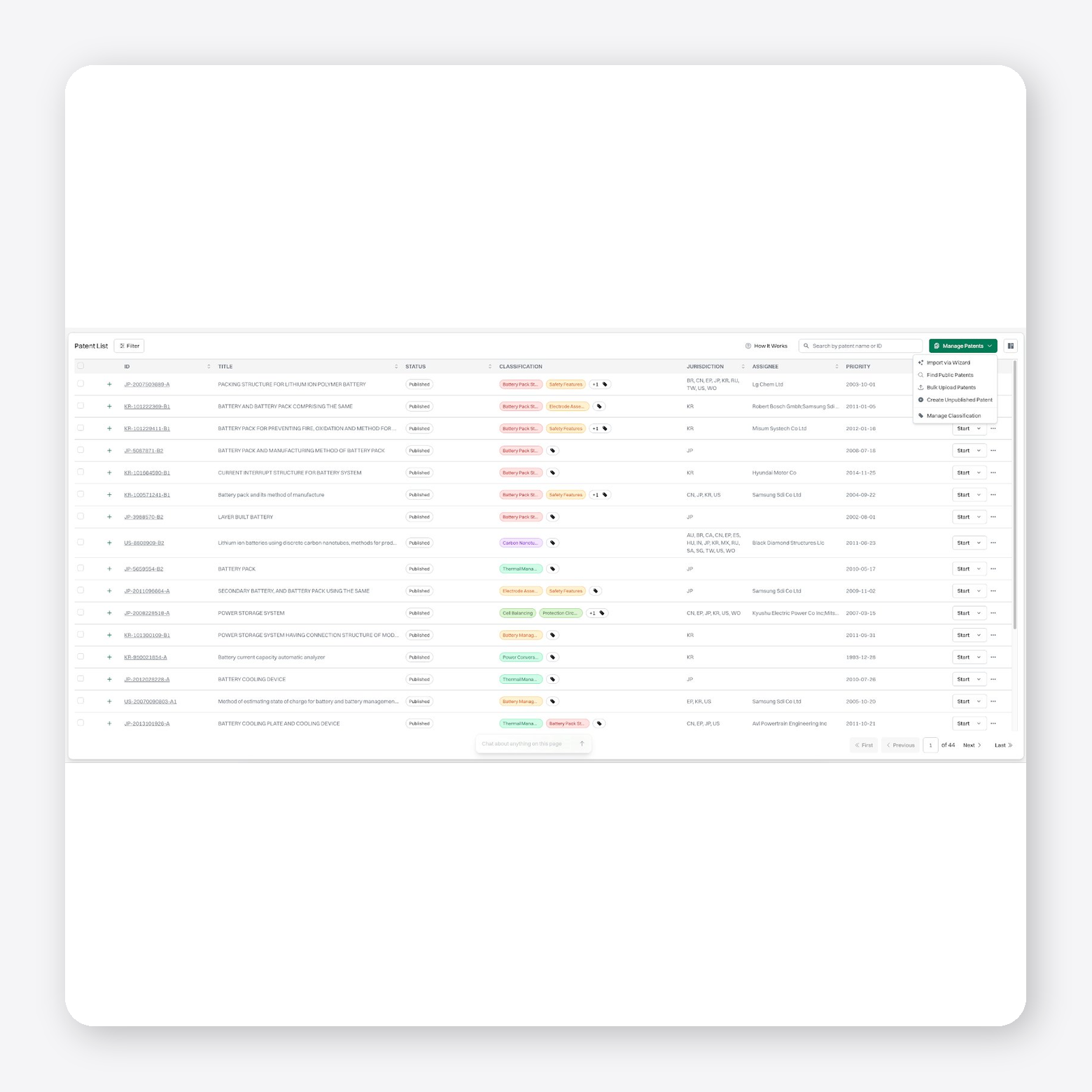
Patlytics is an AI-native patent platform built to support work across the patent lifecycle, including prior art search, claim analysis, and downstream IP workflows. It is designed for patent attorneys, IP teams, and enterprise organizations that need to move from search results to usable analysis without stitching together separate tools.
The platform connects prior art search directly to claim-level evaluation, making it easier to see how specific references map to individual claim elements. Instead of stopping at document retrieval, Patlytics helps teams move more efficiently through validation, structured analysis, and related workflows such as claim charting, infringement review, and portfolio assessment.
Key features
- Semantic and natural-language patent search: Across US, KR, JP, EP, WO, TW patent data, refreshed weekly, with NPL coverage
- Auto-generated search queries: Built from draft claims, IDFs, or product disclosures, editable by the user
- Claim-mapped results: Every reference links to specific claim limitations, ready for invalidity charting
- Integrated invalidity workflow: § 102, § 103, and § 112 analysis built into the same system
- FTO module: Searches and screens up to 2000 potentially relevant patents from a product disclosure
- Portfolio heatmaps: Assesses up to 2000 patents at a time for infringement or validity risk
- Patent infringement detection: Identifies potential infringement and generates claim charts automatically
- Patent vault and classification: Organizes patent assets and supports classification for strategy and analysis
User testimonials:
“The combination of a user-friendly interface and precise, accurate information makes Patlytics stand out. It covers all the important categories and is more robust than other databases on the market. It's a holistic tool for anyone involved in patent research.” — G2 Review
2. Derwent Innovation: Best for Curated Patent Data and Expert-Authored Summaries

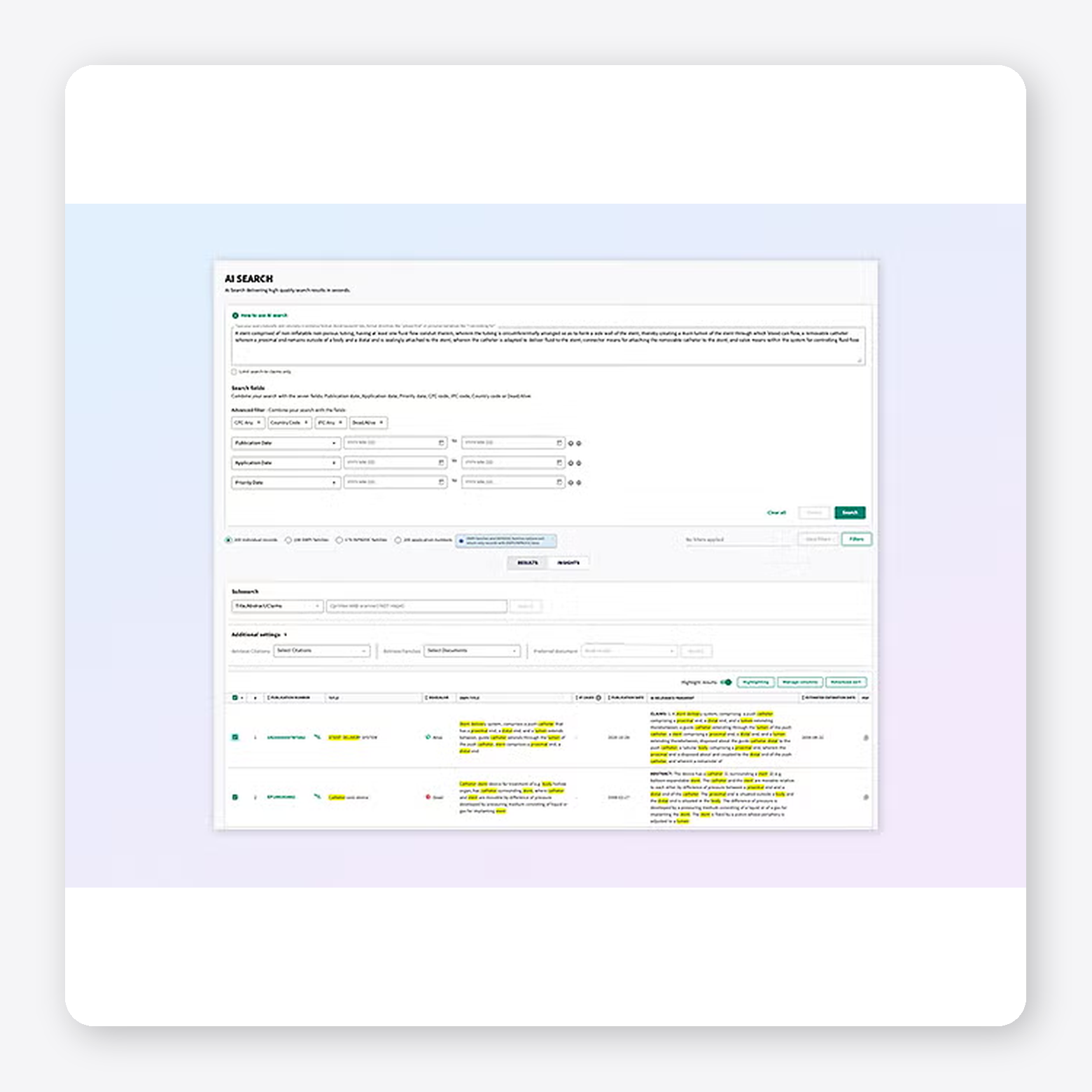
Derwent Patent Search is a patent search platform from Clarivate that combines AI-driven search with curated patent data and expert-written invention summaries. It gives patent professionals access to global patent publications, legal status data, litigation records, and non-patent literature within a single system, supporting patentability, FTO, and validity analysis across jurisdictions.
Key features:
- AI patent search: Identifies relevant prior art using models trained on Derwent World Patents Index (DWPI) data
- Invention summaries: Provides expert-authored descriptions of novelty, use, and advantage for each record
- Global patent data: Includes enhanced full-text and bibliographic patent records across jurisdictions
- Litigation data integration: Connects search results with patent litigation data for added context
User testimonials:
"Although the database is very fantastic, the user interface to analyze the patents is not good enough; we can not highlight words of our choice, and full figures are not visible directly, so we need to open the patent to see all the figures." — G2 review
3. IPRally: Best for Explainable AI Patent Search

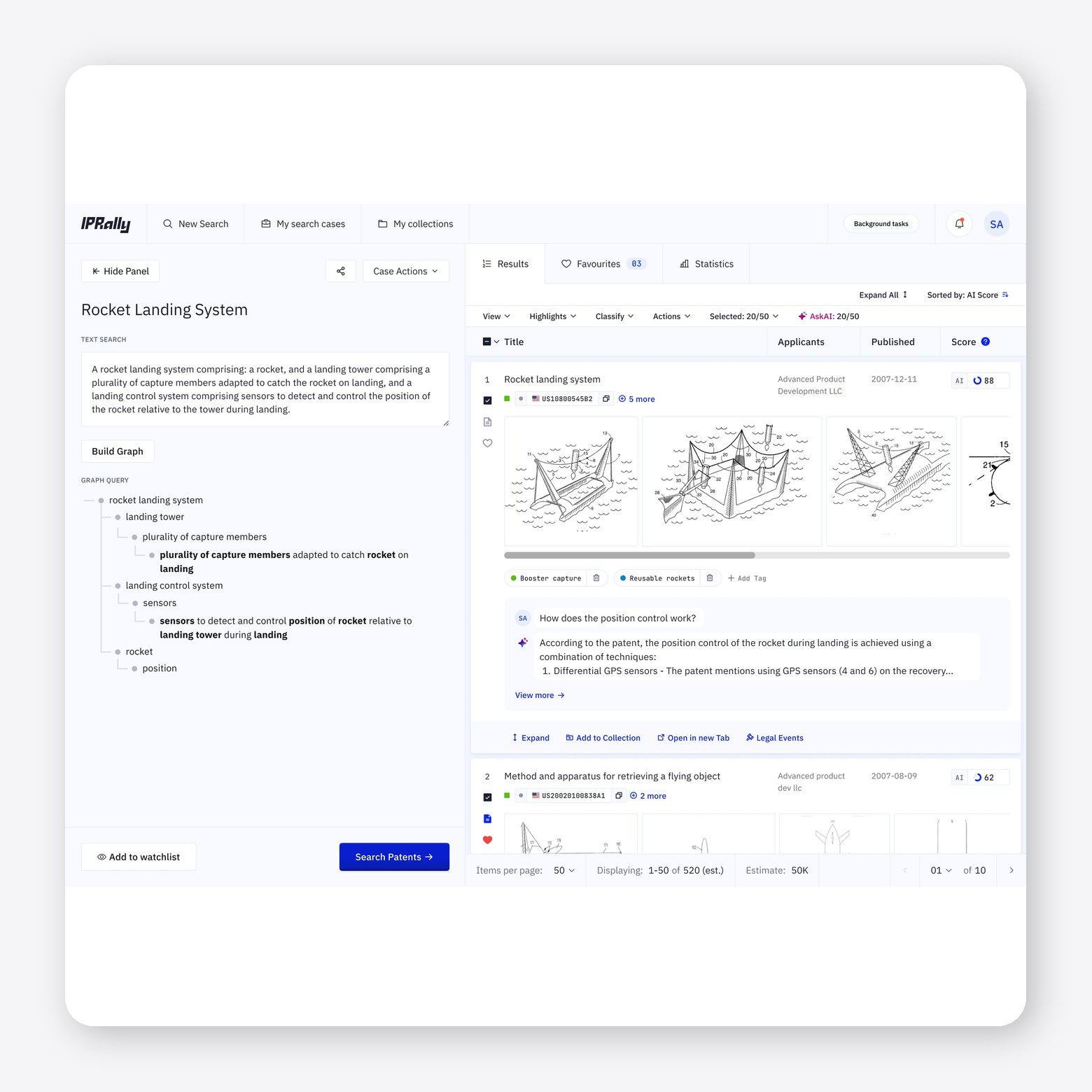
IPRally is an AI-native patent search platform built for IP and R&D teams that need structured, explainable search results. It uses graph-based AI to analyze technical relationships between patents, helping users move from raw inputs to structured search outputs and reports. IPRally supports patentability, invalidity, and FTO searches, as well as portfolio analysis and monitoring, all within a single system.
Key features:
- AI patent search: Identifies relevant prior art using graph-based models trained on patent data
- Explainable search results: Links findings to underlying reasoning so users can trace how results were generated
- Multi-input search: Accepts text, images, and documents to generate structured search queries
- Automated search workflows: Converts inputs into search results and structured reports
User testimonials:
“Citation screening and searching are not so straightforward as other searches." — G2 review
4. LexisNexis PatentSight: Best for Patent Portfolio Analytics and Competitive Intelligence

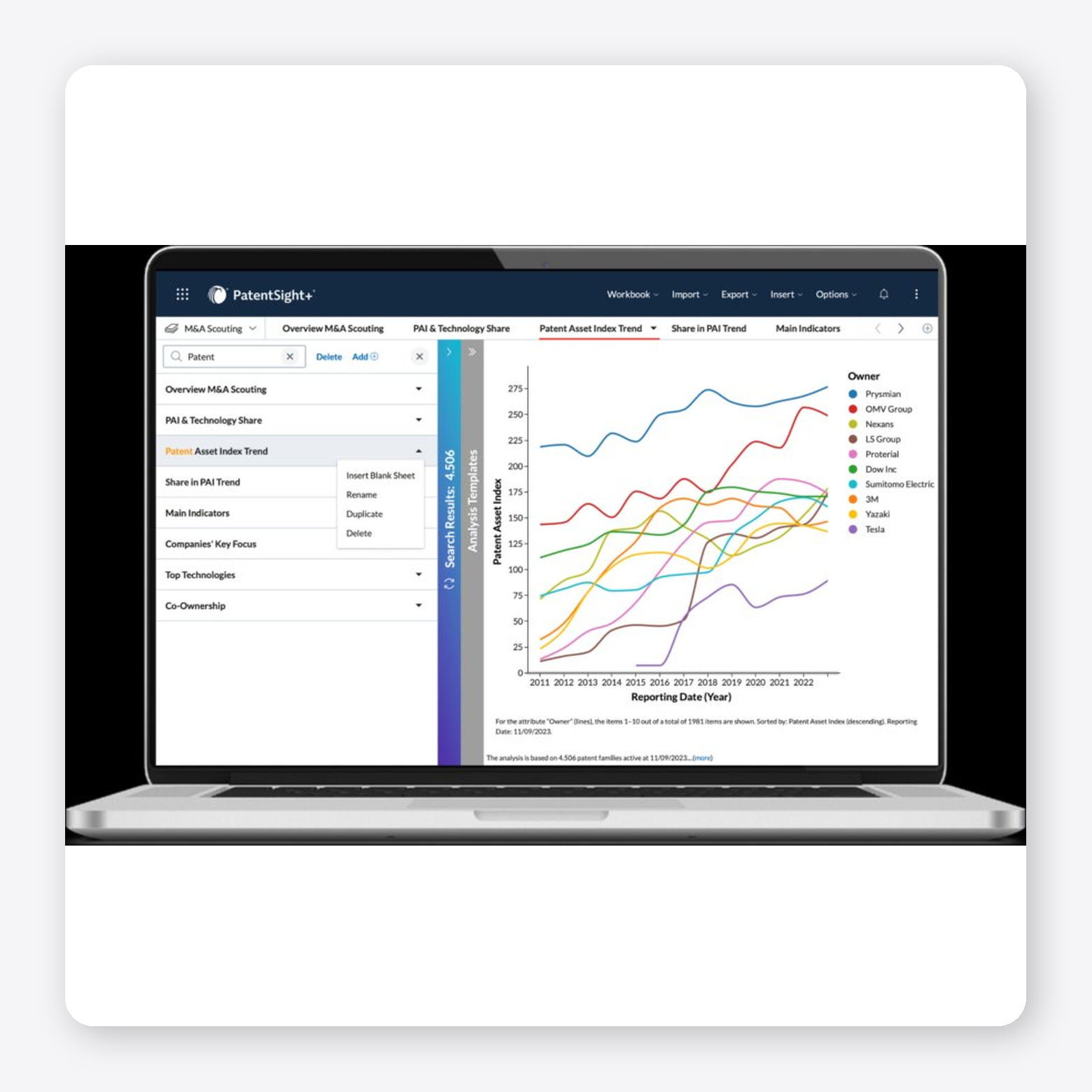
PatentSight is a patent analytics platform from LexisNexis designed to support portfolio evaluation, competitive intelligence, and strategic IP decision-making. It combines curated patent data with AI-driven analysis and visualization tools, allowing teams to explore patent landscapes, benchmark competitors, and assess portfolio quality within a single system. The platform focuses on aligning patent data with business strategy, using structured datasets and analytical models to support decision-making across IP and R&D functions.
Key features:
- AI-powered analysis builder: Generates structured analysis workbooks from natural language inputs
- AI-powered insights: Provides explanations and interpretations for charts and analytical outputs
- Patent portfolio analytics: Evaluates portfolio strength using standardized metrics and benchmarking tools
- Competitive intelligence: Tracks competitor activity and technology trends across patent datasets
User testimonials: No user reviews found
5. PatSeer: Best for Hybrid AI and Expert Patent Search

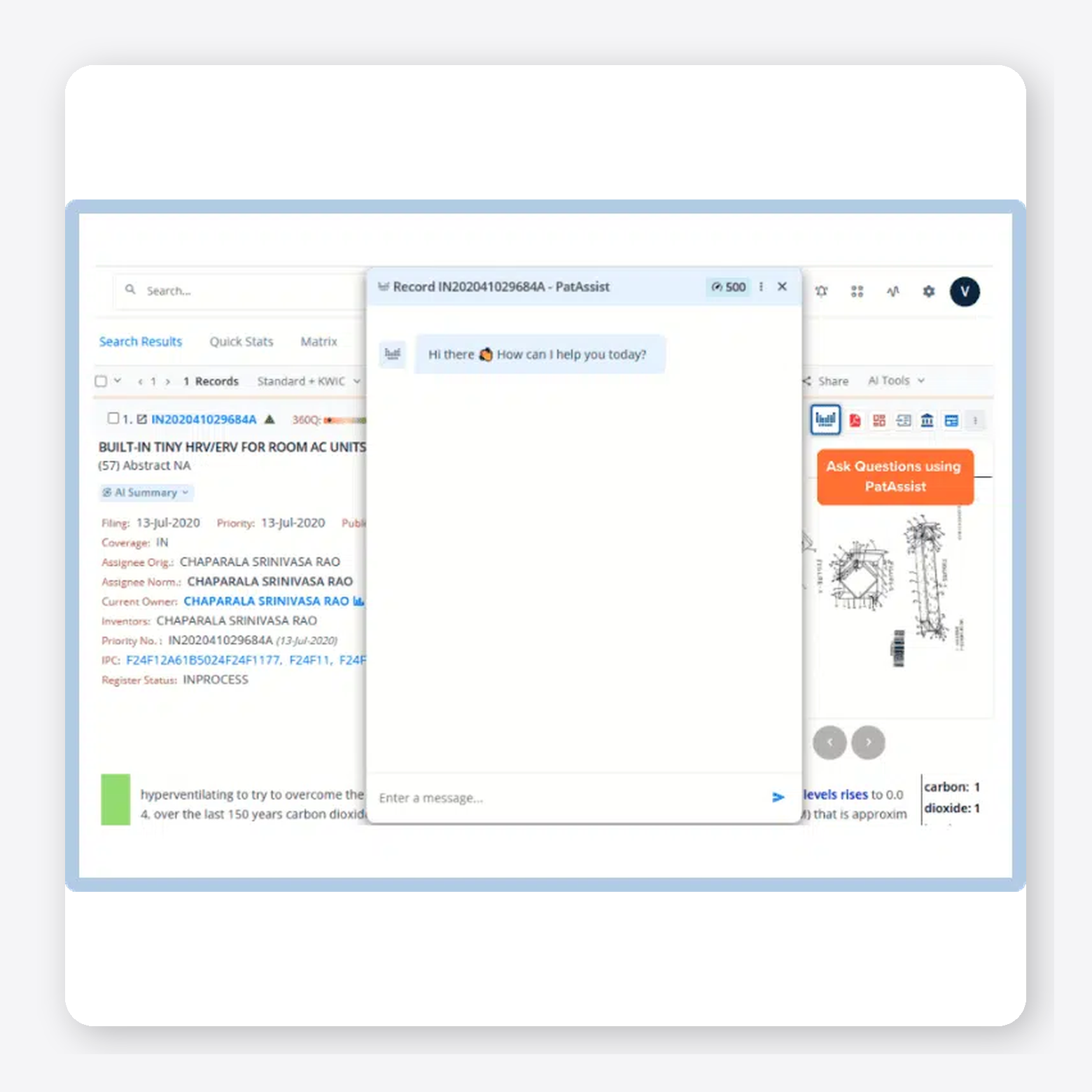
PatSeer is a patent research platform that combines AI-driven semantic search with traditional keyword and Boolean search methods. It supports patent search, analysis, and collaboration across the innovation lifecycle, with access to global patent data, non-patent literature, and design records. The platform allows users to refine searches using multiple approaches, manage results through dashboards and analytics tools, and apply structured workflows for patentability, FTO, and portfolio analysis.
Key features:
- AI-powered patent search: Identifies relevant prior art using semantic and keyword-based search methods
- Hybrid search approach: Combines Boolean, semantic, and expert search techniques in one workflow
- Analytics and dashboards: Visualizes patent data through charts, trends, and customizable dashboards
- Integrated non-patent literature search: Includes scientific and technical literature alongside patent data
User testimonials: “Although PatSeer provides a Non-Patent Literature (NPL) search option, I have found that the results are frequently incomplete. The coverage seems restricted, and certain relevant literature is not retrieved, which diminishes the overall usefulness of the NPL search feature.” — G2 Review
6. Patsnap: Best for End-to-End R&D and IP Intelligence

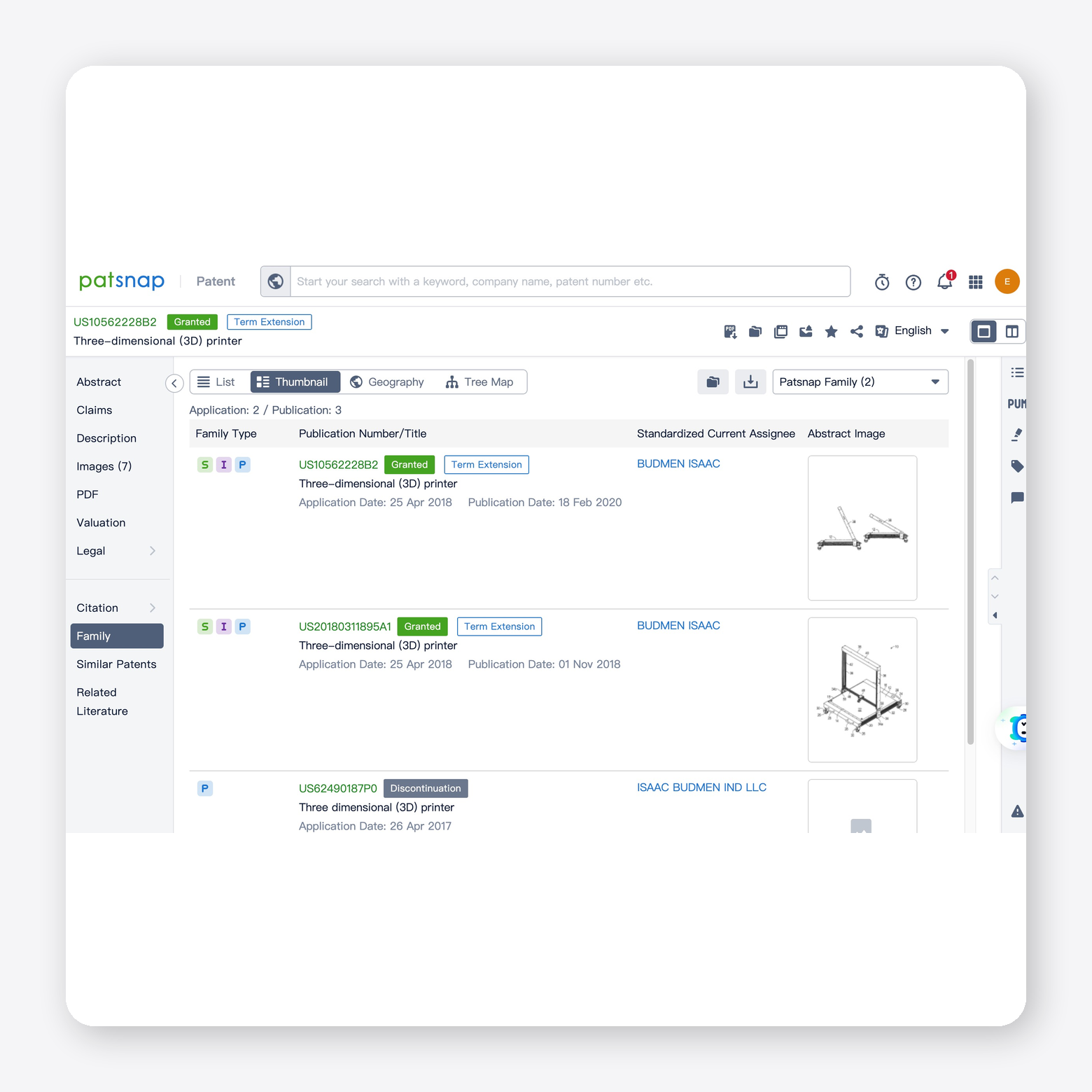
PatSnap supports patent search, analysis, and innovation workflows across R&D and IP teams. It brings together patent data, non-patent literature, and technical datasets into a single system, enabling teams to move from prior art search to patentability, FTO, and commercialization analysis within a single platform.
Key features:
- AI-powered patent search: Identifies prior art across patent and non-patent datasets using semantic search
- FTO and patentability analysis: Supports evaluation of freedom-to-operate and claim scope
- Patent landscapes: Visualizes technology areas, competitors, and innovation trends
- Invention disclosure and drafting: Supports early-stage idea capture and patent drafting workflows
User testimonials: "I do dislike the limitations placed on standard subscribers, such as restrictions on report generation and the file download limit. These constraints can make it difficult to fully leverage the platform's capabilities, especially when working on large projects or requiring detailed reports."— G2 review
7. PQAI: Best for Open-Source AI Patent Search

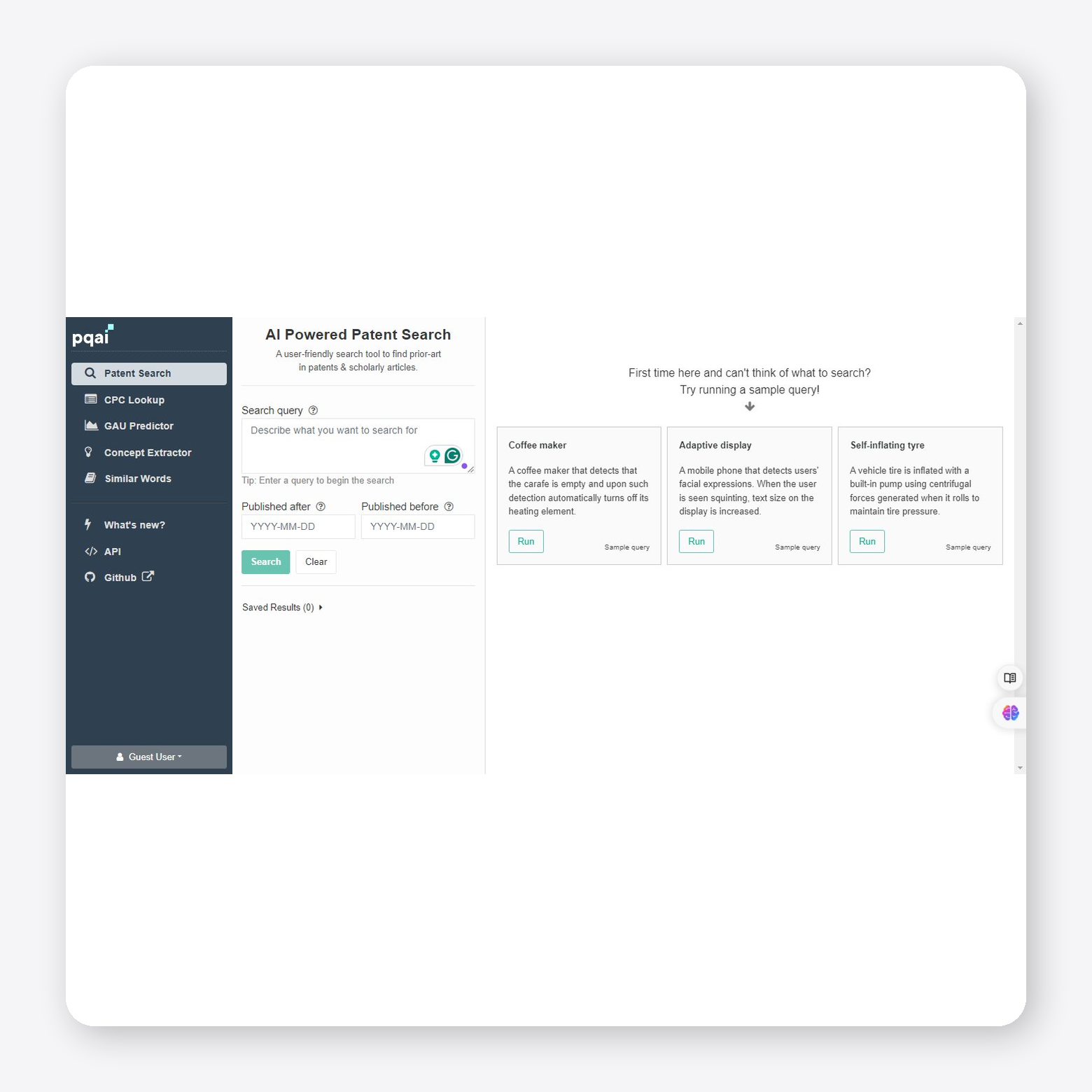
PQAI is an open-source patent search platform designed to make prior art search more accessible for inventors, researchers, and developers. It uses natural language processing to help users run semantic searches across patent data, extract key concepts, and identify relevant classifications. PQAI is built as a collaborative ecosystem, with tools and APIs that support integration, customization, and community-driven development for patent data analysis.
Key features:
- Semantic patent search: Identifies prior art using natural language queries instead of keyword-only inputs
- Concept extraction: Pulls key terms and technical concepts from patent text to refine searches
- Keyword suggestion: Recommends relevant terminology based on the invention description
- CPC and IPC lookup: Maps inventions to classification codes for targeted searching
User testimonials: "Nothing to be disliked, but I guess the user interface can be more refined." — G2 review
8. Questel Orbit: Best for Patent Analytics and Large-Scale Search

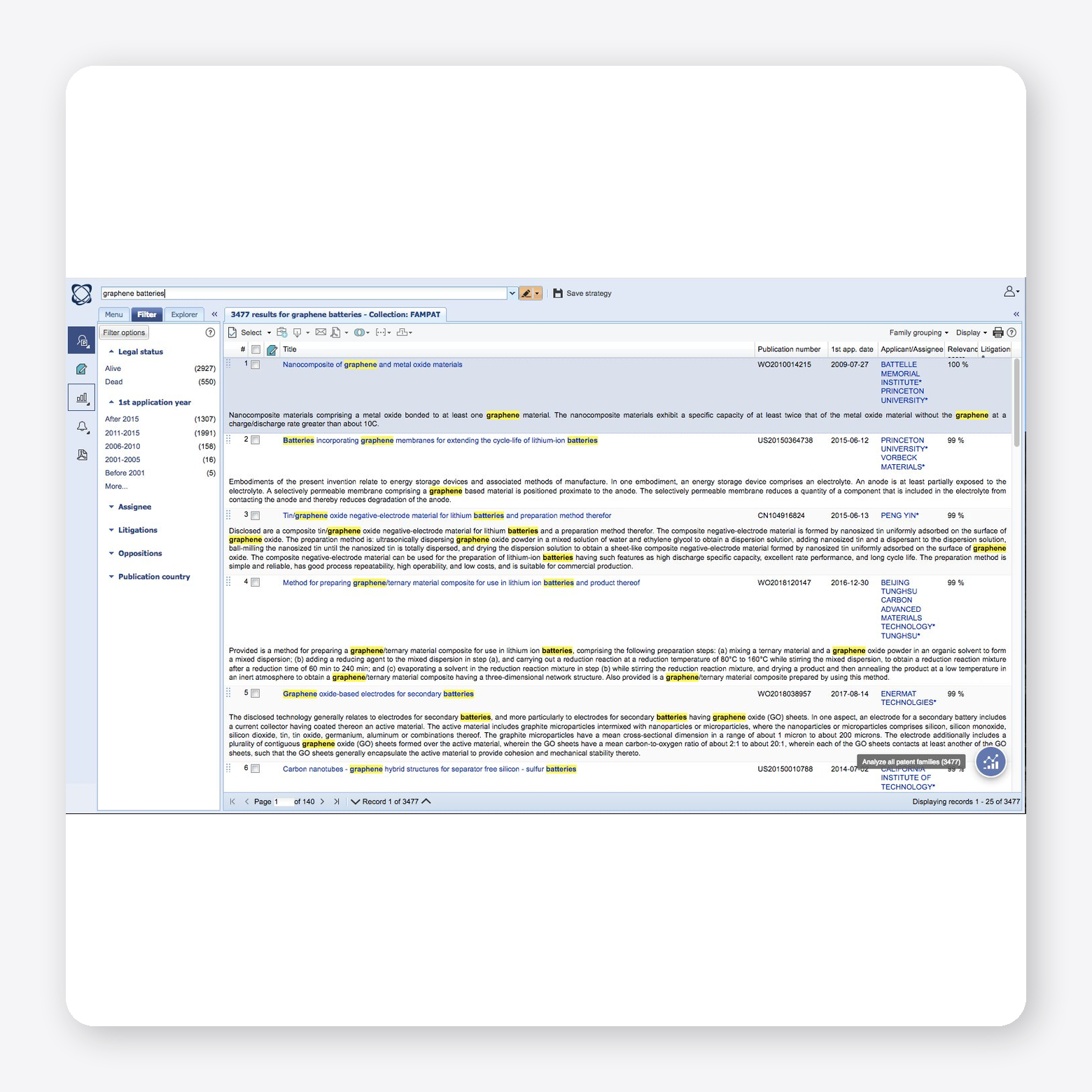
Orbit Intelligence is a patent analytics and search platform from Questel that supports prior art search, portfolio analysis, and competitive intelligence. It provides access to global patent data, non-patent literature, and legal information within a single system, allowing IP and R&D teams to analyze technology landscapes and track competitor activity.
Key features:
- AI-assisted patent search: Generates and refines search queries using natural language inputs
- Global patent and literature data: Provides access to patent, design, and scientific datasets in one platform
- Similarity search: Identifies related patents based on technical and conceptual similarity
- Data visualization: Displays patent landscapes, trends, and competitor positioning through interactive charts
User testimonials: "The database does not offer a smart search feature, although it has a semantic search feature that works the same as smart search, but is not as good as the smart search feature in other databases." — G2 review
9. The Lens: Best for Open Patent and Scholarly Data Integration

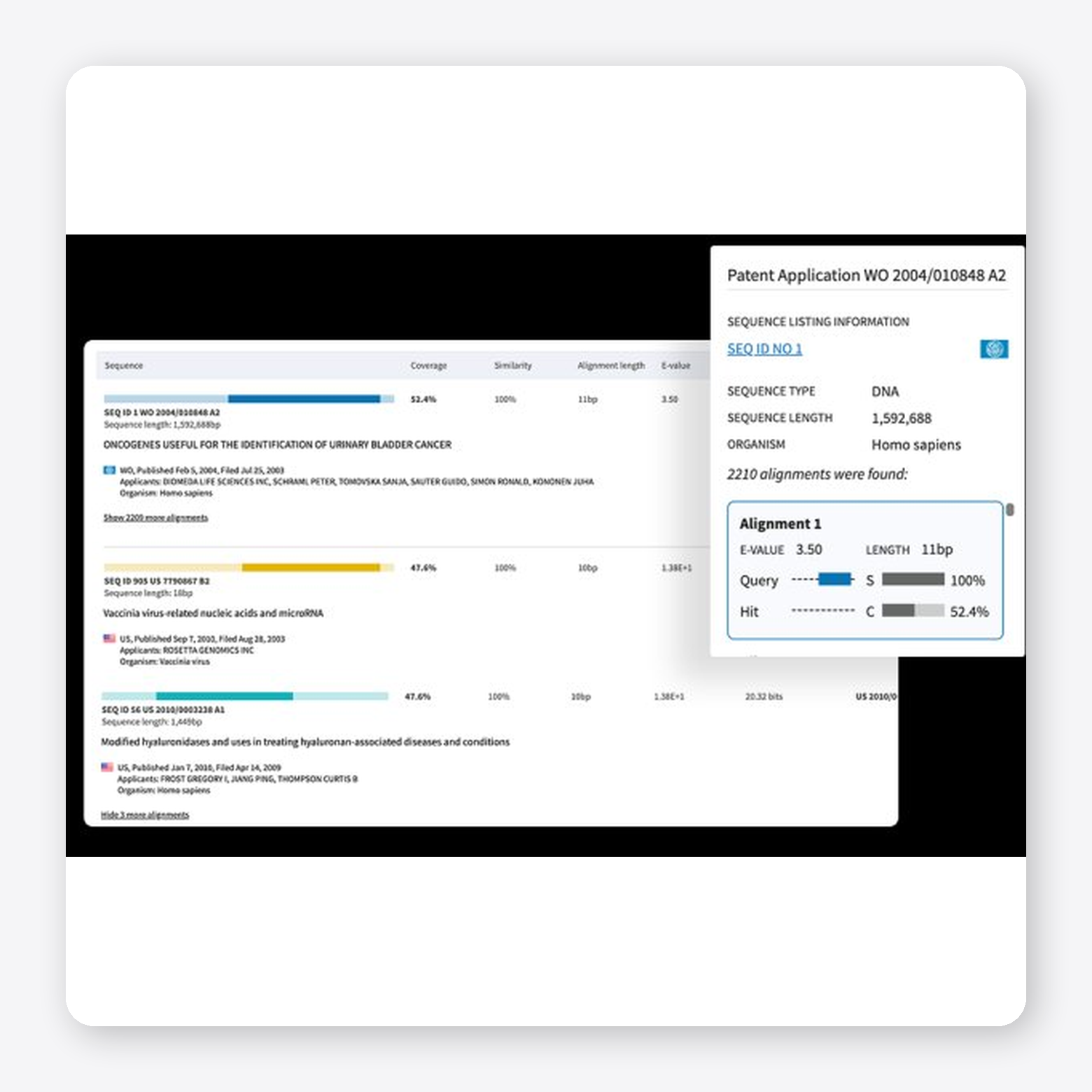
The Lens is an open patent search and analytics platform that combines global patent data with scholarly research records in a single system. It allows users to search, analyze, and manage patent and scientific data together, supporting prior art search, citation analysis, and technology exploration. The Lens focuses on linking patents with research outputs, enabling users to trace how scientific work connects to inventions and innovation activity across industries.
Key features:
- Patent and scholarly search: Searches patents and academic literature in one platform
- Citation analysis: Links patents to scientific publications and tracks influence
- Advanced search tools: Supports Boolean, classification, and structured search queries
User testimonials: No user reviews found
What Practitioners and Online Communities Say About Patent Search Engine Software
Across r/Patents and r/patentlaw, one theme comes up repeatedly: many practitioners still rely on multiple search tools in parallel. They use one platform for structured search, another for concept-based discovery, and often a third source to validate the results manually. That approach can improve confidence, but it also reflects a gap in the market. When teams have to stitch together multiple tools just to get to a usable answer, the workflow itself becomes slower, less consistent, and harder to scale.
A recurring frustration is not just relevance. It is explainability. For FTO and validity work, a ranked list of references is not enough. Practitioners want to see why a result surfaced and how specific claim limitations map to the underlying disclosure. Without that, search output is harder to trust and harder to use in practice.
Several experienced commenters point to a broader product issue. Many AI patent search tools still treat patent documents too much like ordinary text, which can obscure the structure that matters most, especially the relationship between individual claim elements and specific disclosures. What practitioners want is not a broader set of possible references. They want a clearer path from claim language to usable evidence.
Scientific literature is another recurring gap. Research papers and patent claims often describe similar concepts in very different languages, and many tools still struggle to connect those sources reliably. Security remains a practical barrier as well. Practitioners regularly raise confidentiality and data-handling concerns as a reason firms hesitate to adopt tools more broadly, regardless of how strong the search functionality appears on paper.
That is where a more integrated approach stands apart. Instead of forcing teams to move between separate search, analysis, and claim-mapping tools, an AI-native platform like Patlytics brings those workflows together in one system. The advantage is not just convenience. It is better continuity from search to structured analysis to downstream decision-making, with less manual handoff and less workflow friction. Users describe it as easier to get started with than alternatives and most effective when used as a guide rather than handed the wheel entirely.
Choosing the Right Patent Search Platform for Your Workflow
Patent search platforms vary widely in how they handle prior art, data quality, and analysis. The right choice depends on how your team runs searches and what you need to do with the results.
For some teams, that's straightforward. If the goal is raw database access — broad coverage, Boolean search, exporting hit lists for downstream review — legacy tools have decades of curated data behind them and could be sufficient.
For most teams, though, the search itself isn't the destination. Search work feeds into patentability, FTO, invalidity, or infringement analysis, and that's usually where the friction shows up. Practitioners describe spending less time on the search itself and more time on the handoff, re-keying references into charting tools, manually mapping results to claim limitations, and rebuilding context every time the work moves between systems.
That's the gap worth optimizing for. Look for platforms that connect search to the analysis it's actually for: citation-backed outputs you can verify, claim-level mapping rather than ranked lists, integrated charting, and enterprise-grade security (SOC 2 Type 2, ISO 27001, ISO 42001) as the baseline. Platforms like Patlytics take that further by connecting search to invalidity, FTO, infringement, and prosecution workflows in one system, eliminating the manual handoff that creates most of the friction in the first place. It's part of why the Patlytics has been adopted by 40% of the Am Law 100 and Fortune 500 IP teams across automotive, pharma, semiconductor, software, and chemicals.
Best Patent Search Engine Software FAQs
How do I search for a patent number?
Enter the patent number directly into a patent search platform or database search bar. Most tools support exact-match queries, so you can retrieve the full record, including claims, description, legal status, and related family documents.
Can anyone perform a patent search?
Yes, anyone can perform a patent search using public databases or commercial tools. However, patent attorneys and experienced IP professionals typically run more structured searches, especially for patentability, FTO, or invalidity analysis.
How much does a patent search cost?
Costs vary based on the tool and scope of the search. Public databases are free, while commercial platforms charge subscription fees. Professional searches conducted by attorneys or search firms can range from a few hundred to several thousand dollars, depending on complexity.

Best Patent Search Engine Software
The patent landscape is more crowded than ever. The USPTO’s backlog reached 800,000 unexamined applications and applicants are waiting nearly 20 months for a first office action. In that environment, prior art search is not just an early research step. It shapes filing strategy, product risk, and the quality of downstream IP decisions.
A missed reference can weaken patentability analysis. An overlooked competing claim can complicate product clearance or create avoidable exposure later. For patent attorneys, IP teams, and other organizations doing high-stakes patent work, the search platform matters because it affects not just what you find, but how well you can evaluate and use the results.
This guide covers the best patent search engine software options available today, what each does well, where each falls short, and how to find the right fit for your team.
Key takeaways:
- Patent search tools range from basic databases to platforms that support claim-level analysis and portfolio decision-making.
- AI-powered search can surface relevant prior art beyond exact keyword matching across technical and legal language.
- Tools that connect search to FTO, invalidity, and claim mapping can support stronger downstream IP decisions.
- The right platform depends on how your team searches, evaluates results, and uses patent data across the broader workflow.
What Is Patent Search Engine Software?
Patent search engine software helps teams find relevant prior art, competing claims, and related technical disclosures across large patent datasets. It is used to support filing decisions, product clearance, licensing, acquisition, and portfolio review.
With more than 2.1 million patents granted worldwide in 2024 alone, manual searching across government databases is increasingly inefficient. Patent search platforms help by surfacing relevant results based on technical concepts, claims language, and filing data. The strongest tools go further by supporting claim mapping, FTO analysis, scientific literature review, and competitor monitoring.
What to Look for in a Patent Search Platform
The right patent search platform should help your team find relevant prior art efficiently, assess risk earlier, and fit into the rest of the IP workflow. The most useful tools typically stand out in a few areas:
- AI-powered search: Surfaces relevant prior art beyond exact keyword matching by identifying similar concepts across different terminology.
- FTO and infringement support: Helps flag potential risk by analyzing claims against existing patents earlier in the process.
- Integration with IP systems: Connects search results to prosecution, portfolio management, and reporting workflows.
- Data security and confidentiality: Protects sensitive invention and matter data through secure environments and controlled access.
- Speed, traceability, and usability: Reduces manual review time while making it easier to understand why a result surfaced and how it connects to the analysis.
Best Patent Search Engine Software
Patent search tools serve different parts of the IP workflow. Some focus on fast prior art discovery, while others support deeper analysis, claim mapping, and portfolio insights. We selected these platforms based on how accurately they surface relevant results, the strength of their patent-specific features, ease of use for IP teams, integration with existing systems, and overall data security.
Each tool is evaluated based on what it does best and who it’s built for, so you can quickly find the right fit for your workflow.
1. Patlytics: Best for End-to-end Patent Lifecycle Management
Patlytics is an AI-native patent platform built to support work across the patent lifecycle, including prior art search, claim analysis, and downstream IP workflows. It is designed for patent attorneys, IP teams, and enterprise organizations that need to move from search results to usable analysis without stitching together separate tools.
The platform connects prior art search directly to claim-level evaluation, making it easier to see how specific references map to individual claim elements. Instead of stopping at document retrieval, Patlytics helps teams move more efficiently through validation, structured analysis, and related workflows such as claim charting, infringement review, and portfolio assessment.
Key features
- Semantic and natural-language patent search: Across US, KR, JP, EP, WO, TW patent data, refreshed weekly, with NPL coverage
- Auto-generated search queries: Built from draft claims, IDFs, or product disclosures, editable by the user
- Claim-mapped results: Every reference links to specific claim limitations, ready for invalidity charting
- Integrated invalidity workflow: § 102, § 103, and § 112 analysis built into the same system
- FTO module: Searches and screens up to 2000 potentially relevant patents from a product disclosure
- Portfolio heatmaps: Assesses up to 2000 patents at a time for infringement or validity risk
- Patent infringement detection: Identifies potential infringement and generates claim charts automatically
- Patent vault and classification: Organizes patent assets and supports classification for strategy and analysis
User testimonials:
“The combination of a user-friendly interface and precise, accurate information makes Patlytics stand out. It covers all the important categories and is more robust than other databases on the market. It's a holistic tool for anyone involved in patent research.” — G2 Review
2. Derwent Innovation: Best for Curated Patent Data and Expert-Authored Summaries
Derwent Patent Search is a patent search platform from Clarivate that combines AI-driven search with curated patent data and expert-written invention summaries. It gives patent professionals access to global patent publications, legal status data, litigation records, and non-patent literature within a single system, supporting patentability, FTO, and validity analysis across jurisdictions.
Key features:
- AI patent search: Identifies relevant prior art using models trained on Derwent World Patents Index (DWPI) data
- Invention summaries: Provides expert-authored descriptions of novelty, use, and advantage for each record
- Global patent data: Includes enhanced full-text and bibliographic patent records across jurisdictions
- Litigation data integration: Connects search results with patent litigation data for added context
User testimonials:
"Although the database is very fantastic, the user interface to analyze the patents is not good enough; we can not highlight words of our choice, and full figures are not visible directly, so we need to open the patent to see all the figures." — G2 review
3. IPRally: Best for Explainable AI Patent Search
IPRally is an AI-native patent search platform built for IP and R&D teams that need structured, explainable search results. It uses graph-based AI to analyze technical relationships between patents, helping users move from raw inputs to structured search outputs and reports. IPRally supports patentability, invalidity, and FTO searches, as well as portfolio analysis and monitoring, all within a single system.
Key features:
- AI patent search: Identifies relevant prior art using graph-based models trained on patent data
- Explainable search results: Links findings to underlying reasoning so users can trace how results were generated
- Multi-input search: Accepts text, images, and documents to generate structured search queries
- Automated search workflows: Converts inputs into search results and structured reports
User testimonials:
“Citation screening and searching are not so straightforward as other searches." — G2 review
4. LexisNexis PatentSight: Best for Patent Portfolio Analytics and Competitive Intelligence
PatentSight is a patent analytics platform from LexisNexis designed to support portfolio evaluation, competitive intelligence, and strategic IP decision-making. It combines curated patent data with AI-driven analysis and visualization tools, allowing teams to explore patent landscapes, benchmark competitors, and assess portfolio quality within a single system. The platform focuses on aligning patent data with business strategy, using structured datasets and analytical models to support decision-making across IP and R&D functions.
Key features:
- AI-powered analysis builder: Generates structured analysis workbooks from natural language inputs
- AI-powered insights: Provides explanations and interpretations for charts and analytical outputs
- Patent portfolio analytics: Evaluates portfolio strength using standardized metrics and benchmarking tools
- Competitive intelligence: Tracks competitor activity and technology trends across patent datasets
User testimonials: No user reviews found
5. PatSeer: Best for Hybrid AI and Expert Patent Search
PatSeer is a patent research platform that combines AI-driven semantic search with traditional keyword and Boolean search methods. It supports patent search, analysis, and collaboration across the innovation lifecycle, with access to global patent data, non-patent literature, and design records. The platform allows users to refine searches using multiple approaches, manage results through dashboards and analytics tools, and apply structured workflows for patentability, FTO, and portfolio analysis.
Key features:
- AI-powered patent search: Identifies relevant prior art using semantic and keyword-based search methods
- Hybrid search approach: Combines Boolean, semantic, and expert search techniques in one workflow
- Analytics and dashboards: Visualizes patent data through charts, trends, and customizable dashboards
- Integrated non-patent literature search: Includes scientific and technical literature alongside patent data
User testimonials: “Although PatSeer provides a Non-Patent Literature (NPL) search option, I have found that the results are frequently incomplete. The coverage seems restricted, and certain relevant literature is not retrieved, which diminishes the overall usefulness of the NPL search feature.” — G2 Review
6. Patsnap: Best for End-to-End R&D and IP Intelligence
PatSnap supports patent search, analysis, and innovation workflows across R&D and IP teams. It brings together patent data, non-patent literature, and technical datasets into a single system, enabling teams to move from prior art search to patentability, FTO, and commercialization analysis within a single platform.
Key features:
- AI-powered patent search: Identifies prior art across patent and non-patent datasets using semantic search
- FTO and patentability analysis: Supports evaluation of freedom-to-operate and claim scope
- Patent landscapes: Visualizes technology areas, competitors, and innovation trends
- Invention disclosure and drafting: Supports early-stage idea capture and patent drafting workflows
User testimonials: "I do dislike the limitations placed on standard subscribers, such as restrictions on report generation and the file download limit. These constraints can make it difficult to fully leverage the platform's capabilities, especially when working on large projects or requiring detailed reports."— G2 review
7. PQAI: Best for Open-Source AI Patent Search
PQAI is an open-source patent search platform designed to make prior art search more accessible for inventors, researchers, and developers. It uses natural language processing to help users run semantic searches across patent data, extract key concepts, and identify relevant classifications. PQAI is built as a collaborative ecosystem, with tools and APIs that support integration, customization, and community-driven development for patent data analysis.
Key features:
- Semantic patent search: Identifies prior art using natural language queries instead of keyword-only inputs
- Concept extraction: Pulls key terms and technical concepts from patent text to refine searches
- Keyword suggestion: Recommends relevant terminology based on the invention description
- CPC and IPC lookup: Maps inventions to classification codes for targeted searching
User testimonials: "Nothing to be disliked, but I guess the user interface can be more refined." — G2 review
8. Questel Orbit: Best for Patent Analytics and Large-Scale Search
Orbit Intelligence is a patent analytics and search platform from Questel that supports prior art search, portfolio analysis, and competitive intelligence. It provides access to global patent data, non-patent literature, and legal information within a single system, allowing IP and R&D teams to analyze technology landscapes and track competitor activity.
Key features:
- AI-assisted patent search: Generates and refines search queries using natural language inputs
- Global patent and literature data: Provides access to patent, design, and scientific datasets in one platform
- Similarity search: Identifies related patents based on technical and conceptual similarity
- Data visualization: Displays patent landscapes, trends, and competitor positioning through interactive charts
User testimonials: "The database does not offer a smart search feature, although it has a semantic search feature that works the same as smart search, but is not as good as the smart search feature in other databases." — G2 review
9. The Lens: Best for Open Patent and Scholarly Data Integration
The Lens is an open patent search and analytics platform that combines global patent data with scholarly research records in a single system. It allows users to search, analyze, and manage patent and scientific data together, supporting prior art search, citation analysis, and technology exploration. The Lens focuses on linking patents with research outputs, enabling users to trace how scientific work connects to inventions and innovation activity across industries.
Key features:
- Patent and scholarly search: Searches patents and academic literature in one platform
- Citation analysis: Links patents to scientific publications and tracks influence
- Advanced search tools: Supports Boolean, classification, and structured search queries
User testimonials: No user reviews found
What Practitioners and Online Communities Say About Patent Search Engine Software
Across r/Patents and r/patentlaw, one theme comes up repeatedly: many practitioners still rely on multiple search tools in parallel. They use one platform for structured search, another for concept-based discovery, and often a third source to validate the results manually. That approach can improve confidence, but it also reflects a gap in the market. When teams have to stitch together multiple tools just to get to a usable answer, the workflow itself becomes slower, less consistent, and harder to scale.
A recurring frustration is not just relevance. It is explainability. For FTO and validity work, a ranked list of references is not enough. Practitioners want to see why a result surfaced and how specific claim limitations map to the underlying disclosure. Without that, search output is harder to trust and harder to use in practice.
Several experienced commenters point to a broader product issue. Many AI patent search tools still treat patent documents too much like ordinary text, which can obscure the structure that matters most, especially the relationship between individual claim elements and specific disclosures. What practitioners want is not a broader set of possible references. They want a clearer path from claim language to usable evidence.
Scientific literature is another recurring gap. Research papers and patent claims often describe similar concepts in very different languages, and many tools still struggle to connect those sources reliably. Security remains a practical barrier as well. Practitioners regularly raise confidentiality and data-handling concerns as a reason firms hesitate to adopt tools more broadly, regardless of how strong the search functionality appears on paper.
That is where a more integrated approach stands apart. Instead of forcing teams to move between separate search, analysis, and claim-mapping tools, an AI-native platform like Patlytics brings those workflows together in one system. The advantage is not just convenience. It is better continuity from search to structured analysis to downstream decision-making, with less manual handoff and less workflow friction. Users describe it as easier to get started with than alternatives and most effective when used as a guide rather than handed the wheel entirely.
Choosing the Right Patent Search Platform for Your Workflow
Patent search platforms vary widely in how they handle prior art, data quality, and analysis. The right choice depends on how your team runs searches and what you need to do with the results.
For some teams, that's straightforward. If the goal is raw database access — broad coverage, Boolean search, exporting hit lists for downstream review — legacy tools have decades of curated data behind them and could be sufficient.
For most teams, though, the search itself isn't the destination. Search work feeds into patentability, FTO, invalidity, or infringement analysis, and that's usually where the friction shows up. Practitioners describe spending less time on the search itself and more time on the handoff, re-keying references into charting tools, manually mapping results to claim limitations, and rebuilding context every time the work moves between systems.
That's the gap worth optimizing for. Look for platforms that connect search to the analysis it's actually for: citation-backed outputs you can verify, claim-level mapping rather than ranked lists, integrated charting, and enterprise-grade security (SOC 2 Type 2, ISO 27001, ISO 42001) as the baseline. Platforms like Patlytics take that further by connecting search to invalidity, FTO, infringement, and prosecution workflows in one system, eliminating the manual handoff that creates most of the friction in the first place. It's part of why the Patlytics has been adopted by 40% of the Am Law 100 and Fortune 500 IP teams across automotive, pharma, semiconductor, software, and chemicals.
Best Patent Search Engine Software FAQs
How do I search for a patent number?
Enter the patent number directly into a patent search platform or database search bar. Most tools support exact-match queries, so you can retrieve the full record, including claims, description, legal status, and related family documents.
Can anyone perform a patent search?
Yes, anyone can perform a patent search using public databases or commercial tools. However, patent attorneys and experienced IP professionals typically run more structured searches, especially for patentability, FTO, or invalidity analysis.
How much does a patent search cost?
Costs vary based on the tool and scope of the search. Public databases are free, while commercial platforms charge subscription fees. Professional searches conducted by attorneys or search firms can range from a few hundred to several thousand dollars, depending on complexity.
The Premier AI-Powered Patent Platform
Reduce cycle times. Increase margins. Deliver winning IP outcomes.
Book a DemoThe Premier AI-Powered
Patent Platform
Reduce cycle times. Increase margins. Deliver winning IP outcomes.