Patent AI vendor evaluation: 10 questions to document
March 11, 2026
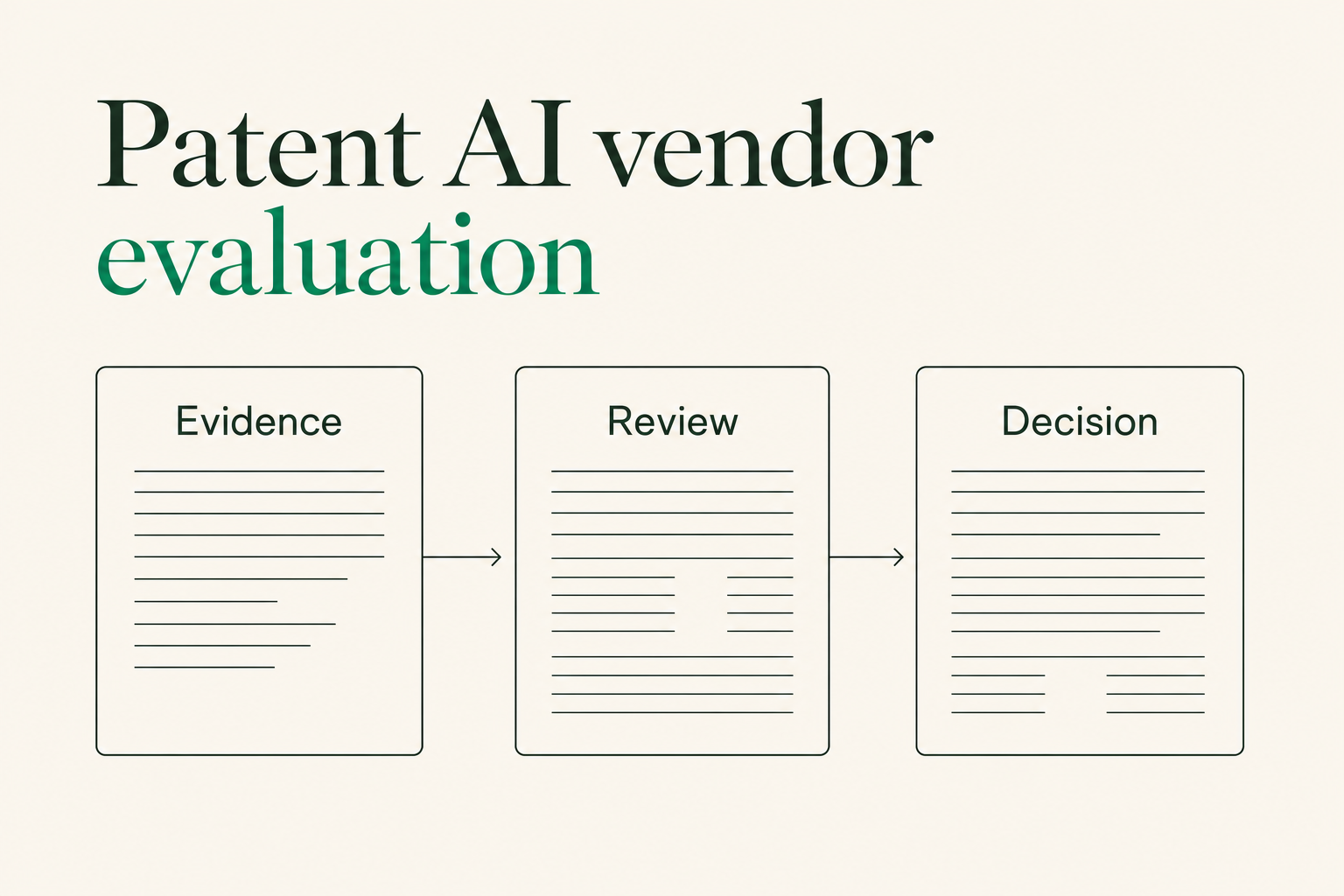
Which patent AI platform can produce a source-linked analysis or draft your team can use, and how much review will it take to get there? A polished demonstration can leave those practical questions unanswered. These 10 questions help your law firm or in-house intellectual property (IP) team document the evidence behind a buying decision, from claim-level support to the first practitioner-reviewed result.
This framework supports vendor selection, with AI assisting practitioners and attorneys retaining review and decision authority over drafts, charts, evidence, and legal analysis.
Set up a vendor-evaluation record
Start with the work you intend to purchase: drafting from an invention disclosure, searching for prior art, preparing an invalidity chart, or investigating possible infringement. Identify the jurisdiction, technical field, source documents, expected deliverable, and responsible attorney. Record a separate finding for each workflow.
Give greatest weight to source-linked analysis, practitioner-reviewed AI work product, and time to a first usable result, including review and rework. Treat task-relevant data coverage as a necessary eligibility gate. Compare eligible platforms on the quality and usability of the work they produce.
Use public or permission-cleared materials for demonstrations. Confidential disclosures require a separate data-handling decision before submission.
For each question, retain the vendor's response and the artifact supporting it. Record the product version, configuration, evidence date, reviewer, finding, and unresolved limitation. Use 3 decision statuses:
- Meets requirement: the reviewed evidence supports the defined use case.
- Conditional: a named gap needs a specific artifact, contractual commitment, or separate performance assessment before approval.
- Does not meet requirement: the evidence conflicts with a mandatory requirement or the required capability is unavailable.
Keep evidence types distinct. A public page describes a capability. A demonstration shows a configured example. A contract establishes commitments. A scoped assessment supplies performance evidence.
1. Does the platform analyze claims at the limitation level?
A claim limitation is a specific element or requirement within a patent claim. Your reviewer needs to see how each limitation relates to the source material, including dependencies and relationships between elements.
Evidence to request: An editable claim chart or draft claim set, the underlying source files, and a limitation-to-source mapping. For drafting, request the specification and drawings alongside the claims, with missing technical details and proposed additions identified.
Review action, patent attorney: Inspect whether the output preserves claim language, dependencies, terminology, drawing references, and the disclosed combinations. Separate a drafting-support map from a prior-art or product-evidence map. They answer different questions.
For U.S. applications, the United States Patent and Trademark Office's written-description guidance recognizes express, implicit, or inherent support. Review therefore extends beyond literal word matching. For European applications, Article 84 of the European Patent Convention requires clear, concise claims supported by the description. Inspect support for the claimed combination as well as its individual elements.
Decision to document: Which claim structures and technical fields the evidence supports, which defects require correction, and whether the reviewer can inspect the basis for proposed language. The AI patent drafting guide explains the surrounding drafting workflow.
2. Does semantic search retrieve relevant technical disclosures?
Semantic search seeks technical similarity beyond identical wording. Its usefulness depends on the retrieved passages and the search task, rather than the label attached to the retrieval method.
Evidence to request: Saved queries, filters, result lists, and passage-level explanations for representative technical concepts. Request both terminology-matched results and results using different language, plus the available keyword, classification, and date controls.
Review action, search lead and patent attorney: Inspect why a reference was retrieved and which requested elements appear in its disclosure. Distinguish technical similarity from evidence that a reference addresses the relevant claim limitations. Preserve the search settings so another practitioner can understand the result set.
Decision to document: The retrieval modes suitable for your intended search, filters that remain necessary, and gaps requiring another search source.
3. How does the platform expose unsupported content?
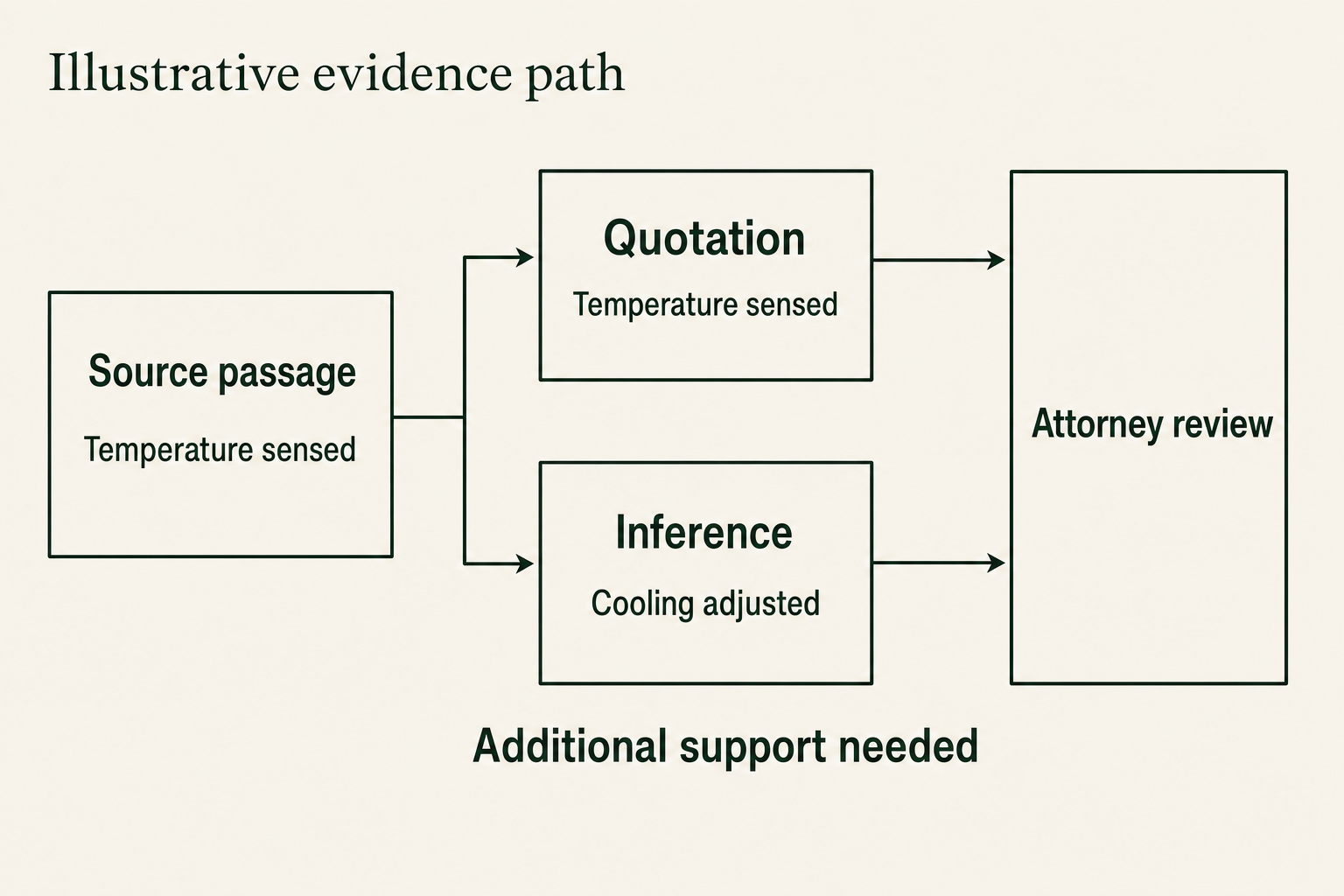
Traceability connects a generated assertion to the cited passage and distinguishes quotation, paraphrase, inference, and missing support. A source-linked analysis should make that distinction inspectable at each material mapping.
Evidence to request: An output with source identifiers, document versions, paragraph or page locators, accessible excerpts, and explicit gaps. Request an example where the source is incomplete or contradictory and the platform leaves the issue unresolved.
Review action, patent attorney: Follow a material assertion to its cited passage and inspect the surrounding context. Compare the assertion with what the passage actually says. In a fictional example, a passage describing temperature sensing supports that step; a proposed relationship between the sensor and a cooling controller needs its own evidence or an explicit inference label.
Decision to document: Whether unsupported statements are visible, whether source passages remain accessible, and which classes of inference require attorney escalation.
4. What data sources cover your intended work?
Confirm coverage for the defined task, jurisdictions, document types, and retrieval date before assessing the result's completeness.
Evidence to request: A coverage matrix naming patent jurisdictions, document types, languages, update schedules, and access limitations. Include non-patent literature (NPL), such as technical papers and manuals, when relevant. For standard-essential patent (SEP) work, request the supported standards bodies and document versions. Ask how publication records, patent-family relationships, and legal-status data are sourced.
Review action, search or IP operations lead: Compare the matrix with the jurisdictions, dates, and document types in your intended workflow. Inspect whether full text, figures, searchable text, and translated passages are available, and whether a missing record is disclosed. Separate publication-date filtering for prior-art work from legal-status and jurisdiction needs in a freedom-to-operate (FTO) review.
Decision to document: Coverage accepted for each workflow, freshness requirements, known exclusions, and supplementary sources.
5. Do connected workflows and integrations fit your process?
Select the workflow handoffs your team needs, including source intake, review, and export. Focus on whether the reviewed deliverable reaches its next use with its evidence intact.
Evidence to request: A walkthrough from source intake to editable work product and attorney handoff. Request supported file formats, exports, version behavior, permission controls, and integration documentation. For each connection, obtain a data-flow diagram identifying what leaves the platform, what returns, and which service stores the interaction.
Review action, IP operations and information technology leads: Inspect the deliverable in the destination where counsel will edit or use it. Look for lost citations, changed numbering, inaccessible evidence, duplicated entry, and broken version links. Identify whether an integration is read-only or can change records, and how the initiating practitioner's permissions apply.
Decision to document: Required handoffs supported, manual steps remaining, integration scope, and responsibility for configuration. Include each connected service in the retention review.
6. Can you edit and compare claim interpretations within an analysis?
Claim construction concerns the meaning and scope of claim terms. The interpretation used in an analysis shapes which passages support a limitation and how competing mappings are assessed.
Evidence to request: An analysis showing editable claim interpretations, supporting material, and a comparison of the results under competing readings. Ask how the platform handles a revised interpretation or a court's construction within that analysis.
Review action, responsible patent attorney: Edit a disputed term's interpretation and compare the resulting mappings within the same analysis. Inspect whether each result uses the intended claim version and interpretation, and identify conclusions that change. Keep proposed, attorney-approved, and court-adopted interpretations clearly labeled.
Decision to document: The interpretation accepted for the specified analysis, alternatives considered, affected mappings, and reasons for the attorney's decision.
7. What protects confidential material, and what is retained?
Treat access, training use, retention, and deletion as separate questions. Record the storage period for files and logs alongside permitted uses.
Evidence to request: The applicable agreement, data-processing and security addenda, subprocessor and model-provider list, data-flow diagram, and retention schedule. Ask for current security artifacts with their system scope, dates, exceptions, and remediation status.
A System and Organization Controls (SOC) 2 Type II report includes a system description, auditor's report, and control-testing results, as set out in the American Institute of Certified Public Accountants' illustrative report description. Request the underlying report, plus the scope and validity of any claimed information-security or AI-management-system certifications.
Review action, security lead and legal counsel: Map each commitment to the actual deployment, processing and storage locations, and data class:
| Data class | Questions the evidence must resolve |
|---|---|
| Uploaded disclosures and source files | Where are originals, extracted text, and derived indexes stored? Who can access them? |
| Prompts and outputs | Are they retained by the platform or model providers? What training or tuning uses are permitted? |
| Telemetry, history, and audit logs | What content is captured, who can access it, and when is it deleted? |
| Backups and connected services | What survives deletion, for how long, and under whose agreement? |
Separate website personal-information policies from terms governing customer matter content. Resolve differences between public statements and applicable contractual definitions. Inspect administrative access, matter separation, incident notice, export, and termination deletion. Include privilege and confidentiality obligations in counsel's contractual review.
Decision to document: The permitted data classes for the evaluated configuration, unresolved retention or access paths, required contractual terms, and security/legal reviewers' findings. Keep confidential-content approval conditional until material gaps are resolved.
8. Is model flexibility controlled and relevant to your work?
Selecting a model or reasoning level matters only when it addresses a defined task requirement.
Evidence to request: The available configurations for your intended tasks, model-provider dependencies, configuration records, release notes, and change-notification practices. Request the method and task scope behind any quality claim, including the human review included in reported results.
Review action, technical lead and patent attorney: Inspect whether the configuration used in a demonstration can be identified later. Determine which model or provider changes alter data handling, source access, or the work product your attorney reviews. Distinguish customer-selectable settings from vendor-managed changes.
Decision to document: The configuration evaluated, the reason it fits the workflow, known constraints, and changes that require a new evidence review. Record the task-specific evidence supporting each performance claim.
9. Can attorneys explain and review the work product?
An inspectable work product exposes the evidence, assumptions, and gaps needed for a professional decision. A first usable result is a practitioner-reviewed deliverable ready for its defined next step, such as a corrected draft claim set or a source-linked chart ready for matter discussion.
Evidence to request: Editable outputs, source navigation, assumption and gap labels, correction history, and an attorney-review walkthrough. Request the generated and reviewed deliverables, with evidence of elapsed time to the usable result and the review or rework involved. Ask the vendor to show how a rejected mapping, changed limitation, or corrected citation affects the downstream output.
Review action, attorney reviewer and workflow lead: Inspect the steps required to locate evidence, resolve conflicts, edit substantive content, and approve the final deliverable. Identify whether corrections persist or disappear when analysis is regenerated. Record work shifted to senior counsel, including reconstruction of sources and technical relationships.
The American Bar Association's Formal Opinion 512, interpreting its Model Rules, ties the appropriate degree of independent verification or review to the system and task.
Decision to document: Whether time to the first usable result and the review burden fit your matter timeline and team capacity. Record required review steps, reviewer expertise, correction effort, senior-counsel involvement, unresolved usability barriers, and the approval handoff. Logins and query volume show activity; judge value by the reviewed deliverable and the effort required to make it usable.
10. Does the evidence support your intended IP decision?
The final question connects the reviewed deliverable to the decision your team actually needs to make.
Evidence to request: A decision-ready example with supporting documents, assumptions, alternatives, and unresolved issues. For drafting, that might be claim options for attorney review. For a portfolio matter, it might be a prioritization report with the evidence behind each recommendation.
Review action, IP leader and responsible attorney: Inspect whether the output informs the defined decision without collapsing different legal tasks: patentability concerns whether an invention may qualify for patent protection, while a freedom-to-operate review concerns potential exposure from third-party patent rights for specified activity, jurisdictions, and dates.
Decision to document: The supported use case, excluded decisions, mandatory gaps, and evidence that could change the selection decision. For validity, infringement, or clearance work, record the responsible attorney's conclusion and its supporting claim analysis.
Close the selection with a documented decision
Summarize the 10 findings in one record. Include the selected workflows and configuration, evidence references, reviewer names, unresolved conditions, and reasons to proceed or decline. Explain how source-linked analysis, the reviewed work product, and time to a first usable result drove the choice. Keep mandatory coverage and confidentiality gaps visible even when the deliverable is persuasive.
A fictional selection entry could read: “Conditional for U.S. drafting assistance. The reviewed draft and claim-support mapping meet the stated deliverable requirements. Unpublished disclosures remain outside the approved configuration until model-provider retention terms are supplied. Security counsel owns that condition.”
Keep performance pilots and organizational AI-use policies separate from the vendor-selection record.
Where Patlytics fits
Patlytics is a patent-specific platform built for teams that need drafting, search, and charting in one connected patent workflow. Its Patent Drafting module supports source-material review, claim-tree structuring, and detailed-description drafting, producing a draft for substantive review and refinement.
Patent & NPL Search supports prior-art retrieval. The Invalidity module charts at the limitation level with citations to the source passage, so a practitioner can inspect each proposed mapping against its evidence. Claim Construction provides editable interpretations for reviewing prior art under competing readings within an analysis. Reviewed search evidence supplies the basis for claim-chart review and matter discussion. Attorneys retain review and decision authority over drafts, charts, evidence, and legal analysis.
Patlytics provides SOC 2 Type II attestation and certifications to ISO 27001 and ISO 42001. ISO 42001 is the International Organization for Standardization's AI management system standard. Patlytics does not use customer data to tune or train its models without explicit consent or necessity.
Get a source-linked claim analysis or structured draft ready for substantive review with Patlytics. Book a demo to see the source evidence and editable work product behind that result.
Patent AI vendor evaluation: 10 questions to document
Which patent AI platform can produce a source-linked analysis or draft your team can use, and how much review will it take to get there? A polished demonstration can leave those practical questions unanswered. These 10 questions help your law firm or in-house intellectual property (IP) team document the evidence behind a buying decision, from claim-level support to the first practitioner-reviewed result.
This framework supports vendor selection, with AI assisting practitioners and attorneys retaining review and decision authority over drafts, charts, evidence, and legal analysis.
Set up a vendor-evaluation record
Start with the work you intend to purchase: drafting from an invention disclosure, searching for prior art, preparing an invalidity chart, or investigating possible infringement. Identify the jurisdiction, technical field, source documents, expected deliverable, and responsible attorney. Record a separate finding for each workflow.
Give greatest weight to source-linked analysis, practitioner-reviewed AI work product, and time to a first usable result, including review and rework. Treat task-relevant data coverage as a necessary eligibility gate. Compare eligible platforms on the quality and usability of the work they produce.
Use public or permission-cleared materials for demonstrations. Confidential disclosures require a separate data-handling decision before submission.
For each question, retain the vendor's response and the artifact supporting it. Record the product version, configuration, evidence date, reviewer, finding, and unresolved limitation. Use 3 decision statuses:
- Meets requirement: the reviewed evidence supports the defined use case.
- Conditional: a named gap needs a specific artifact, contractual commitment, or separate performance assessment before approval.
- Does not meet requirement: the evidence conflicts with a mandatory requirement or the required capability is unavailable.
Keep evidence types distinct. A public page describes a capability. A demonstration shows a configured example. A contract establishes commitments. A scoped assessment supplies performance evidence.
1. Does the platform analyze claims at the limitation level?
A claim limitation is a specific element or requirement within a patent claim. Your reviewer needs to see how each limitation relates to the source material, including dependencies and relationships between elements.
Evidence to request: An editable claim chart or draft claim set, the underlying source files, and a limitation-to-source mapping. For drafting, request the specification and drawings alongside the claims, with missing technical details and proposed additions identified.
Review action, patent attorney: Inspect whether the output preserves claim language, dependencies, terminology, drawing references, and the disclosed combinations. Separate a drafting-support map from a prior-art or product-evidence map. They answer different questions.
For U.S. applications, the United States Patent and Trademark Office's written-description guidance recognizes express, implicit, or inherent support. Review therefore extends beyond literal word matching. For European applications, Article 84 of the European Patent Convention requires clear, concise claims supported by the description. Inspect support for the claimed combination as well as its individual elements.
Decision to document: Which claim structures and technical fields the evidence supports, which defects require correction, and whether the reviewer can inspect the basis for proposed language. The AI patent drafting guide explains the surrounding drafting workflow.
2. Does semantic search retrieve relevant technical disclosures?
Semantic search seeks technical similarity beyond identical wording. Its usefulness depends on the retrieved passages and the search task, rather than the label attached to the retrieval method.
Evidence to request: Saved queries, filters, result lists, and passage-level explanations for representative technical concepts. Request both terminology-matched results and results using different language, plus the available keyword, classification, and date controls.
Review action, search lead and patent attorney: Inspect why a reference was retrieved and which requested elements appear in its disclosure. Distinguish technical similarity from evidence that a reference addresses the relevant claim limitations. Preserve the search settings so another practitioner can understand the result set.
Decision to document: The retrieval modes suitable for your intended search, filters that remain necessary, and gaps requiring another search source.
3. How does the platform expose unsupported content?
Traceability connects a generated assertion to the cited passage and distinguishes quotation, paraphrase, inference, and missing support. A source-linked analysis should make that distinction inspectable at each material mapping.
Evidence to request: An output with source identifiers, document versions, paragraph or page locators, accessible excerpts, and explicit gaps. Request an example where the source is incomplete or contradictory and the platform leaves the issue unresolved.
Review action, patent attorney: Follow a material assertion to its cited passage and inspect the surrounding context. Compare the assertion with what the passage actually says. In a fictional example, a passage describing temperature sensing supports that step; a proposed relationship between the sensor and a cooling controller needs its own evidence or an explicit inference label.
Decision to document: Whether unsupported statements are visible, whether source passages remain accessible, and which classes of inference require attorney escalation.
4. What data sources cover your intended work?
Confirm coverage for the defined task, jurisdictions, document types, and retrieval date before assessing the result's completeness.
Evidence to request: A coverage matrix naming patent jurisdictions, document types, languages, update schedules, and access limitations. Include non-patent literature (NPL), such as technical papers and manuals, when relevant. For standard-essential patent (SEP) work, request the supported standards bodies and document versions. Ask how publication records, patent-family relationships, and legal-status data are sourced.
Review action, search or IP operations lead: Compare the matrix with the jurisdictions, dates, and document types in your intended workflow. Inspect whether full text, figures, searchable text, and translated passages are available, and whether a missing record is disclosed. Separate publication-date filtering for prior-art work from legal-status and jurisdiction needs in a freedom-to-operate (FTO) review.
Decision to document: Coverage accepted for each workflow, freshness requirements, known exclusions, and supplementary sources.
5. Do connected workflows and integrations fit your process?
Select the workflow handoffs your team needs, including source intake, review, and export. Focus on whether the reviewed deliverable reaches its next use with its evidence intact.
Evidence to request: A walkthrough from source intake to editable work product and attorney handoff. Request supported file formats, exports, version behavior, permission controls, and integration documentation. For each connection, obtain a data-flow diagram identifying what leaves the platform, what returns, and which service stores the interaction.
Review action, IP operations and information technology leads: Inspect the deliverable in the destination where counsel will edit or use it. Look for lost citations, changed numbering, inaccessible evidence, duplicated entry, and broken version links. Identify whether an integration is read-only or can change records, and how the initiating practitioner's permissions apply.
Decision to document: Required handoffs supported, manual steps remaining, integration scope, and responsibility for configuration. Include each connected service in the retention review.
6. Can you edit and compare claim interpretations within an analysis?
Claim construction concerns the meaning and scope of claim terms. The interpretation used in an analysis shapes which passages support a limitation and how competing mappings are assessed.
Evidence to request: An analysis showing editable claim interpretations, supporting material, and a comparison of the results under competing readings. Ask how the platform handles a revised interpretation or a court's construction within that analysis.
Review action, responsible patent attorney: Edit a disputed term's interpretation and compare the resulting mappings within the same analysis. Inspect whether each result uses the intended claim version and interpretation, and identify conclusions that change. Keep proposed, attorney-approved, and court-adopted interpretations clearly labeled.
Decision to document: The interpretation accepted for the specified analysis, alternatives considered, affected mappings, and reasons for the attorney's decision.
7. What protects confidential material, and what is retained?
Treat access, training use, retention, and deletion as separate questions. Record the storage period for files and logs alongside permitted uses.
Evidence to request: The applicable agreement, data-processing and security addenda, subprocessor and model-provider list, data-flow diagram, and retention schedule. Ask for current security artifacts with their system scope, dates, exceptions, and remediation status.
A System and Organization Controls (SOC) 2 Type II report includes a system description, auditor's report, and control-testing results, as set out in the American Institute of Certified Public Accountants' illustrative report description. Request the underlying report, plus the scope and validity of any claimed information-security or AI-management-system certifications.
Review action, security lead and legal counsel: Map each commitment to the actual deployment, processing and storage locations, and data class:
| Data class | Questions the evidence must resolve |
|---|---|
| Uploaded disclosures and source files | Where are originals, extracted text, and derived indexes stored? Who can access them? |
| Prompts and outputs | Are they retained by the platform or model providers? What training or tuning uses are permitted? |
| Telemetry, history, and audit logs | What content is captured, who can access it, and when is it deleted? |
| Backups and connected services | What survives deletion, for how long, and under whose agreement? |
Separate website personal-information policies from terms governing customer matter content. Resolve differences between public statements and applicable contractual definitions. Inspect administrative access, matter separation, incident notice, export, and termination deletion. Include privilege and confidentiality obligations in counsel's contractual review.
Decision to document: The permitted data classes for the evaluated configuration, unresolved retention or access paths, required contractual terms, and security/legal reviewers' findings. Keep confidential-content approval conditional until material gaps are resolved.
8. Is model flexibility controlled and relevant to your work?
Selecting a model or reasoning level matters only when it addresses a defined task requirement.
Evidence to request: The available configurations for your intended tasks, model-provider dependencies, configuration records, release notes, and change-notification practices. Request the method and task scope behind any quality claim, including the human review included in reported results.
Review action, technical lead and patent attorney: Inspect whether the configuration used in a demonstration can be identified later. Determine which model or provider changes alter data handling, source access, or the work product your attorney reviews. Distinguish customer-selectable settings from vendor-managed changes.
Decision to document: The configuration evaluated, the reason it fits the workflow, known constraints, and changes that require a new evidence review. Record the task-specific evidence supporting each performance claim.
9. Can attorneys explain and review the work product?
An inspectable work product exposes the evidence, assumptions, and gaps needed for a professional decision. A first usable result is a practitioner-reviewed deliverable ready for its defined next step, such as a corrected draft claim set or a source-linked chart ready for matter discussion.
Evidence to request: Editable outputs, source navigation, assumption and gap labels, correction history, and an attorney-review walkthrough. Request the generated and reviewed deliverables, with evidence of elapsed time to the usable result and the review or rework involved. Ask the vendor to show how a rejected mapping, changed limitation, or corrected citation affects the downstream output.
Review action, attorney reviewer and workflow lead: Inspect the steps required to locate evidence, resolve conflicts, edit substantive content, and approve the final deliverable. Identify whether corrections persist or disappear when analysis is regenerated. Record work shifted to senior counsel, including reconstruction of sources and technical relationships.
The American Bar Association's Formal Opinion 512, interpreting its Model Rules, ties the appropriate degree of independent verification or review to the system and task.
Decision to document: Whether time to the first usable result and the review burden fit your matter timeline and team capacity. Record required review steps, reviewer expertise, correction effort, senior-counsel involvement, unresolved usability barriers, and the approval handoff. Logins and query volume show activity; judge value by the reviewed deliverable and the effort required to make it usable.
10. Does the evidence support your intended IP decision?
The final question connects the reviewed deliverable to the decision your team actually needs to make.
Evidence to request: A decision-ready example with supporting documents, assumptions, alternatives, and unresolved issues. For drafting, that might be claim options for attorney review. For a portfolio matter, it might be a prioritization report with the evidence behind each recommendation.
Review action, IP leader and responsible attorney: Inspect whether the output informs the defined decision without collapsing different legal tasks: patentability concerns whether an invention may qualify for patent protection, while a freedom-to-operate review concerns potential exposure from third-party patent rights for specified activity, jurisdictions, and dates.
Decision to document: The supported use case, excluded decisions, mandatory gaps, and evidence that could change the selection decision. For validity, infringement, or clearance work, record the responsible attorney's conclusion and its supporting claim analysis.
Close the selection with a documented decision
Summarize the 10 findings in one record. Include the selected workflows and configuration, evidence references, reviewer names, unresolved conditions, and reasons to proceed or decline. Explain how source-linked analysis, the reviewed work product, and time to a first usable result drove the choice. Keep mandatory coverage and confidentiality gaps visible even when the deliverable is persuasive.
A fictional selection entry could read: “Conditional for U.S. drafting assistance. The reviewed draft and claim-support mapping meet the stated deliverable requirements. Unpublished disclosures remain outside the approved configuration until model-provider retention terms are supplied. Security counsel owns that condition.”
Keep performance pilots and organizational AI-use policies separate from the vendor-selection record.
Where Patlytics fits
Patlytics is a patent-specific platform built for teams that need drafting, search, and charting in one connected patent workflow. Its Patent Drafting module supports source-material review, claim-tree structuring, and detailed-description drafting, producing a draft for substantive review and refinement.
Patent & NPL Search supports prior-art retrieval. The Invalidity module charts at the limitation level with citations to the source passage, so a practitioner can inspect each proposed mapping against its evidence. Claim Construction provides editable interpretations for reviewing prior art under competing readings within an analysis. Reviewed search evidence supplies the basis for claim-chart review and matter discussion. Attorneys retain review and decision authority over drafts, charts, evidence, and legal analysis.
Patlytics provides SOC 2 Type II attestation and certifications to ISO 27001 and ISO 42001. ISO 42001 is the International Organization for Standardization's AI management system standard. Patlytics does not use customer data to tune or train its models without explicit consent or necessity.
Get a source-linked claim analysis or structured draft ready for substantive review with Patlytics. Book a demo to see the source evidence and editable work product behind that result.
The Premier AI-Powered Patent Platform
Reduce cycle times. Increase margins. Deliver winning IP outcomes.
Book a DemoThe Premier AI-Powered
Patent Platform
Reduce cycle times. Increase margins. Deliver winning IP outcomes.