How to Draft Patents with AI: A Step-by-Step Guide

July 16, 2025

By: 넬슨 탕, 제품

thumbnail

Traditionally, patent drafting has been a time-consuming and complex part of intellectual property (IP) management. The process demands meticulous attention to detail, deep technical understanding, and legal expertise, from analyzing invention disclosures to crafting precise claims and detailed specifications. 

According to Bloomberg Law’s 2025 State of Practice Survey, more than half of respondents use AI in legal processes. Among legal practitioners who have incorporated AI into their workflows, 37% reported improved workflow automation, while 33% gained more time for higher-level tasks. Patent teams achieve similar efficiencies by using AI to structure claims, draft background sections, and maintain consistent reference numerals throughout an application.

This article offers a step-by-step guide to drafting patents with AI, covering process integration, benefits, best practices, and critical considerations. Whether you're a patent attorney modernizing your practice or in-house IP counsel seeking efficiency, this guide will help you understand how AI fits into the patent drafting process.

Key Takeaways 

  • AI can organize invention disclosures, identify technical concepts, and create a structured foundation for drafting.
  • Patent-specific AI tools can support prior art searches, initial claim drafting, specifications, and figure descriptions.
  • AI-generated patent content requires careful review for technical accuracy, claim support, enablement, and compliance with patent law.
  • Secure platforms are essential because invention disclosures contain confidential technical and business information.
  • Patent practitioners remain responsible for every filing and should treat AI output as a starting point rather than a final application.

The AI Advantage: Why Use AI in Patent Drafting?

Integrating AI into patent drafting workflows offers significant advantages for patent practitioners and innovators:

  • Enhanced Efficiency & Speed: AI accelerates drafting tasks from research through preliminary draft generation. Platforms like Patlytics, using specialized AI, report potential efficiency gains of up to 80% in certain patent tasks. This allows practitioners to automate components of patent drafting that require hours of manual work.
  • Improved Consistency: AI tools maintain terminological and formatting consistency in complex patent documents, reducing the risk of inconsistencies that create vulnerabilities during prosecution or litigation.
  • Cost Reduction Potential: Increased efficiency translates to cost savings, as attorneys and agents can spend less time on repetitive tasks and more on high-value strategic work. 
  • Idea Generation & Exploration: Beyond drafting assistance, advanced AI can suggest alternative claim language or additional embodiments based on the initial disclosure. This expands the patent protection scope.
  • Data Analysis Capabilities: AI excels at processing and synthesizing large volumes of information from invention disclosures and prior art faster than humans. This enables thorough analysis in less time.

Exploring and implementing AI tools in patent law is a strategic imperative for forward-thinking IP practices seeking competitive advantage while maintaining quality, given AI's benefits in this field.

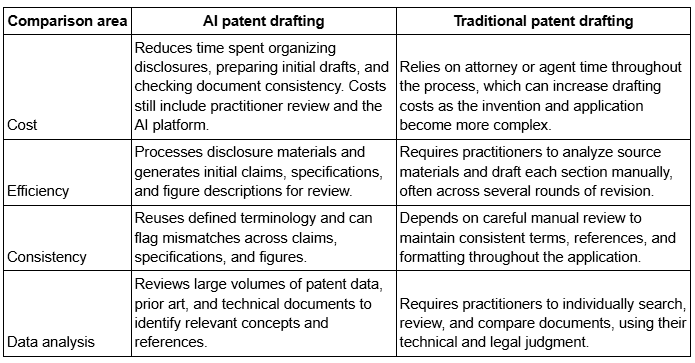
AI Patent Drafting vs. Traditional Patent Drafting

Understanding AI Tools: LLMs and Generative AI in IP

LLMs are AI systems trained on large text datasets to model language patterns and generate fluent, context-appropriate text. In AI-powered patent drafting tools, they can produce draft language for claims, specifications, and other patent content in response to practitioner inputs and supporting materials — but they don't draft independently or in a single pass. Fluency is not accuracy: an LLM can generate text that reads well while being technically incorrect or legally deficient. Usable output depends on practitioner direction, iteration, and review at every stage.

On their own, generic models also lack the patent-specific language, technical context, and drafting conventions this work requires. Patent-focused platforms treat the LLM as one component of a larger workflow, pairing it with patent data, legal terminology, technical documents, and Retrieval-Augmented Generation (RAG) so that generated language is grounded in the practitioner's source materials rather than the model's general training. Platforms such as Patlytics use this broader approach to generate substantive content, flag inconsistencies, and suggest alternative claim structures. The practitioner still directs the drafting, evaluates the output, and remains responsible for what gets filed.

Here’s how AI is transforming patent drafting:

  • Prior Art and Patent Searching: AI can analyze invention disclosures, generate search terms, suggest classifications, and rank potentially relevant patents for practitioner review. It can also summarize references and highlight possible points of distinction.
  • Drafting Assistance: AI can generate initial claims, specification sections, summaries, and figure descriptions from invention materials. It can also check terminology, antecedent basis, and alignment across the application.
  • Portfolio Management: AI can organize patent data, classify assets, identify overlapping technologies, and support portfolio reviews. This helps teams assess coverage, spot gaps, and decide which patents may require further investment or action.

Drafting Patents with AI: A Step-by-Step Workflow

AI doesn't replace the patent drafting process; rather, it integrates strategically at key stages to enhance efficiency and quality. The following workflow represents a collaborative approach between the human practitioner and AI tools. Here's a step-by-step look at how to draft patents with AI in a practical manner:

Step 1: Invention Disclosure Intake & Analysis

AI can analyze disclosure materials, including documents, emails, drawings, and forms, to create a structured foundation for patent drafting. Advanced AI tools identify key concepts, potential novel features, technical components, and relationships.

The AI assistant can extract critical information, including the technical field, potential inventive concepts, suggested embodiments, and preliminary classifications. This analysis gives patent practitioners a head start by organizing inventors' unstructured information into a patent-friendly format. For example, AI may identify three distinct inventive concepts within lengthy technical documentation that could be protected separately or together, significantly reducing analysis time.

Step 2: AI-Assisted Prior Art Searching

AI tools enhance patentability searches by analyzing the invention disclosure, generating relevant search queries, suggesting CPC classifications, and identifying potentially relevant technical fields.

AI-powered prior art analysis rapidly processes thousands of patents and non-patent literature to identify the most relevant documents. The technology can also:

  • Generate concise summaries of key findings from prior art.
  • Highlight problematic references needing closer examination.
  • Suggest potential differentiation points between the invention and prior art.
  • Create visualizations of the technical landscape to identify white space.

AI-assisted searching typically serves as an initial assessment tool or as a supplement to comprehensive patentability searches.

Step 3: Generating Initial Claim Drafts

AI patent drafting tools can propose draft independent and dependent claims as starting points, based on the analyzed disclosure and prior art context. They can help by:

  • Generating multiple claim sets that focus on different aspects of the invention.
  • Suggesting variations in claim scope (broader vs. narrower protection).
  • Ensuring proper antecedent basis and claim dependency structures.
  • Identifying potential areas for additional dependent claims to provide fallback positions.
  • Flagging potential clarity or definiteness issues.

These AI-generated claims provide an initial draft based on the invention disclosure, prior art context, and selected claim scope.

Step 4: Drafting the Patent Specification

Once the claims are preliminarily settled, AI can use them and the invention disclosure to generate initial drafts of various specification sections. Patent specification writing AI is valuable for accelerating this time-consuming aspect of patent drafting.

Background

AI tools can generate summaries that align with the drafted claims, ensuring consistency between the claims and the specification. This creates a cohesive narrative that connects the background problem to the claimed solution.

Invention

AI tools can generate summaries that align with the drafted claims, ensuring consistency between the claims and the specification. This creates a cohesive narrative that connects the background problem to the claimed solution.

Detailed Description

For technical inventions, AI can expand sparse inventor notes into comprehensive descriptions, ensuring sufficient detail for enablement while maintaining consistency.

The practitioner should ensure that the final description supports the full claim scope, satisfies enablement requirements, and explains critical elements in sufficient detail.

Step 5: Generating Figure Descriptions

AI helps generate consistent descriptions for patent drawings by leveraging figure labels and content from the detailed description. This helps maintain consistent terminology throughout the application and proper referencing of all numbered elements in the drawings.

The AI can systematically work through each figure, creating descriptions that connect the visuals to the concepts in the claims and detailed description. This routine task often consumes substantial time in traditional drafting but can be handled efficiently with AI assistance.

Step 6: Critical Review, Refinement, and Human Oversight

This is the most critical step. AI-generated drafts are a starting point and should never be submitted without thorough human review and refinement. Human expertise is non-negotiable to ensure the accuracy, clarity, and legal quality of patent applications. The patent practitioner must:

  • Verify legal accuracy of claims (scope, eligibility, clarity, definiteness).
  • Ensure the technical correctness and completeness of all descriptions.
  • Check for adequate enablement and written description support across the full claim scope.
  • Refine language for strategic advantage in prosecution and litigation scenarios.
  • Confirm consistency across claims, specifications, and figures.
  • Apply professional judgment regarding the strategic inclusion or exclusion of information.
  • Identify and address issues related to Sections 101, 102, 103, and 112.

This human oversight transforms the AI-generated draft into a strategically crafted legal document ready for filing.

See Patlytics’ patent drafting workflow in action.

Best Practices and Key Considerations for Using AI in Patent Drafting

AI can speed up patent drafting, but it also introduces risks around accuracy, confidentiality, and overreliance. These best practices can help you use AI without losing the legal judgment and technical control that the process requires.

Data Security and Confidentiality

Invention disclosures contain sensitive intellectual property that must be protected throughout the drafting process. When selecting AI patent drafting tools, prioritize platforms with robust security measures, including encryption, secure cloud infrastructure, and clear data handling policies. Ensure vendors provide binding confidentiality agreements and understand their data retention practices. Client confidentiality and invention secrecy must never be compromised in pursuit of efficiency.

Understand Tool Limitations and Biases

Patent practitioners must recognize the limitations of even sophisticated AI systems. AI models can occasionally "hallucinate" (generate plausible but incorrect information), misunderstand technical nuances, or reflect biases from their training data. One of the primary risks of AI patent drafting is overreliance on generated content without sufficient verification. AI lacks the contextual understanding of industry-specific implications and competitive landscapes that experienced practitioners possess. Approach AI-generated content with skepticism and verify technical details against the original invention disclosure.

Choosing the Right AI Patent Drafting Tools

When comparing tools, prioritize solutions that understand patent-specific terminology, claim structures, and drafting requirements, integrate with existing workflows, and provide strong security controls. Also look for transparency, customization, and features that let practitioners maintain control over how AI-generated content is developed and used.

Platforms like Patlytics are purpose-built for the patent lifecycle rather than general document generation. Its patent-native approach supports workflows across drafting, prosecution, portfolio analysis, and litigation, with structured workflows, claim-level reasoning, and source-backed outputs designed for IP professionals. Practitioner oversight remains central, allowing users to review, refine, and validate AI-generated work rather than relying on opaque outputs.

Ethical Considerations

Patent attorneys and agents remain responsible for work produced with AI tools. The USPTO’s guidance on AI-assisted practice emphasizes that practitioners must review and verify AI-generated material before submitting it, comply with existing duties governing representations to the Office, and protect confidential information. 

For attorneys, the ABA’s Formal Opinion 512 says lawyers must understand generative AI’s capabilities and limitations and protect client information. They must also supervise its use and remain responsible for the work product. Because requirements vary by jurisdiction, practitioners should review applicable state bar and USPTO guidance before using AI in patent workflows.

The Future of AI in Patent Drafting

AI-related patent activity is increasing. Published generative AI patent families rose from about 14,000 in 2023 to more than 37,800 in 2025. As filings grow, patent teams may need to search more prior art, compare related inventions, and manage more complex applications.

The following trends could shape how they handle that work:

  • AI will become part of routine legal workflows: More than half (52%) of in-house counsel now actively use generative AI in their practice, more than double the 23% reported in 2024. Patent teams may increasingly connect drafting tools with research, document review, and prosecution workflows.
  • AI-assisted patent searching will continue to expand: The USPTO planned to include at least 3,200 patent applications in its Artificial Intelligence Search Automated Pilot. The program tests AI-generated prior art searches before substantive examination.
  • AI tools will support a growing volume of complex patent data: Generative AI accounted for 8.7% of all AI-related patent family publications in 2025, up from 6.1% in 2023. Patent platforms may need stronger classification, comparison, and portfolio analysis capabilities as this volume grows.
  • Patent offices will use AI across more parts of examination: USPTO examiners have used the agency’s AI-assisted Similarity Search tool since September 2022. Wider adoption could create closer links between prior art searching, application drafting, and examination strategy.

Final Thoughts: Making AI Patent Drafting Work for You

AI tools significantly improve efficiency in the patent drafting process, from initial disclosure analysis and prior art searching to generating preliminary claims and specifications. These tools require thoughtful integration into existing workflows and expert human oversight at every stage to ensure legal accuracy, technical correctness, and strategic advantage.

Patent professionals can modernize their practice, reduce time on repetitive tasks, and focus on higher-value strategic work by leveraging AI tools like Patlytics. By responsibly embracing these technologies, practitioners can deliver higher-quality patent applications more efficiently, providing better service to inventors and organizations seeking to protect their innovations.

Explore AI patent drafting with Patlytics.

Disclaimer: This article provides general information only and does not constitute legal advice. Consult a qualified patent attorney or agent for specific advice.

How to Draft Patents with AI FAQs

Which AI is best for patent drafting?

The best AI for patent drafting is a patent-specific platform that can process invention disclosures, search prior art, draft claims and specifications, and maintain consistent terminology. It should also protect confidential data and allow practitioners to control the final application. Platforms such as Patlytics support these workflows within a single system.

Can ChatGPT write a patent?

ChatGPT can help organize invention details and generate preliminary patent language. However, it is a general-purpose writing tool rather than a patent drafting platform. A patent attorney or agent should verify the claims, technical details, legal support, and confidentiality requirements before filing.

How do law firms use AI for patent drafting?

Law firms use AI to organize invention disclosures, support prior art searches, prepare initial claims and specification sections, and check consistency across an application. Attorneys then apply legal judgment to claim scope, patentability, and filing strategy. They must also protect client information and understand the limits of the tools they use.

넬슨 탕

제품

넬슨은 SAP, PwC, Affirm과 같은 기업에서 엔터프라이즈 소프트웨어, 컨설팅, 금융 기술 분야를 두루 거친 제품 전문가입니다. 그는 기업이 기술을 평가하고 전략적 의사결정을 내리며 새로운 도구를 도입하는 과정에 대한 깊은 이해를 갖추고 있습니다. Patlytics에서 넬슨은 제품 담당자로서 고객의 요구사항과 시장 인사이트를 파악하여 지식재산권(IP) 전문가를 위한 실질적인 개선안을 도출하는 역할을 합니다.

LinkedIn
Thank you! Your submission has been received!
Oops! Something went wrong while submitting the form.
July 16, 2025

How to Draft Patents with AI: A Step-by-Step Guide

How to Draft Patents with AI: A Step-by-Step Guide

Traditionally, patent drafting has been a time-consuming and complex part of intellectual property (IP) management. The process demands meticulous attention to detail, deep technical understanding, and legal expertise, from analyzing invention disclosures to crafting precise claims and detailed specifications. 

According to Bloomberg Law’s 2025 State of Practice Survey, more than half of respondents use AI in legal processes. Among legal practitioners who have incorporated AI into their workflows, 37% reported improved workflow automation, while 33% gained more time for higher-level tasks. Patent teams achieve similar efficiencies by using AI to structure claims, draft background sections, and maintain consistent reference numerals throughout an application.

This article offers a step-by-step guide to drafting patents with AI, covering process integration, benefits, best practices, and critical considerations. Whether you're a patent attorney modernizing your practice or in-house IP counsel seeking efficiency, this guide will help you understand how AI fits into the patent drafting process.

Key Takeaways 

  • AI can organize invention disclosures, identify technical concepts, and create a structured foundation for drafting.
  • Patent-specific AI tools can support prior art searches, initial claim drafting, specifications, and figure descriptions.
  • AI-generated patent content requires careful review for technical accuracy, claim support, enablement, and compliance with patent law.
  • Secure platforms are essential because invention disclosures contain confidential technical and business information.
  • Patent practitioners remain responsible for every filing and should treat AI output as a starting point rather than a final application.

The AI Advantage: Why Use AI in Patent Drafting?

Integrating AI into patent drafting workflows offers significant advantages for patent practitioners and innovators:

  • Enhanced Efficiency & Speed: AI accelerates drafting tasks from research through preliminary draft generation. Platforms like Patlytics, using specialized AI, report potential efficiency gains of up to 80% in certain patent tasks. This allows practitioners to automate components of patent drafting that require hours of manual work.
  • Improved Consistency: AI tools maintain terminological and formatting consistency in complex patent documents, reducing the risk of inconsistencies that create vulnerabilities during prosecution or litigation.
  • Cost Reduction Potential: Increased efficiency translates to cost savings, as attorneys and agents can spend less time on repetitive tasks and more on high-value strategic work. 
  • Idea Generation & Exploration: Beyond drafting assistance, advanced AI can suggest alternative claim language or additional embodiments based on the initial disclosure. This expands the patent protection scope.
  • Data Analysis Capabilities: AI excels at processing and synthesizing large volumes of information from invention disclosures and prior art faster than humans. This enables thorough analysis in less time.

Exploring and implementing AI tools in patent law is a strategic imperative for forward-thinking IP practices seeking competitive advantage while maintaining quality, given AI's benefits in this field.

AI Patent Drafting vs. Traditional Patent Drafting

Understanding AI Tools: LLMs and Generative AI in IP

LLMs are AI systems trained on large text datasets to model language patterns and generate fluent, context-appropriate text. In AI-powered patent drafting tools, they can produce draft language for claims, specifications, and other patent content in response to practitioner inputs and supporting materials — but they don't draft independently or in a single pass. Fluency is not accuracy: an LLM can generate text that reads well while being technically incorrect or legally deficient. Usable output depends on practitioner direction, iteration, and review at every stage.

On their own, generic models also lack the patent-specific language, technical context, and drafting conventions this work requires. Patent-focused platforms treat the LLM as one component of a larger workflow, pairing it with patent data, legal terminology, technical documents, and Retrieval-Augmented Generation (RAG) so that generated language is grounded in the practitioner's source materials rather than the model's general training. Platforms such as Patlytics use this broader approach to generate substantive content, flag inconsistencies, and suggest alternative claim structures. The practitioner still directs the drafting, evaluates the output, and remains responsible for what gets filed.

Here’s how AI is transforming patent drafting:

  • Prior Art and Patent Searching: AI can analyze invention disclosures, generate search terms, suggest classifications, and rank potentially relevant patents for practitioner review. It can also summarize references and highlight possible points of distinction.
  • Drafting Assistance: AI can generate initial claims, specification sections, summaries, and figure descriptions from invention materials. It can also check terminology, antecedent basis, and alignment across the application.
  • Portfolio Management: AI can organize patent data, classify assets, identify overlapping technologies, and support portfolio reviews. This helps teams assess coverage, spot gaps, and decide which patents may require further investment or action.

Drafting Patents with AI: A Step-by-Step Workflow

AI doesn't replace the patent drafting process; rather, it integrates strategically at key stages to enhance efficiency and quality. The following workflow represents a collaborative approach between the human practitioner and AI tools. Here's a step-by-step look at how to draft patents with AI in a practical manner:

Step 1: Invention Disclosure Intake & Analysis

AI can analyze disclosure materials, including documents, emails, drawings, and forms, to create a structured foundation for patent drafting. Advanced AI tools identify key concepts, potential novel features, technical components, and relationships.

The AI assistant can extract critical information, including the technical field, potential inventive concepts, suggested embodiments, and preliminary classifications. This analysis gives patent practitioners a head start by organizing inventors' unstructured information into a patent-friendly format. For example, AI may identify three distinct inventive concepts within lengthy technical documentation that could be protected separately or together, significantly reducing analysis time.

Step 2: AI-Assisted Prior Art Searching

AI tools enhance patentability searches by analyzing the invention disclosure, generating relevant search queries, suggesting CPC classifications, and identifying potentially relevant technical fields.

AI-powered prior art analysis rapidly processes thousands of patents and non-patent literature to identify the most relevant documents. The technology can also:

  • Generate concise summaries of key findings from prior art.
  • Highlight problematic references needing closer examination.
  • Suggest potential differentiation points between the invention and prior art.
  • Create visualizations of the technical landscape to identify white space.

AI-assisted searching typically serves as an initial assessment tool or as a supplement to comprehensive patentability searches.

Step 3: Generating Initial Claim Drafts

AI patent drafting tools can propose draft independent and dependent claims as starting points, based on the analyzed disclosure and prior art context. They can help by:

  • Generating multiple claim sets that focus on different aspects of the invention.
  • Suggesting variations in claim scope (broader vs. narrower protection).
  • Ensuring proper antecedent basis and claim dependency structures.
  • Identifying potential areas for additional dependent claims to provide fallback positions.
  • Flagging potential clarity or definiteness issues.

These AI-generated claims provide an initial draft based on the invention disclosure, prior art context, and selected claim scope.

Step 4: Drafting the Patent Specification

Once the claims are preliminarily settled, AI can use them and the invention disclosure to generate initial drafts of various specification sections. Patent specification writing AI is valuable for accelerating this time-consuming aspect of patent drafting.

Background

AI tools can generate summaries that align with the drafted claims, ensuring consistency between the claims and the specification. This creates a cohesive narrative that connects the background problem to the claimed solution.

Invention

AI tools can generate summaries that align with the drafted claims, ensuring consistency between the claims and the specification. This creates a cohesive narrative that connects the background problem to the claimed solution.

Detailed Description

For technical inventions, AI can expand sparse inventor notes into comprehensive descriptions, ensuring sufficient detail for enablement while maintaining consistency.

The practitioner should ensure that the final description supports the full claim scope, satisfies enablement requirements, and explains critical elements in sufficient detail.

Step 5: Generating Figure Descriptions

AI helps generate consistent descriptions for patent drawings by leveraging figure labels and content from the detailed description. This helps maintain consistent terminology throughout the application and proper referencing of all numbered elements in the drawings.

The AI can systematically work through each figure, creating descriptions that connect the visuals to the concepts in the claims and detailed description. This routine task often consumes substantial time in traditional drafting but can be handled efficiently with AI assistance.

Step 6: Critical Review, Refinement, and Human Oversight

This is the most critical step. AI-generated drafts are a starting point and should never be submitted without thorough human review and refinement. Human expertise is non-negotiable to ensure the accuracy, clarity, and legal quality of patent applications. The patent practitioner must:

  • Verify legal accuracy of claims (scope, eligibility, clarity, definiteness).
  • Ensure the technical correctness and completeness of all descriptions.
  • Check for adequate enablement and written description support across the full claim scope.
  • Refine language for strategic advantage in prosecution and litigation scenarios.
  • Confirm consistency across claims, specifications, and figures.
  • Apply professional judgment regarding the strategic inclusion or exclusion of information.
  • Identify and address issues related to Sections 101, 102, 103, and 112.

This human oversight transforms the AI-generated draft into a strategically crafted legal document ready for filing.

See Patlytics’ patent drafting workflow in action.

Best Practices and Key Considerations for Using AI in Patent Drafting

AI can speed up patent drafting, but it also introduces risks around accuracy, confidentiality, and overreliance. These best practices can help you use AI without losing the legal judgment and technical control that the process requires.

Data Security and Confidentiality

Invention disclosures contain sensitive intellectual property that must be protected throughout the drafting process. When selecting AI patent drafting tools, prioritize platforms with robust security measures, including encryption, secure cloud infrastructure, and clear data handling policies. Ensure vendors provide binding confidentiality agreements and understand their data retention practices. Client confidentiality and invention secrecy must never be compromised in pursuit of efficiency.

Understand Tool Limitations and Biases

Patent practitioners must recognize the limitations of even sophisticated AI systems. AI models can occasionally "hallucinate" (generate plausible but incorrect information), misunderstand technical nuances, or reflect biases from their training data. One of the primary risks of AI patent drafting is overreliance on generated content without sufficient verification. AI lacks the contextual understanding of industry-specific implications and competitive landscapes that experienced practitioners possess. Approach AI-generated content with skepticism and verify technical details against the original invention disclosure.

Choosing the Right AI Patent Drafting Tools

When comparing tools, prioritize solutions that understand patent-specific terminology, claim structures, and drafting requirements, integrate with existing workflows, and provide strong security controls. Also look for transparency, customization, and features that let practitioners maintain control over how AI-generated content is developed and used.

Platforms like Patlytics are purpose-built for the patent lifecycle rather than general document generation. Its patent-native approach supports workflows across drafting, prosecution, portfolio analysis, and litigation, with structured workflows, claim-level reasoning, and source-backed outputs designed for IP professionals. Practitioner oversight remains central, allowing users to review, refine, and validate AI-generated work rather than relying on opaque outputs.

Ethical Considerations

Patent attorneys and agents remain responsible for work produced with AI tools. The USPTO’s guidance on AI-assisted practice emphasizes that practitioners must review and verify AI-generated material before submitting it, comply with existing duties governing representations to the Office, and protect confidential information. 

For attorneys, the ABA’s Formal Opinion 512 says lawyers must understand generative AI’s capabilities and limitations and protect client information. They must also supervise its use and remain responsible for the work product. Because requirements vary by jurisdiction, practitioners should review applicable state bar and USPTO guidance before using AI in patent workflows.

The Future of AI in Patent Drafting

AI-related patent activity is increasing. Published generative AI patent families rose from about 14,000 in 2023 to more than 37,800 in 2025. As filings grow, patent teams may need to search more prior art, compare related inventions, and manage more complex applications.

The following trends could shape how they handle that work:

  • AI will become part of routine legal workflows: More than half (52%) of in-house counsel now actively use generative AI in their practice, more than double the 23% reported in 2024. Patent teams may increasingly connect drafting tools with research, document review, and prosecution workflows.
  • AI-assisted patent searching will continue to expand: The USPTO planned to include at least 3,200 patent applications in its Artificial Intelligence Search Automated Pilot. The program tests AI-generated prior art searches before substantive examination.
  • AI tools will support a growing volume of complex patent data: Generative AI accounted for 8.7% of all AI-related patent family publications in 2025, up from 6.1% in 2023. Patent platforms may need stronger classification, comparison, and portfolio analysis capabilities as this volume grows.
  • Patent offices will use AI across more parts of examination: USPTO examiners have used the agency’s AI-assisted Similarity Search tool since September 2022. Wider adoption could create closer links between prior art searching, application drafting, and examination strategy.

Final Thoughts: Making AI Patent Drafting Work for You

AI tools significantly improve efficiency in the patent drafting process, from initial disclosure analysis and prior art searching to generating preliminary claims and specifications. These tools require thoughtful integration into existing workflows and expert human oversight at every stage to ensure legal accuracy, technical correctness, and strategic advantage.

Patent professionals can modernize their practice, reduce time on repetitive tasks, and focus on higher-value strategic work by leveraging AI tools like Patlytics. By responsibly embracing these technologies, practitioners can deliver higher-quality patent applications more efficiently, providing better service to inventors and organizations seeking to protect their innovations.

Explore AI patent drafting with Patlytics.

Disclaimer: This article provides general information only and does not constitute legal advice. Consult a qualified patent attorney or agent for specific advice.

How to Draft Patents with AI FAQs

Which AI is best for patent drafting?

The best AI for patent drafting is a patent-specific platform that can process invention disclosures, search prior art, draft claims and specifications, and maintain consistent terminology. It should also protect confidential data and allow practitioners to control the final application. Platforms such as Patlytics support these workflows within a single system.

Can ChatGPT write a patent?

ChatGPT can help organize invention details and generate preliminary patent language. However, it is a general-purpose writing tool rather than a patent drafting platform. A patent attorney or agent should verify the claims, technical details, legal support, and confidentiality requirements before filing.

How do law firms use AI for patent drafting?

Law firms use AI to organize invention disclosures, support prior art searches, prepare initial claims and specification sections, and check consistency across an application. Attorneys then apply legal judgment to claim scope, patentability, and filing strategy. They must also protect client information and understand the limits of the tools they use.

The Premier AI-Powered Patent Platform

Reduce cycle times. Increase margins. Deliver winning IP outcomes.

Book a Demo
넬슨 탕
제품

넬슨은 SAP, PwC, Affirm과 같은 기업에서 엔터프라이즈 소프트웨어, 컨설팅, 금융 기술 분야를 두루 거친 제품 전문가입니다. 그는 기업이 기술을 평가하고 전략적 의사결정을 내리며 새로운 도구를 도입하는 과정에 대한 깊은 이해를 갖추고 있습니다. Patlytics에서 넬슨은 제품 담당자로서 고객의 요구사항과 시장 인사이트를 파악하여 지식재산권(IP) 전문가를 위한 실질적인 개선안을 도출하는 역할을 합니다.

LinkedIn
Thank you! Your submission has been received!
Oops! Something went wrong while submitting the form.

The Premier AI-Powered
Patent Platform

처리 시간은 단축하고, 수익성은 높이고, 성공적인 IP 성과를 달성하세요.

신뢰하는 기업
Asahi Kasei
Taylor Made Golf Company, Inc.
AUO Corporation
Stradling Yocca Carlson & Rauth LLP
Aspen Aerogels, Inc.
Panasonic Intellectual Property Corporation of America
Jasco Products Company LLC
Ahmad, Zavitsanos & Mensing PLLC
Becker Transactions LLC
Foresight Valuation Group
Grail, Inc.
Nissan Motor, Co. Ltd.
Supertab, Inc.
Brown Rudnick LLP
Cahill Gordon & Reindel LLP
Holland & Knight LLP
Nixon Peabody LLP
Sanofi
Canon
Quinn Emanuel Urquhart & Sullivan
McDermott Will & Emery LLP
Foley & Lardner LLP
Richardson Oliver Law Group LLP
Reichman Jorgensen Lehman & Feldberg LLP
Caldwell Cassady & Curry
Maschoff Brennan Gilmore Israelsen & Mauriel LLP
Rivian Automotive, Inc.
Rheem Manufacturing Company, Inc.
Abnormal Security
Asahi Kasei
Taylor Made Golf Company, Inc.
AUO Corporation
Stradling Yocca Carlson & Rauth LLP
Aspen Aerogels, Inc.
Panasonic Intellectual Property Corporation of America
Jasco Products Company LLC
Ahmad, Zavitsanos & Mensing PLLC
Becker Transactions LLC
Foresight Valuation Group
Grail, Inc.
Nissan Motor, Co. Ltd.
Supertab, Inc.
Brown Rudnick LLP
Cahill Gordon & Reindel LLP
Holland & Knight LLP
Nixon Peabody LLP
Sanofi
Canon
Quinn Emanuel Urquhart & Sullivan
McDermott Will & Emery LLP
Foley & Lardner LLP
Richardson Oliver Law Group LLP
Reichman Jorgensen Lehman & Feldberg LLP
Caldwell Cassady & Curry
Maschoff Brennan Gilmore Israelsen & Mauriel LLP
Rivian Automotive, Inc.
Rheem Manufacturing Company, Inc.
Abnormal Security