Patlytics Announces Next-Generation SEP Analysis Workflow
























Standard Essential Patents (SEP) contain intellectual property at the crux of the world’s most valuable technology ecosystems, with standards that include everything from WiFi-6 and 5G to video compression and audio coding.
However, identifying whether a patent is essential or even relevant to a standard has been an arduous, painstaking manual process. Expert analysts have typically needed to conduct detailed review across highly technical documents, cross-reference them with patent claims, and then determine whether specific limitations map to a required standard behavior.
Now, Patlytics is proud to unveil its Next-Generation SEP Analysis Workflow, a groundbreaking product feature that can reliably turn massive technical standards (hundreds of PDFs, ranging from 30-2000+ pages each) into structured, queryable, and citable evidence for claim charting on a claim-by-claim, limitation-by-limitation basis in view of claim construction.
This represents a significant evolution in AI-assisted support for SEP analysis. General LLMs and other AI products have been limited in their ability to upload and understand these standards, documents which often include technical equations, tables, and illustrations that aren’t easily interpretable by AI.
This Patlytics tool enables access to accurate and speedy claim charting of more than 4 million pages of standards documents and more than 1 million images, tables, and formulas. It empowers SEP experts to reduce their manual research load so they can hone in on what’s truly important, rather than trying to decipher not just the patent but also the standard it should be associated with. Critically, it also opens up the ability for initial SEP analysis to be conducted by IP professionals who have less expertise in the field.
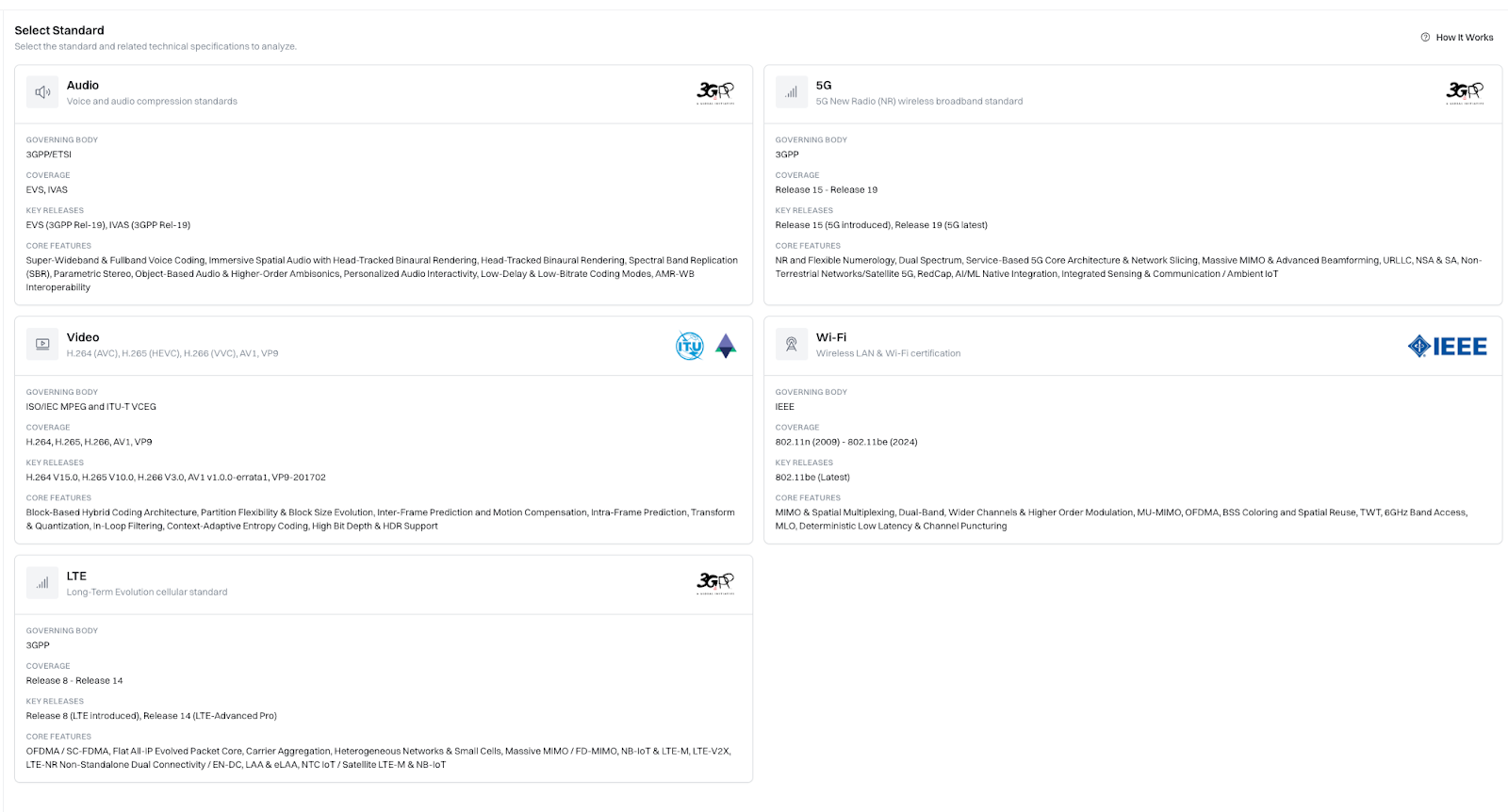
Patlytics is continuously updating its standard coverage, and includes multiple versions of each, so analysts can compare past and present standards.
The workflow currently includes standard coverage for:
5G/LTE (3GPP)
- 5G: Release 15 - Release 19
- LTE: Release 8 - Release 14
WiFi (IEEE)
- 802.11n (2009) - 802.11be (2024)
Video (ITU-T, AOMedia)
- H.266 (VVC), H.265 (HEVC), H.264 (AVC)
- AV1 v1.0.0-errata1
- VP9-201702
Audio (3GPP)
- IVAS and EVS - Release 19
And we’re adding to this standard library every week, with our SEP Workflow in constant iteration to keep up with shifting industry trends.
To learn more about its technical architecture, read on for a more in-depth breakdown.
The Technical Innovation Driving The SEP Analysis Workflow
The core technical advantage behind Patlytics’ approach is that it doesn’t treat standards as flat text to be chunked. Instead, the platform performs section-aware extraction, preserves the document hierarchy, and builds explicit links between sections, figures/tables/equations, and cross-references.
That structure becomes the backbone of a deeper knowledge graph, letting the system traverse and reassemble the exact context a lawyer/analyst needs - definitions, prerequisites, referenced tables, parent sections, and cited sections - while still enabling high-recall retrieval via section-level vector indexing.
The result is higher-fidelity evidence mapping, more defensible citations, and better scaling to long, interdependent standards where meaning lives in the structure.
Features include:
1. Section-structure-first parsing (not semantic chunking)
Extracts each standard into a hierarchical section graph (parent/child + previous/next ordering) so retrieval and reasoning preserve normative scope and dependencies instead of losing context in arbitrary chunks.
2. Knowledge graph linking across the entire corpus
Creates explicit edges such as section→section references, section→image/table/equation, and potentially cross-document references—so the system can follow “see §X” / “as defined in…” chains and assemble complete evidence packages.
3. Multi-modal, citation-ready extraction pipeline
Aims for the cleanest text while also extracting tables/equations/diagrams (with LaTeX for formulas) and attaching them to the correct section nodes, supporting precise pin-citations (section + page range + excerpt).
4. Dual-index architecture: structured DB as source of truth + vector RAG for scale
Stores canonical structure/metadata/relationships in a database, while embedding exactly one vector per section (1–3 pages) in Pinecone for retrieval, enabling fast search without sacrificing document integrity.
5. Evidence-first SEP analysis flow with controllable synthesis
Retrieval expands context via graph traversal (hierarchy + cross-references), then LLM prompts operate over grouped “section bundles” to produce ratings (Normative/Contextual/etc.), explanations, and a curated set of excerpts optimized for claim chart display and auditability.
Core Standards Coverage
Mobile Network Standards
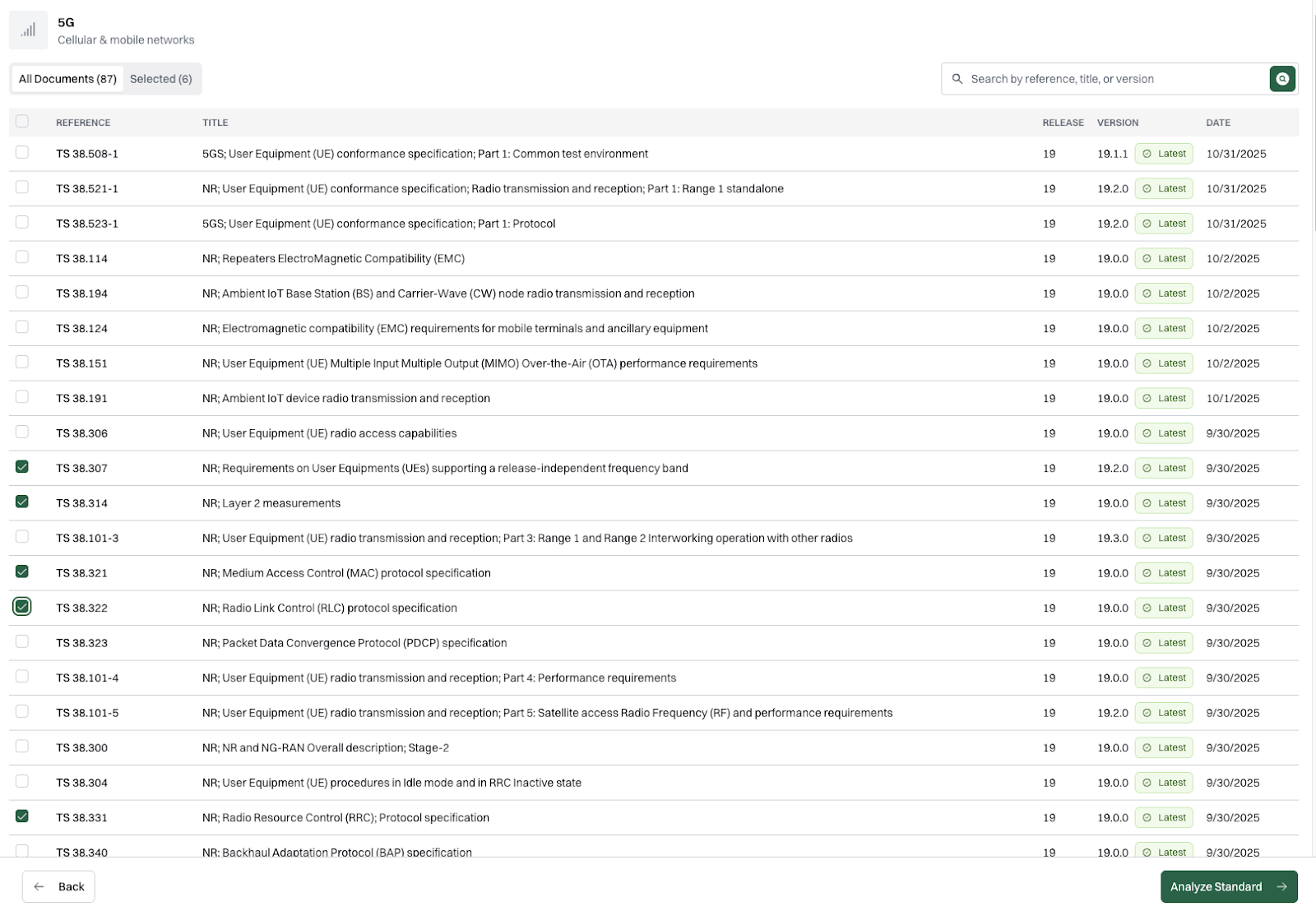
One of the most significant advancements in Patlytics’ SEP capabilities is the completion of 3GPP automation for Releases v15, v16, and v17. These releases form the technical foundation for modern 5G and advanced mobile network technologies.
With this expansion, Patlytics has increased its coverage of 3GPP technical specification (TS) documents from 89 documents to 419 documents, dramatically improving the depth and breadth of standard analysis.
This expanded dataset allows practitioners to:
- Identify relevant sections of cellular standards more quickly
- Map patent claims against a broader set of technical specifications
- Analyze standard evolution across multiple 3GPP releases
For companies operating in telecommunications, semiconductors, and wireless infrastructure, this deeper coverage provides a much clearer picture of how patent assets relate to evolving standards.
Wi-Fi Standards
The platform now supports analysis against Wi-Fi 4 and Wi-Fi 7, enabling teams to evaluate patent relevance across both established and emerging wireless protocols.
Wi-Fi 7, in particular, represents a major step forward in wireless performance and capacity, making it a critical standard for next-generation devices and infrastructure.
Video Standards
Patlytics also supports analysis for the VP9 video codec, expanding its coverage of media compression technologies.
This complements existing support for major video standards including:
- H.264 (AVC)
- H.265 (HEVC)
- H.266 (VVC)
- AV1
For companies operating in streaming platforms, consumer electronics, and semiconductor design, these standards play a key role in licensing and litigation strategy.
Audio Standards
Patlytics covers audio compression standards governed by 3GPP/ETSI, with support for both EVS (Enhanced Voice Services) and IVAS (Immersive Voice and Audio Services).
- Audio (3GPP)
- IVAS (Release 19)
- EVS (Release 19)
For teams working on patents in mobile audio, XR hardware, consumer electronics, or teleconferencing, this coverage makes it easier to map claims against the specific specs that govern how audio works in modern devices.
Enhanced Product Tools
Patlytics has been intentional in not just building a workflow that supports deep SEP analysis through its knowledge graph, but also creating tools to help assist analysts in getting better results out of their research.
Key tools:
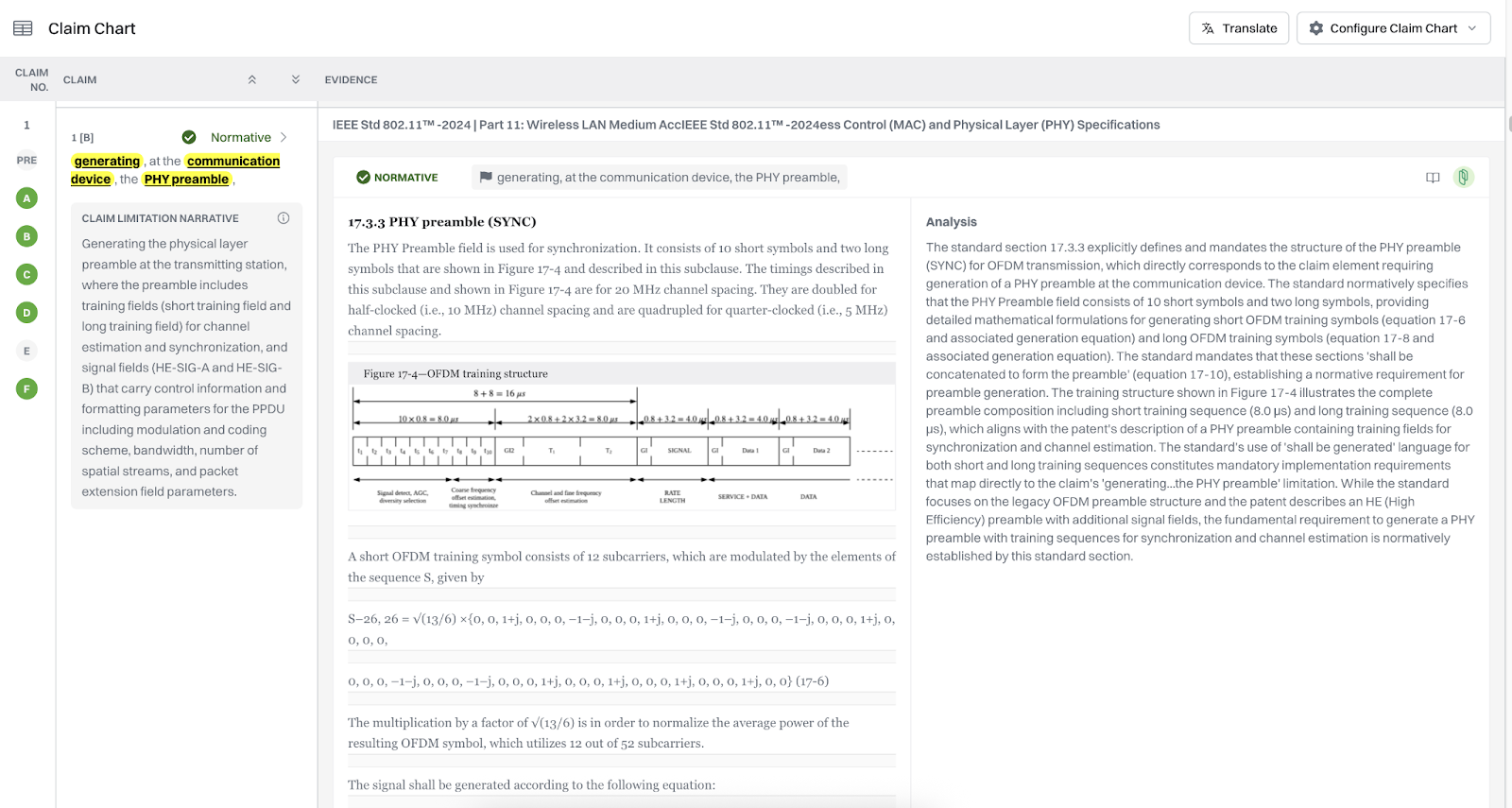
1. Granular Essentiality Ratings. Whether a patent, pending application, or yet to be filed application is essential to a standard, or not, is rarely a simple “yes” or “no” determination. Patlytics provides four ratings that classify claim limitations on a spectrum, each supported by citation-backed claim charts in view of claim construction, including exact sections of the technical specification used in the analysis (which can be pulled up directly from within the platform without having to open another browser tab or window).
- Normative – explicitly required by the standard
- Implied – a natural way to satisfy the standard requirements
- Informative – described but not mandatory
- Contextual – relevant but indirectly related
2. Interactive Agentic Analysis. Analysts can directly interact with their SEP claim charts, with the help of interactive agents. They can ask direct, natural language questions about essentiality determination, request deeper reasoning behind specific mappings and explore additional context within relevant standard sections.
3. Strategic Insights Aided By Full Platform Context. SEP analysis can touch on everything from licensing negotiations and portfolio valuation to litigation strategy and standards participation. By bringing standards documentation into an AI-native workflow that is already aware of the rest of your organization’s patent work, analysts are now able to more seamlessly apply SEP analysis to their organization’s full IP context … making for faster strategic insights to better your patent actions.
The Only Truly Comprehensive AI-Assisted SEP Workflow
IP teams can finally evaluate patents against major connectivity and media standards with far greater speed and accuracy, thanks to this next-generation workflow.
- Map multiple versions of standards, including cellular (e.g., 5G), wireless (e.g., Wi-Fi 7), video (e.g., H.266, AV1, VP9), and audio (e.g., EVS) from directly within the platform.
- Generate citation-backed claim charts in view of claim construction to assess essentiality on a claim-by-claim and limitation-by-limitation basis, including analysis based on normative, implied, informative, and contextual ratings.
- Interact with SEP claim charts with agentic assistance, asking the questions you need, before applying them to your overall patent strategy with full platform context at your side.
The SEP space is only expanding: as global technology innovations grow, so too do the standards and technical specifications supporting them. Patlytics’ unique product and technical approach provides a scalable environment for managing SEP analysis across the next generation of connectivity technologies.
Request a demo to see how Patlytics can help you produce actionable patent intelligence and strategy.
The Premier AI-Powered
Patent Platform
Reduce cycle times. Increase margins. Deliver winning IP outcomes.