EPO and UK IPO: AI assistance within two modernization programs
Where can artificial intelligence (AI) assistance fit into your office’s search and examination work without weakening the evidence behind the next action? For examination, search-quality, AI program, and procurement leads, the answer starts with the office’s existing process. The European Patent Office (EPO) and the UK Intellectual Property Office (UK IPO) have different modernization programs, working environments, and search records. A useful proposal names the specific task, its source material, and the work product that colleagues will receive.
Scope: AI supports office search and examination; examiners and responsible staff retain substantive decisions.
EPO: place assistance within the patent grant process
The EPO’s AI account describes established assistance in pre-search, classification, and file allocation, plus an in-house optical character recognition (OCR) pipeline for patent text. Examination assistance is being developed; the 2026 work plan provides for progressive AI embedding and AI-assisted communication drafting (printed page 14).
These tasks have different evidence needs. Keep a classification suggestion, a retrieved document, and a proposed passage for a communication distinguishable.
For an EPO buyer, begin with the point in the patent grant process where assistance would be used. A proposal for pre-search evidence preparation needs a different handoff from a proposal for communication drafting.
Name the working systems precisely
Printed page 14 of the work plan identifies the functions of these working systems:
- ANSERA: the prior-art search system used by patent examiners.
- Patent Workbench (PWB): the hub for managing patent-grant workflows.
- Digital File Repository (DFR): the platform for accessing legal documents relating to patent applications.
Working tip: Describe the intended handoff before discussing a connection to an office system. For search assistance, specify the reviewed evidence package. For workflow assistance, identify the case action and responsible role. For document assistance, identify the authoritative document and the proposed text.
Preserve the search basis and the route to each passage
Under the EPO’s basis for the search, claims provide the starting point, with the description and drawings informing their reading. For a bounded assignment, retain the exact application-document set and claim text supplied to the assistance process. A later claim amendment should be visible as a changed input, rather than silently replacing the basis of an earlier result.
The search-strategy guidance calls for a precise approach using concepts, classes, and keywords. Claims may need generalisation to cover the invention’s aspects and embodiments. Restrictions also have procedural consequences and must be reflected in the appropriate search record.
An office-specific working brief can make this concrete:
- State the search question. Identify the claimed combination and the technical concepts that need coverage. Keep any proposed generalisation visible beside the original wording.
- Separate routes to evidence. Preserve the concepts, classification areas, and search terms used, together with the databases or collections involved. Record the retrieval date and any known coverage boundary.
- Keep documents inspectable. Retain publication identifiers, relevant dates, and precise passage or figure locations. Distinguish source text from generated explanation, including where OCR or translation affects the reading.
- Carry unresolved scope forward. Describe an unsearched aspect or uncertain passage explicitly so the next colleague can understand what remains open.
Keep the reasoning behind a candidate reference available when the file moves beyond pre-search.
Connect evidence to the written opinion
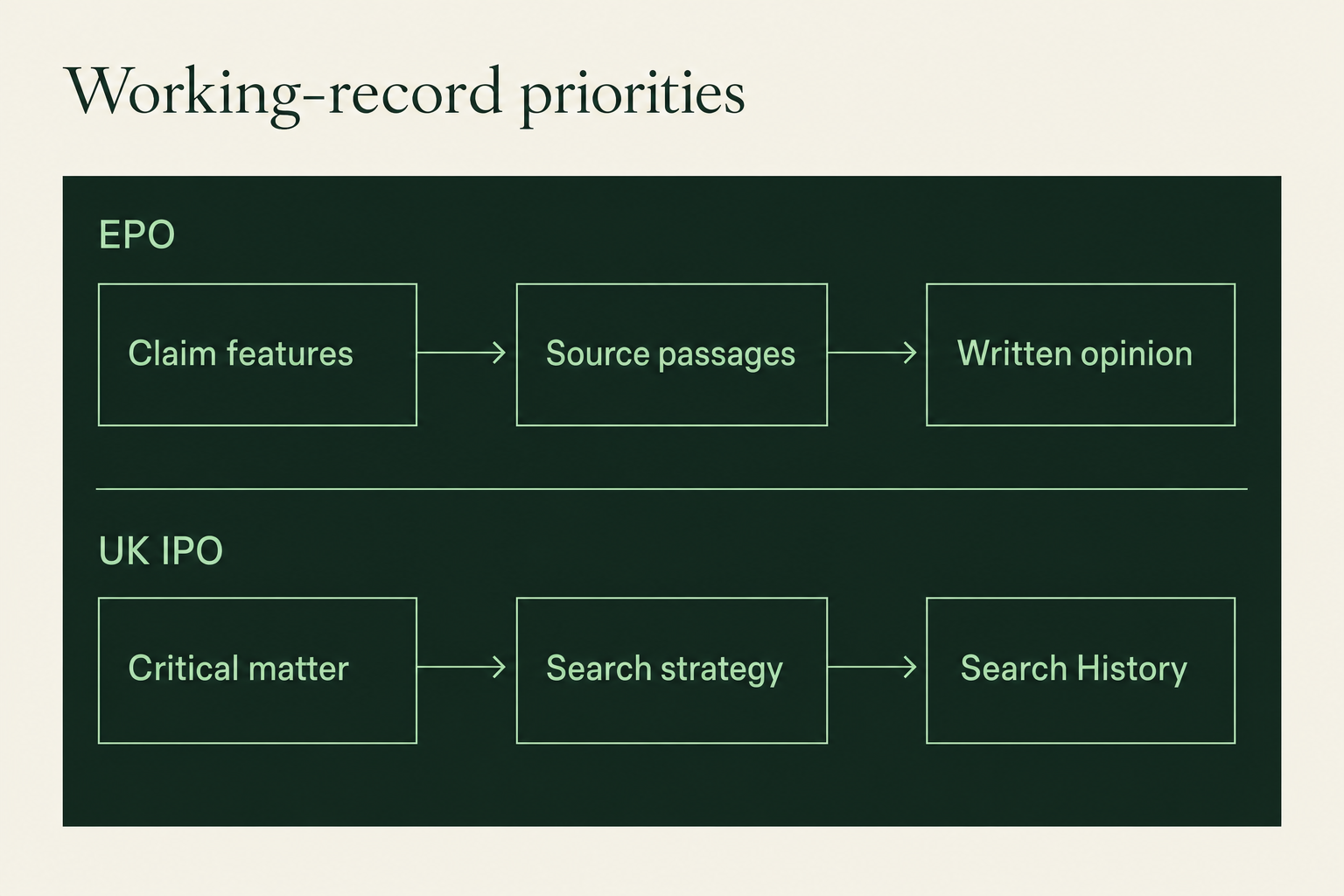
The work plan’s search priorities, on printed pages 20–21, include complete and accurate searches, clearer references in written opinions to prior-art passages relevant to dependent-claim features, and documented added-subject-matter assessments during examination. The EPO’s Quality Action Plan also calls for broader non-patent literature (NPL) coverage and builds on the 3-examiner Active Search Division.
For search-quality discussions, organise candidate passages around the claim features they address. A passage supporting an independent claim’s general concept may leave a dependent claim’s added feature unresolved. Preserve that distinction in the handoff instead of allowing a convincing summary to stand in for feature-level evidence.
Working tip: Include the reason a passage matters and the question it leaves open. That gives division colleagues something specific to discuss, such as whether the cited embodiment contains the full claimed combination or only a related technical idea. Keep proposals about drafted communications separate from the underlying evidence assessment.
UK IPO: build around the search statement and Search History
For the UK IPO, distinguish the One IPO Transformation Programme from the search examiner’s substantive work. 3 published developments have different scopes:
- Application allocation: a July 2024 announcement described AI routing applications to the right examiner team during the One IPO pilot period.
- Customer services: the One IPO patents service launched to all customers on 1 April 2026. Customer-facing One IPO Search launched publicly in January 2025 for exploring intellectual property data.
- Future search enhancements: the 2025–2026 annual report describes groundwork for future AI-assisted One IPO Search functionality. The annual report’s service account covers the separate service launches and search development.
The 2026–2027 corporate plan also sets out organization-wide AI planning aligned with the UK Government’s AI Playbook. A patents-service lead and an AI program lead therefore need a shared task description, even when their responsibilities differ.
Keep the critical matter visible
The Manual of Patent Practice (MoPP), sections 17.50–17.53, addresses the search statement’s critical matter, source and term choices, and revision of the provisional statement and strategy as prior art emerges. MoPP search practice supplies the foundation.
Working tip: Keep the search statement beside suggested reformulations. Label proposed synonyms, broader concepts, and classifications until incorporated into the strategy. Preserve the reason for each revision.
Hypothetical scope handoff: Claim 1 concerns a porous filter cartridge; dependent claim 4 adds a membrane pore-size range of 0.2–0.4 micrometres. An initial search statement, S1, covers cartridge construction. Prior art found during that search leads to a revised statement, S2, focused on the dependent claim’s fallback position.
Retain S1 and the documents it produced alongside S2, its additional terms and classifications, and its results. Record the claim 4 passages examined or the reason that work was deferred. A later amendment incorporating claim 4 can then be traced to the scope of the earlier search. For an EPO handoff, identify the passages relevant to the dependent-claim features. For a UK IPO handoff, connect each reference to the search statement and strategy that produced it. The lesson is to preserve the scope of each search as the critical matter changes.
Make the internal search report useful to the substantive examiner
MoPP section 17.86 addresses internal-report reasoning and Search History records, including classifications, words, combined markers and filters, sources, and viewed documents. The internal-report guidance also covers deferred work and document relevance.
Working tip: Separate candidates from documents viewed and selected. Place generated explanations beside cited passages. Preserve selection reasons and unresolved points for the colleague receiving the report.
Protect prepublication material at the input boundary
MoPP sections 118.16–118.16.1 address the confidentiality and protection of unpublished application material, subject to the statutory exceptions. Those unpublished-application safeguards belong at the start of any external-assistance discussion.
Begin exploratory conversations with published documents or clearly fictional material. Before any non-public input is supplied, establish the authorized data route, permitted recipients, retention arrangements, model-training terms, and deletion process through the office’s information-security and procurement procedures. Include prompts and generated outputs in that data description, alongside source files.
Give each buying conversation a defined handoff
A useful working brief ends with an identifiable work product. For an EPO search discussion, that might be candidate references mapped to claim features and precise source locations. For a UK IPO search discussion, it might be evidence organized around the search statement and a record suitable for the internal search-report workflow.
Keep 3 responsibilities explicit:
- Examination and search-quality leads: define the substantive task and the information colleagues need at the handoff.
- AI program and technical leads: describe the operating boundary, access route, and handling of generated material.
- Procurement and information-security leads: establish the authorized commercial and data-handling arrangements before operational use.
Where Patlytics fits
Patlytics prepares source-linked evidence packages around the claim scope supplied for review. Classification applies your team’s own taxonomy to patent material, producing technical-subject labels for the working collection.
Patent & NPL Search supports prior-art discovery across patents and non-patent literature, including publications from PubMed. Claim Charting maps underlying disclosures to individual claim limitations. Exhaustive mode searches for additional charting evidence tied to the invention’s broader technical context. The examiner receives ranked references with passage-level citations and claim charts against the limitations under review.
For an EPO handoff, organize this evidence around claim features, including dependent-claim fallback positions. For a UK IPO handoff, use the reviewed references and charts alongside the critical-matter statement, document-selection reasons, and Search History.
Patlytics holds a System and Organization Controls (SOC) 2 Type II attestation, plus International Organization for Standardization (ISO) 27001 information-security and ISO 42001 AI-management certifications. Patlytics does not use customer data to tune or train its models without explicit consent or necessity.
Examiners and responsible staff retain substantive decisions.
Prepare a claim-scope evidence package for an EPO division or UK IPO search-report handoff. Book a demo to see Patlytics organize ranked references, cited passages, and claim charts for review.

EPO and UK IPO: AI assistance within two modernization programs
Where can artificial intelligence (AI) assistance fit into your office’s search and examination work without weakening the evidence behind the next action? For examination, search-quality, AI program, and procurement leads, the answer starts with the office’s existing process. The European Patent Office (EPO) and the UK Intellectual Property Office (UK IPO) have different modernization programs, working environments, and search records. A useful proposal names the specific task, its source material, and the work product that colleagues will receive.
Scope: AI supports office search and examination; examiners and responsible staff retain substantive decisions.
EPO: place assistance within the patent grant process
The EPO’s AI account describes established assistance in pre-search, classification, and file allocation, plus an in-house optical character recognition (OCR) pipeline for patent text. Examination assistance is being developed; the 2026 work plan provides for progressive AI embedding and AI-assisted communication drafting (printed page 14).
These tasks have different evidence needs. Keep a classification suggestion, a retrieved document, and a proposed passage for a communication distinguishable.
For an EPO buyer, begin with the point in the patent grant process where assistance would be used. A proposal for pre-search evidence preparation needs a different handoff from a proposal for communication drafting.
Name the working systems precisely
Printed page 14 of the work plan identifies the functions of these working systems:
- ANSERA: the prior-art search system used by patent examiners.
- Patent Workbench (PWB): the hub for managing patent-grant workflows.
- Digital File Repository (DFR): the platform for accessing legal documents relating to patent applications.
Working tip: Describe the intended handoff before discussing a connection to an office system. For search assistance, specify the reviewed evidence package. For workflow assistance, identify the case action and responsible role. For document assistance, identify the authoritative document and the proposed text.
Preserve the search basis and the route to each passage
Under the EPO’s basis for the search, claims provide the starting point, with the description and drawings informing their reading. For a bounded assignment, retain the exact application-document set and claim text supplied to the assistance process. A later claim amendment should be visible as a changed input, rather than silently replacing the basis of an earlier result.
The search-strategy guidance calls for a precise approach using concepts, classes, and keywords. Claims may need generalisation to cover the invention’s aspects and embodiments. Restrictions also have procedural consequences and must be reflected in the appropriate search record.
An office-specific working brief can make this concrete:
- State the search question. Identify the claimed combination and the technical concepts that need coverage. Keep any proposed generalisation visible beside the original wording.
- Separate routes to evidence. Preserve the concepts, classification areas, and search terms used, together with the databases or collections involved. Record the retrieval date and any known coverage boundary.
- Keep documents inspectable. Retain publication identifiers, relevant dates, and precise passage or figure locations. Distinguish source text from generated explanation, including where OCR or translation affects the reading.
- Carry unresolved scope forward. Describe an unsearched aspect or uncertain passage explicitly so the next colleague can understand what remains open.
Keep the reasoning behind a candidate reference available when the file moves beyond pre-search.
Connect evidence to the written opinion
The work plan’s search priorities, on printed pages 20–21, include complete and accurate searches, clearer references in written opinions to prior-art passages relevant to dependent-claim features, and documented added-subject-matter assessments during examination. The EPO’s Quality Action Plan also calls for broader non-patent literature (NPL) coverage and builds on the 3-examiner Active Search Division.
For search-quality discussions, organise candidate passages around the claim features they address. A passage supporting an independent claim’s general concept may leave a dependent claim’s added feature unresolved. Preserve that distinction in the handoff instead of allowing a convincing summary to stand in for feature-level evidence.
Working tip: Include the reason a passage matters and the question it leaves open. That gives division colleagues something specific to discuss, such as whether the cited embodiment contains the full claimed combination or only a related technical idea. Keep proposals about drafted communications separate from the underlying evidence assessment.
UK IPO: build around the search statement and Search History
For the UK IPO, distinguish the One IPO Transformation Programme from the search examiner’s substantive work. 3 published developments have different scopes:
- Application allocation: a July 2024 announcement described AI routing applications to the right examiner team during the One IPO pilot period.
- Customer services: the One IPO patents service launched to all customers on 1 April 2026. Customer-facing One IPO Search launched publicly in January 2025 for exploring intellectual property data.
- Future search enhancements: the 2025–2026 annual report describes groundwork for future AI-assisted One IPO Search functionality. The annual report’s service account covers the separate service launches and search development.
The 2026–2027 corporate plan also sets out organization-wide AI planning aligned with the UK Government’s AI Playbook. A patents-service lead and an AI program lead therefore need a shared task description, even when their responsibilities differ.
Keep the critical matter visible
The Manual of Patent Practice (MoPP), sections 17.50–17.53, addresses the search statement’s critical matter, source and term choices, and revision of the provisional statement and strategy as prior art emerges. MoPP search practice supplies the foundation.
Working tip: Keep the search statement beside suggested reformulations. Label proposed synonyms, broader concepts, and classifications until incorporated into the strategy. Preserve the reason for each revision.
Hypothetical scope handoff: Claim 1 concerns a porous filter cartridge; dependent claim 4 adds a membrane pore-size range of 0.2–0.4 micrometres. An initial search statement, S1, covers cartridge construction. Prior art found during that search leads to a revised statement, S2, focused on the dependent claim’s fallback position.
Retain S1 and the documents it produced alongside S2, its additional terms and classifications, and its results. Record the claim 4 passages examined or the reason that work was deferred. A later amendment incorporating claim 4 can then be traced to the scope of the earlier search. For an EPO handoff, identify the passages relevant to the dependent-claim features. For a UK IPO handoff, connect each reference to the search statement and strategy that produced it. The lesson is to preserve the scope of each search as the critical matter changes.
Make the internal search report useful to the substantive examiner
MoPP section 17.86 addresses internal-report reasoning and Search History records, including classifications, words, combined markers and filters, sources, and viewed documents. The internal-report guidance also covers deferred work and document relevance.
Working tip: Separate candidates from documents viewed and selected. Place generated explanations beside cited passages. Preserve selection reasons and unresolved points for the colleague receiving the report.
Protect prepublication material at the input boundary
MoPP sections 118.16–118.16.1 address the confidentiality and protection of unpublished application material, subject to the statutory exceptions. Those unpublished-application safeguards belong at the start of any external-assistance discussion.
Begin exploratory conversations with published documents or clearly fictional material. Before any non-public input is supplied, establish the authorized data route, permitted recipients, retention arrangements, model-training terms, and deletion process through the office’s information-security and procurement procedures. Include prompts and generated outputs in that data description, alongside source files.
Give each buying conversation a defined handoff
A useful working brief ends with an identifiable work product. For an EPO search discussion, that might be candidate references mapped to claim features and precise source locations. For a UK IPO search discussion, it might be evidence organized around the search statement and a record suitable for the internal search-report workflow.
Keep 3 responsibilities explicit:
- Examination and search-quality leads: define the substantive task and the information colleagues need at the handoff.
- AI program and technical leads: describe the operating boundary, access route, and handling of generated material.
- Procurement and information-security leads: establish the authorized commercial and data-handling arrangements before operational use.
Where Patlytics fits
Patlytics prepares source-linked evidence packages around the claim scope supplied for review. Classification applies your team’s own taxonomy to patent material, producing technical-subject labels for the working collection.
Patent & NPL Search supports prior-art discovery across patents and non-patent literature, including publications from PubMed. Claim Charting maps underlying disclosures to individual claim limitations. Exhaustive mode searches for additional charting evidence tied to the invention’s broader technical context. The examiner receives ranked references with passage-level citations and claim charts against the limitations under review.
For an EPO handoff, organize this evidence around claim features, including dependent-claim fallback positions. For a UK IPO handoff, use the reviewed references and charts alongside the critical-matter statement, document-selection reasons, and Search History.
Patlytics holds a System and Organization Controls (SOC) 2 Type II attestation, plus International Organization for Standardization (ISO) 27001 information-security and ISO 42001 AI-management certifications. Patlytics does not use customer data to tune or train its models without explicit consent or necessity.
Examiners and responsible staff retain substantive decisions.
Prepare a claim-scope evidence package for an EPO division or UK IPO search-report handoff. Book a demo to see Patlytics organize ranked references, cited passages, and claim charts for review.
The Premier AI-Powered Patent Platform
Reduce cycle times. Increase margins. Deliver winning IP outcomes.
Book a DemoThe Premier AI-Powered
Patent Platform
Reduce cycle times. Increase margins. Deliver winning IP outcomes.