Examiner-controlled AI in patent examination: an office-side guide

How can your patent office add artificial intelligence (AI) search assistance while keeping the path from claim to evidence to examination record inspectable? Examination leaders need a clear division of work, search specialists need access to the underlying documents, and AI program and procurement leads need a defined operating boundary. A useful design connects those needs through the same evidence trail.
Scope: This guide addresses office-side search and examination assistance; examiners and responsible staff retain substantive decisions.
What examiner-controlled AI means in practice
Examiner-controlled AI in patent examination means that assistance operates within a defined search task, produces inspectable suggestions, and preserves the distinction between retrieved material, reviewed evidence, and the official examination record.
That distinction matters when a system ranks a document highly because it shares technical language with an application. The ranking helps direct attention. Establishing what the document discloses requires reading the relevant text and drawings, identifying the document and dates, and relating the disclosure to the subject matter under examination.
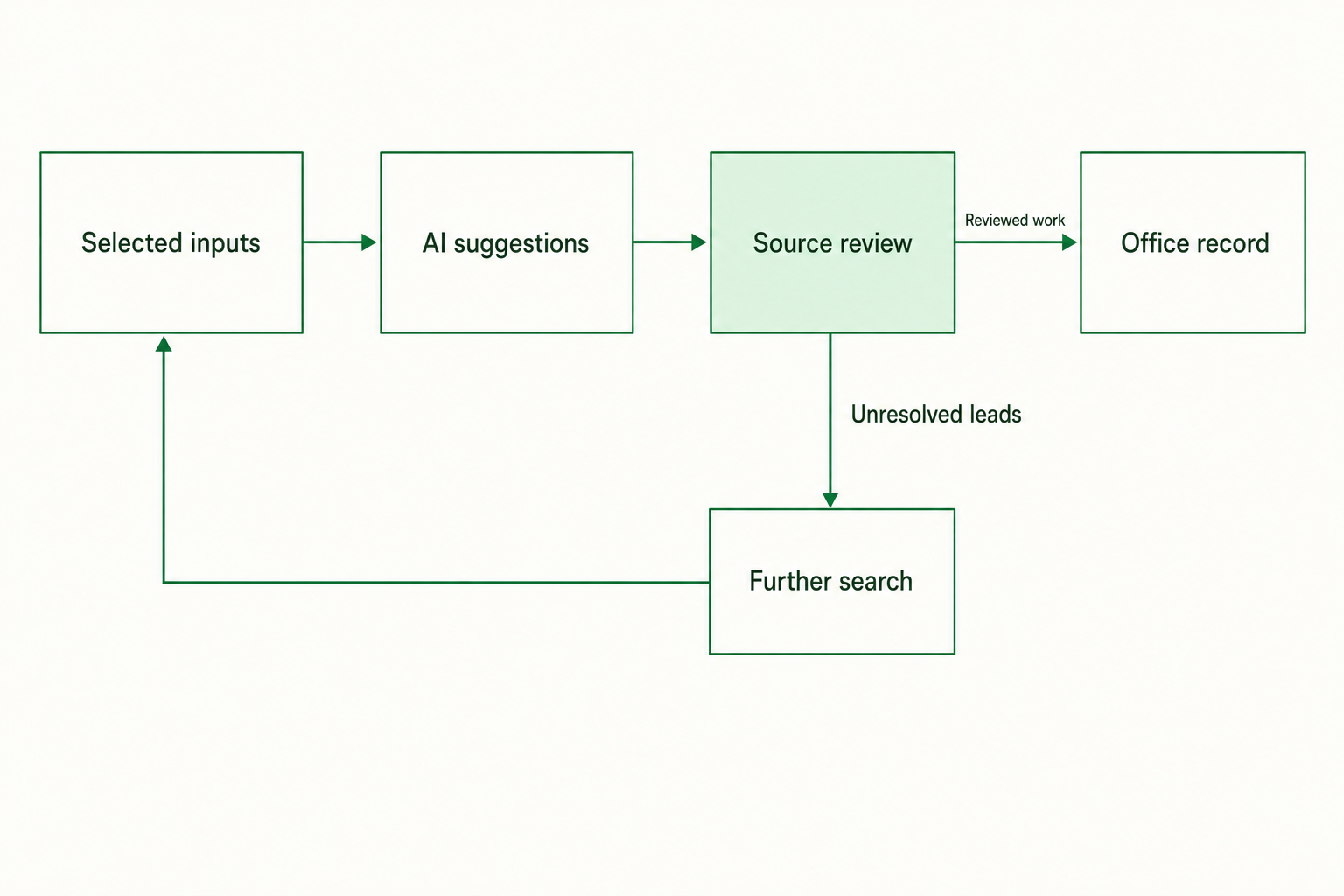
Design the workflow around 3 separate states:
- Suggested: A retrieved document, proposed classification, extracted passage, or draft explanation awaiting review.
- Reviewed: Material inspected against the underlying source, with its relevance, limitations, and follow-up actions recorded.
- Recorded: Search information and examination work entered into the office's required records through its established procedures.
An empty result list should lead to a documented next search action. An unavailable source should remain an unresolved lead. Neither should disappear inside a fluent generated summary.
Build the responsibility map before connecting systems
Use this proposed operating model to assign work. The office's own procedures supply the required records, access permissions, and approval routes.
| Responsibility | Assigned role | Inspectable work product |
|---|---|---|
| Define the search task | Examiner or search examiner | Application and claim version, technical concepts, relevant dates, languages, and sources to consider |
| Establish the information boundary | Information-security and data-governance leads | Permitted input categories, approved environment, access rules, retention terms, and incident route |
| Refine the search | Examiner, supported by search specialists where appropriate | Query history, classifications, filters, selected text, and reasons for changes |
| Review suggested evidence | Examiner or designated search specialist | Source locators, relevant disclosures, missing features, date questions, and further-search actions |
| Prepare required records and communications | Staff assigned under local procedures | Search record and reviewed examination work, with required checks and approvals |
| Maintain the AI service | AI program owner and technical team | Identified service configuration, change history, and a route to investigate faulty outputs |
Keep the search record and the technical service log connected by a stable reference where office policy permits. They serve different purposes. The search record explains the work on an application. The service log supports investigation of a changed configuration, missing source, or processing failure.
Apply each office's published practice
Shared design principles can support a discussion across offices. Local terminology and procedural requirements still shape the implementation.
USPTO: selected inputs, refinements, and search recordation
The United States Patent and Trademark Office (USPTO), in its 2022 Similarity Search notice, describes optional assistance within Patents End-to-End (PE2E) Search alongside traditional retrieval approaches. It uses examiner-selected application information and permits refinements through Cooperative Patent Classification (CPC) symbols and selected text. The notice explains how queries and results appear in search history, including protections for confidential application information.
For an office-side discussion, demonstrate the selected input, the refinement, and the resulting search record as separate steps.
EPO: search and examination assistance
The European Patent Office (EPO) identifies pre-search, classification, and file allocation as established uses of AI. Its human-centric AI approach describes examination-phase assistance for analysing information and drafting communications as work being developed. It also addresses data protection, information security, and governance.
Keep those stages separate in a proposed design: finding prior art, organising a file, analysing evidence, and preparing a communication each need a defined input and reviewable output. Use European patent grant terminology, including novelty and inventive step, when describing the substantive examination context.
UK IPO: the search statement and Search History
The UK Intellectual Property Office (UK IPO), in its Manual of Patent Practice, requires the search examiner to formulate a search statement and strategy, then revise them as the search develops. Its Section 17 guidance also addresses the internal search report and Search History, including classifications, words, sources, and how searches were combined or limited. Pre-publication application information receives specific protection.
An AI-assisted workflow should preserve that reasoning. Keep the critical matter being searched visible, identify which strategy produced a document, and explain deferred work.
JPO: consultations, checks, and audits
The Rev.2025 AI action plan from the Japan Patent Office (JPO) moves Prior Art Search (2) into agile development and sets out proof-of-concept work, including generative AI for patent examination.
The JPO's examination quality framework separately describes examiner consultations, director checks of drafted notices, and audits of search validity and reasoning before dispatch. Fit proposed AI evidence packets into the relevant existing review route. Keep the underlying document and the reasoning available together so that a consultation or check can address the actual search work.
Carry one search task through to the record
1. Establish the task and permitted inputs
Identify the application and claim version, the technical subject matter, the relevant date questions, and the purpose of the search. Record the sources, jurisdictions, languages, and retrieval date that define the work. A description such as “global patent search” leaves too much unresolved for an examination file.
Classify the proposed inputs before they enter the AI environment. Public patent text, unpublished application content, internal annotations, and draft communications may have different handling rules. Use public or fictional material for an initial workflow demonstration unless the office has authorised the environment for the actual information involved.
2. Preserve the search choices
Retain the exact selected text, query, classifications, filters, and refinements. When a suggestion changes the direction of the search, record the technical reason for the change. For example, a document may reveal a different name for the same mechanism or point to a neighbouring technical field.
Keep a broader search plan visible alongside AI retrieval. Domestic patent documents, foreign patent documents, and non-patent literature (NPL), such as technical papers and manuals, can contribute different evidence. Any claim of complete coverage needs a defined task and documented consideration of the relevant sources.
3. Review the document behind the suggestion
For each material lead, open the underlying document and capture the exact passage, figure, or other locator supporting its proposed relevance. Review the surrounding disclosure. Record whether an extracted passage omits a condition, reverses a relationship, or describes a different embodiment.
Keep technical relevance separate from date and legal-use questions. A closely related disclosure may need further work on publication, priority, or the applicable prior-art rules. A machine translation can assist reading, while a disputed technical term needs a recorded source-language resolution.
If a source cannot be retrieved, preserve that problem as an open action. If a suggested explanation overstates the disclosure, replace it with the supported explanation and retain the reason for correction in the working record.
4. Prepare the office-required record
Bring the reviewed search work into the required local record. Preserve the difference between documents retrieved and documents actually viewed or considered. Include outstanding search actions and the reasons for them where the office's procedures call for that information.
For proposed AI services, specify how a reviewed evidence packet will reach that record: an authorised export, a staff entry, or an approved connection. Identify the responsible role and the information being transferred.
Practical tips for USPTO working discussions
Anchor a technical presentation in the USPTO's search procedures rather than applicant drafting or response preparation.
- Start with the field of search. The Manual of Patent Examining Procedure (MPEP) §904.02 calls for identifying the field, selecting appropriate search resources, and defining a strategy. Explain which part of that work the proposed assistance supports.
- Keep source categories visible. The same general search guidelines address domestic patents, foreign patent documents, and NPL. Show how the proposed workflow records source selection and further-search needs.
- Use an information-safe demonstration. For an unpublished application outside a reissue or reexamination proceeding, §904.02(c) restricts internet searches to the general state of the art unless the Office has established a secure vendor link protecting confidentiality. Use an authorised environment for application-specific unpublished information.
- Show the record, including limits. MPEP §719.05 addresses Search Notes, dates, initials, and documentation of limited electronic searches. A classification symbol should not make a limited search appear unrestricted. Include the relevant search history and explain any limit that the history does not make apparent.
A useful meeting packet contains a public or fictional search task, a proposed input boundary, the resulting evidence packet, and a sample record handoff. Label proposed behaviour as proposed and keep official terminology attached to the office process it actually describes.
A fictional semiconductor-packaging review record
On September 18, 2026, a search examiner reviews a semiconductor-packaging claim that requires forming a redistribution layer, the wiring that connects dies to external contacts, while the molded assembly remains on a temporary carrier, followed by laser debonding. An AI suggestion combines steps from 2 alternative process routes in Reference A.
| Record field | Example entry |
|---|---|
| Search task | Find the claimed sequence of redistribution-layer formation followed by laser release from the temporary carrier |
| Input and refinement | Claim 1 as reviewed on September 18, 2026; selected process steps refined with “carrier release” and “laser lift-off” terminology |
| AI suggestion | Reference A is proposed as disclosing laser debonding after redistribution-layer formation |
| Source review | Paragraphs 24–28 describe laser release before the redistribution layer is formed. Paragraphs 41–44 describe a separate route with mechanical release after layer formation |
| Supported relevance | Record each route separately: the laser-release route supplies a lead on release technique; the mechanical-release route supplies a lead on process order |
| Further-search action | Search for laser release after redistribution-layer formation, keeping the release method and step order together in the query |
| Unresolved lead | Reference B's abstract mentions late-stage laser debonding; the full process description remains an open document request |
| Record handoff | Carry the route-specific passages and outstanding document request into the local search record, preserving which material was inspected |
The correction changes the search direction: a chart entry must preserve which steps belong to the same disclosed process route. A merged summary would obscure the distinction.
Define the service boundary in the procurement scope
Give examination, information-security, and procurement leads the same concrete description of the proposed service:
- Permitted information: Which input categories may enter the environment, who may access them, and where processing and storage occur.
- Data handling: Retention, deletion, subprocessors, model-training use, and the handling of logs, support access, and incidents.
- Evidence access: How staff obtain underlying documents, inspect passages, distinguish translations, and retain source locators.
- Change handling: How service or model changes are identified, investigated, and controlled within the authorised operating scope.
- Record handoff: Which outputs stay in a working area, which enter the application record, and what required review precedes that handoff.
Put office-specific authorisation and contractual requirements against that scope. A general security credential and an office's approval to process its application information answer different questions.
Where Patlytics fits
Patlytics supports the classification, prior-art search, and limitation-level evidence work behind an examination search record. For a USPTO-led workflow, the relevant outputs are:
- Classification module: Labels patent review sets using the office's own controlled taxonomy, organising the technical concepts identified in the field of search.
- Patent & NPL Search: Returns ranked references across patent documents and non-patent literature, including PubMed, with passage-level citations.
- Claim Charting: Produces limitation-by-limitation charts that map cited disclosures against the claims under review, with passage-level citations.
- Exhaustive mode: Broadens claim-chart evidence discovery to the invention's wider technical context, surfacing support beyond strict limitation matching when potential misses call for deeper evidence coverage.
Patlytics' security credentials include a System and Organization Controls (SOC) 2 Type II attestation, ISO 27001 certification, and ISO 42001 certification. Patlytics does not use customer data to tune or train its models without explicit consent or necessity.
Define access to application information and the authorised record handoff in the office's technical and procurement scope. Examiners and responsible staff retain substantive decisions.
See ranked references, passage-level citations, and claim charts organised for a USPTO search-record handoff. Book a demo using a public or fictional search task.

Examiner-controlled AI in patent examination: an office-side guide
How can your patent office add artificial intelligence (AI) search assistance while keeping the path from claim to evidence to examination record inspectable? Examination leaders need a clear division of work, search specialists need access to the underlying documents, and AI program and procurement leads need a defined operating boundary. A useful design connects those needs through the same evidence trail.
Scope: This guide addresses office-side search and examination assistance; examiners and responsible staff retain substantive decisions.
What examiner-controlled AI means in practice
Examiner-controlled AI in patent examination means that assistance operates within a defined search task, produces inspectable suggestions, and preserves the distinction between retrieved material, reviewed evidence, and the official examination record.
That distinction matters when a system ranks a document highly because it shares technical language with an application. The ranking helps direct attention. Establishing what the document discloses requires reading the relevant text and drawings, identifying the document and dates, and relating the disclosure to the subject matter under examination.
Design the workflow around 3 separate states:
- Suggested: A retrieved document, proposed classification, extracted passage, or draft explanation awaiting review.
- Reviewed: Material inspected against the underlying source, with its relevance, limitations, and follow-up actions recorded.
- Recorded: Search information and examination work entered into the office's required records through its established procedures.
An empty result list should lead to a documented next search action. An unavailable source should remain an unresolved lead. Neither should disappear inside a fluent generated summary.
Build the responsibility map before connecting systems
Use this proposed operating model to assign work. The office's own procedures supply the required records, access permissions, and approval routes.
| Responsibility | Assigned role | Inspectable work product |
|---|---|---|
| Define the search task | Examiner or search examiner | Application and claim version, technical concepts, relevant dates, languages, and sources to consider |
| Establish the information boundary | Information-security and data-governance leads | Permitted input categories, approved environment, access rules, retention terms, and incident route |
| Refine the search | Examiner, supported by search specialists where appropriate | Query history, classifications, filters, selected text, and reasons for changes |
| Review suggested evidence | Examiner or designated search specialist | Source locators, relevant disclosures, missing features, date questions, and further-search actions |
| Prepare required records and communications | Staff assigned under local procedures | Search record and reviewed examination work, with required checks and approvals |
| Maintain the AI service | AI program owner and technical team | Identified service configuration, change history, and a route to investigate faulty outputs |
Keep the search record and the technical service log connected by a stable reference where office policy permits. They serve different purposes. The search record explains the work on an application. The service log supports investigation of a changed configuration, missing source, or processing failure.
Apply each office's published practice
Shared design principles can support a discussion across offices. Local terminology and procedural requirements still shape the implementation.
USPTO: selected inputs, refinements, and search recordation
The United States Patent and Trademark Office (USPTO), in its 2022 Similarity Search notice, describes optional assistance within Patents End-to-End (PE2E) Search alongside traditional retrieval approaches. It uses examiner-selected application information and permits refinements through Cooperative Patent Classification (CPC) symbols and selected text. The notice explains how queries and results appear in search history, including protections for confidential application information.
For an office-side discussion, demonstrate the selected input, the refinement, and the resulting search record as separate steps.
EPO: search and examination assistance
The European Patent Office (EPO) identifies pre-search, classification, and file allocation as established uses of AI. Its human-centric AI approach describes examination-phase assistance for analysing information and drafting communications as work being developed. It also addresses data protection, information security, and governance.
Keep those stages separate in a proposed design: finding prior art, organising a file, analysing evidence, and preparing a communication each need a defined input and reviewable output. Use European patent grant terminology, including novelty and inventive step, when describing the substantive examination context.
UK IPO: the search statement and Search History
The UK Intellectual Property Office (UK IPO), in its Manual of Patent Practice, requires the search examiner to formulate a search statement and strategy, then revise them as the search develops. Its Section 17 guidance also addresses the internal search report and Search History, including classifications, words, sources, and how searches were combined or limited. Pre-publication application information receives specific protection.
An AI-assisted workflow should preserve that reasoning. Keep the critical matter being searched visible, identify which strategy produced a document, and explain deferred work.
JPO: consultations, checks, and audits
The Rev.2025 AI action plan from the Japan Patent Office (JPO) moves Prior Art Search (2) into agile development and sets out proof-of-concept work, including generative AI for patent examination.
The JPO's examination quality framework separately describes examiner consultations, director checks of drafted notices, and audits of search validity and reasoning before dispatch. Fit proposed AI evidence packets into the relevant existing review route. Keep the underlying document and the reasoning available together so that a consultation or check can address the actual search work.
Carry one search task through to the record
1. Establish the task and permitted inputs
Identify the application and claim version, the technical subject matter, the relevant date questions, and the purpose of the search. Record the sources, jurisdictions, languages, and retrieval date that define the work. A description such as “global patent search” leaves too much unresolved for an examination file.
Classify the proposed inputs before they enter the AI environment. Public patent text, unpublished application content, internal annotations, and draft communications may have different handling rules. Use public or fictional material for an initial workflow demonstration unless the office has authorised the environment for the actual information involved.
2. Preserve the search choices
Retain the exact selected text, query, classifications, filters, and refinements. When a suggestion changes the direction of the search, record the technical reason for the change. For example, a document may reveal a different name for the same mechanism or point to a neighbouring technical field.
Keep a broader search plan visible alongside AI retrieval. Domestic patent documents, foreign patent documents, and non-patent literature (NPL), such as technical papers and manuals, can contribute different evidence. Any claim of complete coverage needs a defined task and documented consideration of the relevant sources.
3. Review the document behind the suggestion
For each material lead, open the underlying document and capture the exact passage, figure, or other locator supporting its proposed relevance. Review the surrounding disclosure. Record whether an extracted passage omits a condition, reverses a relationship, or describes a different embodiment.
Keep technical relevance separate from date and legal-use questions. A closely related disclosure may need further work on publication, priority, or the applicable prior-art rules. A machine translation can assist reading, while a disputed technical term needs a recorded source-language resolution.
If a source cannot be retrieved, preserve that problem as an open action. If a suggested explanation overstates the disclosure, replace it with the supported explanation and retain the reason for correction in the working record.
4. Prepare the office-required record
Bring the reviewed search work into the required local record. Preserve the difference between documents retrieved and documents actually viewed or considered. Include outstanding search actions and the reasons for them where the office's procedures call for that information.
For proposed AI services, specify how a reviewed evidence packet will reach that record: an authorised export, a staff entry, or an approved connection. Identify the responsible role and the information being transferred.
Practical tips for USPTO working discussions
Anchor a technical presentation in the USPTO's search procedures rather than applicant drafting or response preparation.
- Start with the field of search. The Manual of Patent Examining Procedure (MPEP) §904.02 calls for identifying the field, selecting appropriate search resources, and defining a strategy. Explain which part of that work the proposed assistance supports.
- Keep source categories visible. The same general search guidelines address domestic patents, foreign patent documents, and NPL. Show how the proposed workflow records source selection and further-search needs.
- Use an information-safe demonstration. For an unpublished application outside a reissue or reexamination proceeding, §904.02(c) restricts internet searches to the general state of the art unless the Office has established a secure vendor link protecting confidentiality. Use an authorised environment for application-specific unpublished information.
- Show the record, including limits. MPEP §719.05 addresses Search Notes, dates, initials, and documentation of limited electronic searches. A classification symbol should not make a limited search appear unrestricted. Include the relevant search history and explain any limit that the history does not make apparent.
A useful meeting packet contains a public or fictional search task, a proposed input boundary, the resulting evidence packet, and a sample record handoff. Label proposed behaviour as proposed and keep official terminology attached to the office process it actually describes.
A fictional semiconductor-packaging review record
On September 18, 2026, a search examiner reviews a semiconductor-packaging claim that requires forming a redistribution layer, the wiring that connects dies to external contacts, while the molded assembly remains on a temporary carrier, followed by laser debonding. An AI suggestion combines steps from 2 alternative process routes in Reference A.
| Record field | Example entry |
|---|---|
| Search task | Find the claimed sequence of redistribution-layer formation followed by laser release from the temporary carrier |
| Input and refinement | Claim 1 as reviewed on September 18, 2026; selected process steps refined with “carrier release” and “laser lift-off” terminology |
| AI suggestion | Reference A is proposed as disclosing laser debonding after redistribution-layer formation |
| Source review | Paragraphs 24–28 describe laser release before the redistribution layer is formed. Paragraphs 41–44 describe a separate route with mechanical release after layer formation |
| Supported relevance | Record each route separately: the laser-release route supplies a lead on release technique; the mechanical-release route supplies a lead on process order |
| Further-search action | Search for laser release after redistribution-layer formation, keeping the release method and step order together in the query |
| Unresolved lead | Reference B's abstract mentions late-stage laser debonding; the full process description remains an open document request |
| Record handoff | Carry the route-specific passages and outstanding document request into the local search record, preserving which material was inspected |
The correction changes the search direction: a chart entry must preserve which steps belong to the same disclosed process route. A merged summary would obscure the distinction.
Define the service boundary in the procurement scope
Give examination, information-security, and procurement leads the same concrete description of the proposed service:
- Permitted information: Which input categories may enter the environment, who may access them, and where processing and storage occur.
- Data handling: Retention, deletion, subprocessors, model-training use, and the handling of logs, support access, and incidents.
- Evidence access: How staff obtain underlying documents, inspect passages, distinguish translations, and retain source locators.
- Change handling: How service or model changes are identified, investigated, and controlled within the authorised operating scope.
- Record handoff: Which outputs stay in a working area, which enter the application record, and what required review precedes that handoff.
Put office-specific authorisation and contractual requirements against that scope. A general security credential and an office's approval to process its application information answer different questions.
Where Patlytics fits
Patlytics supports the classification, prior-art search, and limitation-level evidence work behind an examination search record. For a USPTO-led workflow, the relevant outputs are:
- Classification module: Labels patent review sets using the office's own controlled taxonomy, organising the technical concepts identified in the field of search.
- Patent & NPL Search: Returns ranked references across patent documents and non-patent literature, including PubMed, with passage-level citations.
- Claim Charting: Produces limitation-by-limitation charts that map cited disclosures against the claims under review, with passage-level citations.
- Exhaustive mode: Broadens claim-chart evidence discovery to the invention's wider technical context, surfacing support beyond strict limitation matching when potential misses call for deeper evidence coverage.
Patlytics' security credentials include a System and Organization Controls (SOC) 2 Type II attestation, ISO 27001 certification, and ISO 42001 certification. Patlytics does not use customer data to tune or train its models without explicit consent or necessity.
Define access to application information and the authorised record handoff in the office's technical and procurement scope. Examiners and responsible staff retain substantive decisions.
See ranked references, passage-level citations, and claim charts organised for a USPTO search-record handoff. Book a demo using a public or fictional search task.
The Premier AI-Powered Patent Platform
Reduce cycle times. Increase margins. Deliver winning IP outcomes.
Book a DemoThe Premier AI-Powered
Patent Platform
Reduce cycle times. Increase margins. Deliver winning IP outcomes.