Hatch-Waxman Act: a patent and exclusivity guide
November 6, 2026
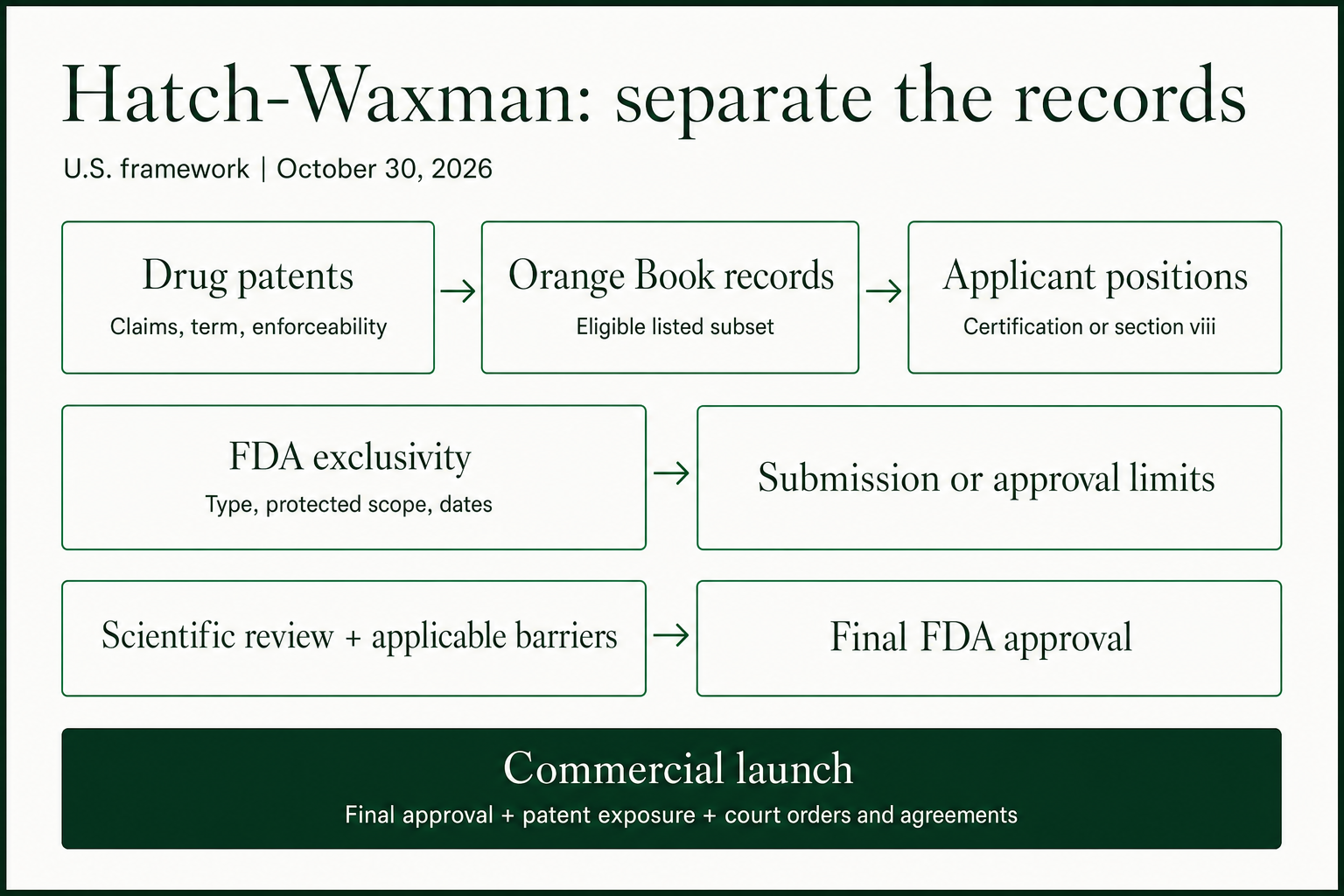
Which patent certifications and regulatory exclusivities affect a generic drug’s path to market? For patent counsel and pharmaceutical intellectual property (IP) leaders, the answer drives development spending, litigation strategy, and commercial planning. A useful Hatch-Waxman assessment distinguishes the records behind each barrier, the decision it affects, and the evidence needed to resolve it.
The focus here is U.S. drug patents and exclusivities for abbreviated new drug applications and related 505(b)(2) applications.
What the Hatch-Waxman Act created
The Hatch-Waxman Act is the common name for the Drug Price Competition and Patent Term Restoration Act of 1984. It established the modern abbreviated approval pathway for generic drugs while providing patent-term restoration and regulatory incentives for drug development. Its patent and exclusivity provisions connect Food and Drug Administration (FDA) approval under the Federal Food, Drug, and Cosmetic Act with U.S. patent law. FDA describes the Hatch-Waxman framework through its patent and exclusivity decisions.
An abbreviated new drug application (ANDA), submitted under section 505(j), relies on FDA’s finding of safety and effectiveness for a reference listed drug (RLD). The applicant must satisfy generic approval requirements, including applicable sameness and bioequivalence requirements. A new drug application (NDA) under section 505(b)(2) relies in part on investigations conducted by others for which the applicant lacks a right of reference. It can support certain changes from an approved drug that require additional evidence. FDA distinguishes these application pathways by their scientific and regulatory requirements.
Hatch-Waxman also allows qualifying development work before patent expiration. Under 35 U.S.C. §271(e)(1), the safe harbor covers specified activities solely for uses reasonably related to developing and submitting information under federal drug-regulatory law. Section 271(e)(2) creates an artificial act of infringement for qualifying application submissions seeking pre-expiration marketing approval, enabling patent litigation before commercial launch. These statutory provisions address different stages of development.
Separate submission, approval, and launch
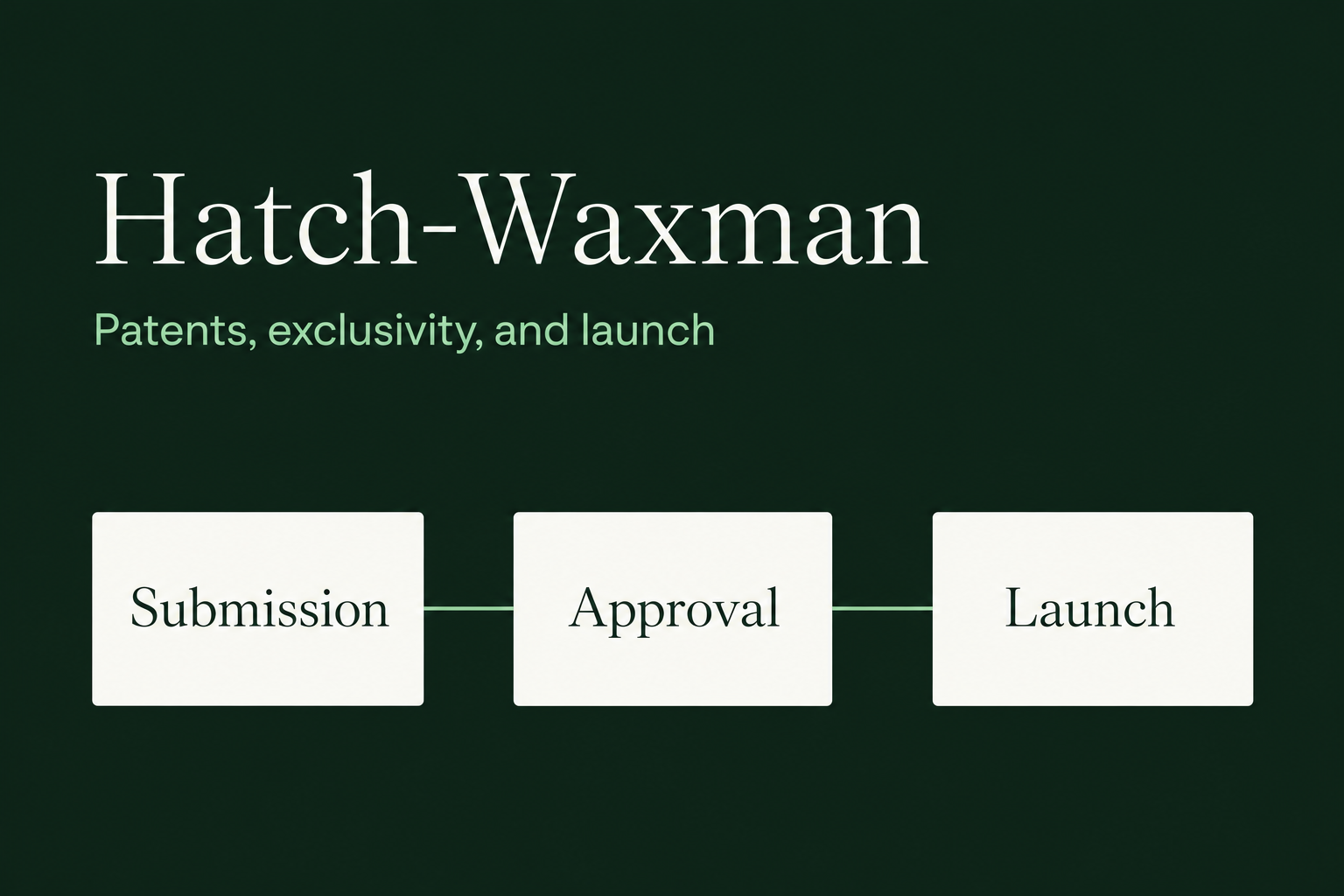
Build the assessment around 3 gates:
- Submission: When may FDA receive the proposed ANDA or 505(b)(2) application?
- Final approval: When can FDA make approval effective after scientific review and applicable patent or exclusivity barriers?
- Commercial launch: What patent judgments, injunctions, licenses, or settlement obligations affect selling the product?
Assign each issue to its gate. A submission opportunity can arrive years before final approval. Tentative approval means an application meets approval requirements but awaits an applicable barrier’s removal; commercial marketing requires final approval. Patent exposure also requires its own launch decision. The approval-timing regulation separates scientific readiness from effective approval.
Patents and FDA exclusivity protect different interests
A patent gives its owner enforceable rights over the claimed invention. Regulatory exclusivity restricts FDA’s acceptance or approval of specified competing applications when statutory requirements are met. A drug can have either protection, both, or neither. Their periods can overlap, and their scope can differ. FDA describes these distinct protections separately.
The ordinary term of a modern U.S. utility patent ends 20 years from the applicable filing date. Filing history, adjustments, extensions, and terminal disclaimers can change the expiration calculation. The United States Patent and Trademark Office (USPTO) sets out the patent-term rules.
For launch planning, record the following periods independently:
| Protection | General period | Gate and scope |
|---|---|---|
| New chemical entity (NCE) exclusivity | 5 years | Generally bars submission of ANDAs and 505(b)(2) applications containing the same active moiety, the pharmacologically active molecule or ion. A qualifying Paragraph IV application may be submitted after 4 years. |
| New clinical investigation exclusivity | 3 years | Restricts approval for protected conditions of approval or a protected change supported by qualifying new clinical investigations. Applications can be submitted during the period. |
| Pediatric exclusivity | 6 additional months | Attaches to qualifying existing patent-linked or regulatory protections. It can shift submission and approval dates. |
| Paragraph IV first-applicant exclusivity | 180 days | Can delay approval of subsequent ANDAs for the same drug. Eligibility, triggering, and forfeiture require a separate analysis. |
The NCE and clinical-investigation rules govern the first 2 rows. Pediatric exclusivity and generic exclusivity have additional statutory requirements.
For 3-year exclusivity, the NDA or supplement must contain new clinical investigations, other than bioavailability studies, that were essential to approval and conducted or sponsored by the applicant. Identify the protected conditions precisely, such as a qualifying new indication. Treating the period as protection for every use of an active ingredient can overstate the approval barrier.
Pediatric exclusivity adds a regulatory period associated with existing protection; the underlying patent expiration date and the pediatric approval restriction belong in separate fields. Other regimes can also matter, including 7-year orphan-drug exclusivity and qualifying antibiotic incentives. Include applicable protections from FDA’s patent and exclusivity records in the same assessment.
Start with the Orange Book, then examine the claims
The Orange Book, formally Approved Drug Products with Therapeutic Equivalence Evaluations, links approved drug products to submitted patent information and FDA exclusivity information.
NDA holders submit eligible drug-substance, drug-product, and method-of-use patents. The patent-listing regulation excludes process, packaging, metabolite, and intermediate patents. For method-of-use patents, the submitted use code describes the approved use claimed by the patent.
For each relevant product and strength, capture the patent number, expiration date, patent submission date, drug-substance or drug-product designation, and any use code. Put exclusivity codes and their expiration dates in a separate record. Then map the actual claims to the proposed formulation, manufacturing process, and labeling. Use scientific evidence mapping to keep the proposed product and claim analysis tied to the same asset.
FDA’s listing role is ministerial. Counsel must analyze claim scope, validity, enforceability, and potential infringement. Include relevant unlisted patents, especially manufacturing-process patents, in the broader freedom-to-operate assessment.
Listing timing also matters. NDA holders generally submit post-approval patent information within 30 days of patent issuance. An untimely listing can change a pending applicant’s certification obligations under FDA’s patent-submission rules. Preserve the submission history alongside the patent record.
Choose the patent certification for each listed patent
An ANDA applicant supplies the applicable certification or statement for each relevant listed patent. A single application can contain different certifications for different patents.
| Certification | Applicant’s position | Planning consequence |
|---|---|---|
| Paragraph I | Required patent information has not been submitted to FDA. | Address the remaining approval requirements and other applicable barriers. |
| Paragraph II | The patent has expired. | Address remaining exclusivities and approval requirements. |
| Paragraph III | The patent will expire on a specified date. | Approval generally waits for that patent’s expiration and any applicable additional protection. |
| Paragraph IV | The patent is invalid, unenforceable, or will not be infringed. | Prepare the notice, supporting analysis, and potential litigation strategy. |
These positions come from the ANDA certification requirements.
For a method-of-use patent covering an indication the applicant omits, a section viii statement may support a labeling carve-out, often called a skinny label. FDA must permit the proposed omission. Analyze the remaining label and planned promotional conduct against the patent claims when assessing induced-infringement exposure under §271(b).
Where Paragraph IV fits
Paragraph IV connects the certification record to notice and possible pre-launch litigation. A qualifying suit within 45 days after notice can trigger a 30-month stay of final approval. Eligibility, exceptions, and court orders affect the result. Record the actual suit and stay status separately from the certification and exclusivity records. FDA’s Paragraph IV explanation sets out the official framework.
Analyze 180-day generic exclusivity separately
The 180-day period can be available to eligible first applicants. Eligibility centers on a substantially complete ANDA with a qualifying Paragraph IV certification submitted on the first day such an application is filed, and lawfully maintaining that certification. Multiple first applicants can qualify.
Under the current statutory framework, the period generally starts with the first commercial marketing by any first applicant, including qualifying marketing of the listed drug. Eligibility can be forfeited. If all first applicants forfeit, exclusivity does not pass to the next filer. These rules appear in 21 U.S.C. §355(j)(5).
Track FDA’s product-specific first-applicant and exclusivity determinations alongside the Orange Book. FDA’s Paragraph IV list provides decision-status information, including whether eligibility has been deferred or exclusivity extinguished.
This exclusivity restricts subsequent ANDA approvals. An authorized generic marketed under an NDA can compete during the period. FDA addresses this scope in its generic-exclusivity draft guidance. Model that possibility when estimating the commercial value of first-applicant status.
Keep patent-term extension in the patent record
Patent-term extension (PTE) under 35 U.S.C. §156 restores qualifying patent term consumed by regulatory review. It has separate eligibility, calculation, and filing requirements. A manufacturing-method patent can qualify under the PTE eligibility requirements, although process patents are excluded from Orange Book listing. Record the resulting term separately from FDA exclusivity. Keep stage and territory decisions in the broader drug-development strategy.
Build a decision record around the proposed product
For an enterprise portfolio review, use one product identity across the following records. Preserve the source, capture date, responsible owner, and unresolved question for every row. Record both the snapshot date and the underlying legal or regulatory event date.
| Record | Fields to preserve | Evidence to retain | Decision supported |
|---|---|---|---|
| Product and application identity | RLD, NDA number, active ingredient, strength, dosage form, route, pathway, proposed indications | Dated Orange Book entry, approval letter, approved label, proposed product description | Whether the records concern the same product and proposed use |
| Patent rights | Claims, filing chain, term, adjustments or extensions, ownership, relevant unlisted patents | Patent text, prosecution history, term records, claim-to-product analysis | Claim scope and potential launch exposure |
| Orange Book listing | Patent number, submission date, expiration date, substance/product flags, use code | Dated listing and available NDA-holder submission records | Which listed patents require an applicant position; whether listing timing matters |
| Certification or statement | Paragraph I–IV position by patent; section viii statement where applicable | Application version, certification or statement, proposed labeling | How the applicant addresses each relevant listed patent |
| Regulatory exclusivity | Type, protected scope, start and end dates; first-applicant status separately | Orange Book exclusivity entry, FDA approval correspondence and product-specific decisions | Submission restriction, approval restriction, or subsequent-ANDA barrier |
| FDA approval status | Pending, tentative, or final; effective date and conditions | FDA application correspondence and approval documentation | Whether commercial marketing is authorized |
| Litigation and permissions | Relevant orders, judgments, licenses, settlement constraints | Filed decisions, operative orders, executed agreements | Whether patent or contractual barriers remain after final approval |
Use the Orange Book record to locate the listed issue, then use the underlying legal and scientific evidence to assess it. Keep the certification, protected exclusivity scope, and litigation result in separate fields even when they concern the same drug.
For a Paragraph IV position, keep noninfringement and invalidity analysis distinct. One compares claims with the proposed product or use. The other addresses whether the claims survive the asserted validity challenges. Each needs its own evidence and reasoning.
Fictional example: an approval barrier survives a patent win
Assume a generic applicant is ready for a 2026 launch assessment. A court judgment removes the relevant patent-based approval barrier on June 1, 2026. A 3-year exclusivity protecting the proposed indication runs through September 1, 2026. Assume no other approval barriers.
For that indication, the September exclusivity date remains relevant even after the June patent judgment. If an earlier, unprotected indication is commercially viable, evaluate a permissible labeling carve-out and its claim implications as a separate scenario.
The decision record should therefore show both label-specific paths, their evidence, and the next unresolved event. Adding patent, exclusivity, stay, and first-applicant periods into one cumulative number would obscure the actual approval and launch choices.
Does Hatch-Waxman govern biosimilars?
Biosimilar applications follow section 351(k) of the Public Health Service Act under the Biologics Price Competition and Innovation Act. Their licensure, exclusivity, and patent-dispute procedures require a separate assessment. FDA explains this biosimilar pathway. Section 156 patent-term extension can also apply to qualifying human biological products.
Where Patlytics fits
Patlytics supports the claim analysis and evidence development behind Hatch-Waxman patent positions:
- Patent & NPL Search searches patents and non-patent literature (NPL), including PubMed, for references relevant to an invalidity position.
- Invalidity and Claim Charting support prior-art analysis and invalidity charts. Infringement and FTO (freedom to operate) support claim-to-product analysis and launch-risk assessment, with infringement charts and Detection Reports organizing potential infringement findings. Exhaustive mode provides deeper coverage on selected priority claims.
- Claim Construction proposes constructions with pin cites to the specification. Constructions are editable, and edits re-run the chart. Word, Excel, and PDF exports support counsel’s next work product.
- Life-sciences inputs include a structure editor, image-to-SMILES (simplified molecular-input line-entry system) conversion, Markush/R-group generation for variable chemical structures, and sequence uploads with complementarity-determining-region (CDR) detection.
Attorneys retain review and decision authority over the evidence, charts, constructions, and legal positions.
Build a source-linked patent position for your next generic-drug review with Patlytics. Book a demo focused on prior-art evidence and claim charts behind patent-certification positions.

Hatch-Waxman Act: a patent and exclusivity guide
Which patent certifications and regulatory exclusivities affect a generic drug’s path to market? For patent counsel and pharmaceutical intellectual property (IP) leaders, the answer drives development spending, litigation strategy, and commercial planning. A useful Hatch-Waxman assessment distinguishes the records behind each barrier, the decision it affects, and the evidence needed to resolve it.
The focus here is U.S. drug patents and exclusivities for abbreviated new drug applications and related 505(b)(2) applications.
What the Hatch-Waxman Act created
The Hatch-Waxman Act is the common name for the Drug Price Competition and Patent Term Restoration Act of 1984. It established the modern abbreviated approval pathway for generic drugs while providing patent-term restoration and regulatory incentives for drug development. Its patent and exclusivity provisions connect Food and Drug Administration (FDA) approval under the Federal Food, Drug, and Cosmetic Act with U.S. patent law. FDA describes the Hatch-Waxman framework through its patent and exclusivity decisions.
An abbreviated new drug application (ANDA), submitted under section 505(j), relies on FDA’s finding of safety and effectiveness for a reference listed drug (RLD). The applicant must satisfy generic approval requirements, including applicable sameness and bioequivalence requirements. A new drug application (NDA) under section 505(b)(2) relies in part on investigations conducted by others for which the applicant lacks a right of reference. It can support certain changes from an approved drug that require additional evidence. FDA distinguishes these application pathways by their scientific and regulatory requirements.
Hatch-Waxman also allows qualifying development work before patent expiration. Under 35 U.S.C. §271(e)(1), the safe harbor covers specified activities solely for uses reasonably related to developing and submitting information under federal drug-regulatory law. Section 271(e)(2) creates an artificial act of infringement for qualifying application submissions seeking pre-expiration marketing approval, enabling patent litigation before commercial launch. These statutory provisions address different stages of development.
Separate submission, approval, and launch
Build the assessment around 3 gates:
- Submission: When may FDA receive the proposed ANDA or 505(b)(2) application?
- Final approval: When can FDA make approval effective after scientific review and applicable patent or exclusivity barriers?
- Commercial launch: What patent judgments, injunctions, licenses, or settlement obligations affect selling the product?
Assign each issue to its gate. A submission opportunity can arrive years before final approval. Tentative approval means an application meets approval requirements but awaits an applicable barrier’s removal; commercial marketing requires final approval. Patent exposure also requires its own launch decision. The approval-timing regulation separates scientific readiness from effective approval.
Patents and FDA exclusivity protect different interests
A patent gives its owner enforceable rights over the claimed invention. Regulatory exclusivity restricts FDA’s acceptance or approval of specified competing applications when statutory requirements are met. A drug can have either protection, both, or neither. Their periods can overlap, and their scope can differ. FDA describes these distinct protections separately.
The ordinary term of a modern U.S. utility patent ends 20 years from the applicable filing date. Filing history, adjustments, extensions, and terminal disclaimers can change the expiration calculation. The United States Patent and Trademark Office (USPTO) sets out the patent-term rules.
For launch planning, record the following periods independently:
| Protection | General period | Gate and scope |
|---|---|---|
| New chemical entity (NCE) exclusivity | 5 years | Generally bars submission of ANDAs and 505(b)(2) applications containing the same active moiety, the pharmacologically active molecule or ion. A qualifying Paragraph IV application may be submitted after 4 years. |
| New clinical investigation exclusivity | 3 years | Restricts approval for protected conditions of approval or a protected change supported by qualifying new clinical investigations. Applications can be submitted during the period. |
| Pediatric exclusivity | 6 additional months | Attaches to qualifying existing patent-linked or regulatory protections. It can shift submission and approval dates. |
| Paragraph IV first-applicant exclusivity | 180 days | Can delay approval of subsequent ANDAs for the same drug. Eligibility, triggering, and forfeiture require a separate analysis. |
The NCE and clinical-investigation rules govern the first 2 rows. Pediatric exclusivity and generic exclusivity have additional statutory requirements.
For 3-year exclusivity, the NDA or supplement must contain new clinical investigations, other than bioavailability studies, that were essential to approval and conducted or sponsored by the applicant. Identify the protected conditions precisely, such as a qualifying new indication. Treating the period as protection for every use of an active ingredient can overstate the approval barrier.
Pediatric exclusivity adds a regulatory period associated with existing protection; the underlying patent expiration date and the pediatric approval restriction belong in separate fields. Other regimes can also matter, including 7-year orphan-drug exclusivity and qualifying antibiotic incentives. Include applicable protections from FDA’s patent and exclusivity records in the same assessment.
Start with the Orange Book, then examine the claims
The Orange Book, formally Approved Drug Products with Therapeutic Equivalence Evaluations, links approved drug products to submitted patent information and FDA exclusivity information.
NDA holders submit eligible drug-substance, drug-product, and method-of-use patents. The patent-listing regulation excludes process, packaging, metabolite, and intermediate patents. For method-of-use patents, the submitted use code describes the approved use claimed by the patent.
For each relevant product and strength, capture the patent number, expiration date, patent submission date, drug-substance or drug-product designation, and any use code. Put exclusivity codes and their expiration dates in a separate record. Then map the actual claims to the proposed formulation, manufacturing process, and labeling. Use scientific evidence mapping to keep the proposed product and claim analysis tied to the same asset.
FDA’s listing role is ministerial. Counsel must analyze claim scope, validity, enforceability, and potential infringement. Include relevant unlisted patents, especially manufacturing-process patents, in the broader freedom-to-operate assessment.
Listing timing also matters. NDA holders generally submit post-approval patent information within 30 days of patent issuance. An untimely listing can change a pending applicant’s certification obligations under FDA’s patent-submission rules. Preserve the submission history alongside the patent record.
Choose the patent certification for each listed patent
An ANDA applicant supplies the applicable certification or statement for each relevant listed patent. A single application can contain different certifications for different patents.
| Certification | Applicant’s position | Planning consequence |
|---|---|---|
| Paragraph I | Required patent information has not been submitted to FDA. | Address the remaining approval requirements and other applicable barriers. |
| Paragraph II | The patent has expired. | Address remaining exclusivities and approval requirements. |
| Paragraph III | The patent will expire on a specified date. | Approval generally waits for that patent’s expiration and any applicable additional protection. |
| Paragraph IV | The patent is invalid, unenforceable, or will not be infringed. | Prepare the notice, supporting analysis, and potential litigation strategy. |
These positions come from the ANDA certification requirements.
For a method-of-use patent covering an indication the applicant omits, a section viii statement may support a labeling carve-out, often called a skinny label. FDA must permit the proposed omission. Analyze the remaining label and planned promotional conduct against the patent claims when assessing induced-infringement exposure under §271(b).
Where Paragraph IV fits
Paragraph IV connects the certification record to notice and possible pre-launch litigation. A qualifying suit within 45 days after notice can trigger a 30-month stay of final approval. Eligibility, exceptions, and court orders affect the result. Record the actual suit and stay status separately from the certification and exclusivity records. FDA’s Paragraph IV explanation sets out the official framework.
Analyze 180-day generic exclusivity separately
The 180-day period can be available to eligible first applicants. Eligibility centers on a substantially complete ANDA with a qualifying Paragraph IV certification submitted on the first day such an application is filed, and lawfully maintaining that certification. Multiple first applicants can qualify.
Under the current statutory framework, the period generally starts with the first commercial marketing by any first applicant, including qualifying marketing of the listed drug. Eligibility can be forfeited. If all first applicants forfeit, exclusivity does not pass to the next filer. These rules appear in 21 U.S.C. §355(j)(5).
Track FDA’s product-specific first-applicant and exclusivity determinations alongside the Orange Book. FDA’s Paragraph IV list provides decision-status information, including whether eligibility has been deferred or exclusivity extinguished.
This exclusivity restricts subsequent ANDA approvals. An authorized generic marketed under an NDA can compete during the period. FDA addresses this scope in its generic-exclusivity draft guidance. Model that possibility when estimating the commercial value of first-applicant status.
Keep patent-term extension in the patent record
Patent-term extension (PTE) under 35 U.S.C. §156 restores qualifying patent term consumed by regulatory review. It has separate eligibility, calculation, and filing requirements. A manufacturing-method patent can qualify under the PTE eligibility requirements, although process patents are excluded from Orange Book listing. Record the resulting term separately from FDA exclusivity. Keep stage and territory decisions in the broader drug-development strategy.
Build a decision record around the proposed product
For an enterprise portfolio review, use one product identity across the following records. Preserve the source, capture date, responsible owner, and unresolved question for every row. Record both the snapshot date and the underlying legal or regulatory event date.
| Record | Fields to preserve | Evidence to retain | Decision supported |
|---|---|---|---|
| Product and application identity | RLD, NDA number, active ingredient, strength, dosage form, route, pathway, proposed indications | Dated Orange Book entry, approval letter, approved label, proposed product description | Whether the records concern the same product and proposed use |
| Patent rights | Claims, filing chain, term, adjustments or extensions, ownership, relevant unlisted patents | Patent text, prosecution history, term records, claim-to-product analysis | Claim scope and potential launch exposure |
| Orange Book listing | Patent number, submission date, expiration date, substance/product flags, use code | Dated listing and available NDA-holder submission records | Which listed patents require an applicant position; whether listing timing matters |
| Certification or statement | Paragraph I–IV position by patent; section viii statement where applicable | Application version, certification or statement, proposed labeling | How the applicant addresses each relevant listed patent |
| Regulatory exclusivity | Type, protected scope, start and end dates; first-applicant status separately | Orange Book exclusivity entry, FDA approval correspondence and product-specific decisions | Submission restriction, approval restriction, or subsequent-ANDA barrier |
| FDA approval status | Pending, tentative, or final; effective date and conditions | FDA application correspondence and approval documentation | Whether commercial marketing is authorized |
| Litigation and permissions | Relevant orders, judgments, licenses, settlement constraints | Filed decisions, operative orders, executed agreements | Whether patent or contractual barriers remain after final approval |
Use the Orange Book record to locate the listed issue, then use the underlying legal and scientific evidence to assess it. Keep the certification, protected exclusivity scope, and litigation result in separate fields even when they concern the same drug.
For a Paragraph IV position, keep noninfringement and invalidity analysis distinct. One compares claims with the proposed product or use. The other addresses whether the claims survive the asserted validity challenges. Each needs its own evidence and reasoning.
Fictional example: an approval barrier survives a patent win
Assume a generic applicant is ready for a 2026 launch assessment. A court judgment removes the relevant patent-based approval barrier on June 1, 2026. A 3-year exclusivity protecting the proposed indication runs through September 1, 2026. Assume no other approval barriers.
For that indication, the September exclusivity date remains relevant even after the June patent judgment. If an earlier, unprotected indication is commercially viable, evaluate a permissible labeling carve-out and its claim implications as a separate scenario.
The decision record should therefore show both label-specific paths, their evidence, and the next unresolved event. Adding patent, exclusivity, stay, and first-applicant periods into one cumulative number would obscure the actual approval and launch choices.
Does Hatch-Waxman govern biosimilars?
Biosimilar applications follow section 351(k) of the Public Health Service Act under the Biologics Price Competition and Innovation Act. Their licensure, exclusivity, and patent-dispute procedures require a separate assessment. FDA explains this biosimilar pathway. Section 156 patent-term extension can also apply to qualifying human biological products.
Where Patlytics fits
Patlytics supports the claim analysis and evidence development behind Hatch-Waxman patent positions:
- Patent & NPL Search searches patents and non-patent literature (NPL), including PubMed, for references relevant to an invalidity position.
- Invalidity and Claim Charting support prior-art analysis and invalidity charts. Infringement and FTO (freedom to operate) support claim-to-product analysis and launch-risk assessment, with infringement charts and Detection Reports organizing potential infringement findings. Exhaustive mode provides deeper coverage on selected priority claims.
- Claim Construction proposes constructions with pin cites to the specification. Constructions are editable, and edits re-run the chart. Word, Excel, and PDF exports support counsel’s next work product.
- Life-sciences inputs include a structure editor, image-to-SMILES (simplified molecular-input line-entry system) conversion, Markush/R-group generation for variable chemical structures, and sequence uploads with complementarity-determining-region (CDR) detection.
Attorneys retain review and decision authority over the evidence, charts, constructions, and legal positions.
Build a source-linked patent position for your next generic-drug review with Patlytics. Book a demo focused on prior-art evidence and claim charts behind patent-certification positions.
The Premier AI-Powered Patent Platform
Reduce cycle times. Increase margins. Deliver winning IP outcomes.
Book a DemoThe Premier AI-Powered
Patent Platform
Reduce cycle times. Increase margins. Deliver winning IP outcomes.