How patent offices evaluate AI-assisted search quality
November 6, 2026

Can your examination team explain why an AI-assisted search returned particular references, which technical areas it covered, and what still needs attention? Search-quality and technical evaluation leads need an inspectable search record before they can judge whether assistance belongs in examination. Published office guidance provides concrete starting points for that discussion, from search scope and source selection to the reasoning preserved for later review.
Scope: Government patent-office search and examination workflows. Examiners and responsible staff retain substantive decisions.
Start with the office’s search duties
AI-assisted search can involve selecting candidate documents, ordering retrieved results, or suggesting search directions. Those activities require different evidence. A document-ranking review asks why relevant material appears where it does. A retrieval review also asks which sources and search areas were reachable in the first place.
Define the proposed activity before discussing quality:
- Search purpose: State the examination task and the claimed subject matter. Distinguish retrieval of prior art from its assessment under novelty, inventive step, or other patentability requirements.
- Input: Identify the claim version, relevant description, selected passages, classifications, and any starting documents supplied to the system.
- Source boundary: Name the patent collections, non-patent literature (NPL), languages, date limits, and retrieval date relevant to that task.
- Output: Specify whether the reviewer will receive a candidate list, source passages, a recorded search path, or explanatory text.
Apply these review prompts within each office’s published practice and internal authorization process.
What published office guidance contributes
Published examination instructions, quality controls, and AI plans identify different parts of the search record that examination and search-quality teams need.
USPTO: search coverage and work-product review
The United States Patent and Trademark Office (USPTO) gives “thorough” and “complete” specific meanings in the Manual of Patent Examining Procedure (MPEP) search guidelines. A thorough search identifies the areas most likely to contain relevant prior art; a complete search fully considers the identified areas. Domestic patents, foreign patent documents, and NPL must be considered, with a reasoned basis for eliminating a source. The same guidance recognizes technology-specific search needs.
For an AI-assisted search review, preserve the connection between the claimed invention, the chosen search areas, and the sources actually searched. A list of similar documents leaves the source-selection question open.
MPEP §904 also requires Search Notes identifying the classification locations, collections, and other sources searched, along with search dates. Those fields connect the planned search scope to the work actually performed.
The Office of Patent Quality Assurance (OPQA) and Technology Centers use the Master Review Form for work-product review, including search. That broader quality-review structure places search alongside other prosecution-quality issues.
EPO: complete searches and collaboration within the division
The European Patent Office (EPO) describes established AI assistance in pre-search, classification, and file allocation in its published AI-use account, with examination assistance in development.
Its 2026 work plan, printed pages 20–21, emphasizes complete and accurate searches, consistent application of the European Patent Convention, and interaction within three-person divisions through active search division practices. It also sets out planned improvements to NPL coverage.
A useful review question follows: can another member of the division understand the search choices and examine the relevant source material? Keep the search evidence connected to the search and written opinion.
UK IPO: the search statement and the internal search report
The UK Intellectual Property Office (UK IPO) ties search strategy to a statement of the critical matter in its Section 17 guidance. Paragraphs 17.50–17.53 address understanding the invention, selecting sources, and developing the strategy. Paragraph 17.86 addresses the internal search report and Search History.
The record should explain choices that would otherwise be unclear later, including the relationship between a search strategy and the documents it produced. For an AI-assisted workflow, preserve the original search statement, meaningful refinements, and the reason a candidate matters to the search.
The office’s 2026–2027 corporate plan sets out organization-wide AI planning and responsible adoption.
JPO: search validity and the accuracy of reasoning
The Japan Patent Office (JPO) describes consultations between examiners, substantive and formal checks by directors, and quality audits before notices are sent. Its patent examination quality controls expressly include review of the validity of prior-art searches and the accuracy of reasoning.
That distinction matters for technical evaluation. A candidate document can be relevant while the explanation attached to it overstates what its disclosure supports. Preserve the passage and the reasoning as separate reviewable objects.
The JPO’s Rev.2025 AI action plan identifies development and proof-of-concept work, including advanced prior-art search and consideration of generative AI in patent examination.
Korea’s MOIP: proposed search-system development
The Republic of Korea’s Ministry of Intellectual Property (MOIP), formerly the Korean Intellectual Property Office (KIPO), proposes development of a next-generation AI patent-search system in its 2027 budget proposal, subject to legislative review.
For discussion of that project, organize the search-quality questions around input scope, source access, candidate ordering, and the supporting evidence available for each reference.
Follow the evidence from the claim to the reference
A concrete technical review needs more than a presentation of successful search results. Assemble a review packet that lets examination and search-quality staff follow the work without reconstructing it from memory.
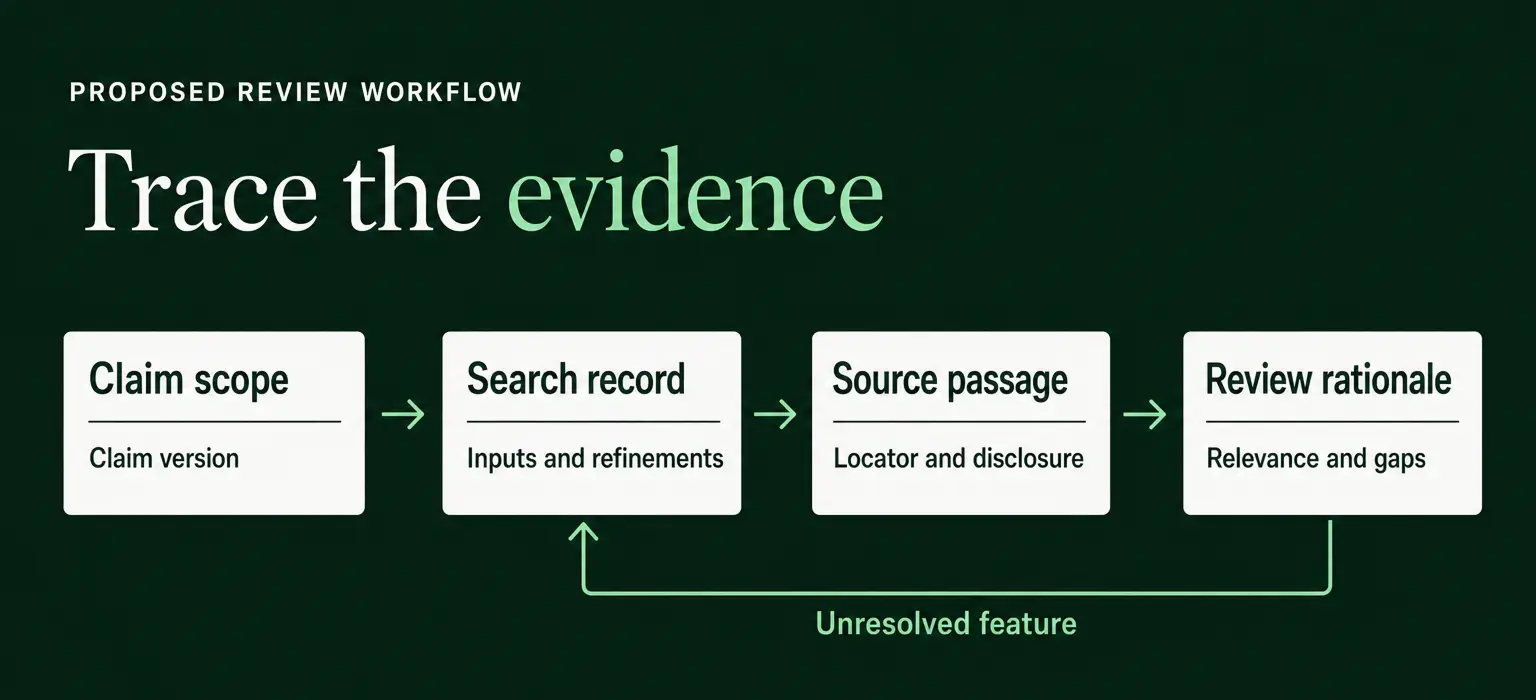
Claim scope leads to the search record, source passage, and review rationale. The feedback arrow returns unresolved features to search.
Preserve the search input and path
Keep the claim and description versions used for the search, the selected technical concepts, the source boundary, and the search date together. Record material changes to query text, classifications, selected passages, and date restrictions. Where an AI operation uses a seed document or selected claim text, retain that input with its results.
For systems that change over time, record the available system or model version and corpus update information. An archived result list preserves what was returned even when a later run produces a different ordering.
Connect each material result to its disclosure
For each reference taken forward, retain its identifier, relevant publication information, source location, and the passage or figure that supports the proposed relevance. Distinguish an original document from a translation, and a complete document from an abstract or bibliographic record.
Keep generated explanations visibly separate from source text. The reviewer needs to see which technical feature the reference discloses, which relationship remains uncertain, and where the explanation goes beyond the cited passage. For NPL, publication and access details deserve the same attention as the technical content. Different non-patent literature sources can supply different forms of evidence.
Resolve gaps through further search
Use a familiar, publicly available application to discuss missed art with the technical team. Retain its existing search record as a comparison aid, while allowing additional relevant references to emerge. Trace an omitted document through the workflow: was it outside the accessible collection, excluded by a restriction, retrieved but buried, or set aside during review?
Those explanations point to different next actions. An unavailable source calls for another search route. A terminology gap calls for a revised search expression or classification route. A passage that fails to support the proposed relevance calls for correction of the explanation. Document the unresolved issue and the next search action, rather than describing every omission as an AI failure.
A fictional example: an earlier abstract missed by a source filter
Suppose a search-quality team reviews NPL for a software patent application concerning task processing in a message queue, using 1 July 2026 as the search cutoff. A conference abstract appeared in March 2026, followed by a full journal paper in September 2026. The authors and titles are similar. The returned list contains the full paper, but its generated explanation attaches the abstract’s March 2026 date to a retry-handling sequence that stores a task’s completion record before acknowledging its queue message, a detail found only in the later paper.
The review packet needs 2 separate corrections:
- Separate the versions and their evidence. Preserve the abstract and full paper as distinct records, with the exact copies reviewed, source locations, retrieval dates, and publication evidence for each. Attribute the retry-handling sequence to the September 2026 paper. Assess each version’s timing and disclosure separately under the applicable office’s practice.
- Trace the omitted abstract. The saved search shows that the conference record was in the selected collection but excluded by a journal-article filter. Remove that restriction, retrieve the abstract, and preserve the revised search alongside the original result list. Record the filter as the point where the earlier document was missed.
The corrected rationale can now explain what each version disclosed and when it was published. The search note identifies the omitted document and the retrieval change that recovered it, so another reviewer can follow both the evidence correction and the search-path correction.
Settle technical and information-handling questions before use
Search evidence and deployment authorization are separate decisions. For a government evaluation, identify the permitted data, intended environment, and responsible approval route before supplying application material.
Unpublished applications need particular care. The USPTO’s internet-search guidance in MPEP §904.02(c) restricts searches involving unpublished material and addresses secure vendor connections. The UK search guidance, Section 17.01.1, requires protection of prepublication application content and related documents. Apply the relevant office’s confidentiality rules to the actual information flow.
The technical discussion should establish where queries and documents travel, what records are retained, who can access them, and how an office can preserve a review record. Keep any unanswered requirement explicit.
Where Patlytics fits
Patlytics helps your search-quality team organize technical search areas, retrieve prior art, and connect source passages to claim limitations.
- The Classification module organizes patents using your team’s own controlled taxonomy. Proposed categories can be edited before they are applied, giving the review packet a consistent technical grouping for discussing which search areas were covered and where further search is needed.
- Patent & NPL Search supports research across patents and non-patent literature, including PubMed for biomedical work. The examiner receives ranked references with passage-level citations.
- Claim Charting produces claim charts against the limitations under review and links each charted disclosure to its supporting citation. For coverage and potential-miss concerns, Exhaustive mode provides deeper coverage on selected priority claims.
Patlytics holds a SOC 2 Type II attestation, plus ISO 27001 and ISO 42001 certifications. Patlytics does not use customer data to tune or train its models without explicit consent or necessity. For the proposed engagement, specify service scope, access controls, retention arrangements, and contractual terms alongside the office’s records and data-handling requirements.
Examiners and responsible staff retain substantive decisions.
Connect ranked prior-art references to the passages and claim limitations under review. Book a demo to explore source-linked search and evidence review with Patlytics.

How patent offices evaluate AI-assisted search quality
Can your examination team explain why an AI-assisted search returned particular references, which technical areas it covered, and what still needs attention? Search-quality and technical evaluation leads need an inspectable search record before they can judge whether assistance belongs in examination. Published office guidance provides concrete starting points for that discussion, from search scope and source selection to the reasoning preserved for later review.
Scope: Government patent-office search and examination workflows. Examiners and responsible staff retain substantive decisions.
Start with the office’s search duties
AI-assisted search can involve selecting candidate documents, ordering retrieved results, or suggesting search directions. Those activities require different evidence. A document-ranking review asks why relevant material appears where it does. A retrieval review also asks which sources and search areas were reachable in the first place.
Define the proposed activity before discussing quality:
- Search purpose: State the examination task and the claimed subject matter. Distinguish retrieval of prior art from its assessment under novelty, inventive step, or other patentability requirements.
- Input: Identify the claim version, relevant description, selected passages, classifications, and any starting documents supplied to the system.
- Source boundary: Name the patent collections, non-patent literature (NPL), languages, date limits, and retrieval date relevant to that task.
- Output: Specify whether the reviewer will receive a candidate list, source passages, a recorded search path, or explanatory text.
Apply these review prompts within each office’s published practice and internal authorization process.
What published office guidance contributes
Published examination instructions, quality controls, and AI plans identify different parts of the search record that examination and search-quality teams need.
USPTO: search coverage and work-product review
The United States Patent and Trademark Office (USPTO) gives “thorough” and “complete” specific meanings in the Manual of Patent Examining Procedure (MPEP) search guidelines. A thorough search identifies the areas most likely to contain relevant prior art; a complete search fully considers the identified areas. Domestic patents, foreign patent documents, and NPL must be considered, with a reasoned basis for eliminating a source. The same guidance recognizes technology-specific search needs.
For an AI-assisted search review, preserve the connection between the claimed invention, the chosen search areas, and the sources actually searched. A list of similar documents leaves the source-selection question open.
MPEP §904 also requires Search Notes identifying the classification locations, collections, and other sources searched, along with search dates. Those fields connect the planned search scope to the work actually performed.
The Office of Patent Quality Assurance (OPQA) and Technology Centers use the Master Review Form for work-product review, including search. That broader quality-review structure places search alongside other prosecution-quality issues.
EPO: complete searches and collaboration within the division
The European Patent Office (EPO) describes established AI assistance in pre-search, classification, and file allocation in its published AI-use account, with examination assistance in development.
Its 2026 work plan, printed pages 20–21, emphasizes complete and accurate searches, consistent application of the European Patent Convention, and interaction within three-person divisions through active search division practices. It also sets out planned improvements to NPL coverage.
A useful review question follows: can another member of the division understand the search choices and examine the relevant source material? Keep the search evidence connected to the search and written opinion.
UK IPO: the search statement and the internal search report
The UK Intellectual Property Office (UK IPO) ties search strategy to a statement of the critical matter in its Section 17 guidance. Paragraphs 17.50–17.53 address understanding the invention, selecting sources, and developing the strategy. Paragraph 17.86 addresses the internal search report and Search History.
The record should explain choices that would otherwise be unclear later, including the relationship between a search strategy and the documents it produced. For an AI-assisted workflow, preserve the original search statement, meaningful refinements, and the reason a candidate matters to the search.
The office’s 2026–2027 corporate plan sets out organization-wide AI planning and responsible adoption.
JPO: search validity and the accuracy of reasoning
The Japan Patent Office (JPO) describes consultations between examiners, substantive and formal checks by directors, and quality audits before notices are sent. Its patent examination quality controls expressly include review of the validity of prior-art searches and the accuracy of reasoning.
That distinction matters for technical evaluation. A candidate document can be relevant while the explanation attached to it overstates what its disclosure supports. Preserve the passage and the reasoning as separate reviewable objects.
The JPO’s Rev.2025 AI action plan identifies development and proof-of-concept work, including advanced prior-art search and consideration of generative AI in patent examination.
Korea’s MOIP: proposed search-system development
The Republic of Korea’s Ministry of Intellectual Property (MOIP), formerly the Korean Intellectual Property Office (KIPO), proposes development of a next-generation AI patent-search system in its 2027 budget proposal, subject to legislative review.
For discussion of that project, organize the search-quality questions around input scope, source access, candidate ordering, and the supporting evidence available for each reference.
Follow the evidence from the claim to the reference
A concrete technical review needs more than a presentation of successful search results. Assemble a review packet that lets examination and search-quality staff follow the work without reconstructing it from memory.
Claim scope leads to the search record, source passage, and review rationale. The feedback arrow returns unresolved features to search.
Preserve the search input and path
Keep the claim and description versions used for the search, the selected technical concepts, the source boundary, and the search date together. Record material changes to query text, classifications, selected passages, and date restrictions. Where an AI operation uses a seed document or selected claim text, retain that input with its results.
For systems that change over time, record the available system or model version and corpus update information. An archived result list preserves what was returned even when a later run produces a different ordering.
Connect each material result to its disclosure
For each reference taken forward, retain its identifier, relevant publication information, source location, and the passage or figure that supports the proposed relevance. Distinguish an original document from a translation, and a complete document from an abstract or bibliographic record.
Keep generated explanations visibly separate from source text. The reviewer needs to see which technical feature the reference discloses, which relationship remains uncertain, and where the explanation goes beyond the cited passage. For NPL, publication and access details deserve the same attention as the technical content. Different non-patent literature sources can supply different forms of evidence.
Resolve gaps through further search
Use a familiar, publicly available application to discuss missed art with the technical team. Retain its existing search record as a comparison aid, while allowing additional relevant references to emerge. Trace an omitted document through the workflow: was it outside the accessible collection, excluded by a restriction, retrieved but buried, or set aside during review?
Those explanations point to different next actions. An unavailable source calls for another search route. A terminology gap calls for a revised search expression or classification route. A passage that fails to support the proposed relevance calls for correction of the explanation. Document the unresolved issue and the next search action, rather than describing every omission as an AI failure.
A fictional example: an earlier abstract missed by a source filter
Suppose a search-quality team reviews NPL for a software patent application concerning task processing in a message queue, using 1 July 2026 as the search cutoff. A conference abstract appeared in March 2026, followed by a full journal paper in September 2026. The authors and titles are similar. The returned list contains the full paper, but its generated explanation attaches the abstract’s March 2026 date to a retry-handling sequence that stores a task’s completion record before acknowledging its queue message, a detail found only in the later paper.
The review packet needs 2 separate corrections:
- Separate the versions and their evidence. Preserve the abstract and full paper as distinct records, with the exact copies reviewed, source locations, retrieval dates, and publication evidence for each. Attribute the retry-handling sequence to the September 2026 paper. Assess each version’s timing and disclosure separately under the applicable office’s practice.
- Trace the omitted abstract. The saved search shows that the conference record was in the selected collection but excluded by a journal-article filter. Remove that restriction, retrieve the abstract, and preserve the revised search alongside the original result list. Record the filter as the point where the earlier document was missed.
The corrected rationale can now explain what each version disclosed and when it was published. The search note identifies the omitted document and the retrieval change that recovered it, so another reviewer can follow both the evidence correction and the search-path correction.
Settle technical and information-handling questions before use
Search evidence and deployment authorization are separate decisions. For a government evaluation, identify the permitted data, intended environment, and responsible approval route before supplying application material.
Unpublished applications need particular care. The USPTO’s internet-search guidance in MPEP §904.02(c) restricts searches involving unpublished material and addresses secure vendor connections. The UK search guidance, Section 17.01.1, requires protection of prepublication application content and related documents. Apply the relevant office’s confidentiality rules to the actual information flow.
The technical discussion should establish where queries and documents travel, what records are retained, who can access them, and how an office can preserve a review record. Keep any unanswered requirement explicit.
Where Patlytics fits
Patlytics helps your search-quality team organize technical search areas, retrieve prior art, and connect source passages to claim limitations.
- The Classification module organizes patents using your team’s own controlled taxonomy. Proposed categories can be edited before they are applied, giving the review packet a consistent technical grouping for discussing which search areas were covered and where further search is needed.
- Patent & NPL Search supports research across patents and non-patent literature, including PubMed for biomedical work. The examiner receives ranked references with passage-level citations.
- Claim Charting produces claim charts against the limitations under review and links each charted disclosure to its supporting citation. For coverage and potential-miss concerns, Exhaustive mode provides deeper coverage on selected priority claims.
Patlytics holds a SOC 2 Type II attestation, plus ISO 27001 and ISO 42001 certifications. Patlytics does not use customer data to tune or train its models without explicit consent or necessity. For the proposed engagement, specify service scope, access controls, retention arrangements, and contractual terms alongside the office’s records and data-handling requirements.
Examiners and responsible staff retain substantive decisions.
Connect ranked prior-art references to the passages and claim limitations under review. Book a demo to explore source-linked search and evidence review with Patlytics.
The Premier AI-Powered Patent Platform
Reduce cycle times. Increase margins. Deliver winning IP outcomes.
Book a DemoThe Premier AI-Powered
Patent Platform
Reduce cycle times. Increase margins. Deliver winning IP outcomes.