Invalidity contentions: organize the evidence behind every ground
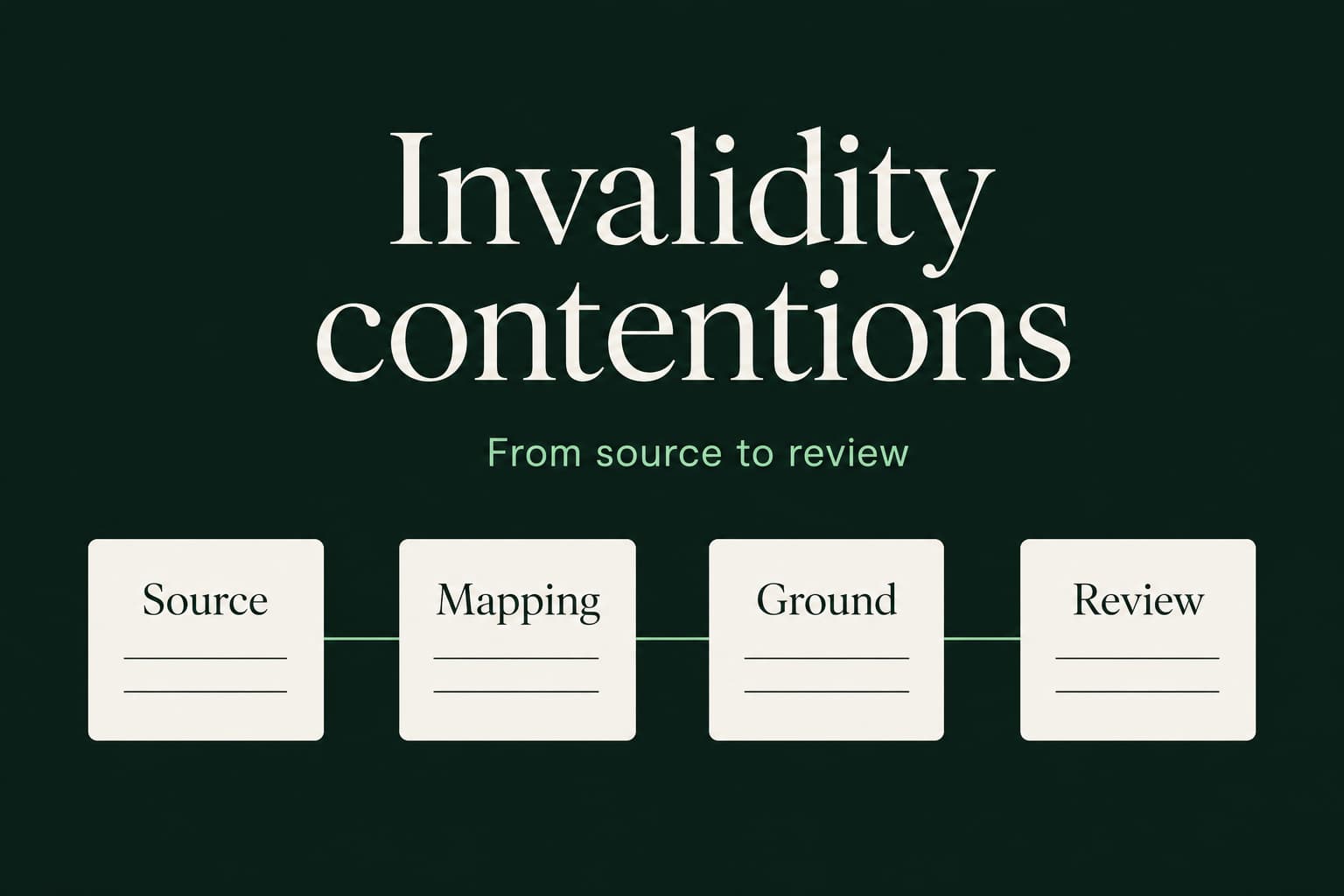
Can another attorney follow each proposed invalidity ground from the asserted claim to the exact source passage, date evidence, and unresolved issue? That question matters when researchers, technical experts, and litigation counsel contribute to the same work product. A useful evidence package gives each reviewer a defined decision and preserves the record behind it.
This workflow covers prior-art evidence for U.S. district-court utility-patent contentions, using Northern District of California rules as a local example.
Start with the disclosure obligation
Invalidity contentions disclose the grounds on which a party challenges asserted patent claims. In the Northern District of California, Patent Local Rule 3-3 requires identified prior art, anticipation or obviousness positions, identified combinations, and charts specifying where and how each limitation appears. Rule 1-3 permits case-specific changes to obligations and deadlines. Build your matter checklist from the governing rules and orders. Patent local rules
Separate the material into three layers:
- Source record: the preserved reference, bibliographic identity, date evidence, and production information.
- Analysis record: the limitation mapping, construction used, proposed ground, and open questions.
- Service package: the contentions, charts, and accompanying production approved for disclosure.
Keep internal questions and strategic notes in the review workspace. Counsel selects the material included in the service package and handles privilege, confidentiality designations, and protective-order obligations.
For the earlier claim-first research stage, use the invalidity planning workflow. Evidence preparation begins when a candidate reference becomes part of a proposed ground.
1. Give claims, references, and grounds stable identities
Use a consistent identifier for every patent, asserted claim, claim limitation, source, and proposed ground. Preserve the exact asserted claim text alongside the working segmentation. Carry dependent claims' inherited limitations into the review, with explicit links to the parent mapping.
A reference can support several grounds. Give each ground its own record containing:
- The patent and claims challenged.
- The statutory basis and exact reference or combination.
- The construction applied, including disputed terms and alternative readings.
- The reference's role and the explanation connecting its disclosures to the claim.
- The responsible attorney, decision status, and affected chart rows.
Keep an anticipation ground and an obviousness ground separate even when they share a reference. For combinations, identify which reference supplies each limitation and retain the combination rationale with that particular ground. The Eastern District of Texas expressly requires each asserted combination and its motivation to combine to be identified under P. R. 3-3(b). Texas patent rules
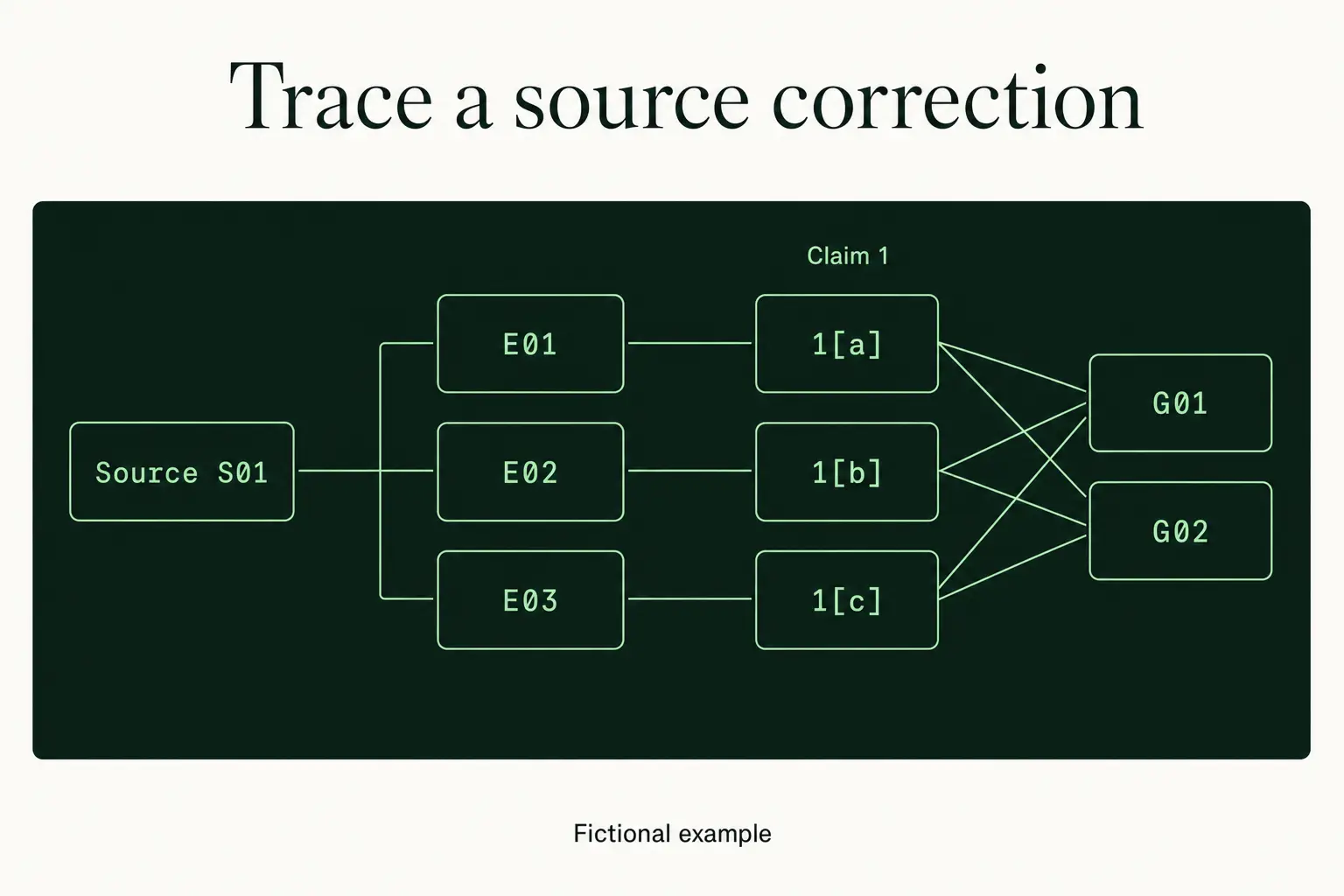
Stable identifiers let you move in both directions: from an argument to its evidence, and from a corrected source to every affected argument.
2. Preserve the cited document and its dates
Create one source record for the exact version used in the chart. Capture patent number, country, publication or kind code, issue date, and relevant filing or priority dates for patent documents. For publications, retain title, author, publisher, edition, and publication information. For products or public disclosures, identify the item, event, participants, and evidence of the asserted date.
Add the acquisition location, acquisition date, original filename, preserved file, and production identifier when assigned. Keep the original scan beside any optical character recognition (OCR) text, translation, or annotated working copy. Record who supplied a translation and which passages it covers.
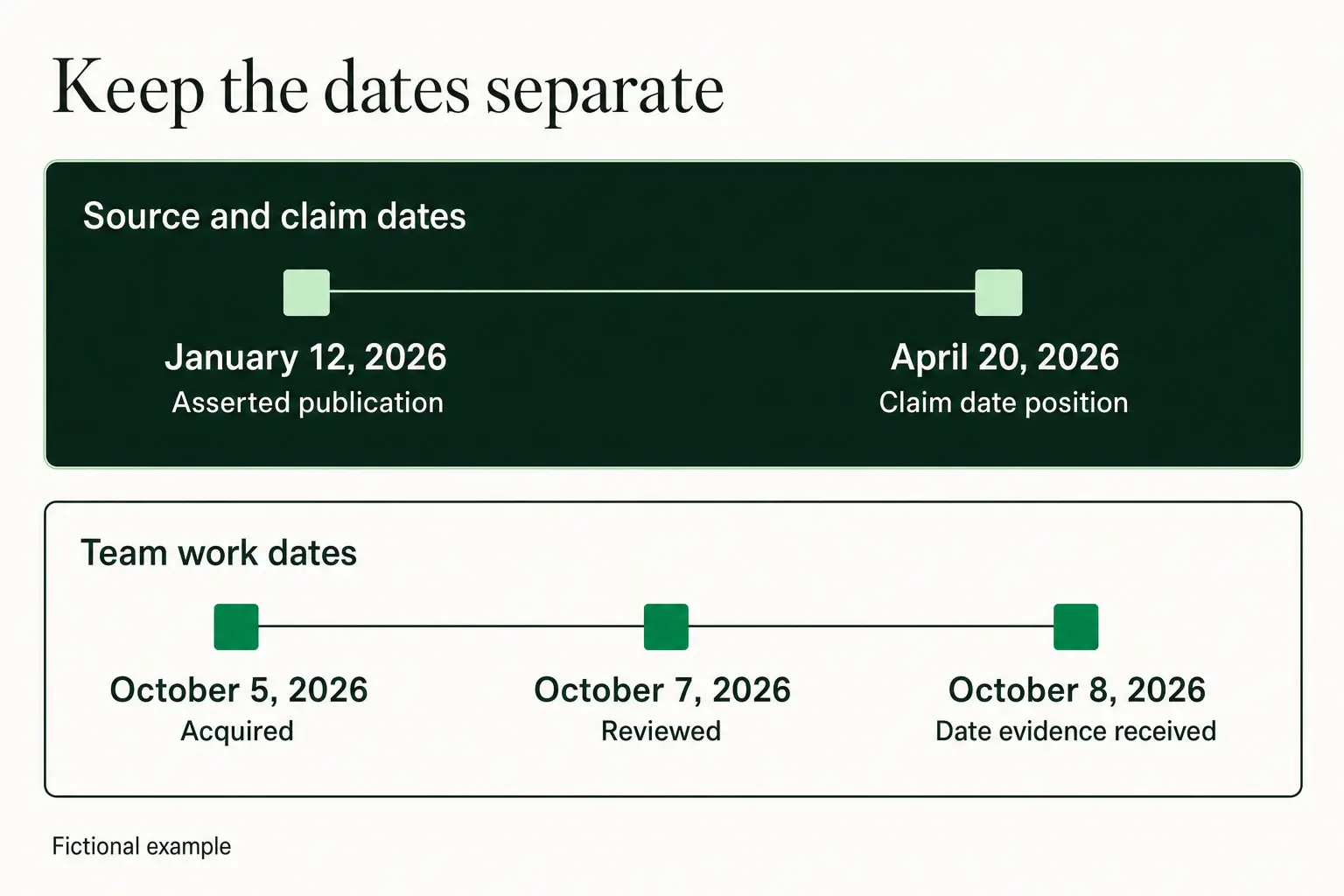
Maintain separate date fields for:
- The challenged claim's date position: the date relied upon and the record supporting that position.
- The reference's relevant dates: filing, publication, issue, or asserted public availability, with evidence for each.
- The team's work dates: discovery, acquisition, review, and decision.
Have counsel resolve the applicable America Invents Act (AIA) or pre-AIA framework and reference qualification. Preserve disputed dates as open issues. A download timestamp belongs in the acquisition field; publication evidence belongs in the chronology.
Synthetic dated source log
Fictional battery-electrode manufacturing review, October 2026. S01 is Electrode coating process note, revision A, by fictional publisher Alder Electrode Research. S02 is Electrode slitting process bulletin, issue 2, by fictional publisher Briar Materials Lab. The working claim-date position is April 20, 2026.
| Logged on | Source and event | Date evidence retained | Preserved record | Decision or next owner |
|---|---|---|---|---|
| October 5, 2026 | S01 acquired from publisher archive | Cover states January 12, 2026; public-release evidence pending | S01-original.pdf; acquisition record AC01 | Researcher to obtain archive distribution record |
| October 6, 2026 | S02 acquired and indexed | Bulletin states February 3, 2026; dated catalog entry preserved | S02-original.pdf; catalog capture S02-D01 | Counsel to resolve qualification and date position |
| October 7, 2026 | S01 sequence reviewed | Page 6 places slitting before calendering | Excerpt E03; annotation AN01 | Technical reviewer flags conflict with limitation 1[d] |
| October 8, 2026 | S01 archive response received | Publisher distribution record identifies January 12, 2026 release | S01-D01; correspondence preserved | Counsel to assess date evidence; G01 and G02 remain under review |
Append events as they occur. Keep the original entry when later evidence resolves a question. The log should show what changed, when it changed, and who owns the resulting decision.
3. Separate source excerpts from the mapping explanation
Every mapped limitation needs a precise locator, the source material relied upon, and an explanation of the connection. Use printed page and PDF page numbers where they differ, paragraph or column-and-line references where available, and figure labels that identify the relevant feature.
Preserve enough surrounding text to retain conditions, exceptions, and process order. Compare OCR text with the source page before using it as an excerpt. Mark omissions, and keep quotations distinct from paraphrases and technical inferences.
Give excerpts their own identifiers. An excerpt record should point to its source version and locator; a mapping record should point to that excerpt and the ground it supports. When several rows use one passage, link each row to the shared excerpt without losing its individual explanation.
Synthetic evidence matrix
The abbreviated claim concerns coating a current-collector foil with electrode material, drying the coating, compressing it between calender rolls, and slitting the electrode sheet after calendering. G01 is a proposed S01 anticipation ground. G02 is a proposed S01 + S02 obviousness ground. These rows continue the fictional review above.
| Row and limitation | Source excerpt and locator | Mapping explanation | Ground | Status and next owner |
|---|---|---|---|---|
| E01 · 1[a]: coat a current-collector foil with electrode material | S01, p. 3, Fig. 2: “apply the electrode coating to the current-collector foil” | Coating application maps to the coating step; construction of “current-collector foil” recorded as C01 | G01; G02 | Attorney accepted mapping under C01 on October 7, 2026 |
| E02 · 1[b]: dry the coating on that foil | S01, p. 4: “dry the coating on the current-collector foil” | Passage links drying to the same coated foil used for 1[a] | G01; G02 | Attorney accepted mapping under C01 on October 7, 2026 |
| E03 · 1[c]: calender the dried coating | S01, pp. 5–6: “pass the dried coated foil through calender rolls” | Compression of the dried coating is described; surrounding process sequence must stay attached | G01; G02 | Technical reviewer retained sequence conflict on October 7, 2026 |
| E04 · 1[d]: slit the electrode sheet after calendering | S02, p. 9: “calender the dried coated foil before slitting the electrode sheet” | S02 supplies the proposed sequence change; compatibility with S01's process and combination rationale remain open | G02 only | Technical expert owns compatibility question; attorney owns combination rationale |
G01 stays on hold because S01's slitting-before-calendering sequence conflicts with 1[d]. G02 has a separate path to review, with an identified contribution from S02 and unresolved combination questions. The matrix makes those decisions visible before either ground reaches a service draft.
For each open row, state the missing proposition precisely. “Find better art” leaves the assignment vague. “Identify evidence that S02's calendering-before-slitting sequence can operate on S01's dried coated foil” gives the researcher and expert a defined question.
4. Track unresolved facts and their downstream effects
Keep an issue register linked to the matrix. Each issue needs an owner, the evidence or decision required to close it, a due date, and the grounds affected. Use descriptive statuses such as source acquired, mapping drafted, technical question open, attorney accepted, and excluded, rather than one confidence score.
In the synthetic example, the team has three different decisions:
- Date evidence: counsel assesses S01-D01 and the reference's qualification.
- Technical compatibility: the expert addresses whether S02's calendering-before-slitting sequence can operate in S01's process.
- Legal rationale: counsel decides whether and how to advance G02, using the technical explanation and cited evidence.
If a source changes, trace the impact through every linked excerpt, row, claim, and ground. A corrected publication date may affect several claims. A changed construction may require a new mapping even when the cited passage stays the same.
Record the reason for excluding a reference or ground. Retain its identifier so later reviewers can distinguish a deliberate decision from an unfinished assignment.
5. Hand off decisions with a defined review package
Send each reviewer the material needed for a specific decision:
| Handoff | Material supplied | Decision returned |
|---|---|---|
| Researcher to chart drafter | Source copy, identity, date evidence, excerpt locators, acquisition log | Source record accepted or missing material assigned |
| Drafter to technical expert | Exact limitation, construction, cited passage, explanation, process context | Technical mapping or compatibility issue resolved with reasons |
| Technical expert to litigation counsel | Proposed ground, matrix, technical explanation, unresolved factual issues | Ground accepted, revised, held, or excluded |
| Counsel to service team | Approved contentions and chart revisions, production crosswalk, designation instructions | Correct package assembled for service |
For expert work, counsel should define the assignment and applicable disclosure and protection requirements before the handoff.
At the final review, reconcile the asserted claims, grounds, chart citations, source versions, translations, and production identifiers. Northern District of California Rule 3-4(b) calls for copies or samples of identified art absent from the patent file history, with English translations of relied-on portions. Keep that source-production crosswalk alongside the approved charts. Accompanying production requirements
Preserve the exact served package and its service date. Keep later work in separately identified revisions, with a change record distinguishing added evidence, changed mappings, and new grounds. Route proposed amendments through the applicable rule and order: Northern District of California Rule 3-6 requires a court order on a timely showing of good cause, including when discovery responses are supplemented. Amendment requirements
Where Patlytics fits
Patlytics supports the substantive search, construction, and charting work behind an invalidity-contentions evidence package:
- Patent & NPL Search searches patents and non-patent literature, including PubMed, for candidate references. It returns publication dates with each reference.
- Claim Construction produces proposed constructions with pin cites to the specification. The constructions are editable, and edits can be used to re-run the chart.
- Invalidity and Claim Charting use selected claims and prior-art references to produce citation-backed, limitation-by-limitation anticipation and obviousness charts, including reference combinations and motivations to combine. Exhaustive mode provides deeper coverage on selected priority claims.
- Word, Excel, and PDF exports provide work product for litigation-team handoffs and document preparation.
Attorneys retain review and decision authority over the evidence, constructions, grounds, and final contentions.
Turn cited prior art into a reviewable invalidity-contentions package with Patlytics. Book a demo for a walkthrough of source-backed limitation mapping and contention-chart preparation.

Invalidity contentions: organize the evidence behind every ground
Can another attorney follow each proposed invalidity ground from the asserted claim to the exact source passage, date evidence, and unresolved issue? That question matters when researchers, technical experts, and litigation counsel contribute to the same work product. A useful evidence package gives each reviewer a defined decision and preserves the record behind it.
This workflow covers prior-art evidence for U.S. district-court utility-patent contentions, using Northern District of California rules as a local example.
Start with the disclosure obligation
Invalidity contentions disclose the grounds on which a party challenges asserted patent claims. In the Northern District of California, Patent Local Rule 3-3 requires identified prior art, anticipation or obviousness positions, identified combinations, and charts specifying where and how each limitation appears. Rule 1-3 permits case-specific changes to obligations and deadlines. Build your matter checklist from the governing rules and orders. Patent local rules
Separate the material into three layers:
- Source record: the preserved reference, bibliographic identity, date evidence, and production information.
- Analysis record: the limitation mapping, construction used, proposed ground, and open questions.
- Service package: the contentions, charts, and accompanying production approved for disclosure.
Keep internal questions and strategic notes in the review workspace. Counsel selects the material included in the service package and handles privilege, confidentiality designations, and protective-order obligations.
For the earlier claim-first research stage, use the invalidity planning workflow. Evidence preparation begins when a candidate reference becomes part of a proposed ground.
1. Give claims, references, and grounds stable identities
Use a consistent identifier for every patent, asserted claim, claim limitation, source, and proposed ground. Preserve the exact asserted claim text alongside the working segmentation. Carry dependent claims' inherited limitations into the review, with explicit links to the parent mapping.
A reference can support several grounds. Give each ground its own record containing:
- The patent and claims challenged.
- The statutory basis and exact reference or combination.
- The construction applied, including disputed terms and alternative readings.
- The reference's role and the explanation connecting its disclosures to the claim.
- The responsible attorney, decision status, and affected chart rows.
Keep an anticipation ground and an obviousness ground separate even when they share a reference. For combinations, identify which reference supplies each limitation and retain the combination rationale with that particular ground. The Eastern District of Texas expressly requires each asserted combination and its motivation to combine to be identified under P. R. 3-3(b). Texas patent rules
Stable identifiers let you move in both directions: from an argument to its evidence, and from a corrected source to every affected argument.
2. Preserve the cited document and its dates
Create one source record for the exact version used in the chart. Capture patent number, country, publication or kind code, issue date, and relevant filing or priority dates for patent documents. For publications, retain title, author, publisher, edition, and publication information. For products or public disclosures, identify the item, event, participants, and evidence of the asserted date.
Add the acquisition location, acquisition date, original filename, preserved file, and production identifier when assigned. Keep the original scan beside any optical character recognition (OCR) text, translation, or annotated working copy. Record who supplied a translation and which passages it covers.
Maintain separate date fields for:
- The challenged claim's date position: the date relied upon and the record supporting that position.
- The reference's relevant dates: filing, publication, issue, or asserted public availability, with evidence for each.
- The team's work dates: discovery, acquisition, review, and decision.
Have counsel resolve the applicable America Invents Act (AIA) or pre-AIA framework and reference qualification. Preserve disputed dates as open issues. A download timestamp belongs in the acquisition field; publication evidence belongs in the chronology.
Synthetic dated source log
Fictional battery-electrode manufacturing review, October 2026. S01 is Electrode coating process note, revision A, by fictional publisher Alder Electrode Research. S02 is Electrode slitting process bulletin, issue 2, by fictional publisher Briar Materials Lab. The working claim-date position is April 20, 2026.
| Logged on | Source and event | Date evidence retained | Preserved record | Decision or next owner |
|---|---|---|---|---|
| October 5, 2026 | S01 acquired from publisher archive | Cover states January 12, 2026; public-release evidence pending | S01-original.pdf; acquisition record AC01 | Researcher to obtain archive distribution record |
| October 6, 2026 | S02 acquired and indexed | Bulletin states February 3, 2026; dated catalog entry preserved | S02-original.pdf; catalog capture S02-D01 | Counsel to resolve qualification and date position |
| October 7, 2026 | S01 sequence reviewed | Page 6 places slitting before calendering | Excerpt E03; annotation AN01 | Technical reviewer flags conflict with limitation 1[d] |
| October 8, 2026 | S01 archive response received | Publisher distribution record identifies January 12, 2026 release | S01-D01; correspondence preserved | Counsel to assess date evidence; G01 and G02 remain under review |
Append events as they occur. Keep the original entry when later evidence resolves a question. The log should show what changed, when it changed, and who owns the resulting decision.
3. Separate source excerpts from the mapping explanation
Every mapped limitation needs a precise locator, the source material relied upon, and an explanation of the connection. Use printed page and PDF page numbers where they differ, paragraph or column-and-line references where available, and figure labels that identify the relevant feature.
Preserve enough surrounding text to retain conditions, exceptions, and process order. Compare OCR text with the source page before using it as an excerpt. Mark omissions, and keep quotations distinct from paraphrases and technical inferences.
Give excerpts their own identifiers. An excerpt record should point to its source version and locator; a mapping record should point to that excerpt and the ground it supports. When several rows use one passage, link each row to the shared excerpt without losing its individual explanation.
Synthetic evidence matrix
The abbreviated claim concerns coating a current-collector foil with electrode material, drying the coating, compressing it between calender rolls, and slitting the electrode sheet after calendering. G01 is a proposed S01 anticipation ground. G02 is a proposed S01 + S02 obviousness ground. These rows continue the fictional review above.
| Row and limitation | Source excerpt and locator | Mapping explanation | Ground | Status and next owner |
|---|---|---|---|---|
| E01 · 1[a]: coat a current-collector foil with electrode material | S01, p. 3, Fig. 2: “apply the electrode coating to the current-collector foil” | Coating application maps to the coating step; construction of “current-collector foil” recorded as C01 | G01; G02 | Attorney accepted mapping under C01 on October 7, 2026 |
| E02 · 1[b]: dry the coating on that foil | S01, p. 4: “dry the coating on the current-collector foil” | Passage links drying to the same coated foil used for 1[a] | G01; G02 | Attorney accepted mapping under C01 on October 7, 2026 |
| E03 · 1[c]: calender the dried coating | S01, pp. 5–6: “pass the dried coated foil through calender rolls” | Compression of the dried coating is described; surrounding process sequence must stay attached | G01; G02 | Technical reviewer retained sequence conflict on October 7, 2026 |
| E04 · 1[d]: slit the electrode sheet after calendering | S02, p. 9: “calender the dried coated foil before slitting the electrode sheet” | S02 supplies the proposed sequence change; compatibility with S01's process and combination rationale remain open | G02 only | Technical expert owns compatibility question; attorney owns combination rationale |
G01 stays on hold because S01's slitting-before-calendering sequence conflicts with 1[d]. G02 has a separate path to review, with an identified contribution from S02 and unresolved combination questions. The matrix makes those decisions visible before either ground reaches a service draft.
For each open row, state the missing proposition precisely. “Find better art” leaves the assignment vague. “Identify evidence that S02's calendering-before-slitting sequence can operate on S01's dried coated foil” gives the researcher and expert a defined question.
4. Track unresolved facts and their downstream effects
Keep an issue register linked to the matrix. Each issue needs an owner, the evidence or decision required to close it, a due date, and the grounds affected. Use descriptive statuses such as source acquired, mapping drafted, technical question open, attorney accepted, and excluded, rather than one confidence score.
In the synthetic example, the team has three different decisions:
- Date evidence: counsel assesses S01-D01 and the reference's qualification.
- Technical compatibility: the expert addresses whether S02's calendering-before-slitting sequence can operate in S01's process.
- Legal rationale: counsel decides whether and how to advance G02, using the technical explanation and cited evidence.
If a source changes, trace the impact through every linked excerpt, row, claim, and ground. A corrected publication date may affect several claims. A changed construction may require a new mapping even when the cited passage stays the same.
Record the reason for excluding a reference or ground. Retain its identifier so later reviewers can distinguish a deliberate decision from an unfinished assignment.
5. Hand off decisions with a defined review package
Send each reviewer the material needed for a specific decision:
| Handoff | Material supplied | Decision returned |
|---|---|---|
| Researcher to chart drafter | Source copy, identity, date evidence, excerpt locators, acquisition log | Source record accepted or missing material assigned |
| Drafter to technical expert | Exact limitation, construction, cited passage, explanation, process context | Technical mapping or compatibility issue resolved with reasons |
| Technical expert to litigation counsel | Proposed ground, matrix, technical explanation, unresolved factual issues | Ground accepted, revised, held, or excluded |
| Counsel to service team | Approved contentions and chart revisions, production crosswalk, designation instructions | Correct package assembled for service |
For expert work, counsel should define the assignment and applicable disclosure and protection requirements before the handoff.
At the final review, reconcile the asserted claims, grounds, chart citations, source versions, translations, and production identifiers. Northern District of California Rule 3-4(b) calls for copies or samples of identified art absent from the patent file history, with English translations of relied-on portions. Keep that source-production crosswalk alongside the approved charts. Accompanying production requirements
Preserve the exact served package and its service date. Keep later work in separately identified revisions, with a change record distinguishing added evidence, changed mappings, and new grounds. Route proposed amendments through the applicable rule and order: Northern District of California Rule 3-6 requires a court order on a timely showing of good cause, including when discovery responses are supplemented. Amendment requirements
Where Patlytics fits
Patlytics supports the substantive search, construction, and charting work behind an invalidity-contentions evidence package:
- Patent & NPL Search searches patents and non-patent literature, including PubMed, for candidate references. It returns publication dates with each reference.
- Claim Construction produces proposed constructions with pin cites to the specification. The constructions are editable, and edits can be used to re-run the chart.
- Invalidity and Claim Charting use selected claims and prior-art references to produce citation-backed, limitation-by-limitation anticipation and obviousness charts, including reference combinations and motivations to combine. Exhaustive mode provides deeper coverage on selected priority claims.
- Word, Excel, and PDF exports provide work product for litigation-team handoffs and document preparation.
Attorneys retain review and decision authority over the evidence, constructions, grounds, and final contentions.
Turn cited prior art into a reviewable invalidity-contentions package with Patlytics. Book a demo for a walkthrough of source-backed limitation mapping and contention-chart preparation.
The Premier AI-Powered Patent Platform
Reduce cycle times. Increase margins. Deliver winning IP outcomes.
Book a DemoThe Premier AI-Powered
Patent Platform
Reduce cycle times. Increase margins. Deliver winning IP outcomes.