IPR estoppel: reconcile the record before district court
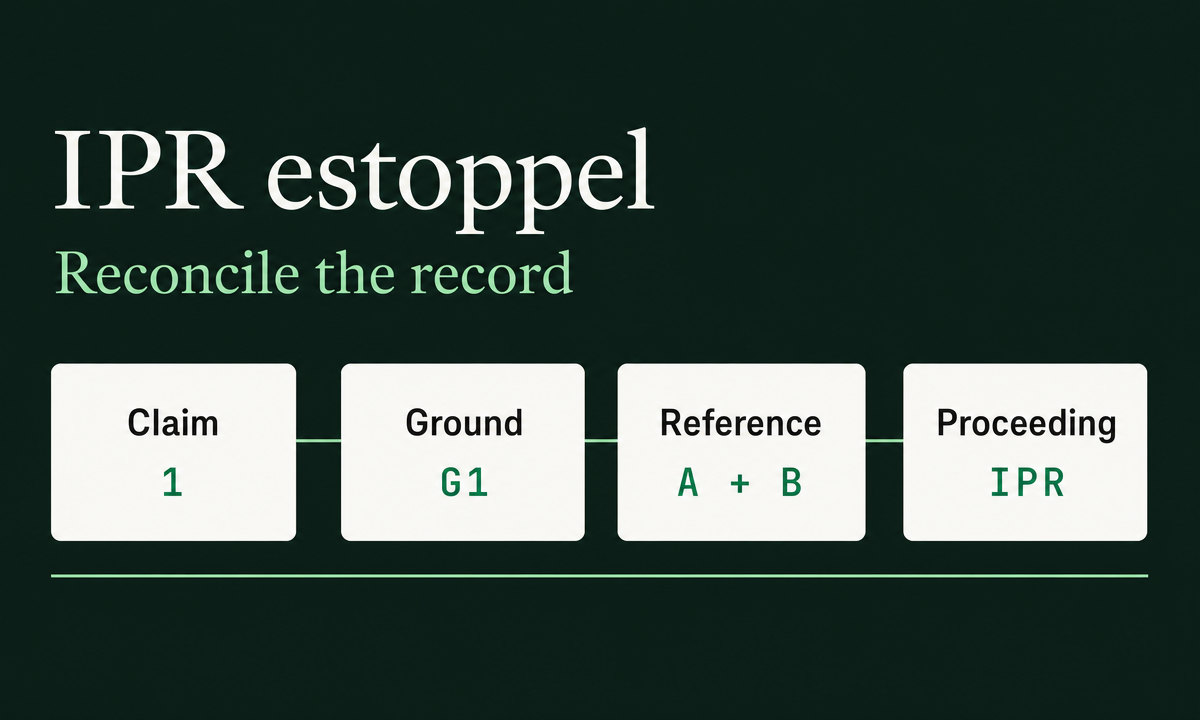
Which invalidity grounds remain available in district court after an inter partes review (IPR), and what evidence supports keeping them? The answer depends on the challenged claims, the parties, the proceeding's disposition, and each theory's relationship to the historical search record. A usable post-IPR audit connects those records before you revise contentions, commission another search, or prepare an estoppel motion.
Scope: U.S. district-court invalidity defenses following IPR.
Start with the claim, party, and disposition
IPR estoppel restricts later invalidity challenges after a qualifying final written decision by the Patent Trial and Appeal Board (PTAB). Under 35 U.S.C. §315(e)(2), the petitioner, its real party in interest, or its privy cannot assert covered grounds in district court or the specified International Trade Commission proceedings. The restriction reaches grounds the petitioner raised or reasonably could have raised during the IPR. Section 315(e)(1) separately governs requesting or maintaining proceedings before the U.S. Patent and Trademark Office.
Start the audit with 3 linked records:
- Party record: Identify whose court defense is at issue, its petitioner status, and any real-party-in-interest or privity basis. Include relevant joinder and termination orders.
- Claim record: List the claims in the petition, institution decision, final written decision, and current district-court case. Keep each claim's procedural history separate.
- Disposition record: Record the final written decision and its date, any party-specific termination, and the status of appeals and claim cancellation.
A denied petition by itself supplies no final-written-decision trigger. A qualifying termination under §317(a)'s settlement provision prevents estoppel based on that petitioner's institution. Use the actual termination order when classifying the disposition. The final written decision and the later claim-cancellation certificate are separate events; the statutory estoppel trigger is the decision.
Omitted grounds also belong in the audit. Caltech v. Broadcom, read with its claim-scope correction, extends estoppel to grounds that reasonably could have been asserted against claims included in the petition. Keep unpetitioned claims separate rather than marking the entire patent estopped.
Historical partial-institution cases need the full procedural record. In Click-to-Call v. Ingenio, estoppel reached a petitioned claim omitted from the final written decision where the petitioner could have sought a remand under SAS Institute v. Iancu and failed to do so.
Separate the invalidity ground from its supporting evidence
IPR permits anticipation and obviousness challenges under §§102 and 103 based on patents or printed publications. That statutory scope restriction makes the distinction between a legal ground and an evidence file central to the post-IPR review.
Give each proposed district-court ground an identity containing:
- The challenged claim.
- The statutory basis and applicable America Invents Act (AIA) or pre-AIA regime.
- The exact reference or combination, or the product, public-use, or sale theory.
- The role of every supporting exhibit.
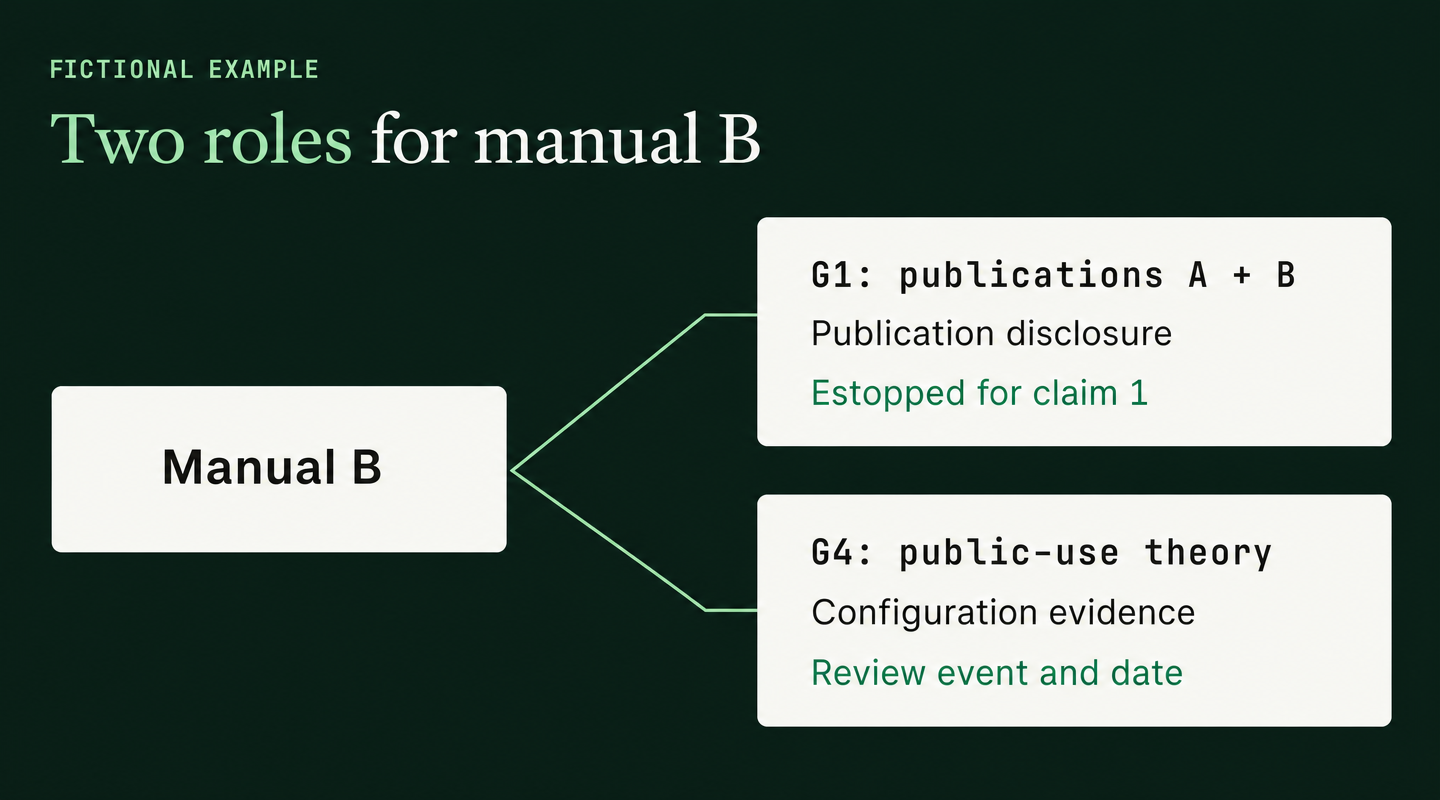
A manual might supply the disclosure for a publication-based obviousness ground. The same manual might help establish the configuration of a product involved in a public-use ground. Preserve those roles separately.
In Ingenico v. IOENGINE, the Federal Circuit held that IPR estoppel concerns grounds rather than a blanket exclusion of references. Printed materials could support product-related grounds unavailable in IPR, even where their disclosures were substantively identical to the product evidence. The case applied pre-AIA §102.
The practical consequence for your audit is an evidence-role column. For a product, use, or sale theory, identify the actual configuration, qualifying event, relevant date, and evidence connecting the configuration to the claim limitations. For a mixed product-and-publication combination, explain the product's substantive contribution to the ground. A revised exhibit label supplies none of those facts.
Reconstruct what reasonably could have been raised
For omitted patent-and-publication grounds, distinguish actual knowledge from objective discoverability. In its 2023 Ironburg decision, the Federal Circuit required the patent owner asserting estoppel to prove, more likely than not, that a skilled searcher exercising reasonable diligence would reasonably have discovered the ground. The inquiry is objective. Another party's later petition, without evidence about its search, was insufficient.
In the June 2026 Ironburg decision, No. 24-2088, decided June 18, the Federal Circuit reversed the estoppel judgment and remanded. A reference's inclusion in an unreviewably large classification-result set required additional evidence of discoverability. Search reconstructions also failed when post-petition citations shaped later queries or a supplemental search targeted a known missing reference. The majority imposed no universal manual-review requirement and left the precise meaning of discovery unresolved.
Build the historical record around the path to the asserted ground:
- Search source, execution date, exact queries, and date filters.
- Classification and keyword narrowing steps, result counts, and any available rankings or review records.
- Reference versions, translations, publication information, and contemporaneous search reports.
- Starting materials and citation paths, including later publications that influenced subsequent queries.
- The explanation connecting the references to the omitted ground, including the proposed combination.
Keep current research separate from historical reconstruction. Label any new search, including an artificial intelligence (AI)-assisted rerun, as new work. Preserve its inputs and search path so later information can be separated from what was available at the relevant time. A current search's technical usefulness and its evidentiary value for historical discoverability are different questions.
Retain the original search materials under the matter's preservation and access procedures. Make privilege and production decisions separately from collecting the record. For claim scoping before additional research, use a claim-first invalidity workflow rather than repeating the original search without identifying the remaining issue.
Build a claim-ground-reference-proceeding audit
Use one row per claim and ground. Repeated references are useful when their evidentiary roles differ. Attach pinpoint citations to the petition, decision, search report, and supporting exhibits so the legal analysis can be traced to the underlying record.
Fictional example: a consumer-electronics evidence package
In October 2026, a team reviews a patent on a wireless-earbud charging case. Assume the same petitioner now defends the district-court case. Its IPR challenged claims 1 and 7, and the final written decision left both claims standing. Claim 12 was never included in that petition. A, B, C, and D are publication references; B is a product manual. Earbud Case X v2 is the physical charging-case configuration at issue. The team is reconciling 6 proposed grounds.
| Claim | Ground | References and evidence roles | Proceeding and search record | Counsel's audit treatment |
|---|---|---|---|---|
| 1 | G1: §103, publications A + B | A and B supply the asserted technical disclosures. | G1 was raised in the petition and addressed in the final written decision. | Mark G1 estopped for this petitioner and remove it from the proposed court grounds. Retain the underlying exhibits. |
| 7 | G2: §103, publications A + C | A and C form a different proposed combination. | G2 was omitted. Historical report S2 identifies C before the petition; its treatment of the proposed combination needs analysis. | Flag omitted-ground estoppel. Connect S2, the claim mapping, and the combination analysis before assigning a disposition. |
| 7 | G3: §103, publications A + D | D supplies an additional claim limitation. | D was first located after the petition. The current showing places it in a large, unnarrowed classification-result set. | Keep discoverability unresolved. Develop evidence of a reasonably diligent search path rather than deciding from result-set membership. |
| 1 | G4: §102, public use of Earbud Case X v2 | Physical sample, demonstration record, witness testimony, and manual B support configuration and use facts. | The proposed ground rests on a public-use event outside IPR's permitted grounds. | Identify the qualifying event and date, authenticate the configuration evidence, and assess the ground under the applicable §102 regime. |
| 7 | G5: §103, Earbud Case X v2 + A | Product evidence supplies one part of the proposed combination; A supplies another. | The court theory combines product art with a publication also used in IPR. | Explain the product's contribution, event facts, limitation mapping, and combination rationale. Analyze this ground separately from G1. |
| 12 | G6: §103, publications A + B | The same publications address a separately asserted claim. | Claim 12 was outside this petition. | Keep its claim-scope analysis separate. Identify other proceedings, stipulations, or orders affecting the proposed defense. |
G1's disposition belongs to a particular claim and ground. B remains in the file because G4 assigns it a different evidentiary role. G2 requires analysis of what the historical record supports, while G3 exposes a missing discoverability showing. G4 and G5 require proof of their underlying product and event facts. G6 prevents a patent-wide estoppel label from swallowing a separate claim.
Keep the audit alongside the limitation charts. The charts explain the technical mapping; the audit records why counsel retains, withdraws, or investigates the legal ground in the identified proceeding.
Close the audit before changing the court record
Use the reconciled matrix to produce a short decision record for litigation counsel:
- Fix the perimeter. Cite the party, claim, and disposition records supporting each row's statutory treatment.
- Resolve omitted grounds. Link the historical evidence to each discoverability conclusion and identify any disputed inference.
- Complete the remaining evidence. Assign an owner to missing configuration, event-date, authentication, or combination support.
- Apply independent restrictions. Record the effect of litigation stipulations, court orders, scheduling deadlines, and any separate preclusion analysis.
- Carry decisions into the work product. Align proposed contentions, expert theories, exhibit lists, and motion positions with counsel's retained and withdrawn grounds. Preserve an internal record of unresolved rows and the evidence needed to resolve them.
This gives outside counsel a defined evidentiary task for each unresolved ground and gives in-house counsel a concrete basis for directing additional search or discovery spend.
Where Patlytics fits
Patlytics supports the substantive search, construction, and claim analysis that supplies evidence for a post-IPR review:
- Patent & NPL Search searches patents and non-patent literature (NPL), including PubMed, and provides publication dates with references.
- Invalidity and Claim Charting produce citation-backed, limitation-level invalidity charts for the selected claims and references.
- Claim Construction proposes constructions with specification pin cites. Constructions are editable, and edits can be used to re-run the chart.
- Exhaustive mode provides deeper coverage on selected priority claims.
- Word, Excel, and PDF export supports preparation of the reviewed analysis for the matter team.
Counsel reviews the source support, selects the grounds, and decides the estoppel and litigation positions.
Bring citation-backed search and claim-chart evidence into your post-IPR review. Book a demo of Patlytics' search, construction, and charting workflow.

IPR estoppel: reconcile the record before district court
Which invalidity grounds remain available in district court after an inter partes review (IPR), and what evidence supports keeping them? The answer depends on the challenged claims, the parties, the proceeding's disposition, and each theory's relationship to the historical search record. A usable post-IPR audit connects those records before you revise contentions, commission another search, or prepare an estoppel motion.
Scope: U.S. district-court invalidity defenses following IPR.
Start with the claim, party, and disposition
IPR estoppel restricts later invalidity challenges after a qualifying final written decision by the Patent Trial and Appeal Board (PTAB). Under 35 U.S.C. §315(e)(2), the petitioner, its real party in interest, or its privy cannot assert covered grounds in district court or the specified International Trade Commission proceedings. The restriction reaches grounds the petitioner raised or reasonably could have raised during the IPR. Section 315(e)(1) separately governs requesting or maintaining proceedings before the U.S. Patent and Trademark Office.
Start the audit with 3 linked records:
- Party record: Identify whose court defense is at issue, its petitioner status, and any real-party-in-interest or privity basis. Include relevant joinder and termination orders.
- Claim record: List the claims in the petition, institution decision, final written decision, and current district-court case. Keep each claim's procedural history separate.
- Disposition record: Record the final written decision and its date, any party-specific termination, and the status of appeals and claim cancellation.
A denied petition by itself supplies no final-written-decision trigger. A qualifying termination under §317(a)'s settlement provision prevents estoppel based on that petitioner's institution. Use the actual termination order when classifying the disposition. The final written decision and the later claim-cancellation certificate are separate events; the statutory estoppel trigger is the decision.
Omitted grounds also belong in the audit. Caltech v. Broadcom, read with its claim-scope correction, extends estoppel to grounds that reasonably could have been asserted against claims included in the petition. Keep unpetitioned claims separate rather than marking the entire patent estopped.
Historical partial-institution cases need the full procedural record. In Click-to-Call v. Ingenio, estoppel reached a petitioned claim omitted from the final written decision where the petitioner could have sought a remand under SAS Institute v. Iancu and failed to do so.
Separate the invalidity ground from its supporting evidence
IPR permits anticipation and obviousness challenges under §§102 and 103 based on patents or printed publications. That statutory scope restriction makes the distinction between a legal ground and an evidence file central to the post-IPR review.
Give each proposed district-court ground an identity containing:
- The challenged claim.
- The statutory basis and applicable America Invents Act (AIA) or pre-AIA regime.
- The exact reference or combination, or the product, public-use, or sale theory.
- The role of every supporting exhibit.
A manual might supply the disclosure for a publication-based obviousness ground. The same manual might help establish the configuration of a product involved in a public-use ground. Preserve those roles separately.
In Ingenico v. IOENGINE, the Federal Circuit held that IPR estoppel concerns grounds rather than a blanket exclusion of references. Printed materials could support product-related grounds unavailable in IPR, even where their disclosures were substantively identical to the product evidence. The case applied pre-AIA §102.
The practical consequence for your audit is an evidence-role column. For a product, use, or sale theory, identify the actual configuration, qualifying event, relevant date, and evidence connecting the configuration to the claim limitations. For a mixed product-and-publication combination, explain the product's substantive contribution to the ground. A revised exhibit label supplies none of those facts.
Reconstruct what reasonably could have been raised
For omitted patent-and-publication grounds, distinguish actual knowledge from objective discoverability. In its 2023 Ironburg decision, the Federal Circuit required the patent owner asserting estoppel to prove, more likely than not, that a skilled searcher exercising reasonable diligence would reasonably have discovered the ground. The inquiry is objective. Another party's later petition, without evidence about its search, was insufficient.
In the June 2026 Ironburg decision, No. 24-2088, decided June 18, the Federal Circuit reversed the estoppel judgment and remanded. A reference's inclusion in an unreviewably large classification-result set required additional evidence of discoverability. Search reconstructions also failed when post-petition citations shaped later queries or a supplemental search targeted a known missing reference. The majority imposed no universal manual-review requirement and left the precise meaning of discovery unresolved.
Build the historical record around the path to the asserted ground:
- Search source, execution date, exact queries, and date filters.
- Classification and keyword narrowing steps, result counts, and any available rankings or review records.
- Reference versions, translations, publication information, and contemporaneous search reports.
- Starting materials and citation paths, including later publications that influenced subsequent queries.
- The explanation connecting the references to the omitted ground, including the proposed combination.
Keep current research separate from historical reconstruction. Label any new search, including an artificial intelligence (AI)-assisted rerun, as new work. Preserve its inputs and search path so later information can be separated from what was available at the relevant time. A current search's technical usefulness and its evidentiary value for historical discoverability are different questions.
Retain the original search materials under the matter's preservation and access procedures. Make privilege and production decisions separately from collecting the record. For claim scoping before additional research, use a claim-first invalidity workflow rather than repeating the original search without identifying the remaining issue.
Build a claim-ground-reference-proceeding audit
Use one row per claim and ground. Repeated references are useful when their evidentiary roles differ. Attach pinpoint citations to the petition, decision, search report, and supporting exhibits so the legal analysis can be traced to the underlying record.
Fictional example: a consumer-electronics evidence package
In October 2026, a team reviews a patent on a wireless-earbud charging case. Assume the same petitioner now defends the district-court case. Its IPR challenged claims 1 and 7, and the final written decision left both claims standing. Claim 12 was never included in that petition. A, B, C, and D are publication references; B is a product manual. Earbud Case X v2 is the physical charging-case configuration at issue. The team is reconciling 6 proposed grounds.
| Claim | Ground | References and evidence roles | Proceeding and search record | Counsel's audit treatment |
|---|---|---|---|---|
| 1 | G1: §103, publications A + B | A and B supply the asserted technical disclosures. | G1 was raised in the petition and addressed in the final written decision. | Mark G1 estopped for this petitioner and remove it from the proposed court grounds. Retain the underlying exhibits. |
| 7 | G2: §103, publications A + C | A and C form a different proposed combination. | G2 was omitted. Historical report S2 identifies C before the petition; its treatment of the proposed combination needs analysis. | Flag omitted-ground estoppel. Connect S2, the claim mapping, and the combination analysis before assigning a disposition. |
| 7 | G3: §103, publications A + D | D supplies an additional claim limitation. | D was first located after the petition. The current showing places it in a large, unnarrowed classification-result set. | Keep discoverability unresolved. Develop evidence of a reasonably diligent search path rather than deciding from result-set membership. |
| 1 | G4: §102, public use of Earbud Case X v2 | Physical sample, demonstration record, witness testimony, and manual B support configuration and use facts. | The proposed ground rests on a public-use event outside IPR's permitted grounds. | Identify the qualifying event and date, authenticate the configuration evidence, and assess the ground under the applicable §102 regime. |
| 7 | G5: §103, Earbud Case X v2 + A | Product evidence supplies one part of the proposed combination; A supplies another. | The court theory combines product art with a publication also used in IPR. | Explain the product's contribution, event facts, limitation mapping, and combination rationale. Analyze this ground separately from G1. |
| 12 | G6: §103, publications A + B | The same publications address a separately asserted claim. | Claim 12 was outside this petition. | Keep its claim-scope analysis separate. Identify other proceedings, stipulations, or orders affecting the proposed defense. |
G1's disposition belongs to a particular claim and ground. B remains in the file because G4 assigns it a different evidentiary role. G2 requires analysis of what the historical record supports, while G3 exposes a missing discoverability showing. G4 and G5 require proof of their underlying product and event facts. G6 prevents a patent-wide estoppel label from swallowing a separate claim.
Keep the audit alongside the limitation charts. The charts explain the technical mapping; the audit records why counsel retains, withdraws, or investigates the legal ground in the identified proceeding.
Close the audit before changing the court record
Use the reconciled matrix to produce a short decision record for litigation counsel:
- Fix the perimeter. Cite the party, claim, and disposition records supporting each row's statutory treatment.
- Resolve omitted grounds. Link the historical evidence to each discoverability conclusion and identify any disputed inference.
- Complete the remaining evidence. Assign an owner to missing configuration, event-date, authentication, or combination support.
- Apply independent restrictions. Record the effect of litigation stipulations, court orders, scheduling deadlines, and any separate preclusion analysis.
- Carry decisions into the work product. Align proposed contentions, expert theories, exhibit lists, and motion positions with counsel's retained and withdrawn grounds. Preserve an internal record of unresolved rows and the evidence needed to resolve them.
This gives outside counsel a defined evidentiary task for each unresolved ground and gives in-house counsel a concrete basis for directing additional search or discovery spend.
Where Patlytics fits
Patlytics supports the substantive search, construction, and claim analysis that supplies evidence for a post-IPR review:
- Patent & NPL Search searches patents and non-patent literature (NPL), including PubMed, and provides publication dates with references.
- Invalidity and Claim Charting produce citation-backed, limitation-level invalidity charts for the selected claims and references.
- Claim Construction proposes constructions with specification pin cites. Constructions are editable, and edits can be used to re-run the chart.
- Exhaustive mode provides deeper coverage on selected priority claims.
- Word, Excel, and PDF export supports preparation of the reviewed analysis for the matter team.
Counsel reviews the source support, selects the grounds, and decides the estoppel and litigation positions.
Bring citation-backed search and claim-chart evidence into your post-IPR review. Book a demo of Patlytics' search, construction, and charting workflow.
The Premier AI-Powered Patent Platform
Reduce cycle times. Increase margins. Deliver winning IP outcomes.
Book a DemoThe Premier AI-Powered
Patent Platform
Reduce cycle times. Increase margins. Deliver winning IP outcomes.