JPO and Korea: prior-art search assistance and examination-quality management
How should search assistance fit the examination practices your office already uses? For examination, search-quality, AI initiative, and procurement leads, a useful proposal must connect retrieved evidence to the people and procedures that review it. Japan and Korea provide different starting points: the Japan Patent Office (JPO) publishes a detailed quality-management framework, while Korea’s Ministry of Intellectual Property (MOIP) describes AI use alongside its AI Transformation in IP (IP-AX) initiative. The practical question is which assistance belongs at each stage, and what record should accompany it.
Scope: AI-assisted prior-art search and examination-quality support; examiners and responsible staff retain substantive decisions.
Start with each office’s published priorities
JPO: search development within an established quality framework
The JPO’s Rev.2025 action plan identifies “Prior Art Search (2),” labeled “Advanced Search” in the complete plan, as transitioning to agile development, with proof-of-concept (PoC) work scheduled for fiscal year (FY) 2025.
The revision temporarily suspends the earlier “Patent Examination Management” PoC and introduces “Application of Generative AI to JPO Patent Examination.” The complete action plan makes that project’s FY2026 agile-development transition conditional on PoC results, with schedules subject to progress, budgets, and other circumstances.
Korea: use MOIP for current work and KIPO for historical sources
Korea’s current office is the Ministry of Intellectual Property (MOIP), formerly the Korean Intellectual Property Office (KIPO). A later MOIP cooperation report, dated October 15, 2025, identifies October 1, 2025 as its inauguration date. Older publications and some official web addresses retain KIPO terminology.
In its July 2026 account of the IP5 meetings, the cooperation forum for 5 major intellectual property offices, MOIP reports current AI use in prior-art search, classification, translation, and examination. It also describes IP-AX, its initiative to build a next-generation AI-based IP administration system. The account records agreement on the Human-in-the-Loop principle.
MOIP’s 2027 budget proposal, announced on September 14, 2026, includes proposed development of a next-generation AI patent-search system. The proposal is subject to National Assembly review, with final approval anticipated in December 2026.
JPO: connect search assistance to consultations, approvals, and audits
The JPO’s patent quality guidance distinguishes Quality Assurance, Quality Verification, and External Evaluation on Quality Management. Within that framework:
- Consultations allow examiners to share technical knowledge and prior-art-search expertise.
- Approvals include directors’ substantive and formal Quality Checks before notices are sent. These address legal conformity, reasoning, and expression.
- Quality audits examine randomly sampled notices after directors’ approvals and before dispatch. Quality Management Officers review search validity and reasoning accuracy, allowing identified problems to be remedied before notices leave the office.
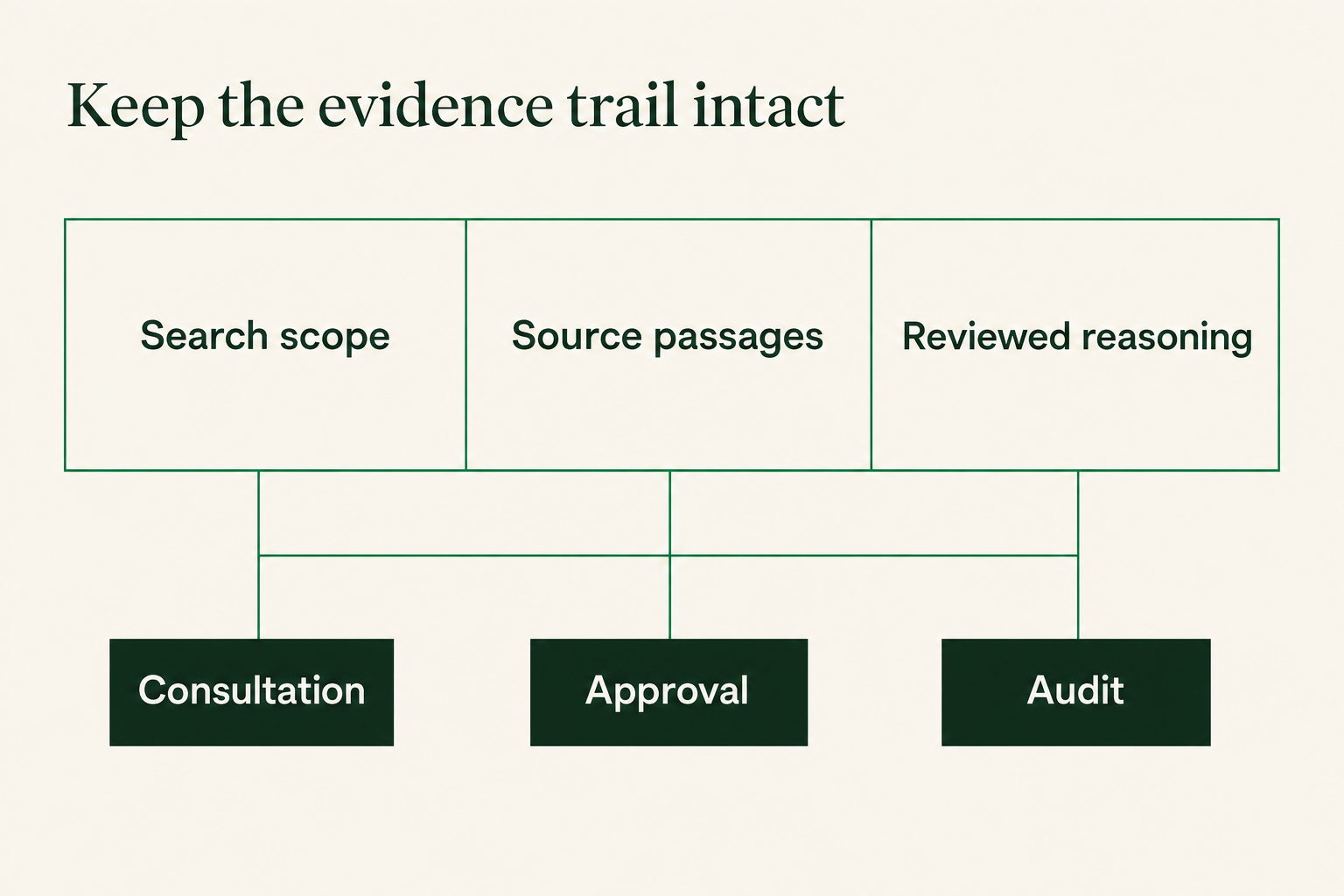
The order matters. A search result list, a draft notice, and a quality-audit finding are different work products with different review purposes. Preserve the search scope, passages, and reviewed reasoning as a connected evidence record across those handoffs.
Scroll horizontally to inspect the full diagram.
A shared evidence record connects JPO consultations, approvals, and quality audits.
Prepare evidence for a consultation
A useful consultation record makes the search question visible. State the claim features being investigated, relevant dates, and search branches already pursued. Keep the retrieved document, its publication identifier, and the specific passage together.
For an assisted search, add a short explanation of why each retained reference matters. Identify the exact condition, quantity, or technical term that needs discussion. Where a translation changes the apparent disclosure, retain both readings and the source-language wording so colleagues can resolve a defined question.
JPO working tip: Bring the disputed passage and its locator to the consultation. A precise question about a process limit gives colleagues a clearer starting point than an undifferentiated set of highly ranked results.
Where an outsourced search is involved, preserve the boundary between its search record and subsequent examination analysis. Bring the search scope, omitted branches, and retained passages into the same discussion record, without converting the provider’s summary into examination reasoning.
Keep evidence and proposed reasoning separable for approval
A director reviewing a proposed notice needs to follow the path from source disclosure to the stated reasoning. Structure an assistance record in separate parts:
- The relevant claim language and technical issue.
- The original source passage and precise locator.
- Any translation or generated explanation, clearly distinguished from the source.
- The proposed reasoning and any unresolved factual question.
This structure makes a specific correction possible. A reviewer can reject a translation, request another search branch, or revise an explanation without losing the underlying evidence.
JPO working tip: Preserve the wording used in the original reference when a generated summary substitutes a broader technical term. A passage about one operating condition can become misleading if the summary presents it as a general teaching.
Preserve the audit sequence
Keep the evidence record associated with the version submitted for approval. When a sampled notice reaches quality audit, the search inputs, retained passages, and proposed reasoning should remain recoverable. Route a discovered omission or reasoning problem through the appropriate correction process before dispatch.
Carry unresolved source-language questions across handoffs. When a summary changes, preserve the correction and its source locator so the approval and audit records refer to the same technical proposition.
Worked example: correct a translated process limit
Hypothetical example: A claim concerns drying a coated membrane at 90–100 °C. Paragraph 12 of fictional Reference A specifies “80°C以下,” meaning at or below 80 °C. A retained English translation renders it as “at least 80 °C,” reversing the upper limit into a lower limit. The proposed analysis consequently treats the passage as support for the claimed drying range.
- Consultation: Compare the Japanese phrase with the retained translation. Record the corrected upper limit, paragraph 12, and the reason the earlier reading was wrong. Revise the search brief to investigate the claimed 90–100 °C range.
- Approval: Remove the proposed assertion that paragraph 12 supports that range. Keep the original passage, corrected translation, and revised explanation together in the approval packet. Complete the additional search before relying on a replacement reference.
- Audit: Suppose the sampled notice contains the corrected explanation, but its attached reference summary still says “at least 80 °C.” The audit identifies that inconsistent reuse of the passage and routes the summary for correction before dispatch. Preserve the superseded wording with the correction record so the reason for the change remains recoverable.
The issue is a reversed numerical boundary. A correction must reach every place that relies on the passage, including the search brief, reference summary, and proposed reasoning.
Apply quality-management recommendations to a defined task
The subcommittee’s FY2025 report, issued in March 2026, describes existing quality-management activities and reports use of generative-AI services in examination operations. Its patent recommendations on printed pages 23–24 call for stronger examiner capabilities, a generative-AI pilot in quality-management procedures, and continued examiner-led improvements, including voluntary consultations. Quality audits and draft checking appear as examples in the supporting discussion; the pilot recommendation covers quality-management procedures. The discussion also addresses transparency, accountability, staff development, and the division of AI and human tasks.
For your proposed JPO pilot, define the assistance task narrowly: retrieving candidate passages, preparing a consultation summary, or flagging a possible gap in a draft. Keep the original evidence, generated suggestion, and staff correction distinguishable. Capture feedback as a concrete issue, such as a missed search branch or a translation that reverses a process limit.
Korea: preserve the handoffs between classification, translation, and search
MOIP’s reported uses span several tasks. Name the particular task and its downstream use in your proposal. Build an inspectable record at each handoff so a correction to classification or terminology reaches the search that depends on it.
Classification: keep the search route visible
Retain the classification suggested, the version of the classification scheme, and the technical description used as input. Record why a class was retained or set aside, and carry any unresolved subject matter into the search brief.
MOIP working tip: Keep a classification suggestion separate from a decision to exclude a technical field from the search. In the hypothetical membrane record above, a corrected drying limit should prompt review of any temperature-dependent categories and search branches that relied on the earlier translation.
Translation: retain the original technical proposition
Store the original Korean or foreign-language passage with the translation and a locator back to the source document. Keep alternative translations of a disputed term visible where they would change the search query or the reading of a reference.
MOIP working tip: Maintain a short, case-specific terminology record linking the Korean term, foreign-language equivalent, and source passage. Include abbreviations and alternative technical expressions that affect retrieval. A polished translation can otherwise conceal the exact wording needed for another search branch.
Prior-art search: retain the reason for keeping a reference
Document the searched concepts, classification branches, language choices, date boundaries, and sources used. A retained reference should include its publication identity, relevant passage, and connection to the technical issue. Record missing full text or uncertain publication information as unresolved evidence questions.
For non-patent literature (NPL), such as journal articles and conference papers, preserve the publication record and the version actually reviewed. An abstract and a full paper can support different levels of technical analysis. A defined NPL search scope keeps journal articles, conference material, and other technical publications visible alongside patent literature.
Examination support: show what changed after review
Keep generated explanations distinguishable from cited text. Preserve corrections to technical terms, source selections, and reasoning so the approved record remains intelligible without reconstructing a conversation.
For the same hypothetical membrane record, connect the corrected upper limit to the terminology record, any affected classification rationale, and the revised search brief. Preserve the Japanese passage and reviewed translation alongside the retained reference. The next reviewer can then follow how a language correction changed the search and the proposed analysis.
Keep the procurement brief tied to a defined assistance task
For either office, begin a commercial demonstration with published documents or approved synthetic material. Describe the expected work product: a search record with retained passages, a consultation brief, or a clearly marked draft-checking suggestion.
Keep these boundaries explicit in the brief:
- Data permissions: Which documents may enter the proposed environment, who may access them, and which handling rules apply to unpublished or restricted material.
- Evidence access: Which sources and language versions are available, how full text is accessed, and how gaps are identified.
- Record handling: Which inputs, outputs, corrections, and document versions must remain accessible, and under what retention arrangements.
- Technical scope: The intended environment, proposed office-system interfaces, and technical and procurement approval owners.
Use office terminology in the requested deliverables. A JPO consultation brief should support the consultation, approval, and audit sequence described above. A MOIP proposal should identify its place within classification, translation, prior-art search, or examination support. Avoid importing applicant-response or litigation templates into an examination-support requirement.
Where Patlytics fits
Patlytics organizes candidate prior art into citation-backed evidence and limitation mappings for JPO consultations and MOIP classification-to-search handoffs.
- Classification applies your team’s own taxonomy, producing AI-proposed categories you can edit or remove before application. Topic-labeled patent sets give a JPO consultation a defined starting set and help structure a MOIP classification-to-search brief.
- Patent & NPL Search covers patents and non-patent literature, including PubMed where biomedical literature is relevant. For the technical question specified, examiners receive ranked references with passage-level citations.
- Claim Charting produces citation-backed claim charts against the limitations under review. Exhaustive mode broadens claim-charting evidence discovery to the invention’s wider technical context when first-pass support is thin or raises potential-miss concerns. The passages and limitation mappings provide material for a JPO approval packet and sampled quality audit, or MOIP’s examination-support record after classification or translation corrections.
Patlytics has a SOC 2 Type II attestation, along with ISO 27001 and ISO/IEC 42001 certifications. Patlytics does not use customer data to tune or train its models without explicit consent or necessity.
Across these review workflows, examiners and responsible staff retain substantive decisions.
Build a source-linked prior-art review record that carries a technical correction through consultation, approval, and audit. Book a demo.

JPO and Korea: prior-art search assistance and examination-quality management
How should search assistance fit the examination practices your office already uses? For examination, search-quality, AI initiative, and procurement leads, a useful proposal must connect retrieved evidence to the people and procedures that review it. Japan and Korea provide different starting points: the Japan Patent Office (JPO) publishes a detailed quality-management framework, while Korea’s Ministry of Intellectual Property (MOIP) describes AI use alongside its AI Transformation in IP (IP-AX) initiative. The practical question is which assistance belongs at each stage, and what record should accompany it.
Scope: AI-assisted prior-art search and examination-quality support; examiners and responsible staff retain substantive decisions.
Start with each office’s published priorities
JPO: search development within an established quality framework
The JPO’s Rev.2025 action plan identifies “Prior Art Search (2),” labeled “Advanced Search” in the complete plan, as transitioning to agile development, with proof-of-concept (PoC) work scheduled for fiscal year (FY) 2025.
The revision temporarily suspends the earlier “Patent Examination Management” PoC and introduces “Application of Generative AI to JPO Patent Examination.” The complete action plan makes that project’s FY2026 agile-development transition conditional on PoC results, with schedules subject to progress, budgets, and other circumstances.
Korea: use MOIP for current work and KIPO for historical sources
Korea’s current office is the Ministry of Intellectual Property (MOIP), formerly the Korean Intellectual Property Office (KIPO). A later MOIP cooperation report, dated October 15, 2025, identifies October 1, 2025 as its inauguration date. Older publications and some official web addresses retain KIPO terminology.
In its July 2026 account of the IP5 meetings, the cooperation forum for 5 major intellectual property offices, MOIP reports current AI use in prior-art search, classification, translation, and examination. It also describes IP-AX, its initiative to build a next-generation AI-based IP administration system. The account records agreement on the Human-in-the-Loop principle.
MOIP’s 2027 budget proposal, announced on September 14, 2026, includes proposed development of a next-generation AI patent-search system. The proposal is subject to National Assembly review, with final approval anticipated in December 2026.
JPO: connect search assistance to consultations, approvals, and audits
The JPO’s patent quality guidance distinguishes Quality Assurance, Quality Verification, and External Evaluation on Quality Management. Within that framework:
- Consultations allow examiners to share technical knowledge and prior-art-search expertise.
- Approvals include directors’ substantive and formal Quality Checks before notices are sent. These address legal conformity, reasoning, and expression.
- Quality audits examine randomly sampled notices after directors’ approvals and before dispatch. Quality Management Officers review search validity and reasoning accuracy, allowing identified problems to be remedied before notices leave the office.
The order matters. A search result list, a draft notice, and a quality-audit finding are different work products with different review purposes. Preserve the search scope, passages, and reviewed reasoning as a connected evidence record across those handoffs.
Scroll horizontally to inspect the full diagram.
A shared evidence record connects JPO consultations, approvals, and quality audits.
Prepare evidence for a consultation
A useful consultation record makes the search question visible. State the claim features being investigated, relevant dates, and search branches already pursued. Keep the retrieved document, its publication identifier, and the specific passage together.
For an assisted search, add a short explanation of why each retained reference matters. Identify the exact condition, quantity, or technical term that needs discussion. Where a translation changes the apparent disclosure, retain both readings and the source-language wording so colleagues can resolve a defined question.
JPO working tip: Bring the disputed passage and its locator to the consultation. A precise question about a process limit gives colleagues a clearer starting point than an undifferentiated set of highly ranked results.
Where an outsourced search is involved, preserve the boundary between its search record and subsequent examination analysis. Bring the search scope, omitted branches, and retained passages into the same discussion record, without converting the provider’s summary into examination reasoning.
Keep evidence and proposed reasoning separable for approval
A director reviewing a proposed notice needs to follow the path from source disclosure to the stated reasoning. Structure an assistance record in separate parts:
- The relevant claim language and technical issue.
- The original source passage and precise locator.
- Any translation or generated explanation, clearly distinguished from the source.
- The proposed reasoning and any unresolved factual question.
This structure makes a specific correction possible. A reviewer can reject a translation, request another search branch, or revise an explanation without losing the underlying evidence.
JPO working tip: Preserve the wording used in the original reference when a generated summary substitutes a broader technical term. A passage about one operating condition can become misleading if the summary presents it as a general teaching.
Preserve the audit sequence
Keep the evidence record associated with the version submitted for approval. When a sampled notice reaches quality audit, the search inputs, retained passages, and proposed reasoning should remain recoverable. Route a discovered omission or reasoning problem through the appropriate correction process before dispatch.
Carry unresolved source-language questions across handoffs. When a summary changes, preserve the correction and its source locator so the approval and audit records refer to the same technical proposition.
Worked example: correct a translated process limit
Hypothetical example: A claim concerns drying a coated membrane at 90–100 °C. Paragraph 12 of fictional Reference A specifies “80°C以下,” meaning at or below 80 °C. A retained English translation renders it as “at least 80 °C,” reversing the upper limit into a lower limit. The proposed analysis consequently treats the passage as support for the claimed drying range.
- Consultation: Compare the Japanese phrase with the retained translation. Record the corrected upper limit, paragraph 12, and the reason the earlier reading was wrong. Revise the search brief to investigate the claimed 90–100 °C range.
- Approval: Remove the proposed assertion that paragraph 12 supports that range. Keep the original passage, corrected translation, and revised explanation together in the approval packet. Complete the additional search before relying on a replacement reference.
- Audit: Suppose the sampled notice contains the corrected explanation, but its attached reference summary still says “at least 80 °C.” The audit identifies that inconsistent reuse of the passage and routes the summary for correction before dispatch. Preserve the superseded wording with the correction record so the reason for the change remains recoverable.
The issue is a reversed numerical boundary. A correction must reach every place that relies on the passage, including the search brief, reference summary, and proposed reasoning.
Apply quality-management recommendations to a defined task
The subcommittee’s FY2025 report, issued in March 2026, describes existing quality-management activities and reports use of generative-AI services in examination operations. Its patent recommendations on printed pages 23–24 call for stronger examiner capabilities, a generative-AI pilot in quality-management procedures, and continued examiner-led improvements, including voluntary consultations. Quality audits and draft checking appear as examples in the supporting discussion; the pilot recommendation covers quality-management procedures. The discussion also addresses transparency, accountability, staff development, and the division of AI and human tasks.
For your proposed JPO pilot, define the assistance task narrowly: retrieving candidate passages, preparing a consultation summary, or flagging a possible gap in a draft. Keep the original evidence, generated suggestion, and staff correction distinguishable. Capture feedback as a concrete issue, such as a missed search branch or a translation that reverses a process limit.
Korea: preserve the handoffs between classification, translation, and search
MOIP’s reported uses span several tasks. Name the particular task and its downstream use in your proposal. Build an inspectable record at each handoff so a correction to classification or terminology reaches the search that depends on it.
Classification: keep the search route visible
Retain the classification suggested, the version of the classification scheme, and the technical description used as input. Record why a class was retained or set aside, and carry any unresolved subject matter into the search brief.
MOIP working tip: Keep a classification suggestion separate from a decision to exclude a technical field from the search. In the hypothetical membrane record above, a corrected drying limit should prompt review of any temperature-dependent categories and search branches that relied on the earlier translation.
Translation: retain the original technical proposition
Store the original Korean or foreign-language passage with the translation and a locator back to the source document. Keep alternative translations of a disputed term visible where they would change the search query or the reading of a reference.
MOIP working tip: Maintain a short, case-specific terminology record linking the Korean term, foreign-language equivalent, and source passage. Include abbreviations and alternative technical expressions that affect retrieval. A polished translation can otherwise conceal the exact wording needed for another search branch.
Prior-art search: retain the reason for keeping a reference
Document the searched concepts, classification branches, language choices, date boundaries, and sources used. A retained reference should include its publication identity, relevant passage, and connection to the technical issue. Record missing full text or uncertain publication information as unresolved evidence questions.
For non-patent literature (NPL), such as journal articles and conference papers, preserve the publication record and the version actually reviewed. An abstract and a full paper can support different levels of technical analysis. A defined NPL search scope keeps journal articles, conference material, and other technical publications visible alongside patent literature.
Examination support: show what changed after review
Keep generated explanations distinguishable from cited text. Preserve corrections to technical terms, source selections, and reasoning so the approved record remains intelligible without reconstructing a conversation.
For the same hypothetical membrane record, connect the corrected upper limit to the terminology record, any affected classification rationale, and the revised search brief. Preserve the Japanese passage and reviewed translation alongside the retained reference. The next reviewer can then follow how a language correction changed the search and the proposed analysis.
Keep the procurement brief tied to a defined assistance task
For either office, begin a commercial demonstration with published documents or approved synthetic material. Describe the expected work product: a search record with retained passages, a consultation brief, or a clearly marked draft-checking suggestion.
Keep these boundaries explicit in the brief:
- Data permissions: Which documents may enter the proposed environment, who may access them, and which handling rules apply to unpublished or restricted material.
- Evidence access: Which sources and language versions are available, how full text is accessed, and how gaps are identified.
- Record handling: Which inputs, outputs, corrections, and document versions must remain accessible, and under what retention arrangements.
- Technical scope: The intended environment, proposed office-system interfaces, and technical and procurement approval owners.
Use office terminology in the requested deliverables. A JPO consultation brief should support the consultation, approval, and audit sequence described above. A MOIP proposal should identify its place within classification, translation, prior-art search, or examination support. Avoid importing applicant-response or litigation templates into an examination-support requirement.
Where Patlytics fits
Patlytics organizes candidate prior art into citation-backed evidence and limitation mappings for JPO consultations and MOIP classification-to-search handoffs.
- Classification applies your team’s own taxonomy, producing AI-proposed categories you can edit or remove before application. Topic-labeled patent sets give a JPO consultation a defined starting set and help structure a MOIP classification-to-search brief.
- Patent & NPL Search covers patents and non-patent literature, including PubMed where biomedical literature is relevant. For the technical question specified, examiners receive ranked references with passage-level citations.
- Claim Charting produces citation-backed claim charts against the limitations under review. Exhaustive mode broadens claim-charting evidence discovery to the invention’s wider technical context when first-pass support is thin or raises potential-miss concerns. The passages and limitation mappings provide material for a JPO approval packet and sampled quality audit, or MOIP’s examination-support record after classification or translation corrections.
Patlytics has a SOC 2 Type II attestation, along with ISO 27001 and ISO/IEC 42001 certifications. Patlytics does not use customer data to tune or train its models without explicit consent or necessity.
Across these review workflows, examiners and responsible staff retain substantive decisions.
Build a source-linked prior-art review record that carries a technical correction through consultation, approval, and audit. Book a demo.
The Premier AI-Powered Patent Platform
Reduce cycle times. Increase margins. Deliver winning IP outcomes.
Book a DemoThe Premier AI-Powered
Patent Platform
Reduce cycle times. Increase margins. Deliver winning IP outcomes.