Markush structure search: a traceable patent workflow
October 9, 2026
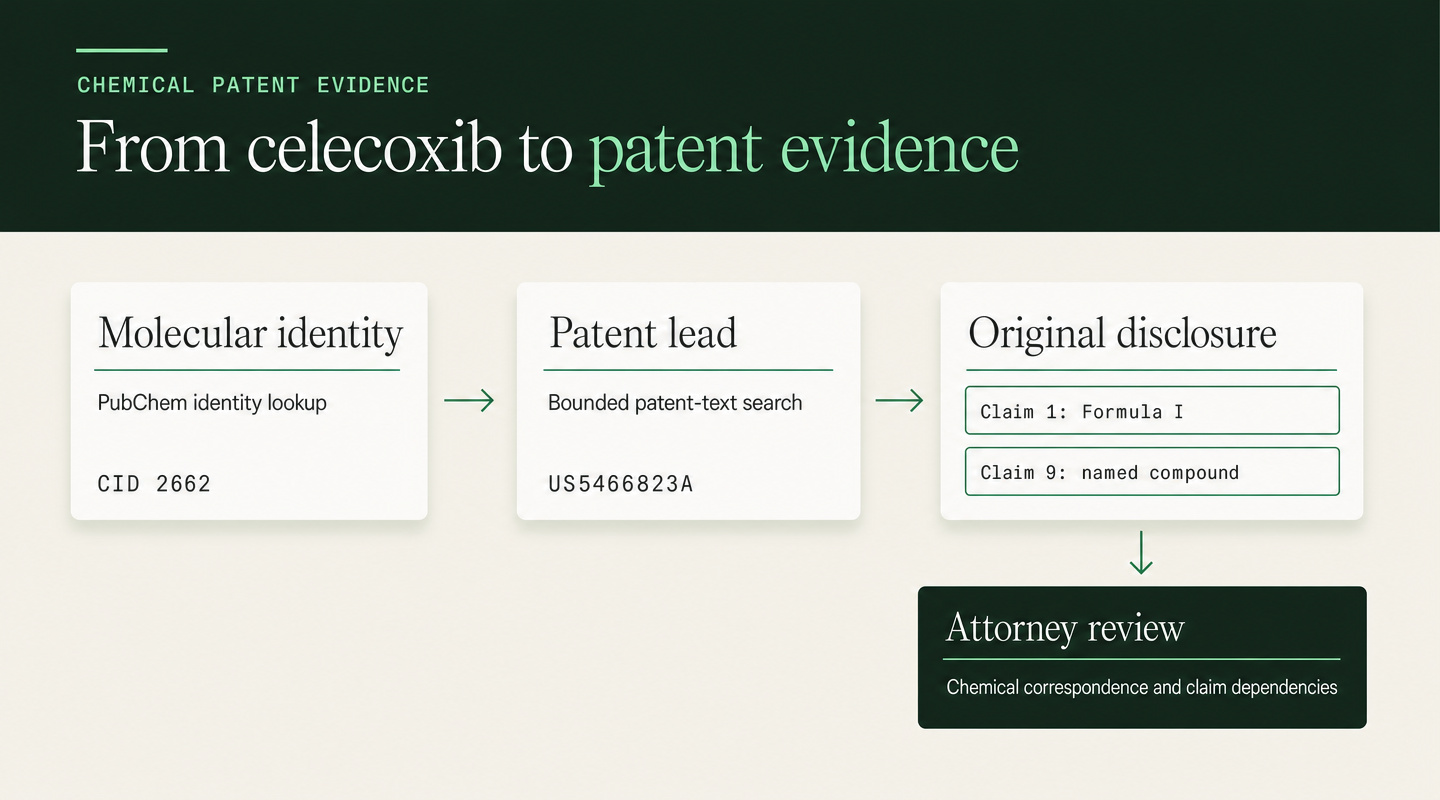
Your target compound is buried in a generic formula. Its substituent definitions sit pages away, and its common name never appears. Finding that disclosure takes more than a keyword hit: you need to reconstruct the molecule, match its attachment points, and carry the evidence into the right legal analysis. A disciplined Markush structure search workflow connects the chemical input to the original disclosure while keeping patentability separate from freedom to operate.
Scope: Educational guidance for attorney-led review, not a matter-specific legal opinion.
1. Define the legal question before drawing the query
A Markush structure represents a family of related molecules through a shared core and variable substituents. The diagram and its accompanying definitions work together. An R-group label such as R1 identifies a position whose permitted groups are defined elsewhere. The International Union of Pure and Applied Chemistry (IUPAC) defines a Markush structure through its core and substituents.
Your search brief should identify which decision the evidence will support:
| Objective | Question | Scope to record | Attorney's next assessment |
|---|---|---|---|
| Patentability | What earlier disclosures bear on the proposed chemical invention? | Proposed claim features, relevant dates, applicable jurisdiction, and patent plus non-patent literature | Novelty, inventive step or nonobviousness, and other patentability requirements |
| Freedom to operate (FTO) | What patent rights could affect the planned commercial activity? | Product composition, process, formulation, intended use, countries, and planned activity date | Current claims, claim interpretation, legal status, and product-to-claim mapping |
A patentability search can draw useful evidence from an expired patent. An FTO review requires the relevant territorial rights and current claims. Pending applications belong in a monitoring track because their claims can change. Owning a patent does not itself authorize commercial activity: a US patent confers a right to exclude, rather than an affirmative right to practice the invention. The US Patent and Trademark Office (USPTO) patent overview explains that distinction.
Attorney checkpoint: Approve the question, dates, jurisdictions, and technical scope before searching. Treat chemical disclosure, patentability, and FTO as separate findings throughout the matter. The broader FTO review workflow connects the product definition to claim analysis and launch decisions.
2. Choose what the chemical query must match
Exact structure, substructure, and similarity describe matching methods. Markush describes a generic chemical representation. An exact molecule or a substructure can therefore be searched against a Markush index. These are overlapping dimensions of a search, rather than 4 mutually exclusive modes.
| Search approach | What it retrieves | What to preserve | Review needed after retrieval |
|---|---|---|---|
| Exact structure | Indexed molecules matching the specified identity rules | Complete structure and handling of stereochemistry, isotopes, charge, and tautomers | Assess patent and chemical-index coverage |
| Substructure | Indexed molecules containing the specified atom-and-bond pattern | Retained scaffold, open attachment positions, bond rules, and relaxed constraints | Compare the full target with the disclosure and claims |
| Similarity | Molecules ranked by a selected chemical similarity measure | Representation, metric, threshold, and returned score | Test structural correspondence separately from the similarity score |
| Markush search | Generic definitions that match a molecule or structural query under the index's rules | Generic formula, variable definitions, dependencies, and matching settings | Assess the complete claim and its legally operative scope |
Similarity finds neighboring chemistry and vocabulary. Markush membership requires a separate comparison of the target's atoms, bonds, attachment positions, and substituents against the generic formula and its definitions.
For Markush review, capture conditions as well as lists. A definition may permit R1 and R2 to form a ring together, restrict a combination through a proviso, or vary the number of repeating units. Selecting an allowed group independently at each position can produce a combination the definition excludes.
3. Build an input packet and expand deliberately
Start with the chemist-approved target structure, including the specific form under consideration. Preserve the original drawing and a machine-readable structure file. Record whether the target is a neutral molecule, salt, stereoisomer, mixture, or particular solid-state form.
Add complementary representations:
- A simplified molecular-input line-entry system (SMILES) string encodes the molecular graph as text.
- The International Chemical Identifier (InChI) and its compact InChIKey provide additional identifiers. Preserve the full identifier alongside the structure.
- Systematic names, common names, development codes, and supported synonyms enable text retrieval.
- A defined substructure retains the scaffold while relaxing specified peripheral groups.
Keep normalization choices visible. Removing a counterion or relaxing stereochemistry changes the search question. Label the resulting query as an expansion and retain its relationship to the original input.
Build the first pass from exact structure and names. Expand into substructures, neighboring chemistry, and indexed Markush definitions. Add patent classifications, citations, and related applications as the retrieved documents reveal them. Search non-patent literature (NPL) for explicit compounds, synthetic routes, and technical disclosures relevant to the approved question.
An expansion log should explain what changed and why: “removed the para-methyl group to search the retained diarylpyrazole scaffold” is more informative than “broadened query.” Log unsuccessful and incomplete searches as well as useful hits.
4. Follow a public molecule into patent evidence
Celecoxib provides a traceable example because its identifiers and an early chemical patent are public. The example uses three bounded searches to show traceability.
Establish the molecular input
The PubChem compound record identifies celecoxib as compound identifier (CID) 2662. Its InChIKey is RZEKVGVHFLEQIL-UHFFFAOYSA-N. Its SMILES representation is:
CC1=CC=C(C=C1)C2=CC(=NN2C3=CC=C(C=C3)S(=O)(=O)N)C(F)(F)F
The systematic name connects the structure to text: 4-[5-(4-methylphenyl)-3-(trifluoromethyl)pyrazol-1-yl]benzenesulfonamide. The development code SC-58635 provides another route into the literature.
Preserve the query-to-result chain
The retrieval record separates a compound-identity result from a patent-text hit and a literature hit. The patent query uses a historical publication filter. A current FTO search needs a scope tied to the planned activity date and the relevant territorial rights.
| Record | Executed query and settings | Recorded result | Evidentiary meaning |
|---|---|---|---|
| Q1 | PubChem SMILES-input fastidentity lookup using the complete structure above; identity_type=same_stereo_isotope |
CID 2662 | The molecular input resolved to the celecoxib compound record under PubChem's identity settings |
| Q2 | Patent text search for "benzenesulfonamide", "4-methylphenyl", and "trifluoromethyl"; US documents published before January 1, 1996; relevance order; family deduplication |
US5466823A, Substituted pyrazolyl benzenesulfonamides, appeared in the retrieved results | A text-retrieved document lead for passage and structure review |
| Q3 | PubMed search for "SC-58635"[Title/Abstract]; no date filter |
PubMed identifier (PMID) 9135032, Penning and colleagues, published April 25, 1997 | A literature record linking the development code, chemical name, and celecoxib |
The example search record preserves the request URLs, settings, selected results, and review limits. The original identity response makes Q1 inspectable.
Q1–Q3 cover identity, patent-text, and literature retrieval. Indexed Markush, substructure, and similarity searches and complete patent-family, prosecution-history, and current legal-status reviews remain outside that record.
The Q2 result snippet quotes claim 12. Establishing the target correspondence requires opening the original document and reviewing the relevant claims and drawings. Assess coverage through the query log and coverage matrix, rather than the displayed result estimate.
The retrieved document, US5466823A, was published November 14, 1995. Its original patent document contains Formula I in claim 1 and names the target structure specifically in claims 9, 11, and 13. The patent uses the chemical name 4-[5-(4-methylphenyl)-3-(trifluoromethyl)-1H-pyrazol-1-yl]benzenesulfonamide rather than the later common name celecoxib. The named compound is a more direct disclosure lead than an inference drawn solely from the broad formula.
Map the molecule to the generic formula
Claim 1’s Formula I appears on PDF page 25 of 28, printed column 48. Its drawing fixes the attachment positions that the text alone cannot convey.
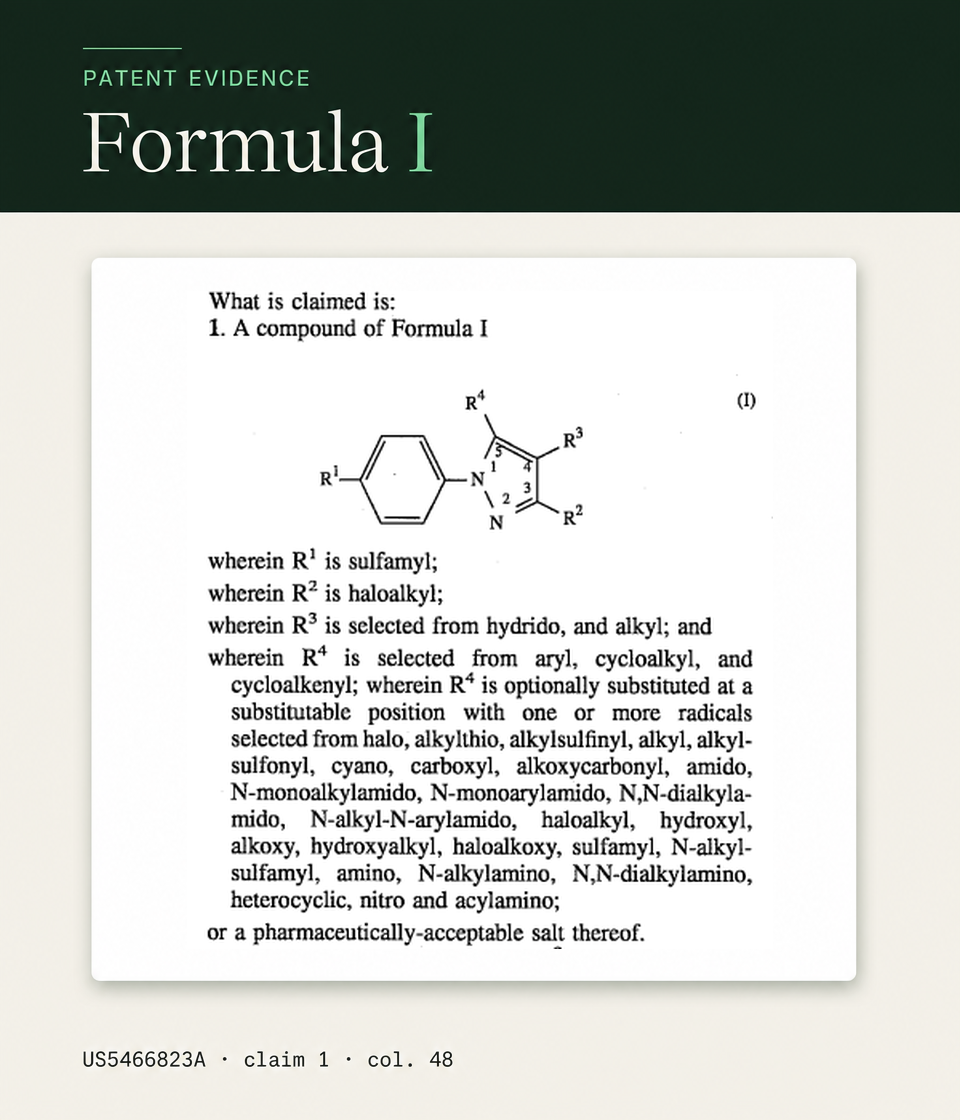
Match celecoxib to Formula I through 4 position-specific assignments:
| Formula I position | Celecoxib assignment | Claim 1 language relevant to review |
|---|---|---|
| R1 | Sulfamyl group, SO2NH2 | R1 is sulfamyl |
| R2 | Trifluoromethyl group, CF3 | R2 is haloalkyl |
| R3 | Hydrogen at the remaining pyrazole carbon | R3 permits hydrido or alkyl |
| R4 | 4-methylphenyl group | R4 permits aryl with optional alkyl substitution |
The reviewer must match these labels to the original drawing's attachment points, read the specification's definitions, and retain the complete claim text.
This also exposes a retrieval hazard: the searchable text version replaces the claim 1 formula with ##STR44##. The original patent preserves the diagram. Reading text alone would leave the attachment positions unexamined.
Keep the claim paths separate
Claim 9 appears on PDF page 26, printed column 50. It depends on claim 8, which depends on claim 7 and Formula II. That dependency chain is different from the claim 1 chain and belongs in its own review row.
Claims 11 and 13 also select the named structural compound and pharmaceutically acceptable salts. Both are compound-selection claims: claim 11 refers to a compound of claim 3, and claim 13 refers to a compound of claim 8. Keep those compound-reference paths distinct from composition and treatment-method claims.
| Evidence | Original-PDF locator | Disclosure and reference path |
|---|---|---|
| Claim 1, Formula I | PDF page 25/28, printed column 48 | Generic formula and variable definitions mapped above |
| Claim 9 | PDF page 26/28, printed column 50 | Named structural compound; claim path 9 → 8 → 7 and Formula II |
| Claim 11 | Target name: PDF page 26/28, printed column 50, lines 41–42 | Named structural compound and acceptable salts; compound-reference path 11 → 3 → 2 → 1. The complete claim continues through columns 51–52. |
| Claim 13 | Target name: PDF page 28/28, printed column 53, lines 15–16 | Named structural compound and acceptable salts; compound-reference path 13 → 8 → 7. The complete claim continues into column 54. |
| Example 1c | Target entry: PDF page 13/28, printed column 23, lines 11–14. Shared preparation statement: PDF page 12/28, printed column 22, lines 64–67. | Synthesis and disclosure evidence, separate from the claim-reference paths. Examples 1a–1j use procedures similar to Example 1 with the appropriate acetophenone substituted. Example 1c records the target as a yellow solid with a melting point of 157–159 °C and elemental analytical data. |
The Example 1c entry and shared preparation statement support the target's synthetic disclosure. Example 1 itself concerns a 4-chlorophenyl analogue; its yield belongs to that analogue.
Attorney checkpoint: Approve the structure correspondence and the claim chain. Keep the explicit compound disclosure, generic-formula mapping, and legal-scope assessment in separate evidence rows.
Assess the literature lead on its own terms
The Penning research record names SC-58635 and celecoxib and reports work on the diarylpyrazole series. Its abstract identifies the compound as 1i. Preserve that locator and the publication date with the evidence.
Record the paper's April 25, 1997 publication date separately from the patent's November 1995 publication date. Its relevance to a patentability question depends on the applicable dates and legal rules. Retrieve the full paper when synthesis or experimental detail is material; the recorded review covers the abstract.
5. Record coverage gaps before drawing conclusions
Full-text patent coverage and chemical-index coverage are different. A database can contain a patent while lacking a searchable structure from its drawing or generic formula.
For every database, retain a coverage row with:
- Patent authorities, historical start dates, and document types included.
- Whether chemical information comes from names, extracted drawings, explicit compound records, or indexed Markush definitions.
- Whether indexing includes claims, descriptions, or selected sections.
- Supported variability, including repeating groups, attachment positions, and substituent dependencies.
- Update lag, result caps, timeouts, and incomplete-search indicators.
- Available original documents, translations, and legal-status sources.
The World Intellectual Property Organization (WIPO) Markush search guidance illustrates why this matters. Its coverage table gives different starting years for different authorities, and its indexing policy distinguishes claims from selected description structures. A broad database label cannot replace those distinctions.
In a live matter, gaps determine the next search: an additional chemical index, manual formula review, original-language documents, related applications, or further literature retrieval. Log a timeout as incomplete. A zero-hit query records that no indexed records matched within the stated settings and coverage. Resolve material gaps before counsel reaches a patentability or FTO conclusion.
6. Deliver evidence an attorney can use
Each retained hit needs a compact evidence row: query ID, publication number or literature identifier, original-document locator, matching structure or passage, relevant dates, reviewer disposition, and unresolved issue. Keep excluded hits with a reason so later reviewers can distinguish an assessed mismatch from an unread result.
For patentability, distinguish explicit disclosure of the target compound from a generic formula encompassing it. Under US practice, a genus does not automatically anticipate every species within it. The disclosure and the ability to envisage the particular species matter, as explained in the USPTO genus-species guidance. Counsel also assesses whether the disclosure enables the claimed subject matter and whether other references bear on nonobviousness.
For FTO, organize the evidence around the specific country's operative claims and the planned activity. Counsel assesses the complete claim limitations, dependencies, prosecution history, and legal status. A compound search alone leaves process, formulation, solid-state, and use claims outside the review unless those subjects were included in the brief.
Artificial intelligence (AI) assists with passage extraction, summaries, and draft comparisons. For a chemical matter, retain the formula drawing, variable definitions, and specialist-approved correspondence with the comparison.
The final handoff should contain the approved search brief, input structures, query log, coverage matrix, retained evidence, and a separately reviewed legal assessment. That gives the attorney a route from the molecule to the source and makes the next search or decision explicit.
Where Patlytics fits
Patlytics picks up where the structure search ends. Once evidence is retrieved, the platform keeps chemistry in native form through review, charting, and drafting. Patent & NPL Search covers patents and non-patent literature, including PubMed. The FTO workflow starts from product literature.
Chemistry capabilities include an embedded structure editor, chemical image-to-SMILES conversion, ChemDraw input, and bulk text-to-structure input. Markush and R-group generation, agentic R-group editing, and Markush claim drafting carry that chemistry into drafting work.
Structures render inside claim limitations and inside invalidity and infringement charts in the Claim Charting module, so claims are compared against references in native form. Attorneys review the structures, source correspondence, and complete claim limitations before approving generated claims or charts. They retain decision authority for the legal analysis.
Book a demo focused on native chemistry review and drafting: your structures, retrieved patent evidence, Markush claims, and invalidity or infringement charts.

Markush structure search: a traceable patent workflow
Your target compound is buried in a generic formula. Its substituent definitions sit pages away, and its common name never appears. Finding that disclosure takes more than a keyword hit: you need to reconstruct the molecule, match its attachment points, and carry the evidence into the right legal analysis. A disciplined Markush structure search workflow connects the chemical input to the original disclosure while keeping patentability separate from freedom to operate.
Scope: Educational guidance for attorney-led review, not a matter-specific legal opinion.
1. Define the legal question before drawing the query
A Markush structure represents a family of related molecules through a shared core and variable substituents. The diagram and its accompanying definitions work together. An R-group label such as R1 identifies a position whose permitted groups are defined elsewhere. The International Union of Pure and Applied Chemistry (IUPAC) defines a Markush structure through its core and substituents.
Your search brief should identify which decision the evidence will support:
| Objective | Question | Scope to record | Attorney's next assessment |
|---|---|---|---|
| Patentability | What earlier disclosures bear on the proposed chemical invention? | Proposed claim features, relevant dates, applicable jurisdiction, and patent plus non-patent literature | Novelty, inventive step or nonobviousness, and other patentability requirements |
| Freedom to operate (FTO) | What patent rights could affect the planned commercial activity? | Product composition, process, formulation, intended use, countries, and planned activity date | Current claims, claim interpretation, legal status, and product-to-claim mapping |
A patentability search can draw useful evidence from an expired patent. An FTO review requires the relevant territorial rights and current claims. Pending applications belong in a monitoring track because their claims can change. Owning a patent does not itself authorize commercial activity: a US patent confers a right to exclude, rather than an affirmative right to practice the invention. The US Patent and Trademark Office (USPTO) patent overview explains that distinction.
Attorney checkpoint: Approve the question, dates, jurisdictions, and technical scope before searching. Treat chemical disclosure, patentability, and FTO as separate findings throughout the matter. The broader FTO review workflow connects the product definition to claim analysis and launch decisions.
2. Choose what the chemical query must match
Exact structure, substructure, and similarity describe matching methods. Markush describes a generic chemical representation. An exact molecule or a substructure can therefore be searched against a Markush index. These are overlapping dimensions of a search, rather than 4 mutually exclusive modes.
| Search approach | What it retrieves | What to preserve | Review needed after retrieval |
|---|---|---|---|
| Exact structure | Indexed molecules matching the specified identity rules | Complete structure and handling of stereochemistry, isotopes, charge, and tautomers | Assess patent and chemical-index coverage |
| Substructure | Indexed molecules containing the specified atom-and-bond pattern | Retained scaffold, open attachment positions, bond rules, and relaxed constraints | Compare the full target with the disclosure and claims |
| Similarity | Molecules ranked by a selected chemical similarity measure | Representation, metric, threshold, and returned score | Test structural correspondence separately from the similarity score |
| Markush search | Generic definitions that match a molecule or structural query under the index's rules | Generic formula, variable definitions, dependencies, and matching settings | Assess the complete claim and its legally operative scope |
Similarity finds neighboring chemistry and vocabulary. Markush membership requires a separate comparison of the target's atoms, bonds, attachment positions, and substituents against the generic formula and its definitions.
For Markush review, capture conditions as well as lists. A definition may permit R1 and R2 to form a ring together, restrict a combination through a proviso, or vary the number of repeating units. Selecting an allowed group independently at each position can produce a combination the definition excludes.
3. Build an input packet and expand deliberately
Start with the chemist-approved target structure, including the specific form under consideration. Preserve the original drawing and a machine-readable structure file. Record whether the target is a neutral molecule, salt, stereoisomer, mixture, or particular solid-state form.
Add complementary representations:
- A simplified molecular-input line-entry system (SMILES) string encodes the molecular graph as text.
- The International Chemical Identifier (InChI) and its compact InChIKey provide additional identifiers. Preserve the full identifier alongside the structure.
- Systematic names, common names, development codes, and supported synonyms enable text retrieval.
- A defined substructure retains the scaffold while relaxing specified peripheral groups.
Keep normalization choices visible. Removing a counterion or relaxing stereochemistry changes the search question. Label the resulting query as an expansion and retain its relationship to the original input.
Build the first pass from exact structure and names. Expand into substructures, neighboring chemistry, and indexed Markush definitions. Add patent classifications, citations, and related applications as the retrieved documents reveal them. Search non-patent literature (NPL) for explicit compounds, synthetic routes, and technical disclosures relevant to the approved question.
An expansion log should explain what changed and why: “removed the para-methyl group to search the retained diarylpyrazole scaffold” is more informative than “broadened query.” Log unsuccessful and incomplete searches as well as useful hits.
4. Follow a public molecule into patent evidence
Celecoxib provides a traceable example because its identifiers and an early chemical patent are public. The example uses three bounded searches to show traceability.
Establish the molecular input
The PubChem compound record identifies celecoxib as compound identifier (CID) 2662. Its InChIKey is RZEKVGVHFLEQIL-UHFFFAOYSA-N. Its SMILES representation is:
CC1=CC=C(C=C1)C2=CC(=NN2C3=CC=C(C=C3)S(=O)(=O)N)C(F)(F)F
The systematic name connects the structure to text: 4-[5-(4-methylphenyl)-3-(trifluoromethyl)pyrazol-1-yl]benzenesulfonamide. The development code SC-58635 provides another route into the literature.
Preserve the query-to-result chain
The retrieval record separates a compound-identity result from a patent-text hit and a literature hit. The patent query uses a historical publication filter. A current FTO search needs a scope tied to the planned activity date and the relevant territorial rights.
| Record | Executed query and settings | Recorded result | Evidentiary meaning |
|---|---|---|---|
| Q1 | PubChem SMILES-input fastidentity lookup using the complete structure above; identity_type=same_stereo_isotope |
CID 2662 | The molecular input resolved to the celecoxib compound record under PubChem's identity settings |
| Q2 | Patent text search for "benzenesulfonamide", "4-methylphenyl", and "trifluoromethyl"; US documents published before January 1, 1996; relevance order; family deduplication |
US5466823A, Substituted pyrazolyl benzenesulfonamides, appeared in the retrieved results | A text-retrieved document lead for passage and structure review |
| Q3 | PubMed search for "SC-58635"[Title/Abstract]; no date filter |
PubMed identifier (PMID) 9135032, Penning and colleagues, published April 25, 1997 | A literature record linking the development code, chemical name, and celecoxib |
The example search record preserves the request URLs, settings, selected results, and review limits. The original identity response makes Q1 inspectable.
Q1–Q3 cover identity, patent-text, and literature retrieval. Indexed Markush, substructure, and similarity searches and complete patent-family, prosecution-history, and current legal-status reviews remain outside that record.
The Q2 result snippet quotes claim 12. Establishing the target correspondence requires opening the original document and reviewing the relevant claims and drawings. Assess coverage through the query log and coverage matrix, rather than the displayed result estimate.
The retrieved document, US5466823A, was published November 14, 1995. Its original patent document contains Formula I in claim 1 and names the target structure specifically in claims 9, 11, and 13. The patent uses the chemical name 4-[5-(4-methylphenyl)-3-(trifluoromethyl)-1H-pyrazol-1-yl]benzenesulfonamide rather than the later common name celecoxib. The named compound is a more direct disclosure lead than an inference drawn solely from the broad formula.
Map the molecule to the generic formula
Claim 1’s Formula I appears on PDF page 25 of 28, printed column 48. Its drawing fixes the attachment positions that the text alone cannot convey.
Match celecoxib to Formula I through 4 position-specific assignments:
| Formula I position | Celecoxib assignment | Claim 1 language relevant to review |
|---|---|---|
| R1 | Sulfamyl group, SO2NH2 | R1 is sulfamyl |
| R2 | Trifluoromethyl group, CF3 | R2 is haloalkyl |
| R3 | Hydrogen at the remaining pyrazole carbon | R3 permits hydrido or alkyl |
| R4 | 4-methylphenyl group | R4 permits aryl with optional alkyl substitution |
The reviewer must match these labels to the original drawing's attachment points, read the specification's definitions, and retain the complete claim text.
This also exposes a retrieval hazard: the searchable text version replaces the claim 1 formula with ##STR44##. The original patent preserves the diagram. Reading text alone would leave the attachment positions unexamined.
Keep the claim paths separate
Claim 9 appears on PDF page 26, printed column 50. It depends on claim 8, which depends on claim 7 and Formula II. That dependency chain is different from the claim 1 chain and belongs in its own review row.
Claims 11 and 13 also select the named structural compound and pharmaceutically acceptable salts. Both are compound-selection claims: claim 11 refers to a compound of claim 3, and claim 13 refers to a compound of claim 8. Keep those compound-reference paths distinct from composition and treatment-method claims.
| Evidence | Original-PDF locator | Disclosure and reference path |
|---|---|---|
| Claim 1, Formula I | PDF page 25/28, printed column 48 | Generic formula and variable definitions mapped above |
| Claim 9 | PDF page 26/28, printed column 50 | Named structural compound; claim path 9 → 8 → 7 and Formula II |
| Claim 11 | Target name: PDF page 26/28, printed column 50, lines 41–42 | Named structural compound and acceptable salts; compound-reference path 11 → 3 → 2 → 1. The complete claim continues through columns 51–52. |
| Claim 13 | Target name: PDF page 28/28, printed column 53, lines 15–16 | Named structural compound and acceptable salts; compound-reference path 13 → 8 → 7. The complete claim continues into column 54. |
| Example 1c | Target entry: PDF page 13/28, printed column 23, lines 11–14. Shared preparation statement: PDF page 12/28, printed column 22, lines 64–67. | Synthesis and disclosure evidence, separate from the claim-reference paths. Examples 1a–1j use procedures similar to Example 1 with the appropriate acetophenone substituted. Example 1c records the target as a yellow solid with a melting point of 157–159 °C and elemental analytical data. |
The Example 1c entry and shared preparation statement support the target's synthetic disclosure. Example 1 itself concerns a 4-chlorophenyl analogue; its yield belongs to that analogue.
Attorney checkpoint: Approve the structure correspondence and the claim chain. Keep the explicit compound disclosure, generic-formula mapping, and legal-scope assessment in separate evidence rows.
Assess the literature lead on its own terms
The Penning research record names SC-58635 and celecoxib and reports work on the diarylpyrazole series. Its abstract identifies the compound as 1i. Preserve that locator and the publication date with the evidence.
Record the paper's April 25, 1997 publication date separately from the patent's November 1995 publication date. Its relevance to a patentability question depends on the applicable dates and legal rules. Retrieve the full paper when synthesis or experimental detail is material; the recorded review covers the abstract.
5. Record coverage gaps before drawing conclusions
Full-text patent coverage and chemical-index coverage are different. A database can contain a patent while lacking a searchable structure from its drawing or generic formula.
For every database, retain a coverage row with:
- Patent authorities, historical start dates, and document types included.
- Whether chemical information comes from names, extracted drawings, explicit compound records, or indexed Markush definitions.
- Whether indexing includes claims, descriptions, or selected sections.
- Supported variability, including repeating groups, attachment positions, and substituent dependencies.
- Update lag, result caps, timeouts, and incomplete-search indicators.
- Available original documents, translations, and legal-status sources.
The World Intellectual Property Organization (WIPO) Markush search guidance illustrates why this matters. Its coverage table gives different starting years for different authorities, and its indexing policy distinguishes claims from selected description structures. A broad database label cannot replace those distinctions.
In a live matter, gaps determine the next search: an additional chemical index, manual formula review, original-language documents, related applications, or further literature retrieval. Log a timeout as incomplete. A zero-hit query records that no indexed records matched within the stated settings and coverage. Resolve material gaps before counsel reaches a patentability or FTO conclusion.
6. Deliver evidence an attorney can use
Each retained hit needs a compact evidence row: query ID, publication number or literature identifier, original-document locator, matching structure or passage, relevant dates, reviewer disposition, and unresolved issue. Keep excluded hits with a reason so later reviewers can distinguish an assessed mismatch from an unread result.
For patentability, distinguish explicit disclosure of the target compound from a generic formula encompassing it. Under US practice, a genus does not automatically anticipate every species within it. The disclosure and the ability to envisage the particular species matter, as explained in the USPTO genus-species guidance. Counsel also assesses whether the disclosure enables the claimed subject matter and whether other references bear on nonobviousness.
For FTO, organize the evidence around the specific country's operative claims and the planned activity. Counsel assesses the complete claim limitations, dependencies, prosecution history, and legal status. A compound search alone leaves process, formulation, solid-state, and use claims outside the review unless those subjects were included in the brief.
Artificial intelligence (AI) assists with passage extraction, summaries, and draft comparisons. For a chemical matter, retain the formula drawing, variable definitions, and specialist-approved correspondence with the comparison.
The final handoff should contain the approved search brief, input structures, query log, coverage matrix, retained evidence, and a separately reviewed legal assessment. That gives the attorney a route from the molecule to the source and makes the next search or decision explicit.
Where Patlytics fits
Patlytics picks up where the structure search ends. Once evidence is retrieved, the platform keeps chemistry in native form through review, charting, and drafting. Patent & NPL Search covers patents and non-patent literature, including PubMed. The FTO workflow starts from product literature.
Chemistry capabilities include an embedded structure editor, chemical image-to-SMILES conversion, ChemDraw input, and bulk text-to-structure input. Markush and R-group generation, agentic R-group editing, and Markush claim drafting carry that chemistry into drafting work.
Structures render inside claim limitations and inside invalidity and infringement charts in the Claim Charting module, so claims are compared against references in native form. Attorneys review the structures, source correspondence, and complete claim limitations before approving generated claims or charts. They retain decision authority for the legal analysis.
Book a demo focused on native chemistry review and drafting: your structures, retrieved patent evidence, Markush claims, and invalidity or infringement charts.
The Premier AI-Powered Patent Platform
Reduce cycle times. Increase margins. Deliver winning IP outcomes.
Book a DemoThe Premier AI-Powered
Patent Platform
Reduce cycle times. Increase margins. Deliver winning IP outcomes.