Paragraph IV: an evidence checklist for patent counsel
November 6, 2026
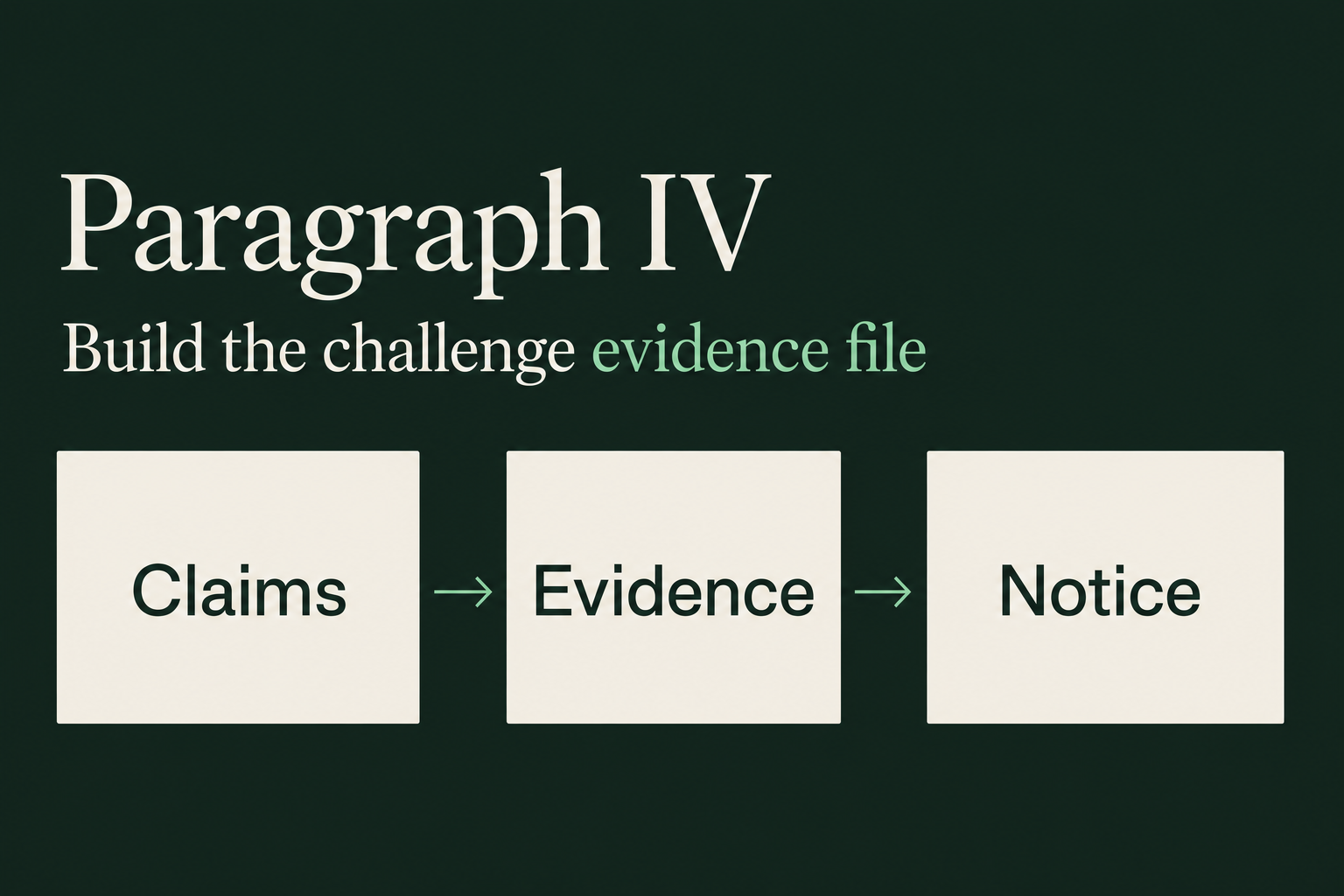
What evidence should counsel have ready before a Paragraph IV patent challenge? The work spans regulatory correspondence, patent claims, proposed product specifications, and litigation preparation. A missed receipt record can distort the timeline. An unsupported claim mapping can weaken the position behind the notice.
For U.S. abbreviated new drug application (ANDA) challenges, connect patent identification, notice preparation, and coordinated invalidity analysis in one evidence file.
What a Paragraph IV certification puts in issue
A Paragraph IV certification states the applicant's position that a relevant Orange Book-listed patent is invalid, unenforceable, or will not be infringed by the proposed generic product. The Orange Book is the Food and Drug Administration's (FDA) publication of approved drug products and related patent and exclusivity information. FDA describes the certification and related notification in its patent certification explanation.
Build the supporting analysis claim by claim. Keep noninfringement, invalidity, and unenforceability theories separately labeled, even when they concern the same patent. A product specification supports a different proposition from a prior-art publication or a prosecution-history document.
For qualifying pre-expiry approval submissions, 35 U.S.C. §271(e)(2) supplies the artificial act of infringement used to litigate before launch. Notice starts separate procedural clocks.
For counsel receiving notice, the same structure supports the response: identify the claims addressed, isolate each asserted ground, and locate the evidence needed to assess it.
Paragraph IV timeline: the 4 clocks counsel track
Keep original correspondence, transmission records, and recipient-specific delivery evidence together. Record actual events alongside calculated dates.
| Checkpoint | Timing rule | Evidence to preserve |
|---|---|---|
| 20-day initial notice | After receipt of FDA's acknowledgment letter, within 20 days after its postmark. | Letter, postmark, receipt, and dispatch record. |
| 45-day suit window | Qualifying infringement suit within 45 days of notice receipt; each recipient's day 1 is the following day. | Recipient-specific receipts, complaint, and filing date. |
| 30-month approval stay | Ordinarily runs from the later receipt by the patent owner or new drug application (NDA) holder. | Controlling receipts and operative court orders. |
| 30-day receipt amendment | Due within 30 days after the last required recipient receives notice. | Timely-sending proof, individual receipts, and dated Orange Book printout. |
Count the initial 20 days from the day after the postmark. Roll 20- and 45-day deadlines forward when they fall on a weekend or federal holiday. Send no earlier than acknowledgment receipt and the first working day after patent listing, under the notice timing rules.
The ordinary stay concerns patents whose required information was submitted before the original ANDA. Later-listed patents, court rulings, cooperation adjustments, and the special 5-year-exclusivity provision can change the approval timing calculation.
Keep approval timing and launch risk separate. Track final FDA approval, other patent and exclusivity barriers, and any injunction or settlement obligation. A freedom-to-operate review addresses launch exposure, including litigation risk after the 45-day window.
1. Identify the product, listed patents, and exact claims
Start with a fixed product-and-application record. Capture the reference listed drug, NDA number, active ingredient, dosage form, strength, proposed labeling, and the ANDA version under review. Preserve scientific identity, including relevant salt form, stereochemistry, formulation, or release characteristics. The life-sciences evidence workflow explains that scientific source record.
Then build a patent-specific index:
- Patent number, issued document, owner information, and dated Orange Book entry.
- Drug-substance, drug-product, or method-of-use category, including use code and relevant labeling.
- Listed expiration date and the documents supporting any material term issue.
- Certification or statement applicable to each patent, with its submission history.
- Claims addressed by each proposed theory, including dependencies and exact claim text.
- Specification passages, prosecution records, and any court constructions relevant to disputed terms.
For a method-of-use patent, align the claim, listed use, and approval sought. A use outside the requested approval can implicate a section viii statement, as provided in 21 U.S.C. §355(j)(2). Keep that assessment patent-specific.
Maintain a separate record of relevant unlisted patents. Orange Book listing categories exclude process patents, among other categories, under the patent listing regulation.
Carry every incorporated limitation into a dependent-claim analysis. Section 112 specifies that dependent claims incorporate limitations from the claims they reference; each claim also carries its own presumption of validity. Extend an independent-claim theory only after addressing each dependent claim's added requirements.
2. Assemble the notice package and delivery record
Use the eCFR notice requirements as the controlling checklist:
- Recipients and identity: confirm every required recipient, address, application, product, patent, and expiration date.
- Content: include the required statements and detailed factual/legal grounds, plus applicable service-agent and confidential-access provisions. Reconcile each ground with the approved claim analysis.
- Delivery: use a permitted method; preserve the exact notice, dispatch proof, and each recipient's receipt. Resolve disputed deliveries before calculating deadlines.
- Later certifications: send notice simultaneously with a qualifying amendment or supplement submitted after acknowledgment.
- FDA amendments: track the §314.95(b)(3) notice-compliance certification separately from the §314.95(e) timely-sending and receipt documentation. Assign each requirement an owner and preserve submission records.
3. Connect every claim position to inspectable evidence
Use one evidence register to coordinate the challenge file. Create a separate row for each material claim, limitation, theory, or timing event. The register organizes counsel's work; the notice and any later filing retain their own content requirements.
| Evidence lane | What belongs in the record | Question to resolve before use |
|---|---|---|
| Noninfringement | Exact claim limitation, construction, proposed product or labeling passage, specification range, and document version. | Does the evidence address the product and use for which approval is sought? |
| Prior-art invalidity | Claim limitation, reference identifier, pinpoint disclosure, relevant dates, and proposed ground. | What supports both the technical mapping and the reference's legal qualification? |
| Other invalidity or unenforceability | Specific ground, supporting patent or prosecution documents, material facts, and contrary evidence. | Which elements of the theory remain unsupported? |
| Notice and timing | Triggering event, original record, recipient, operative rule, calculation, and responsible counsel. | Which document establishes the event and controlling date? |
Keep the source passage separate from the analyst's explanation. Preserve the whole document, supplements, figures, and experimental conditions needed to understand the excerpt. An empty mapping should carry a specific next action, such as obtaining the analytical method or locating the missing formulation range.
For noninfringement, attach the relevant ANDA specifications and proposed labeling version. Reconcile formulation, testing, process, or labeling changes with the existing analysis before relying on it again.
For invalidity, distinguish what a document discloses from when it became available or effective as prior art. Record the applicable pre-America Invents Act or America Invents Act framework. For the latter, assess the Section 102 date requirements, subject-matter support, and exceptions. A search cutoff belongs in the research record; counsel's prior-art qualification belongs in the legal analysis.
4. Coordinate invalidity preparation across forums
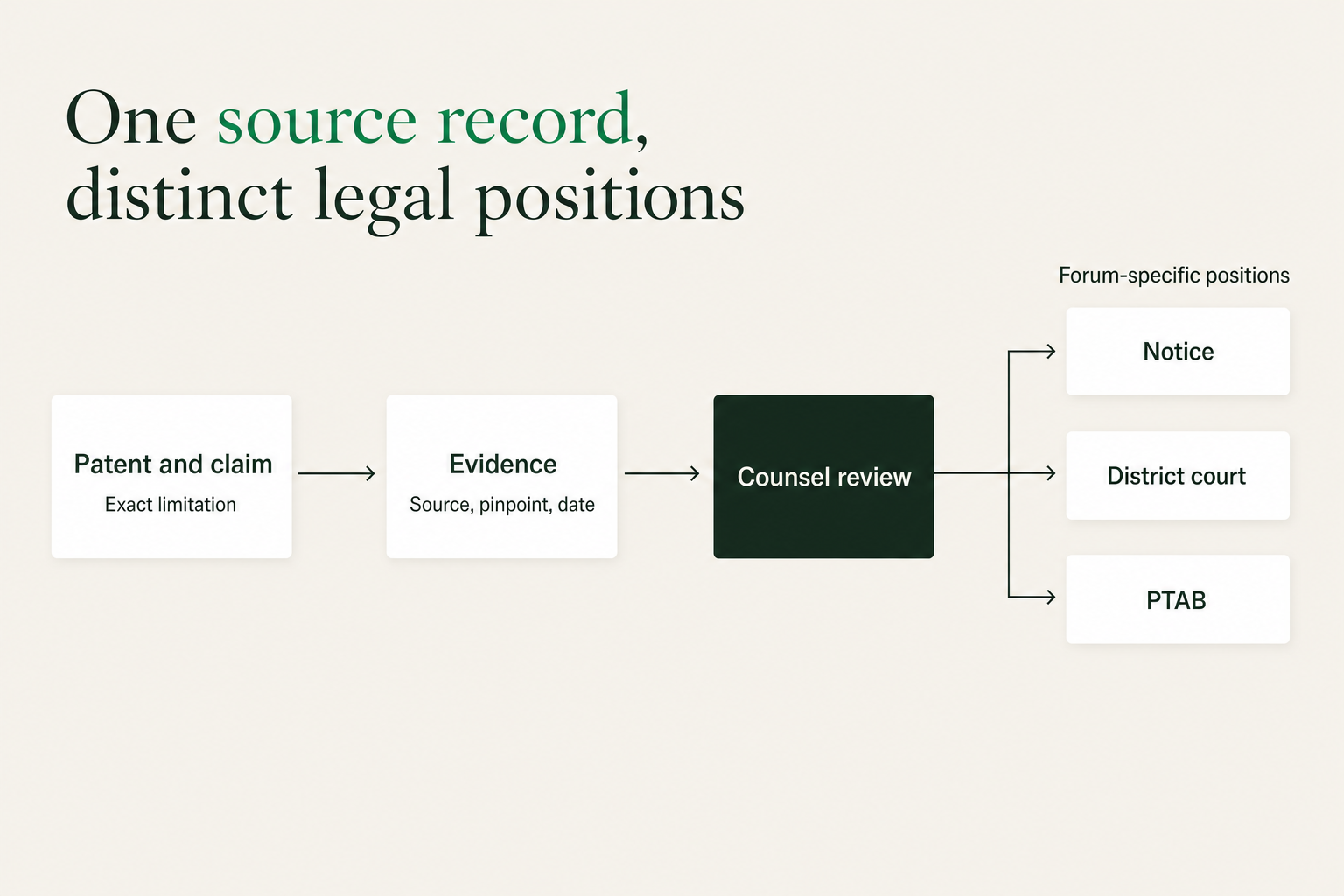
Develop the notice position with the likely litigation evidence needs in view. Preserve the selected claims, constructions, reference disclosures, qualification dates, and technical explanations in a common source record. Keep the forum-specific arguments separately approved.
For an anticipation theory, organize the evidence supporting the complete claimed combination in the asserted reference. For obviousness, develop the proposed combination, reasons for combining, expected results, and material contrary evidence. Address the claimed invention as a whole under 35 U.S.C. §103.
If inter partes review (IPR) before the Patent Trial and Appeal Board (PTAB) is under consideration, divide the evidence accordingly. IPR permits Section 102 or 103 grounds based on patents or printed publications, as specified in 35 U.S.C. §311. Written-description, enablement, and other theories require a separately scoped forum analysis.
Keep a short PTAB decision record covering:
- Challenged claims, proposed grounds, reference copies, and supporting expert evidence required by the petition evidence requirements.
- Patent grant and any post-grant-review dates relevant to petition timing.
- Complaint service on the petitioner, real party in interest, or privy, and the generally applicable 1-year bar.
- Prior validity actions and potential estoppel following a final written decision under the parallel proceeding provisions.
- The institution decision and any resulting changes to the district-court strategy.
Assign one attorney to reconcile inconsistent constructions, missing dependent-claim mappings, and changes in the proposed reference combinations before either filing proceeds.
Fictional example: separate product identity from timing
A list-style record gives you an identification starting point:
| Field | Illustrative value |
|---|---|
| Active ingredient | Example compound A |
| Dosage form and strength | Extended-release tablets, 50 mg |
| Reference listed drug and NDA | Example XR, 000000 |
| First Paragraph IV submission | September 8, 2026 |
| Potential first-applicant ANDAs | 1 |
| 180-day status | Blank |
Match the dosage form, strength, and NDA before linking a product record to a patent review.
For the challenge file, obtain the listed patents, claims addressed, acknowledgment letter, notice, receipts, and any court record. Leave those fields unresolved until their own sources supply them. In particular, the submission date cannot supply a notice-receipt date for a stay calculation.
FDA's list field explanations state that a blank newer-entry field generally means a determination has yet to be made or the relevant event has yet to occur. FDA bases regulatory decisions on application data.
Keep first-applicant status and 180-day exclusivity in a separate regulatory record. Under the current statutory framework, first-applicant status turns on qualifying first-day submission and lawful maintenance of a certification. Multiple applicants can qualify; forfeiture rules apply. The period generally begins with first commercial marketing by any first applicant under Section 355(j)(5)(B)(iv). A litigation victory and a public list row answer different questions from exclusivity eligibility.
5. Close the handoff with named decisions
Before dispatch or a litigation handoff, have responsible counsel close these checkpoints:
- Patent and claim scope: every certification, claim position, dependency, and relevant use is accounted for.
- Technical support: product evidence and prior-art disclosures are separately mapped, with source pinpoints and open issues.
- Notice readiness: required content, recipients, dispatch method, and released version are approved.
- Timing: acknowledgment, listing, dispatch, receipt, and litigation events have their own supporting records.
- FDA amendment checkpoints: responsibility is assigned for both the §314.95(b)(3) notice-compliance certification and §314.95(e) receipt documentation. Preserve the filed statements, supporting documentation, and submission records.
- Forum strategy: district-court and possible PTAB positions are reconciled, with separate timing and estoppel decisions.
Carry forward unresolved issues with an owner and next action. That gives receiving counsel a usable record for the next decision without reconstructing the challenge from disconnected correspondence.
Where Patlytics fits
Patlytics supports the substantive claim analysis behind a Paragraph IV challenge:
- Patent & NPL Search: searches patents and non-patent literature (NPL), including PubMed, to develop the candidate-reference set for Invalidity analysis.
- Invalidity and Claim Charting: generate citation-backed, limitation-level invalidity charts and contention-chart work product. Infringement charts map product evidence; Detection Reports support infringement investigation. Exhaustive mode provides deeper coverage on selected priority claims.
- Claim Construction: proposes editable constructions with specification pin cites and re-runs the chart with the edited construction.
- §112 Check: analyzes written-description, enablement, and definiteness issues for the separately scoped validity review.
- Scientific representations: the structure editor, image-to-SMILES (simplified molecular input line entry system), Markush/R-group generation, and sequence uploads with complementarity-determining-region (CDR) detection support life-sciences materials.
- Handoff: Word, Excel, and PDF exports support preparation of counsel's working evidence package.
Counsel retains review and approval authority over sources, charts, constructions, grounds, and legal positions.
Build a source-linked claim evidence package for your Paragraph IV preparation. Book a demo focused on prior-art analysis, claim charts, and counsel-ready exports.

Paragraph IV: an evidence checklist for patent counsel
What evidence should counsel have ready before a Paragraph IV patent challenge? The work spans regulatory correspondence, patent claims, proposed product specifications, and litigation preparation. A missed receipt record can distort the timeline. An unsupported claim mapping can weaken the position behind the notice.
For U.S. abbreviated new drug application (ANDA) challenges, connect patent identification, notice preparation, and coordinated invalidity analysis in one evidence file.
What a Paragraph IV certification puts in issue
A Paragraph IV certification states the applicant's position that a relevant Orange Book-listed patent is invalid, unenforceable, or will not be infringed by the proposed generic product. The Orange Book is the Food and Drug Administration's (FDA) publication of approved drug products and related patent and exclusivity information. FDA describes the certification and related notification in its patent certification explanation.
Build the supporting analysis claim by claim. Keep noninfringement, invalidity, and unenforceability theories separately labeled, even when they concern the same patent. A product specification supports a different proposition from a prior-art publication or a prosecution-history document.
For qualifying pre-expiry approval submissions, 35 U.S.C. §271(e)(2) supplies the artificial act of infringement used to litigate before launch. Notice starts separate procedural clocks.
For counsel receiving notice, the same structure supports the response: identify the claims addressed, isolate each asserted ground, and locate the evidence needed to assess it.
Paragraph IV timeline: the 4 clocks counsel track
Keep original correspondence, transmission records, and recipient-specific delivery evidence together. Record actual events alongside calculated dates.
| Checkpoint | Timing rule | Evidence to preserve |
|---|---|---|
| 20-day initial notice | After receipt of FDA's acknowledgment letter, within 20 days after its postmark. | Letter, postmark, receipt, and dispatch record. |
| 45-day suit window | Qualifying infringement suit within 45 days of notice receipt; each recipient's day 1 is the following day. | Recipient-specific receipts, complaint, and filing date. |
| 30-month approval stay | Ordinarily runs from the later receipt by the patent owner or new drug application (NDA) holder. | Controlling receipts and operative court orders. |
| 30-day receipt amendment | Due within 30 days after the last required recipient receives notice. | Timely-sending proof, individual receipts, and dated Orange Book printout. |
Count the initial 20 days from the day after the postmark. Roll 20- and 45-day deadlines forward when they fall on a weekend or federal holiday. Send no earlier than acknowledgment receipt and the first working day after patent listing, under the notice timing rules.
The ordinary stay concerns patents whose required information was submitted before the original ANDA. Later-listed patents, court rulings, cooperation adjustments, and the special 5-year-exclusivity provision can change the approval timing calculation.
Keep approval timing and launch risk separate. Track final FDA approval, other patent and exclusivity barriers, and any injunction or settlement obligation. A freedom-to-operate review addresses launch exposure, including litigation risk after the 45-day window.
1. Identify the product, listed patents, and exact claims
Start with a fixed product-and-application record. Capture the reference listed drug, NDA number, active ingredient, dosage form, strength, proposed labeling, and the ANDA version under review. Preserve scientific identity, including relevant salt form, stereochemistry, formulation, or release characteristics. The life-sciences evidence workflow explains that scientific source record.
Then build a patent-specific index:
- Patent number, issued document, owner information, and dated Orange Book entry.
- Drug-substance, drug-product, or method-of-use category, including use code and relevant labeling.
- Listed expiration date and the documents supporting any material term issue.
- Certification or statement applicable to each patent, with its submission history.
- Claims addressed by each proposed theory, including dependencies and exact claim text.
- Specification passages, prosecution records, and any court constructions relevant to disputed terms.
For a method-of-use patent, align the claim, listed use, and approval sought. A use outside the requested approval can implicate a section viii statement, as provided in 21 U.S.C. §355(j)(2). Keep that assessment patent-specific.
Maintain a separate record of relevant unlisted patents. Orange Book listing categories exclude process patents, among other categories, under the patent listing regulation.
Carry every incorporated limitation into a dependent-claim analysis. Section 112 specifies that dependent claims incorporate limitations from the claims they reference; each claim also carries its own presumption of validity. Extend an independent-claim theory only after addressing each dependent claim's added requirements.
2. Assemble the notice package and delivery record
Use the eCFR notice requirements as the controlling checklist:
- Recipients and identity: confirm every required recipient, address, application, product, patent, and expiration date.
- Content: include the required statements and detailed factual/legal grounds, plus applicable service-agent and confidential-access provisions. Reconcile each ground with the approved claim analysis.
- Delivery: use a permitted method; preserve the exact notice, dispatch proof, and each recipient's receipt. Resolve disputed deliveries before calculating deadlines.
- Later certifications: send notice simultaneously with a qualifying amendment or supplement submitted after acknowledgment.
- FDA amendments: track the §314.95(b)(3) notice-compliance certification separately from the §314.95(e) timely-sending and receipt documentation. Assign each requirement an owner and preserve submission records.
3. Connect every claim position to inspectable evidence
Use one evidence register to coordinate the challenge file. Create a separate row for each material claim, limitation, theory, or timing event. The register organizes counsel's work; the notice and any later filing retain their own content requirements.
| Evidence lane | What belongs in the record | Question to resolve before use |
|---|---|---|
| Noninfringement | Exact claim limitation, construction, proposed product or labeling passage, specification range, and document version. | Does the evidence address the product and use for which approval is sought? |
| Prior-art invalidity | Claim limitation, reference identifier, pinpoint disclosure, relevant dates, and proposed ground. | What supports both the technical mapping and the reference's legal qualification? |
| Other invalidity or unenforceability | Specific ground, supporting patent or prosecution documents, material facts, and contrary evidence. | Which elements of the theory remain unsupported? |
| Notice and timing | Triggering event, original record, recipient, operative rule, calculation, and responsible counsel. | Which document establishes the event and controlling date? |
Keep the source passage separate from the analyst's explanation. Preserve the whole document, supplements, figures, and experimental conditions needed to understand the excerpt. An empty mapping should carry a specific next action, such as obtaining the analytical method or locating the missing formulation range.
For noninfringement, attach the relevant ANDA specifications and proposed labeling version. Reconcile formulation, testing, process, or labeling changes with the existing analysis before relying on it again.
For invalidity, distinguish what a document discloses from when it became available or effective as prior art. Record the applicable pre-America Invents Act or America Invents Act framework. For the latter, assess the Section 102 date requirements, subject-matter support, and exceptions. A search cutoff belongs in the research record; counsel's prior-art qualification belongs in the legal analysis.
4. Coordinate invalidity preparation across forums
Develop the notice position with the likely litigation evidence needs in view. Preserve the selected claims, constructions, reference disclosures, qualification dates, and technical explanations in a common source record. Keep the forum-specific arguments separately approved.
For an anticipation theory, organize the evidence supporting the complete claimed combination in the asserted reference. For obviousness, develop the proposed combination, reasons for combining, expected results, and material contrary evidence. Address the claimed invention as a whole under 35 U.S.C. §103.
If inter partes review (IPR) before the Patent Trial and Appeal Board (PTAB) is under consideration, divide the evidence accordingly. IPR permits Section 102 or 103 grounds based on patents or printed publications, as specified in 35 U.S.C. §311. Written-description, enablement, and other theories require a separately scoped forum analysis.
Keep a short PTAB decision record covering:
- Challenged claims, proposed grounds, reference copies, and supporting expert evidence required by the petition evidence requirements.
- Patent grant and any post-grant-review dates relevant to petition timing.
- Complaint service on the petitioner, real party in interest, or privy, and the generally applicable 1-year bar.
- Prior validity actions and potential estoppel following a final written decision under the parallel proceeding provisions.
- The institution decision and any resulting changes to the district-court strategy.
Assign one attorney to reconcile inconsistent constructions, missing dependent-claim mappings, and changes in the proposed reference combinations before either filing proceeds.
Fictional example: separate product identity from timing
A list-style record gives you an identification starting point:
| Field | Illustrative value |
|---|---|
| Active ingredient | Example compound A |
| Dosage form and strength | Extended-release tablets, 50 mg |
| Reference listed drug and NDA | Example XR, 000000 |
| First Paragraph IV submission | September 8, 2026 |
| Potential first-applicant ANDAs | 1 |
| 180-day status | Blank |
Match the dosage form, strength, and NDA before linking a product record to a patent review.
For the challenge file, obtain the listed patents, claims addressed, acknowledgment letter, notice, receipts, and any court record. Leave those fields unresolved until their own sources supply them. In particular, the submission date cannot supply a notice-receipt date for a stay calculation.
FDA's list field explanations state that a blank newer-entry field generally means a determination has yet to be made or the relevant event has yet to occur. FDA bases regulatory decisions on application data.
Keep first-applicant status and 180-day exclusivity in a separate regulatory record. Under the current statutory framework, first-applicant status turns on qualifying first-day submission and lawful maintenance of a certification. Multiple applicants can qualify; forfeiture rules apply. The period generally begins with first commercial marketing by any first applicant under Section 355(j)(5)(B)(iv). A litigation victory and a public list row answer different questions from exclusivity eligibility.
5. Close the handoff with named decisions
Before dispatch or a litigation handoff, have responsible counsel close these checkpoints:
- Patent and claim scope: every certification, claim position, dependency, and relevant use is accounted for.
- Technical support: product evidence and prior-art disclosures are separately mapped, with source pinpoints and open issues.
- Notice readiness: required content, recipients, dispatch method, and released version are approved.
- Timing: acknowledgment, listing, dispatch, receipt, and litigation events have their own supporting records.
- FDA amendment checkpoints: responsibility is assigned for both the §314.95(b)(3) notice-compliance certification and §314.95(e) receipt documentation. Preserve the filed statements, supporting documentation, and submission records.
- Forum strategy: district-court and possible PTAB positions are reconciled, with separate timing and estoppel decisions.
Carry forward unresolved issues with an owner and next action. That gives receiving counsel a usable record for the next decision without reconstructing the challenge from disconnected correspondence.
Where Patlytics fits
Patlytics supports the substantive claim analysis behind a Paragraph IV challenge:
- Patent & NPL Search: searches patents and non-patent literature (NPL), including PubMed, to develop the candidate-reference set for Invalidity analysis.
- Invalidity and Claim Charting: generate citation-backed, limitation-level invalidity charts and contention-chart work product. Infringement charts map product evidence; Detection Reports support infringement investigation. Exhaustive mode provides deeper coverage on selected priority claims.
- Claim Construction: proposes editable constructions with specification pin cites and re-runs the chart with the edited construction.
- §112 Check: analyzes written-description, enablement, and definiteness issues for the separately scoped validity review.
- Scientific representations: the structure editor, image-to-SMILES (simplified molecular input line entry system), Markush/R-group generation, and sequence uploads with complementarity-determining-region (CDR) detection support life-sciences materials.
- Handoff: Word, Excel, and PDF exports support preparation of counsel's working evidence package.
Counsel retains review and approval authority over sources, charts, constructions, grounds, and legal positions.
Build a source-linked claim evidence package for your Paragraph IV preparation. Book a demo focused on prior-art analysis, claim charts, and counsel-ready exports.
The Premier AI-Powered Patent Platform
Reduce cycle times. Increase margins. Deliver winning IP outcomes.
Book a DemoThe Premier AI-Powered
Patent Platform
Reduce cycle times. Increase margins. Deliver winning IP outcomes.