Patent budget allocation: where the next dollar should go
Where should your next patent-budget dollar go when existing applications, new inventions, foreign filings, and renewals all compete for it? The hardest choice is often between a familiar expense and a new business priority. A useful allocation plan makes the consequence of each choice visible before you authorize the work.
For a U.S.-led in-house intellectual property (IP) team with international assets, the roadmap starts with approved commitments, then compares the additional protection each proposed investment would buy.
1. Establish how much budget remains available
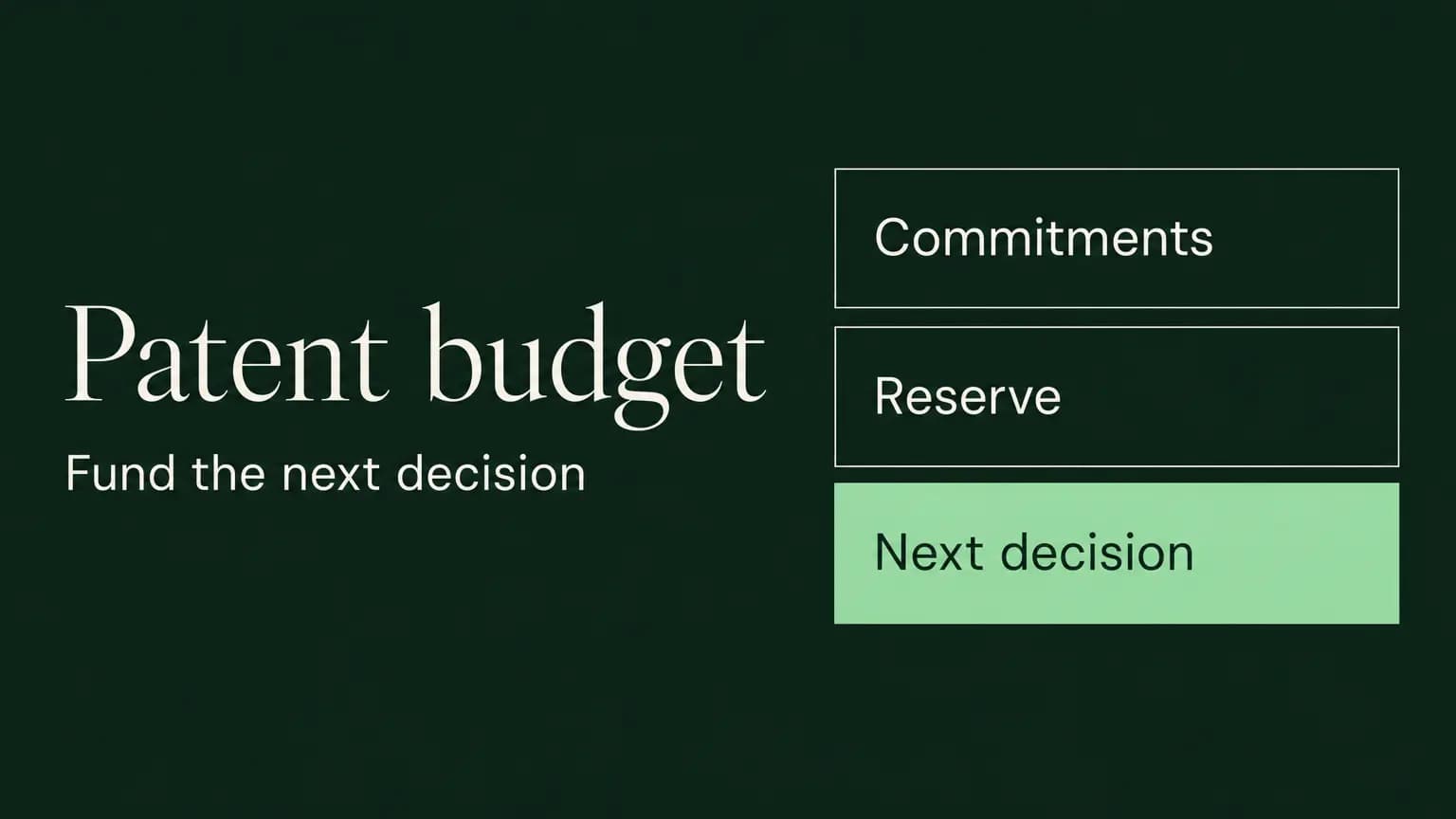
A patent budget is a forward spending plan for creating, prosecuting, extending, and retaining patent rights. The total matters less to the next decision than the amount still available after approved work and a contingency reserve.
Start with 3 amounts:
- Approved baseline: unpaid invoices, work already authorized, and forecast prosecution and retention costs for assets the business has decided to support.
- Decision pool: money available for new approvals, including unresolved continuation, country-entry, and renewal choices.
- Reserve: money held for uncertain timing or additional work on approved matters, such as another examiner response or translation costs above the estimate.
Put each expense in only 1 category. A foreign-filing deadline can be predictable while the decision to fund that country remains open. Keep it in the decision pool until approved. Likewise, a renewal appearing on the docket still needs a retention decision.
Ask outside counsel for matter-level estimates showing professional fees, official fees, local counsel, translations, currency assumptions, and expected billing periods. Match those estimates to work already incurred so the same response appears only once. Separate cash expected within the budget period from later commitments created by today's authorization.
Set the reserve against identified uncertainty. A standard percentage can hide a portfolio concentrated around several expensive decision dates. Keep staffing, litigation, and platform spending separately visible if they sit inside the same departmental ceiling.
2. Make each funding request an incremental decision
The next dollar should fund the highest-priority, decision-ready package that protects a named business objective within its decision window. That package could be an examiner response, a new application, an additional claim strategy, a country entry, or a renewal.
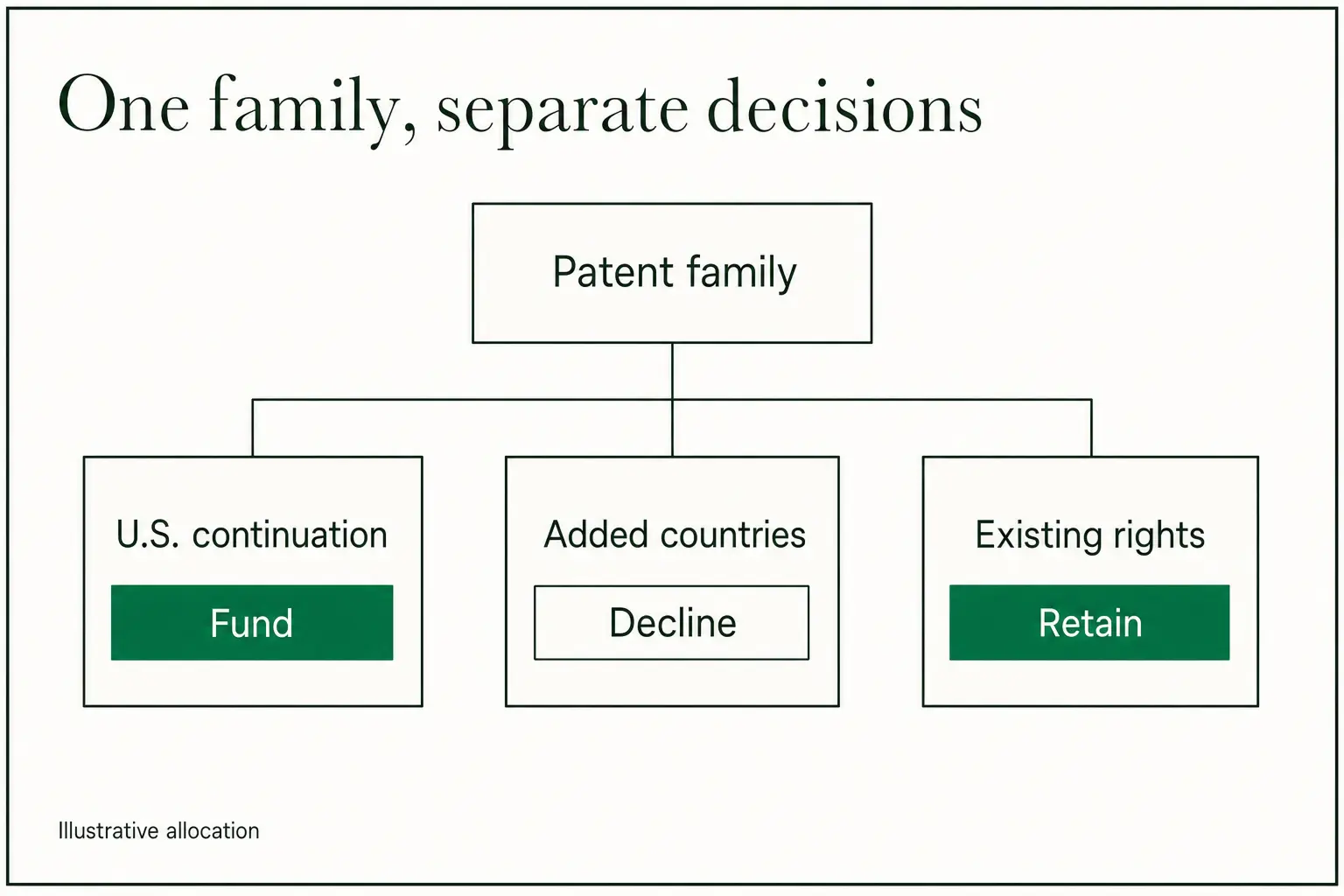
Use the patent family, a group of related applications, to understand the invention. Use the individual funding decision to authorize spending. One family may justify continuing U.S. prosecution while receiving no additional country entries.
For every request, record:
- Commercial purpose: the product, roadmap milestone, manufacturing activity, or specific licensing objective served, with a business owner.
- Incremental protection: the claim scope, territory, or remaining term the expenditure adds or preserves compared with the portfolio already funded.
- Decision window: the legal deadline, internal instruction date, and consequence of declining or waiting.
- Forward cost: cash needed this period and expected follow-on prosecution, translation, and retention costs.
- Evidence and dependencies: the supporting claims, technical materials, market facts, and any linked authorization needed for the package to work.
- Recommendation: fund, fund a narrower package, resolve a named evidence gap, or decline.
Keep portfolio cost analysis as an input to this decision. Historical spending explains how the portfolio reached its current state; the allocation question concerns what another expenditure achieves.
Rank requests by business importance and the protection at stake. Use the decision window to determine when action is necessary. An approaching deadline calls for a prompt decision, including an explicit decline when the commercial case is weak.
Where evidence is incomplete, authorize a bounded analysis task with a deliverable and an instruction date. For example, a claim-to-product assessment may resolve a continuation question before the team commits to filing and prosecution. Put that assessment's cost in the same funding request.
3. Apply a different funding test to each category
Existing commitments: preserve the approved objective
Protect the work needed to deliver an approved claim strategy. For a pending application, connect the next prosecution expense to the claims still worth pursuing and the product or business purpose they serve.
If the examination record has narrowed the likely outcome or the product roadmap has changed, reopen the authorization before the next major expense. Request a recommendation explaining the remaining claim objective, the next procedural step, and its cost. An instruction to continue should have a substantive destination.
Keep the baseline current as matters change. Previously authorized work belongs in the forecast until the responsible owner changes the instruction and accounts for costs already incurred.
New filings: close a named roadmap gap
Give priority to inventions supporting important work that existing claims do not adequately address. For a fictional medical-device company developing catheter-based delivery systems, a new catheter-steering mechanism may deserve funding ahead of another application around a mature product with several relevant families.
The request should include inventor materials, the technical distinction, the relevant existing families, a prior-art search assessment, and planned external disclosures. Prior art means earlier material relevant to assessing patentability. The business owner supplies the product milestone; patent counsel supplies the filing recommendation.
Fund the work through a defined next gate. Depending on the filing route, a first application creates later conversion, prosecution, or international decisions. Show those expected costs beside the current request, even when they fall outside this year's cash budget.
When the strongest opportunity lacks sufficient technical detail, the next expenditure may be an inventor session and targeted assessment. Budget for the work needed to reach a filing decision.
Continuations: identify the additional claim objective
A U.S. continuation pursues additional claims to an invention disclosed in a qualifying parent application and adds no new matter, as explained in the USPTO's continuation guidance.
Require the proposed claim objective and its commercial purpose. Have counsel confirm support for each proposed claim at the earlier filing date sought, along with copendency, at least 1 common inventor, and proper benefit references under the USPTO's earlier-date requirements. Explain how the objective differs from claims already granted or being pursued, considering remaining useful patent term and any double-patenting implications.
Schedule the decision while the required application remains pending. Include applicable age-based continuing-application charges from the USPTO fee schedule in the cost estimate.
Preserving a pending family can have strategic value when a defined product direction is still developing. Name that direction and set the next review event. “Keep options open” needs a concrete claim and business rationale to compete with a new filing.
International protection: approve each family-market pair
Treat each proposed jurisdiction as its own investment. Record the relevant sales, manufacturing, import activity, or licensing opportunity, together with the claims that could matter there. A valuable family can support a selective country plan.
Under the Patent Cooperation Treaty (PCT), national-phase entry takes the international application before selected national or regional offices. Entry is generally due 30 months from the priority date, subject to office-specific time limits. Entry can require translations, local representation, and national fees. The WIPO PCT summary explains these steps.
Build the request around the actual destination and deadline. Include expected prosecution and later renewal costs, rather than pricing only the initial entry. For a regional route, account for later territorial choices and costs as well.
A smaller market may justify protection because an important manufacturing step occurs there. A large market may remain a lower priority if the relevant claims have little commercial application. Tie the country choice to the invention's role in the business.
Retention: preserve a continuing purpose
Review the particular asset and jurisdiction approaching payment. Establish the remaining claim relevance, useful term, and business purpose. A patent can remain relevant to licensing or contractual obligations after your own product moves on.
Keep assets subject to licenses, joint ownership, transaction commitments, or active disputes visible to the responsible counsel before any lapse instruction. An acquired portfolio also needs ownership and obligation review alongside its technology classification.
The existing portfolio-pruning guide addresses the deeper asset review. For allocation, carry forward the approved retention decision and its cash consequence. Release funds only after the instruction is authorized and the avoided expense is reconciled with the forecast.
A fictional 2026 patent-budget allocation
Consider that fictional medical-device company allocating its remaining 2026 budget. It has $360,000 available, with $210,000 allocated to approved existing prosecution and retention work and $30,000 reserved for identified uncertainty. The decision pool is $120,000.
The IP lead and business owners agree on the following order. Amounts are fictional planning allocations.
| Priority and decision | Evidence driving the allocation | 2026 allocation and outcome |
|---|---|---|
| 1. New catheter-steering family | Launch-critical mechanism; no relevant existing family; filing recommendation complete | $35,000 funded through the first-filing gate |
| 2. U.S. continuation | Supported claim objective addresses a planned catheter variant; required parent application remains pending | $20,000 funded for filing and planned prosecution work |
| 3. National-phase entries for a core family | 2 selected jurisdictions correspond to the product's sales and manufacturing plan; local cost estimates complete | $45,000 funded across the selected entries |
| 4. Retain selected deployment-mechanism patents | Current product relevance and remaining useful term support the payment | $20,000 funded for the identified renewals |
| 5. New guidewire-exchange filing | Distinct mechanism and favorable filing recommendation; lower-priority roadmap milestone; filing can follow the next budget decision | $15,000 request remains unfunded |
| Decline additional country entries | No approved market or manufacturing objective for those destinations | $25,000 request declined |
The first 4 decisions consume the entire $120,000 pool. The guidewire-exchange filing remains unfunded. If an additional $15,000 becomes available through a budget increase or an approved reallocation, that filing is first in line, provided its decision window and evidence still hold. It ranks ahead of additional country entries because it serves a defined roadmap need.
A $20,000 cut requires a new choice about protection. The team can consider narrowing a country package or changing another authorization, then state the consequence. Trimming every category by the same percentage would conceal those choices.
For each funded request, show expected later costs alongside this period's allocation. The $35,000 first-filing authorization, for example, also creates a future prosecution and geographic-selection decision. Finance needs visibility into that continuing demand before approving an expansion of the filing plan.
Reallocate when the underlying decision changes
Reopen the queue when a launch shifts, a claim strategy changes, a manufacturing location moves, or an acquisition adds assets and obligations. Carry the changed evidence into the affected requests, then revise the baseline, reserve, and remaining pool.
Present Finance with a short decision record:
- The funded packages and the business objectives they serve.
- Current-period cash and expected follow-on costs.
- The first unfunded package and the amount needed to authorize it.
- The protection forgone under a reduced-budget scenario.
- Named owners and instruction dates for unresolved choices.
This gives the next budget discussion a specific decision: which additional protection deserves funding, and what would the business give up to pay for it?
Where Patlytics fits
Patlytics helps assemble the patent and product evidence behind each funding request:
- Classification applies your team's own taxonomy to the assets under review, creating consistent groups for allocation discussions.
- Clustering groups related technical subject matter, helping organize families around the roadmap areas receiving investment.
- Portfolio Heatmaps visualize patent-to-product relationships grouped by classification, connecting the allocation discussion to your business categories.
- Portfolio Analysis supports patent-to-product mapping across the portfolio, connecting existing assets to the products behind funding requests.
- Patent Pruning uses portfolio-level patent-to-product mapping to surface assets with weak or no current product coverage for claim-relevance assessment and retention review.
For proposed filings, Invention Disclosures (IDF) turns inventor materials, slides, and spoken input into reviewable disclosures. Patent & NPL Search covers patents and non-patent literature (NPL), including PubMed, for prior-art work. §112 Check assists written-description and enablement review relevant to proposed claims and continuation support. These outputs supply substantive evidence for the funding recommendation.
Attorneys retain substantive review and legal decision authority, and authorized IP and business owners approve spending and portfolio actions.
Build a patent-budget allocation backed by organized portfolio and patent-to-product evidence. Book a demo to work through your filing and retention priorities with Patlytics.

Patent budget allocation: where the next dollar should go
Where should your next patent-budget dollar go when existing applications, new inventions, foreign filings, and renewals all compete for it? The hardest choice is often between a familiar expense and a new business priority. A useful allocation plan makes the consequence of each choice visible before you authorize the work.
For a U.S.-led in-house intellectual property (IP) team with international assets, the roadmap starts with approved commitments, then compares the additional protection each proposed investment would buy.
1. Establish how much budget remains available
A patent budget is a forward spending plan for creating, prosecuting, extending, and retaining patent rights. The total matters less to the next decision than the amount still available after approved work and a contingency reserve.
Start with 3 amounts:
- Approved baseline: unpaid invoices, work already authorized, and forecast prosecution and retention costs for assets the business has decided to support.
- Decision pool: money available for new approvals, including unresolved continuation, country-entry, and renewal choices.
- Reserve: money held for uncertain timing or additional work on approved matters, such as another examiner response or translation costs above the estimate.
Put each expense in only 1 category. A foreign-filing deadline can be predictable while the decision to fund that country remains open. Keep it in the decision pool until approved. Likewise, a renewal appearing on the docket still needs a retention decision.
Ask outside counsel for matter-level estimates showing professional fees, official fees, local counsel, translations, currency assumptions, and expected billing periods. Match those estimates to work already incurred so the same response appears only once. Separate cash expected within the budget period from later commitments created by today's authorization.
Set the reserve against identified uncertainty. A standard percentage can hide a portfolio concentrated around several expensive decision dates. Keep staffing, litigation, and platform spending separately visible if they sit inside the same departmental ceiling.
2. Make each funding request an incremental decision
The next dollar should fund the highest-priority, decision-ready package that protects a named business objective within its decision window. That package could be an examiner response, a new application, an additional claim strategy, a country entry, or a renewal.
Use the patent family, a group of related applications, to understand the invention. Use the individual funding decision to authorize spending. One family may justify continuing U.S. prosecution while receiving no additional country entries.
For every request, record:
- Commercial purpose: the product, roadmap milestone, manufacturing activity, or specific licensing objective served, with a business owner.
- Incremental protection: the claim scope, territory, or remaining term the expenditure adds or preserves compared with the portfolio already funded.
- Decision window: the legal deadline, internal instruction date, and consequence of declining or waiting.
- Forward cost: cash needed this period and expected follow-on prosecution, translation, and retention costs.
- Evidence and dependencies: the supporting claims, technical materials, market facts, and any linked authorization needed for the package to work.
- Recommendation: fund, fund a narrower package, resolve a named evidence gap, or decline.
Keep portfolio cost analysis as an input to this decision. Historical spending explains how the portfolio reached its current state; the allocation question concerns what another expenditure achieves.
Rank requests by business importance and the protection at stake. Use the decision window to determine when action is necessary. An approaching deadline calls for a prompt decision, including an explicit decline when the commercial case is weak.
Where evidence is incomplete, authorize a bounded analysis task with a deliverable and an instruction date. For example, a claim-to-product assessment may resolve a continuation question before the team commits to filing and prosecution. Put that assessment's cost in the same funding request.
3. Apply a different funding test to each category
Existing commitments: preserve the approved objective
Protect the work needed to deliver an approved claim strategy. For a pending application, connect the next prosecution expense to the claims still worth pursuing and the product or business purpose they serve.
If the examination record has narrowed the likely outcome or the product roadmap has changed, reopen the authorization before the next major expense. Request a recommendation explaining the remaining claim objective, the next procedural step, and its cost. An instruction to continue should have a substantive destination.
Keep the baseline current as matters change. Previously authorized work belongs in the forecast until the responsible owner changes the instruction and accounts for costs already incurred.
New filings: close a named roadmap gap
Give priority to inventions supporting important work that existing claims do not adequately address. For a fictional medical-device company developing catheter-based delivery systems, a new catheter-steering mechanism may deserve funding ahead of another application around a mature product with several relevant families.
The request should include inventor materials, the technical distinction, the relevant existing families, a prior-art search assessment, and planned external disclosures. Prior art means earlier material relevant to assessing patentability. The business owner supplies the product milestone; patent counsel supplies the filing recommendation.
Fund the work through a defined next gate. Depending on the filing route, a first application creates later conversion, prosecution, or international decisions. Show those expected costs beside the current request, even when they fall outside this year's cash budget.
When the strongest opportunity lacks sufficient technical detail, the next expenditure may be an inventor session and targeted assessment. Budget for the work needed to reach a filing decision.
Continuations: identify the additional claim objective
A U.S. continuation pursues additional claims to an invention disclosed in a qualifying parent application and adds no new matter, as explained in the USPTO's continuation guidance.
Require the proposed claim objective and its commercial purpose. Have counsel confirm support for each proposed claim at the earlier filing date sought, along with copendency, at least 1 common inventor, and proper benefit references under the USPTO's earlier-date requirements. Explain how the objective differs from claims already granted or being pursued, considering remaining useful patent term and any double-patenting implications.
Schedule the decision while the required application remains pending. Include applicable age-based continuing-application charges from the USPTO fee schedule in the cost estimate.
Preserving a pending family can have strategic value when a defined product direction is still developing. Name that direction and set the next review event. “Keep options open” needs a concrete claim and business rationale to compete with a new filing.
International protection: approve each family-market pair
Treat each proposed jurisdiction as its own investment. Record the relevant sales, manufacturing, import activity, or licensing opportunity, together with the claims that could matter there. A valuable family can support a selective country plan.
Under the Patent Cooperation Treaty (PCT), national-phase entry takes the international application before selected national or regional offices. Entry is generally due 30 months from the priority date, subject to office-specific time limits. Entry can require translations, local representation, and national fees. The WIPO PCT summary explains these steps.
Build the request around the actual destination and deadline. Include expected prosecution and later renewal costs, rather than pricing only the initial entry. For a regional route, account for later territorial choices and costs as well.
A smaller market may justify protection because an important manufacturing step occurs there. A large market may remain a lower priority if the relevant claims have little commercial application. Tie the country choice to the invention's role in the business.
Retention: preserve a continuing purpose
Review the particular asset and jurisdiction approaching payment. Establish the remaining claim relevance, useful term, and business purpose. A patent can remain relevant to licensing or contractual obligations after your own product moves on.
Keep assets subject to licenses, joint ownership, transaction commitments, or active disputes visible to the responsible counsel before any lapse instruction. An acquired portfolio also needs ownership and obligation review alongside its technology classification.
The existing portfolio-pruning guide addresses the deeper asset review. For allocation, carry forward the approved retention decision and its cash consequence. Release funds only after the instruction is authorized and the avoided expense is reconciled with the forecast.
A fictional 2026 patent-budget allocation
Consider that fictional medical-device company allocating its remaining 2026 budget. It has $360,000 available, with $210,000 allocated to approved existing prosecution and retention work and $30,000 reserved for identified uncertainty. The decision pool is $120,000.
The IP lead and business owners agree on the following order. Amounts are fictional planning allocations.
| Priority and decision | Evidence driving the allocation | 2026 allocation and outcome |
|---|---|---|
| 1. New catheter-steering family | Launch-critical mechanism; no relevant existing family; filing recommendation complete | $35,000 funded through the first-filing gate |
| 2. U.S. continuation | Supported claim objective addresses a planned catheter variant; required parent application remains pending | $20,000 funded for filing and planned prosecution work |
| 3. National-phase entries for a core family | 2 selected jurisdictions correspond to the product's sales and manufacturing plan; local cost estimates complete | $45,000 funded across the selected entries |
| 4. Retain selected deployment-mechanism patents | Current product relevance and remaining useful term support the payment | $20,000 funded for the identified renewals |
| 5. New guidewire-exchange filing | Distinct mechanism and favorable filing recommendation; lower-priority roadmap milestone; filing can follow the next budget decision | $15,000 request remains unfunded |
| Decline additional country entries | No approved market or manufacturing objective for those destinations | $25,000 request declined |
The first 4 decisions consume the entire $120,000 pool. The guidewire-exchange filing remains unfunded. If an additional $15,000 becomes available through a budget increase or an approved reallocation, that filing is first in line, provided its decision window and evidence still hold. It ranks ahead of additional country entries because it serves a defined roadmap need.
A $20,000 cut requires a new choice about protection. The team can consider narrowing a country package or changing another authorization, then state the consequence. Trimming every category by the same percentage would conceal those choices.
For each funded request, show expected later costs alongside this period's allocation. The $35,000 first-filing authorization, for example, also creates a future prosecution and geographic-selection decision. Finance needs visibility into that continuing demand before approving an expansion of the filing plan.
Reallocate when the underlying decision changes
Reopen the queue when a launch shifts, a claim strategy changes, a manufacturing location moves, or an acquisition adds assets and obligations. Carry the changed evidence into the affected requests, then revise the baseline, reserve, and remaining pool.
Present Finance with a short decision record:
- The funded packages and the business objectives they serve.
- Current-period cash and expected follow-on costs.
- The first unfunded package and the amount needed to authorize it.
- The protection forgone under a reduced-budget scenario.
- Named owners and instruction dates for unresolved choices.
This gives the next budget discussion a specific decision: which additional protection deserves funding, and what would the business give up to pay for it?
Where Patlytics fits
Patlytics helps assemble the patent and product evidence behind each funding request:
- Classification applies your team's own taxonomy to the assets under review, creating consistent groups for allocation discussions.
- Clustering groups related technical subject matter, helping organize families around the roadmap areas receiving investment.
- Portfolio Heatmaps visualize patent-to-product relationships grouped by classification, connecting the allocation discussion to your business categories.
- Portfolio Analysis supports patent-to-product mapping across the portfolio, connecting existing assets to the products behind funding requests.
- Patent Pruning uses portfolio-level patent-to-product mapping to surface assets with weak or no current product coverage for claim-relevance assessment and retention review.
For proposed filings, Invention Disclosures (IDF) turns inventor materials, slides, and spoken input into reviewable disclosures. Patent & NPL Search covers patents and non-patent literature (NPL), including PubMed, for prior-art work. §112 Check assists written-description and enablement review relevant to proposed claims and continuation support. These outputs supply substantive evidence for the funding recommendation.
Attorneys retain substantive review and legal decision authority, and authorized IP and business owners approve spending and portfolio actions.
Build a patent-budget allocation backed by organized portfolio and patent-to-product evidence. Book a demo to work through your filing and retention priorities with Patlytics.
The Premier AI-Powered Patent Platform
Reduce cycle times. Increase margins. Deliver winning IP outcomes.
Book a DemoThe Premier AI-Powered
Patent Platform
Reduce cycle times. Increase margins. Deliver winning IP outcomes.