Patent landscape software: choose a review-ready platform
December 30, 2024
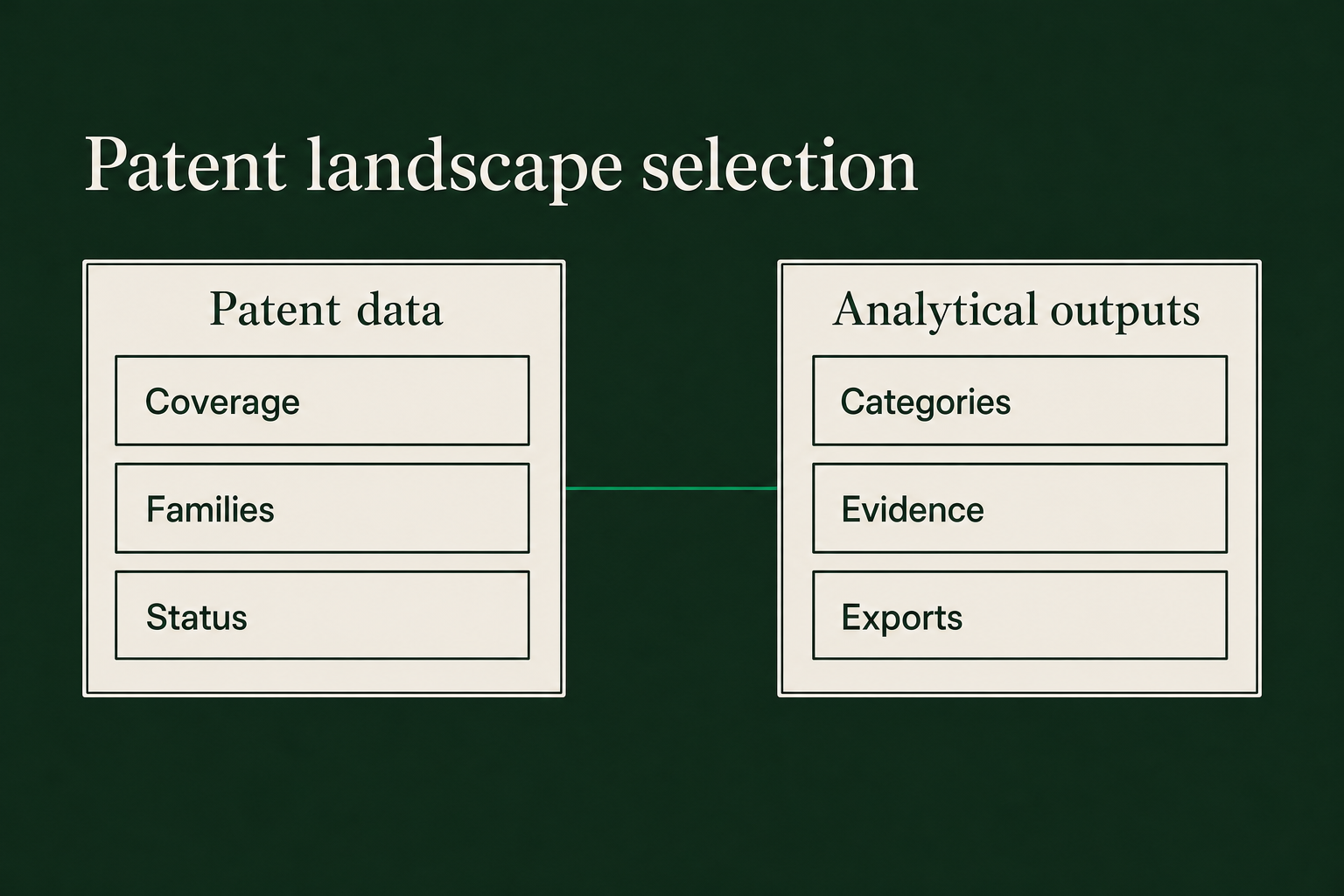
Your team needs a reviewed landscape before the next portfolio or research investment decision. Clean charts leave work unfinished when technology labels need reassignment and the supporting source text is hard to find.
Selecting patent landscape software means assessing both the underlying records and the analytical workflow. Your criteria should compare taxonomy fit and source-linked artificial intelligence (AI) output with practitioner review while keeping essential data gates intact.
A landscape informs technology and portfolio decisions.
Separate patent data from landscape analysis
A patent database holds records and documents. Patent landscape software organizes a selected dataset into views of technical activity, applicants, filing trends, jurisdictions, and relationships. An integrated platform may provide both layers, but each needs its own evaluation.
There are 3 common operating models:
| Operating model | What you receive | What your team owns |
|---|---|---|
| Patent-office sources | Official publications and jurisdiction-specific records | Cross-office retrieval, reconciliation, and analysis |
| Aggregated patent database | Multi-office records, search, and potentially enriched metadata | Dataset selection and any analysis performed elsewhere |
| Integrated patent-analysis platform | Retrieval plus supported classification, analysis, and reporting workflows | Scope, source review, analytical choices, and final decisions |
One important distinction is whether data are searchable, viewable, or exportable. A database can display claims after you open a record while searching keywords only in titles and abstracts. The World Intellectual Property Organization (WIPO) makes this distinction explicit in its patent-information source guidance.
Route product-clearance questions into a jurisdiction-specific freedom to operate (FTO) review of relevant claims and legal status. The landscape analysis guide covers the analytical method; platform selection hinges on how source evidence becomes reviewed work product.
Set the selection requirements around a decision
Write a short requirement statement before comparing platforms. Specify:
- Decision: competitive filing review, portfolio alignment, technology scouting, or acquisition screening.
- Technical boundary: included technologies and explicit exclusions.
- Data scope: patent offices, publication types, languages, date range, and any required non-patent literature (NPL).
- Counting unit: publications, applications, or patent families.
- Taxonomy: your team’s technology categories, definitions, and inclusion rules.
- Deliverable: a practitioner-reviewed, taxonomy-aligned landscape with source passages behind its labels and defined analytical views.
- Review owner: the practitioner responsible for approving relevance, categories, and interpretation.
For an enterprise team, a useful requirement could be a quarterly comparison of competitor filings against named research and development (R&D) priorities. A law firm may instead need a source-linked landscape package for a particular client matter.
Make essential data requirements pass-or-fail gates. A missing target jurisdiction cannot be offset by an attractive visualization. Among platforms that meet those gates, give the greatest weight to taxonomy-aligned analysis and source-linked practitioner review.
Prioritize the analytical layer
Classify under your own taxonomy
A taxonomy is the category system your team uses to organize a technology area. Bring its definitions and inclusion rules into the evaluation. Categories such as sample preparation, fluid control, and detection may map directly to an R&D roadmap; broad patent-office codes serve a different organizing purpose.
Require AI classification that works with your categories and gives practitioners control over proposed assignments. Review clear matches, boundary cases, and patents spanning several categories. Record accepted labels, edits, removals, and unresolved assignments. Assess how much work remains before the categories are usable for the portfolio decision.
Keep source passages behind every label
Each proposed label should lead to the claim or specification passage supporting it, with the publication identifier and a usable locator. Review the passage in context, then approve or correct the assignment. A link to the patent’s front page leaves the practitioner to locate the supporting text again.
Keep the proposed assignment and practitioner correction distinguishable. When the taxonomy changes, retain its version so your team can explain a changed category total.
Require outputs that explain their counts
Choose analytical outputs around the decision you defined. A recurring competitor review usually needs more than a technology map.
Filing trends should identify the date field used. Earliest priority, application filing, publication, and grant dates describe different events. Keep that field and the counting unit visible.
Applicant views should preserve both the original names and normalized groups. A spelling correction and a decision to combine subsidiaries under a parent are different changes. Retain the grouping rule and its effective date, especially when the business question concerns activity before an acquisition.
Jurisdiction views should explain whether geography means publication office, family-member presence, applicant location, or recorded rights status. These measures serve different questions.
Technology categories should use the approved taxonomy and retain its version and inclusion rules. For International Patent Classification (IPC) or Cooperative Patent Classification (CPC) fields, retain the codes used alongside your own categories.
Maps, clusters, and heatmaps should allow a reviewer to reach the records behind a cluster or cell. Show how the grouping relates to your taxonomy. Record whether a patent can appear in multiple categories and how that affects totals.
Treat a sparse technology category as a research question. Examine the underlying search scope, terminology, and category assignments, then take any proposed invention or product into the appropriate patentability or FTO workflow.
Make source quality visible
Require a clear distinction among official publication content, provider-enriched metadata, machine-translated text, and generated interpretation.
A source-linked review record should preserve the publication number, document version or kind code, original text, and a page, paragraph, or claim locator where relevant. A kind code identifies the publication type or stage. Keep translated passages tied to the original publication and identify which text informed the classification.
Review claim-focused excerpts in their original context and against the relevant claim version.
For structured data, retain the original applicant name alongside normalized names. Preserve raw legal events alongside derived status labels. Document corrections to priority links or family membership. These distinctions let your team explain why a source record and an analytical row differ.
Evaluate coverage at the field level
A headline document count gives little guidance about your specific task. Request a coverage matrix by office, publication period, document type, and field.
| Coverage dimension | Evidence required for selection |
|---|---|
| Jurisdiction and period | Included offices, earliest covered records, recent publication coverage, and known gaps |
| Document type | Application publications, granted patents, and other required rights, distinguished by type |
| Text and images | Searchable titles, abstracts, claims, and descriptions; original-language text and publication images |
| Structured fields | Application and publication identifiers, priority links, classifications, applicants, and citation data |
| Update timing | Separate refresh information for publications, bibliographic corrections, and legal events |
The European Patent Office (EPO) monitors bibliographic data, publication images, and full text as separate data streams. Apply the same distinction to a commercial coverage claim.
Use a small reference set of public patents chosen by a domain specialist. Include records from each essential jurisdiction, older and recent publications, and terminology that varies across languages. Record whether each expected document was retrieved, which field matched, and whether its claims and description were available for review.
This reference set exposes retrieval gaps. Assess overall completeness against the agreed scope, sources, and retrieval date separately. Record result caps and whether semantic search returns a ranked subset or the full selected corpus.
Publication timing also affects apparent coverage. In the United States, utility and plant applications generally publish after 18 months from the earliest effective filing or claimed priority date, subject to exceptions. The United States Patent and Trademark Office (USPTO) explains these publication timing rules. Annotate recent filing periods accordingly rather than treating a lower visible count as a confirmed decline in activity.
Inspect family grouping and member-level status
A patent family groups applications connected through priority claims. Family grouping helps manage related filings, but it also changes the unit you count.
The EPO distinguishes simple families covering the same technical content from extended families covering similar technical content. It also explains that family definitions vary across databases. Require the provider’s definition, representative-member rule, and member list.
An extended-family count and a simple-family count answer different aggregation questions. For every chart, preserve the chosen rule and the publications behind each family. Keep related applications accessible for claim review rather than relying on the representative document.
Legal status belongs at the member and jurisdiction level. In a fictional family, a United States application might remain pending, a European application might have resulted in a granted patent, and a Japanese patent might have expired. A single family label hides that distinction.

For selection, require:
- The member identifier and jurisdiction.
- The recorded event, event date, and source.
- The date the platform retrieved or refreshed the information.
- The rule used to derive a summary status.
- A visible distinction between missing status data and a recorded status.
The EPO’s legal-status guidance explains that aggregated events depend on national-office deliveries and may contain gaps or delays. Before status affects a legal or retention decision, the responsible practitioner reconciles the relevant member’s record with the competent office and reviews the applicable claims.
Evaluate exports and reproducibility together
Export is part of the reviewed deliverable. An editable report supports stakeholder discussion; a structured dataset lets another analyst reconstruct the analysis. Preserve approved labels, supporting sources, and reviewer corrections across the handoff.
Require an export containing the fields needed for your task:
- Publication and application identifiers, with family membership.
- Relevant dates, jurisdictions, and original applicant names.
- Normalized entity groups and their mapping rules.
- Legal events, status sources, and retrieval dates where status is used.
- Categories, inclusion decisions, exclusion reasons, and review notes.
- Links or locators back to supporting documents.
Define the needed Word report, Excel dataset, or other format around the handoff. Record export limits, field availability, and contractual rights to share the work product with internal stakeholders or outside counsel. Include requirements for continued access after the subscription ends. Where programmatic transfer is needed, define the required application programming interface (API) fields and permitted use.
Ask for a handoff exercise: export the approved dataset and have a second analyst rebuild a selected chart from it. Reconcile the total and each category’s membership. Record any information that had to be copied manually or was unavailable outside the platform.
Preserve a reproducibility record alongside the output:
| Record | What it preserves |
|---|---|
| Scope and retrieval | Technical boundaries, offices, date filters, sources, and retrieval timestamp |
| Search | Exact queries or semantic inputs, searched fields, filters, ranking settings, and result limits |
| Dataset | Retained identifiers, family rule, representative members, and inclusion or exclusion decisions |
| Transformations | Entity mappings, taxonomy version, category assignments, and reviewer corrections |
| Output | Chart definitions, settings, exported data, report version, and responsible reviewer |
Separate 2 exercises. First, rebuild the original output from the retained snapshot. Then refresh against current data. Explain additions, removals, revised metadata, status changes, and altered family groupings in the refreshed result.
For AI-assisted ranking or classification, preserve the inputs, generated output, available model or configuration identifiers, and approved changes. Judge reproducibility by the reviewable record and reconstruction of the delivered analysis.
A fictional selection record
Consider a fictional diagnostics company evaluating platforms for a quarterly landscape of microfluidic sample preparation as of September 30, 2026. Its required scope includes United States, European, and Japanese publications. The intended output is a family-level competitor view aligned with its R&D taxonomy.
The evaluation package includes public reference documents, an agreed taxonomy, and a family with several publication stages. After the data gates are met, the team compares source-linked classification and the review record supporting the approved result:
| Selection criterion | Acceptance condition |
|---|---|
| Own-taxonomy analysis | AI-proposed assignments follow the team’s category definitions; practitioners approve or correct them |
| Source-linked review | Every technology label has a supporting passage and locator; approved decisions and corrections remain identifiable |
| Coverage gate | Expected reference documents and required fields are available; corpus gaps and result limits are documented |
| Family and status gate | The family count can be traced to every member; each status retains its jurisdiction, source, and date |
| Handoff and refresh | A second analyst reconciles chart membership from the export; refreshed results have identifiable changes |
Suppose an evaluation produces a polished chart, but its technology labels need extensive manual reassignment and its source links stop at document level. Return those assignments for correction before approving the landscape.
An export containing only one representative publication needs a member-level supplement when the deliverable requires family members. Record unmet conditions for procurement rather than averaging them into a score.
Where Patlytics fits
Bring your own taxonomy to Patlytics. Patent Vault and Classification support the controlled categories your team already uses. Classification proposes categories from claims and specifications for approval, editing, or removal before application to the patent set.
- Clustering and Portfolio Heatmaps: The classification-first portfolio workflow groups patents into technology areas that practitioners can refine. Each classification group receives its own product search and heatmap for focused infringement screening.
- Portfolio Analysis and Patent Pruning: Portfolio Analysis maps patents to products across a portfolio. Patent Pruning uses that mapping to surface assets with weak or no current product coverage for claim-relevance assessment, distinct from Classification’s taxonomy labels.
- Patent & NPL Search: Semantic search spans patents and NPL, including PubMed, for the defined technology scope and prior-art screening.
- Claim Charting and Exhaustive mode: Claim Charting connects supporting disclosures and citations to individual claim limitations for claim-level screening. For infringement screening, Exhaustive mode provides deeper coverage on selected priority claims. Claim charts export to Word, Excel, and PDF for handoff.
For mergers and acquisitions (M&A), classified groups, prior-art screening, and product mappings support focused intellectual property due diligence on the target company’s patent assets.
Life-sciences support includes a structure editor, chemical image-to-SMILES (simplified molecular input line entry system) conversion, Markush/R-group generation for variable chemical groups, and sequence uploads with complementarity-determining-region (CDR) detection.
Attorneys retain review and decision authority over generated outputs, claim interpretation, and legal or portfolio recommendations.
See how Patlytics turns a defined technology scope into a reviewed, taxonomy-aligned landscape your team can trace to supporting sources. Book a landscape demo.
The Premier AI-Powered
Patent Platform
Reduce cycle times. Increase margins. Deliver winning IP outcomes.