Patent portfolio benchmarking: find roadmap coverage gaps

Where does your patent portfolio support the next product roadmap, and where are peers building coverage that your team lacks? A company-wide patent count gives you little direction for that discussion. You need a comparison tied to the technologies and markets the business intends to serve.
Patent portfolio benchmarking gives IP leaders a structured way to compare that coverage, explain differences, and assign the next review. The useful output is a short list of evidence-backed roadmap questions.
Scope: peer-patent coverage for roadmap planning, with consistent ownership, family, status, and market boundaries.
What patent portfolio benchmarking compares
Patent portfolio benchmarking compares defined patent estates under the same analytical rules. For roadmap planning, the central question is: Which priority technologies have thinner coverage in your portfolio than in the selected peer portfolios, especially in target markets?
A patent landscape analysis starts with a technology field and discovers activity across it. Benchmarking starts with named peers and asks a narrower comparative question. A broader patent portfolio review addresses your own estate's strategic fit, costs, and disposition decisions.
Keep the benchmark's endpoint specific: a reviewed table connecting each apparent gap to patent evidence, a roadmap dependency, and an accountable next action.
1. Define peers around the business decision
Choose peers because they compete in the relevant technology or market. A diversified corporation's entire estate can overwhelm a specialist's portfolio and obscure the comparison you need.
For a battery-cell manufacturing roadmap, a practical cohort could contain your cell-manufacturing business, a direct cell competitor, and a production-equipment specialist. Record the reason each belongs. Keep adjacent suppliers or emerging entrants in a separate comparison if they answer a different question.
Define the entity perimeter before collecting totals:
- Business boundary: whole corporate group or the named business unit.
- Ownership basis: original applicant or current recorded owner, applied consistently.
- Entity mapping: subsidiaries, former names, spelling variants, and acquired or divested assets.
- Joint ownership: count a jointly owned family once within each relevant peer, and flag overlaps across peers.
Applicant names and current ownership can diverge after transfers or acquisitions, as the World Intellectual Property Organization (WIPO) explains in its patent analysis definitions. Retain the entity mapping with the underlying records so a reviewer can explain why a family belongs to a peer.
Freeze the cohort for the comparison. A newly discovered competitor can trigger a separate cohort revision rather than silently changing the denominator halfway through.
2. Apply one roadmap taxonomy to every portfolio
A taxonomy is the category system used to assign patents to technologies. Build the comparison around the roadmap's technical choices, then apply those definitions to every peer.
For battery-cell manufacturing, useful categories might include electrode-web alignment, winding-tension control, and tab-weld inspection. Define each at a comparable level of detail. Comparing your broad “cell assembly” category with a peer's narrow “winding-tension control” category creates a labeling difference before it reveals a business difference.
For each category, capture:
- A short technical definition and inclusion criteria.
- Excluded neighboring technologies.
- Representative patent passages supporting assignment.
- The rule for patents relevant to more than 1 category.
Official classification codes help retrieve candidates. They can be broader or narrower than business categories. WIPO's landscape preparation guidance recommends defining technical scope and documenting how technology categories are assigned.
Use the same assignment basis across peers. If the benchmark concerns claimed coverage, record the relevant claim language. A specification passage can establish technical relevance while leaving the claim question open. Keep those evidence levels separate.
Before processing the full cohort, have a patent practitioner and a technical lead resolve representative ambiguous records from every peer. Apply resulting definition changes across the whole set. Keep uncertain assignments in a review queue rather than forcing them into whichever category has room.
For multi-category assignments, count each family once within a category and once in the overall estate. Category totals can then exceed the estate total. Record that rule beside the comparison.
3. Lock family, status, geography, and time scope
A patent family groups related applications through their priority relationships to earlier filings. Counting publication records can make a widely filed invention look like several separate inventions.
Choose 1 family definition for every peer. The European Patent Office (EPO) distinguishes simple patent families, which group documents considered to cover a single invention, from extended patent families, which connect applications directly or indirectly through shared priorities. Preserve member-level claim differences when reviewing an important family.
Keep the comparison rules compact and explicit:
- Counting unit: the selected family definition, with publication and application duplicates removed.
- Status: separate pending applications, granted patents recorded as in force, and inactive members. Keep unresolved status visible.
- Geography: the offices and territories relevant to planned sales or manufacturing, with status recorded for each member.
- Time: retrieval date, status cutoff, and any earliest-priority window. Use identical boundaries for every peer.
Show both family totals and jurisdiction-specific coverage. A family with a US grant and a lapsed German member contributes differently to those views. Legal-event feeds can contain gaps or delays; resolve decision-critical status questions against the relevant office record. The EPO describes these legal-status data limits.
Treat Patent Cooperation Treaty (PCT) applications as a separate international-stage pipeline. National or regional offices decide whether to grant protection, as explained in the PCT Applicant's Guide. For European assets, distinguish a pending European application from granted territorial coverage, including unitary effect or relevant national validations.
If you compare filing trends, use earliest-priority cohorts and identify the incomplete recent tail. Patent applications are generally published 18 months after earliest priority, so recent public records give only a partial view of filing activity. WIPO explains this publication timing.
4. Compare category coverage, then inspect the families
Start with category-level family counts. Add each category's share of the scoped estate when portfolio sizes differ. Separate granted coverage from pending pipeline and compare the target-market slices before prioritizing a gap.
Synthetic example: a battery-cell manufacturing roadmap
Your team is planning a battery-cell production line for US and German operations. Peer A is a direct cell competitor; Peer B is a production-equipment specialist. All entities, records, and counts below are fictional.
The comparison uses a shared 3-category taxonomy and simple families visible on October 31, 2026, without a priority-year restriction. A family enters the table when it has at least 1 pending application or granted patent recorded as in force in the US or Germany. Each family has 1 category in this example.
| Roadmap category | Your portfolio | Peer A | Peer B |
|---|---|---|---|
| Electrode-web alignment | 4 | 5 | 3 |
| Winding-tension control | 2 | 3 | 1 |
| Tab-weld inspection | 3 | 1 | 2 |
| Total scoped families | 9 | 9 | 6 |
Winding-tension control looks reasonably represented: 2 of your 9 families, versus 3 of Peer A's 9 and 1 of Peer B's 6. The German slice changes the question.
The evidence register below contains every winding-tension family counted above. “Granted” means recorded as in force at the example cutoff; “absent” means no member in that jurisdiction in the example dataset.
| Family / peer | Claim evidence and category rationale | US status | Germany status |
|---|---|---|---|
| Y-W1 / yours | Y-W1, claim 1: electrode-web tension adjustment using roller-force feedback during cell winding | Granted | Absent |
| Y-W2 / yours | Y-W2, claim 4: feed-speed correction for measured electrode tension during winding | Pending | Lapsed |
| A-W1 / Peer A | A-W1, claim 1: winding-motor control from measured electrode-web tension | Granted | Granted |
| A-W2 / Peer A | A-W2, claim 3: winding-speed adjustment to maintain a programmed electrode-tension profile | Pending | Pending |
| A-W3 / Peer A | A-W3, claim 1: roller-position adjustment to regulate electrode-web tension | Absent | Granted |
| B-W1 / Peer B | B-W1, claim 2: synchronized electrode and separator feed for winding-tension control | Granted | Pending |

Your portfolio has 0 winding-tension families with a pending or in-force member in Germany, compared with Peer A's 3 and Peer B's 1. The relative gap concerns German territorial coverage, even though your portfolio includes the technology.
In a live register, retain the actual publication number, family identifier, claim or passage location, ownership source, status event and source date, category rationale, and reviewer resolution. Those fields let counsel reproduce the count and distinguish a data problem from a substantive gap.
5. Turn apparent gaps into a reviewed roadmap table
Review the families behind each consequential difference. The question is whether the difference survives a closer look and matters to the business.
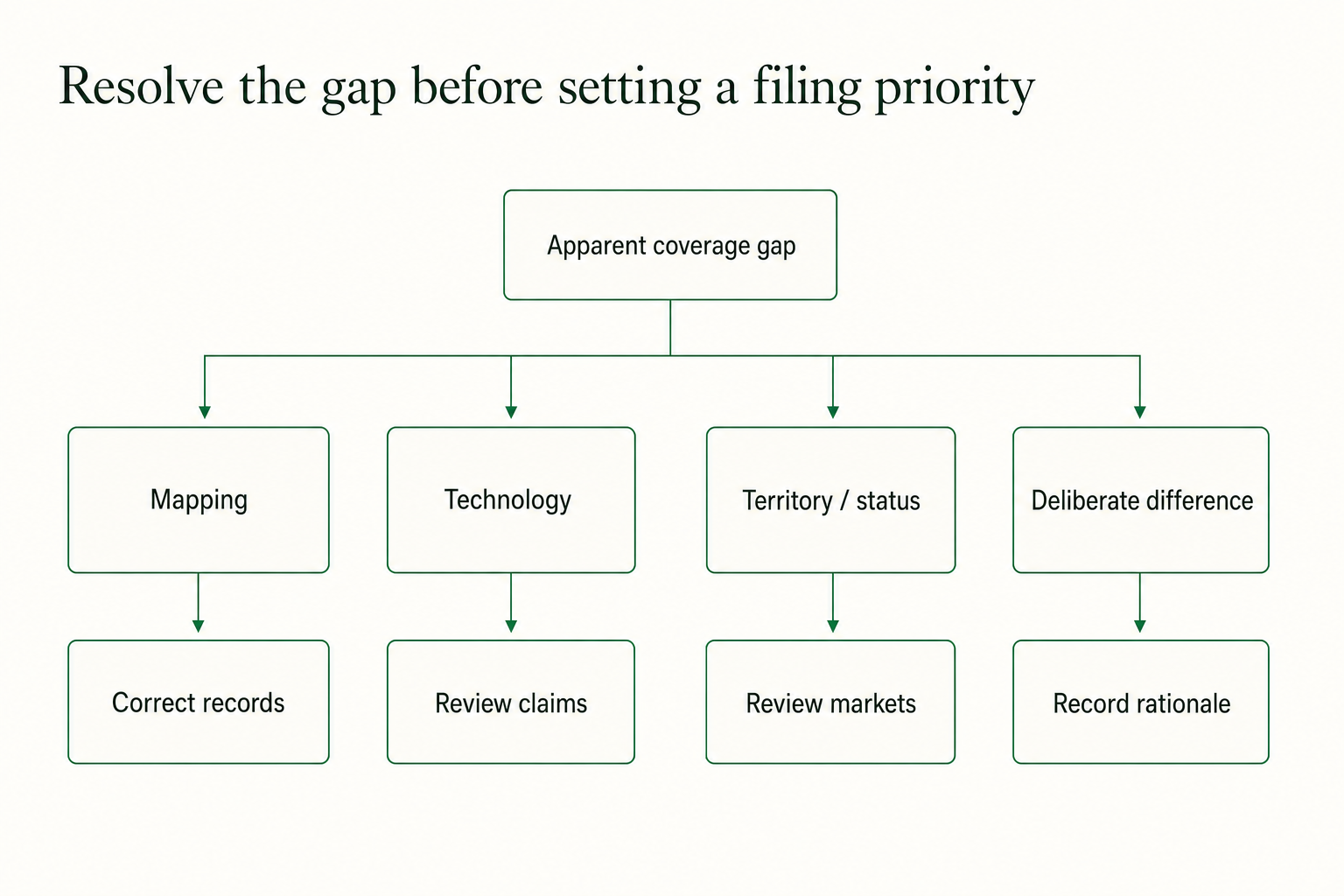
Use 4 possible outcomes:
- Mapping correction: relevant patents sit under another label or entity name. Correct the records and rerun the affected comparison.
- Technology gap: the target function lacks relevant claimed coverage in your scoped estate. Assign a focused technical and claims review.
- Territorial or status gap: relevant families exist, but target-market coverage is absent, inactive, or only pending. Assign jurisdiction-specific counsel review.
- Deliberate difference: the peer emphasis sits outside your roadmap or reflects a different protection strategy. Record the reason for taking no immediate action.
For the synthetic example, the final decision record could read:
| Roadmap dependency | Reviewed evidence | Gap conclusion | Next action and owner |
|---|---|---|---|
| German winding-tension-control process | Y-W1 has no German member; Y-W2's German member lapsed. Peer A has 2 granted and 1 pending German family; Peer B has 1 pending. | Territorial coverage gap within the defined cohort and category | IP counsel assesses available protection paths for the planned process with the cell-manufacturing lead before production-line commitment. |
| US tab-weld-inspection capability | Your 3 families map to the required weld-inspection functions; Peer A has 1 and Peer B has 2. | Retain current priority, with claim relevance recorded | IP lead records the rationale; no extra filing target arises from peer counts. |
Give priority to gaps tied to a committed technical dependency, a required market, and a decision deadline. A large numerical difference in an irrelevant category can stay below a small gap in a launch-critical process. That order also focuses outside counsel spend on the claim and territorial questions that could change the roadmap decision.
A sparse peer category is a question for further investigation. Any freedom-to-operate (FTO) decision requires a separate product clearance review of relevant third-party claims in the target jurisdictions. Keep “white space” language tied to the defined dataset and category.
Where Patlytics fits
Patlytics supports taxonomy-based organization for a peer comparison and patent-to-product analysis for selected follow-up questions:
- Classification applies your team's own taxonomy across patent sets, providing a consistent category foundation for the peer comparison.
- Clustering groups related technical subject matter, helping surface themes that deserve a taxonomy review.
- Portfolio Heatmap screens patent portfolios against products for overlap signals when a reviewed category needs product-level investigation.
- Portfolio Analysis supports patent-to-product mapping across the portfolio, connecting relevant assets to the commercial functions behind the roadmap question.
Attorneys retain review and decision authority over classifications, mappings, and resulting legal analysis.
Turn peer-portfolio differences into a reviewed list of roadmap coverage priorities with Patlytics. Book a demo around your peer set, taxonomy, and target markets.

Patent portfolio benchmarking: find roadmap coverage gaps
Where does your patent portfolio support the next product roadmap, and where are peers building coverage that your team lacks? A company-wide patent count gives you little direction for that discussion. You need a comparison tied to the technologies and markets the business intends to serve.
Patent portfolio benchmarking gives IP leaders a structured way to compare that coverage, explain differences, and assign the next review. The useful output is a short list of evidence-backed roadmap questions.
Scope: peer-patent coverage for roadmap planning, with consistent ownership, family, status, and market boundaries.
What patent portfolio benchmarking compares
Patent portfolio benchmarking compares defined patent estates under the same analytical rules. For roadmap planning, the central question is: Which priority technologies have thinner coverage in your portfolio than in the selected peer portfolios, especially in target markets?
A patent landscape analysis starts with a technology field and discovers activity across it. Benchmarking starts with named peers and asks a narrower comparative question. A broader patent portfolio review addresses your own estate's strategic fit, costs, and disposition decisions.
Keep the benchmark's endpoint specific: a reviewed table connecting each apparent gap to patent evidence, a roadmap dependency, and an accountable next action.
1. Define peers around the business decision
Choose peers because they compete in the relevant technology or market. A diversified corporation's entire estate can overwhelm a specialist's portfolio and obscure the comparison you need.
For a battery-cell manufacturing roadmap, a practical cohort could contain your cell-manufacturing business, a direct cell competitor, and a production-equipment specialist. Record the reason each belongs. Keep adjacent suppliers or emerging entrants in a separate comparison if they answer a different question.
Define the entity perimeter before collecting totals:
- Business boundary: whole corporate group or the named business unit.
- Ownership basis: original applicant or current recorded owner, applied consistently.
- Entity mapping: subsidiaries, former names, spelling variants, and acquired or divested assets.
- Joint ownership: count a jointly owned family once within each relevant peer, and flag overlaps across peers.
Applicant names and current ownership can diverge after transfers or acquisitions, as the World Intellectual Property Organization (WIPO) explains in its patent analysis definitions. Retain the entity mapping with the underlying records so a reviewer can explain why a family belongs to a peer.
Freeze the cohort for the comparison. A newly discovered competitor can trigger a separate cohort revision rather than silently changing the denominator halfway through.
2. Apply one roadmap taxonomy to every portfolio
A taxonomy is the category system used to assign patents to technologies. Build the comparison around the roadmap's technical choices, then apply those definitions to every peer.
For battery-cell manufacturing, useful categories might include electrode-web alignment, winding-tension control, and tab-weld inspection. Define each at a comparable level of detail. Comparing your broad “cell assembly” category with a peer's narrow “winding-tension control” category creates a labeling difference before it reveals a business difference.
For each category, capture:
- A short technical definition and inclusion criteria.
- Excluded neighboring technologies.
- Representative patent passages supporting assignment.
- The rule for patents relevant to more than 1 category.
Official classification codes help retrieve candidates. They can be broader or narrower than business categories. WIPO's landscape preparation guidance recommends defining technical scope and documenting how technology categories are assigned.
Use the same assignment basis across peers. If the benchmark concerns claimed coverage, record the relevant claim language. A specification passage can establish technical relevance while leaving the claim question open. Keep those evidence levels separate.
Before processing the full cohort, have a patent practitioner and a technical lead resolve representative ambiguous records from every peer. Apply resulting definition changes across the whole set. Keep uncertain assignments in a review queue rather than forcing them into whichever category has room.
For multi-category assignments, count each family once within a category and once in the overall estate. Category totals can then exceed the estate total. Record that rule beside the comparison.
3. Lock family, status, geography, and time scope
A patent family groups related applications through their priority relationships to earlier filings. Counting publication records can make a widely filed invention look like several separate inventions.
Choose 1 family definition for every peer. The European Patent Office (EPO) distinguishes simple patent families, which group documents considered to cover a single invention, from extended patent families, which connect applications directly or indirectly through shared priorities. Preserve member-level claim differences when reviewing an important family.
Keep the comparison rules compact and explicit:
- Counting unit: the selected family definition, with publication and application duplicates removed.
- Status: separate pending applications, granted patents recorded as in force, and inactive members. Keep unresolved status visible.
- Geography: the offices and territories relevant to planned sales or manufacturing, with status recorded for each member.
- Time: retrieval date, status cutoff, and any earliest-priority window. Use identical boundaries for every peer.
Show both family totals and jurisdiction-specific coverage. A family with a US grant and a lapsed German member contributes differently to those views. Legal-event feeds can contain gaps or delays; resolve decision-critical status questions against the relevant office record. The EPO describes these legal-status data limits.
Treat Patent Cooperation Treaty (PCT) applications as a separate international-stage pipeline. National or regional offices decide whether to grant protection, as explained in the PCT Applicant's Guide. For European assets, distinguish a pending European application from granted territorial coverage, including unitary effect or relevant national validations.
If you compare filing trends, use earliest-priority cohorts and identify the incomplete recent tail. Patent applications are generally published 18 months after earliest priority, so recent public records give only a partial view of filing activity. WIPO explains this publication timing.
4. Compare category coverage, then inspect the families
Start with category-level family counts. Add each category's share of the scoped estate when portfolio sizes differ. Separate granted coverage from pending pipeline and compare the target-market slices before prioritizing a gap.
Synthetic example: a battery-cell manufacturing roadmap
Your team is planning a battery-cell production line for US and German operations. Peer A is a direct cell competitor; Peer B is a production-equipment specialist. All entities, records, and counts below are fictional.
The comparison uses a shared 3-category taxonomy and simple families visible on October 31, 2026, without a priority-year restriction. A family enters the table when it has at least 1 pending application or granted patent recorded as in force in the US or Germany. Each family has 1 category in this example.
| Roadmap category | Your portfolio | Peer A | Peer B |
|---|---|---|---|
| Electrode-web alignment | 4 | 5 | 3 |
| Winding-tension control | 2 | 3 | 1 |
| Tab-weld inspection | 3 | 1 | 2 |
| Total scoped families | 9 | 9 | 6 |
Winding-tension control looks reasonably represented: 2 of your 9 families, versus 3 of Peer A's 9 and 1 of Peer B's 6. The German slice changes the question.
The evidence register below contains every winding-tension family counted above. “Granted” means recorded as in force at the example cutoff; “absent” means no member in that jurisdiction in the example dataset.
| Family / peer | Claim evidence and category rationale | US status | Germany status |
|---|---|---|---|
| Y-W1 / yours | Y-W1, claim 1: electrode-web tension adjustment using roller-force feedback during cell winding | Granted | Absent |
| Y-W2 / yours | Y-W2, claim 4: feed-speed correction for measured electrode tension during winding | Pending | Lapsed |
| A-W1 / Peer A | A-W1, claim 1: winding-motor control from measured electrode-web tension | Granted | Granted |
| A-W2 / Peer A | A-W2, claim 3: winding-speed adjustment to maintain a programmed electrode-tension profile | Pending | Pending |
| A-W3 / Peer A | A-W3, claim 1: roller-position adjustment to regulate electrode-web tension | Absent | Granted |
| B-W1 / Peer B | B-W1, claim 2: synchronized electrode and separator feed for winding-tension control | Granted | Pending |
Your portfolio has 0 winding-tension families with a pending or in-force member in Germany, compared with Peer A's 3 and Peer B's 1. The relative gap concerns German territorial coverage, even though your portfolio includes the technology.
In a live register, retain the actual publication number, family identifier, claim or passage location, ownership source, status event and source date, category rationale, and reviewer resolution. Those fields let counsel reproduce the count and distinguish a data problem from a substantive gap.
5. Turn apparent gaps into a reviewed roadmap table
Review the families behind each consequential difference. The question is whether the difference survives a closer look and matters to the business.
Use 4 possible outcomes:
- Mapping correction: relevant patents sit under another label or entity name. Correct the records and rerun the affected comparison.
- Technology gap: the target function lacks relevant claimed coverage in your scoped estate. Assign a focused technical and claims review.
- Territorial or status gap: relevant families exist, but target-market coverage is absent, inactive, or only pending. Assign jurisdiction-specific counsel review.
- Deliberate difference: the peer emphasis sits outside your roadmap or reflects a different protection strategy. Record the reason for taking no immediate action.
For the synthetic example, the final decision record could read:
| Roadmap dependency | Reviewed evidence | Gap conclusion | Next action and owner |
|---|---|---|---|
| German winding-tension-control process | Y-W1 has no German member; Y-W2's German member lapsed. Peer A has 2 granted and 1 pending German family; Peer B has 1 pending. | Territorial coverage gap within the defined cohort and category | IP counsel assesses available protection paths for the planned process with the cell-manufacturing lead before production-line commitment. |
| US tab-weld-inspection capability | Your 3 families map to the required weld-inspection functions; Peer A has 1 and Peer B has 2. | Retain current priority, with claim relevance recorded | IP lead records the rationale; no extra filing target arises from peer counts. |
Give priority to gaps tied to a committed technical dependency, a required market, and a decision deadline. A large numerical difference in an irrelevant category can stay below a small gap in a launch-critical process. That order also focuses outside counsel spend on the claim and territorial questions that could change the roadmap decision.
A sparse peer category is a question for further investigation. Any freedom-to-operate (FTO) decision requires a separate product clearance review of relevant third-party claims in the target jurisdictions. Keep “white space” language tied to the defined dataset and category.
Where Patlytics fits
Patlytics supports taxonomy-based organization for a peer comparison and patent-to-product analysis for selected follow-up questions:
- Classification applies your team's own taxonomy across patent sets, providing a consistent category foundation for the peer comparison.
- Clustering groups related technical subject matter, helping surface themes that deserve a taxonomy review.
- Portfolio Heatmap screens patent portfolios against products for overlap signals when a reviewed category needs product-level investigation.
- Portfolio Analysis supports patent-to-product mapping across the portfolio, connecting relevant assets to the commercial functions behind the roadmap question.
Attorneys retain review and decision authority over classifications, mappings, and resulting legal analysis.
Turn peer-portfolio differences into a reviewed list of roadmap coverage priorities with Patlytics. Book a demo around your peer set, taxonomy, and target markets.
The Premier AI-Powered Patent Platform
Reduce cycle times. Increase margins. Deliver winning IP outcomes.
Book a DemoThe Premier AI-Powered
Patent Platform
Reduce cycle times. Increase margins. Deliver winning IP outcomes.