Patent sequence search: from biological match to evidence
October 22, 2026
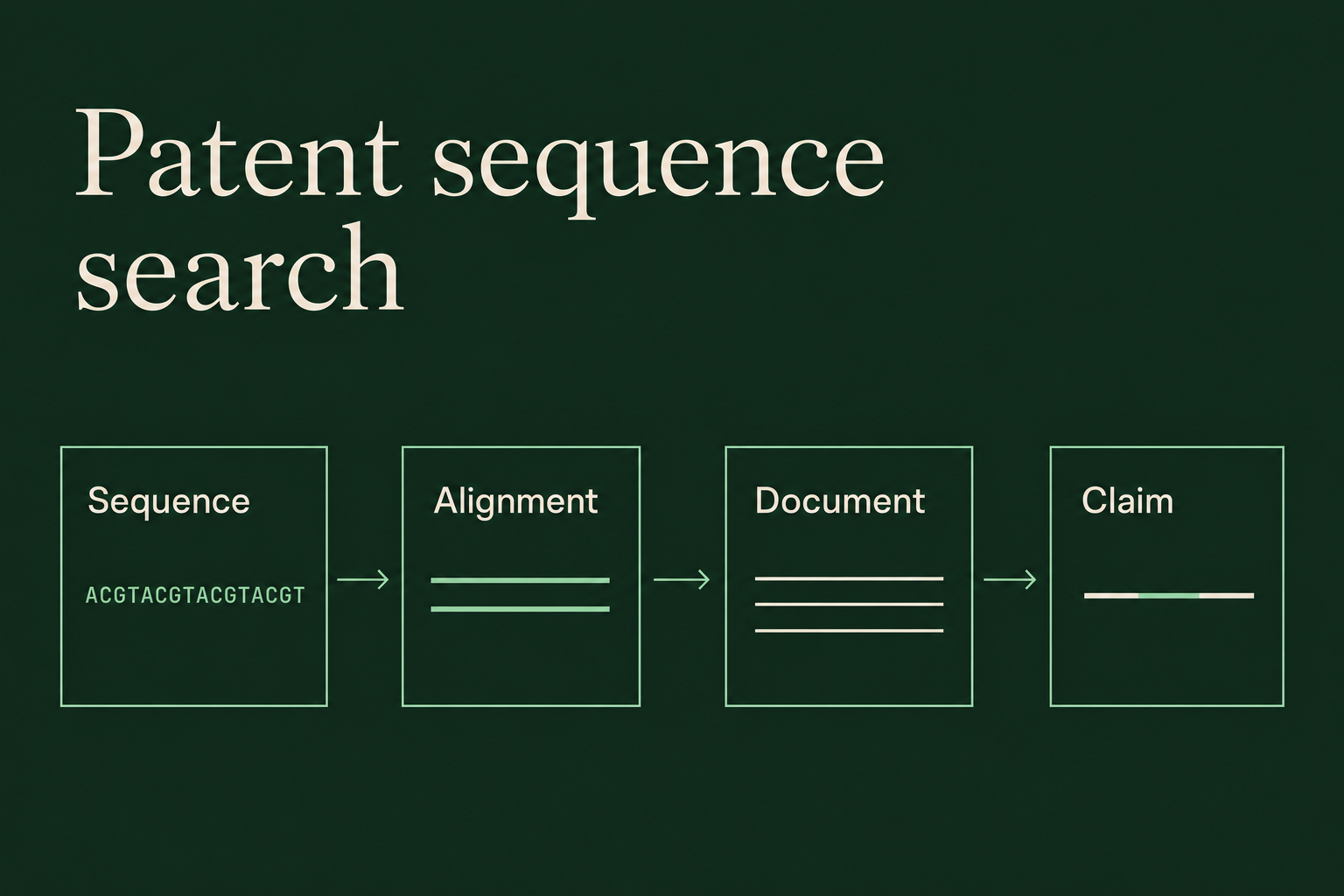
A sequence-search result can show an exact match across a short protein fragment while saying little about the rest of your candidate. It can also point to a sequence disclosed in a patent while leaving claim scope unresolved. For biotechnology patent teams, the work is connecting those matches to source documents and a defined legal question. A documented workflow gives scientists and counsel a common record of the search, evidence, and remaining gaps.
This workflow produces a search record; counsel retains responsibility for matter-specific legal conclusions.
What patent sequence search covers
Patent sequence search retrieves patent-associated nucleotide or amino acid sequences that match a query exactly, share an aligned region, or satisfy a defined sequence pattern. The search produces candidate references. Their relevance depends on the sequence relationship, the surrounding disclosure, the claims, and the purpose of the search.
Sequence-listing preparation is a separate task. It organizes sequences and their identifiers for an application. The World Intellectual Property Organization (WIPO) Standard ST.26 specifies an XML (Extensible Markup Language) format for sequence listings. WIPO’s listing guidance explains the format and its application.
Patent-text and non-patent literature (NPL) searches investigate the target, biological activity, construct, and intended use. Keep their source passages separate from sequence-alignment evidence in the search record.
1. Define the decision before choosing the query
Write a short search brief with the candidate, intended use, jurisdictions, relevant dates, and the decision the team needs to make. A patentability search before filing has a different scope from a product-launch review.
| Search purpose | Question to investigate | Scope to record |
|---|---|---|
| Patentability | What earlier disclosures bear on the proposed invention? | Proposed claim concepts, relevant date rules, patents, and NPL |
| Invalidity | What evidence could support a challenge to specified claims? | Target claims, claim interpretation, jurisdiction, and applicable prior-art dates |
| Freedom to operate (FTO) | Which patent rights may affect a defined product or activity? | Product configuration, planned activities, territories, claim versions, and status date |
| Landscape | Who is disclosing related sequences and technical approaches? | Technology boundaries, time window, family grouping, and inclusion criteria |
For launch work, sequence search supplies candidates for the broader FTO analysis workflow. That review also addresses potentially relevant composition, production method, delivery system, and use claims.
Set review responsibilities at intake. The scientist or sequence-search specialist owns the biological interpretation. Counsel owns claim interpretation, date qualification, and legal conclusions. Any AI-generated summaries or mappings remain subject to attorney review and approval.
2. Preserve the original sequence and document every derivative
Assign each input a stable query ID and version. Preserve the original file separately from the string submitted for searching. Record the molecule type, length, source, and biological boundaries.
For nucleotide queries, document strand orientation and any reverse-complement searches. For proteins, distinguish the precursor, mature protein, variable region, domain, and fusion construct. A fragment search needs its start and end positions in the original sequence.
A minimal input record contains:
- Original input: the sequence file or public accession and version, with its source.
- Submitted query: the exact searched string, molecule type, length, and query ID.
- Transformations: removed numbering, nucleotide-symbol conversions, translated regions, or extracted fragments.
- Special representation: ambiguous residues, degenerate positions, chemical modifications, and nonstandard residues.
- Confidentiality boundary: whether the sequence is public and which search environments are authorized for the matter.
Do not silently replace unknown positions with definite bases or residues. If a search interface cannot represent a modification, preserve the modification separately and label the submitted query as a simplified representation. The resulting alignment only addresses that representation.
FASTA is a common sequence-text format with a header beginning with > followed by the sequence. Keep a descriptive, non-confidential query label in the header. Save the precise query rather than relying on a file name such as “final sequence.”
3. Choose sources by coverage and evidence access
Separate the sequence index that retrieves matches from the patent-office source that supplies the underlying document. Choose an index that supports your molecule type and required search modes. Record covered authorities, publication types, listing formats, extraction methods, update information, and result limits.
Preserve the collection name, settings, result export, coverage statement, and date of access for each run. Record whether the index searches listings, sequences extracted from patent text, or both. Document patent-text coverage and sequence-index coverage separately. The United States Patent and Trademark Office (USPTO) recommends comparing retrieved sequence data with the corresponding published application or issued patent in its sequence-search guidance.
Coverage documentation should address short or ambiguous sequences, indirectly generated sequence sets, publication types, and processing delays. Published sequence coverage notes illustrate those risks. Build the inventory from current source documentation, and log each undocumented category as a gap with an assigned next action.
Keep published applications in scope where the decision requires them. A missing document, unavailable listing, or unsupported query type becomes a recorded gap with a next action.
4. Run complementary passes and retain the settings
Start with the whole candidate, then add component searches that reflect the invention. Each pass needs a reason.
| Pass | What it investigates | What to preserve |
|---|---|---|
| Exact full-length search, where supported | Identical sequences across the defined length | Exact-match definition, strand handling, and results |
| Similarity search | Related sequences and local regions | Algorithm, identity and coverage filters, alignment coordinates, gaps, and scores |
| Component or pattern search | A domain, motif, fragment, or variable region | Parent-query coordinates and the pattern or fragment searched |
| Patent-text and NPL search | Biological activity, target, construct, and use | Queries, date filters, classifications, and cited passages |
Local alignment finds matching regions within sequences. A reported 100% identity can therefore describe a short region rather than an identical full-length molecule. Read it alongside query coverage and alignment length.
Short queries deserve their own search plan. For antibodies, complementarity-determining regions (CDRs) are short binding-region segments. Record the boundary or numbering convention and whether the search requires several regions in the same disclosed construct. Review whether matched CDRs occur together in that construct or in unrelated ones.
Retain word size, scoring settings, gap penalties, low-complexity masking, statistical cutoffs, and maximum reported hits where applicable. Word size controls the length of initial matching segments used to find alignments. Low-complexity masking suppresses repetitive or compositionally biased regions. The expectation value estimates the number of chance matches with an equivalent or better score in the searched database. Short alignments can have relatively high expectation values even when nearly identical, as alignment parameter guidance explains. A stricter statistical cutoff can remove relevant short-region candidates.
Choose retrieval settings for the molecule and search question, document the rationale, and retain changed settings as separate runs. When a claim uses an identity percentage, record its reference sequence and specified comparison method alongside the retrieval alignment.
Run the text branch around the target, activity, structural role, modification, and intended use. It can surface references that a sequence-only pass misses. Preserve each retrieved passage against its own source rather than treating semantic similarity as sequence evidence.
5. Join each retained hit to the exact patent evidence
Review candidates on 3 levels: sequence relationship, document disclosure, and claim relevance.
Sequence relationship. Record the accession and version, query and subject lengths, aligned coordinates, identity, coverage, substitutions, gaps, and score. “Subject” means the database sequence aligned against your query. Percent identity divides identical positions by alignment length, including gaps; query coverage measures how much of your query participates. These alignment reporting definitions explain the different denominators. Keep individual alignment blocks when a hit has several local matches.
Document disclosure. Retrieve the exact publication and its associated listing. Pair the publication number, including its document-type code, with the sequence identifier, usually SEQ ID NO, and the relevant paragraph, example, or claim. A sequence identifier is meaningful within its own document. Preserve the original listing, the source sequence record, and the alignment export.
For US documents, retrieve lengthy listings and other large supplemental items from the USPTO’s published sequence repository. Retrieve shorter listings through Patent Public Search. For ST.26 publications, listings converted to text below 600 KB appear in the specification; lengthy converted text is published separately. Sequence Listing XML files of 1 GB or more use the USPTO Bulk Data Storage System instead, under USPTO publication rules. Follow the exact document’s listing notice to the appropriate source. If the indexed and published sequences differ, retain both and record the discrepancy for specialist resolution.
Claim relevance. Read the complete claim and its dependencies. Identify whether the sequence is directly referenced, included in a defined variant class, or discussed only in the description. Also capture activity, composition, use, and other limitations. In US examination, anticipation requires a single prior-art reference to teach every claim element, expressly or inherently, as explained in USPTO anticipation guidance.
Group duplicates for review without discarding document-level links. Related family members may have different claims and supporting records. Patent family analysis helps keep those distinctions visible.
Keep publication, filing, and claimed priority dates in separate fields. Tie each sequence’s public-availability date to the disclosure where it appears, and retain priority-support documents separately. For US applications subject to the America Invents Act (AIA) first-inventor-to-file provisions, USPTO prior-art guidance distinguishes public-availability-based prior art from specified patent documents that can qualify based on effective filing dates. Include later-published patent documents where the applicable effective-filing-date rules make them relevant. Record sequence-database dates separately from patent publication dates. Counsel resolves the applicable date rules and supporting disclosures for the matter.
Practical example: a full-length hit and an exact fragment
Consider a hypothetical 120-residue protein candidate. The brief asks for related patent disclosures and a separate review of potential US claim relevance. The following invented hits illustrate how alignment length and query coverage affect triage.
| Candidate hit | Single gap-free alignment | Identity | Query coverage | Review priority |
|---|---|---|---|---|
| A | 120 residues, 114 identical | 95% | 100% | Review full-length differences and the document’s sequence-related claims |
| B | 18 residues, all identical | 100% | 15% | Investigate the fragment’s role and any fragment-specific claim language |
| C | 120 residues, all identical | 100% | 100% | Retrieve the source listing, then distinguish disclosure from claim coverage |
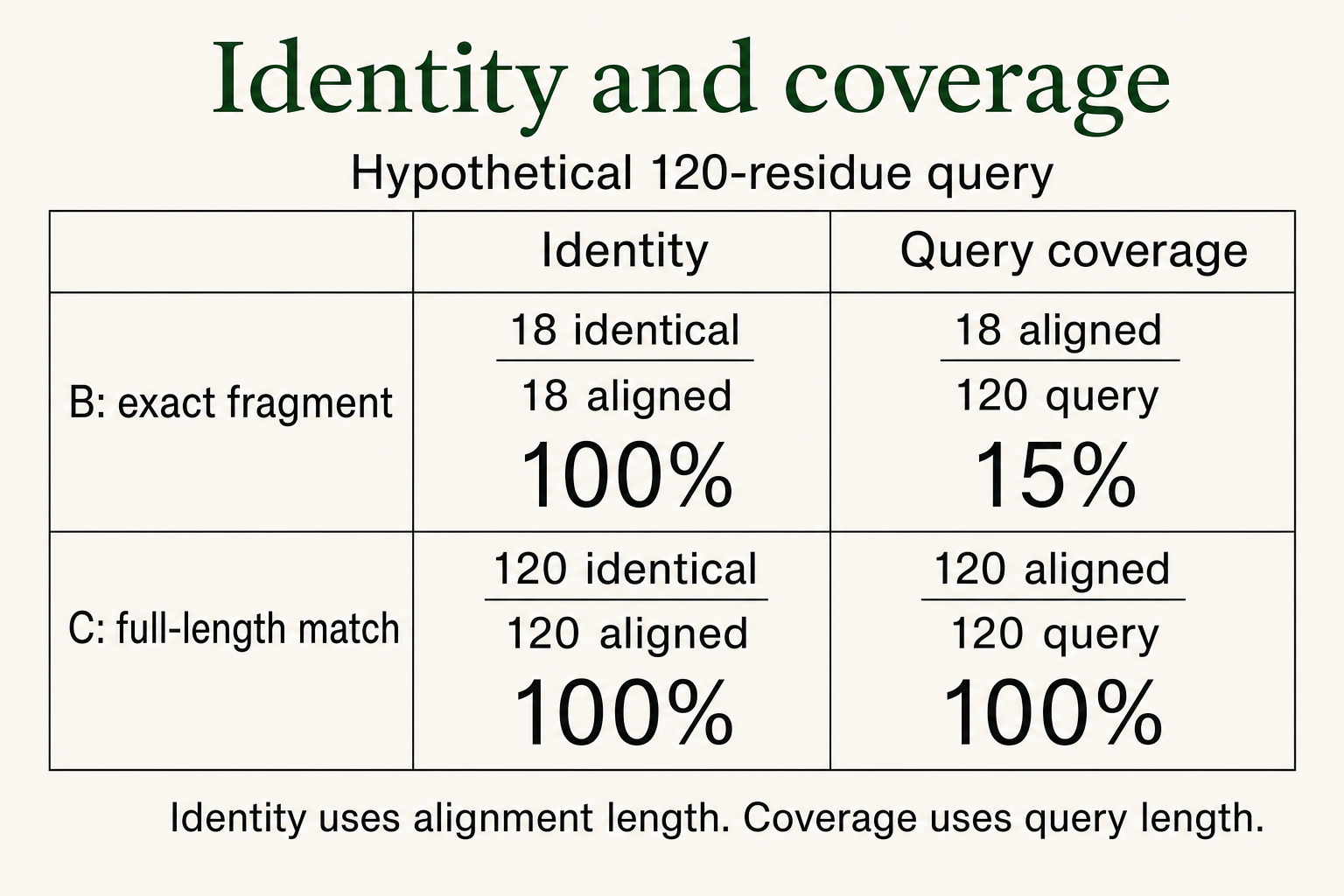
Hit B has the highest identity alongside C, yet covers only 18 of the query’s 120 residues. It is a short-region candidate. Its importance depends on whether that region is the inventive motif, an incidental shared segment, or part of a claimed combination.
For A, the reviewer records the 6 differing positions and the exact document-linked sequence. If a claim uses an identity percentage, counsel examines its reference sequence, comparison method, and remaining limitations. The 95% retrieval value is one input to that claim review.
For C, an exact full-length disclosure warrants attention even if the sequence is only in an example. Its role in patentability work differs from its role in FTO, where the relevant claims and current territorial rights require separate analysis.
An evidence entry for A should join the query version, accession, exact publication, sequence identifier, alignment, claim passage, relevant dates, and reviewer disposition. Until that chain is complete, label A “retained for review,” rather than “blocking patent” or “novelty destroyed.”
6. Close with a coverage record and a usable handoff
Use the sequence search worksheet, a fillable PDF, to preserve the brief, query runs, retained hits, and unresolved gaps. Keep rejected hits too, with a short reason, so later reviewers can distinguish deliberate exclusions from missed evidence.
| Coverage gap | Decision affected | Next action to record |
|---|---|---|
| Published applications absent from a sequence source | Recent disclosures and pending-claim monitoring | Add a source covering those publications and document the additional run |
| Short or modified query inadequately represented | Fragment or modification relevance | Assign a specialist search and retain its representation limits |
| Listing unavailable or inconsistent with the index | Reliability of the sequence-to-document link | Obtain the office record and resolve the discrepancy |
| Reported-hit limit reached | Potential omission of lower-ranked candidates | Partition the search or use an appropriate alternative method |
| Family claims or legal status unresolved | Territorial claim relevance | Assign counsel review of the specified members and status date |
A no-hit result means that no matches were reported for the recorded source and settings. The final handoff should distinguish completed runs, reviewed evidence, unresolved items, and searches outside scope.
Where Patlytics fits after sequence search
Patlytics supports drafting and claim analysis after the sequence-search specialist has retained the relevant hits. Keep the alignment export, query settings, and coverage record with the retained source documents.
Patent Drafting supports sequence uploads and antibody CDR detection. Patent & NPL Search covers patents and NPL, including PubMed, for the target, activity, and use branch. Retained references carry into citation-backed Invalidity charts for limitation-by-limitation review.
Your scientific reviewer examines the uploaded sequences and detected CDR boundaries. Counsel reviews draft language and chart citations against the retained sources, and approves claim scope and legal conclusions.
See how Patlytics carries your retained sequence hits into drafting and citation-backed claim charts. Book a demo.

Patent sequence search: from biological match to evidence
A sequence-search result can show an exact match across a short protein fragment while saying little about the rest of your candidate. It can also point to a sequence disclosed in a patent while leaving claim scope unresolved. For biotechnology patent teams, the work is connecting those matches to source documents and a defined legal question. A documented workflow gives scientists and counsel a common record of the search, evidence, and remaining gaps.
This workflow produces a search record; counsel retains responsibility for matter-specific legal conclusions.
What patent sequence search covers
Patent sequence search retrieves patent-associated nucleotide or amino acid sequences that match a query exactly, share an aligned region, or satisfy a defined sequence pattern. The search produces candidate references. Their relevance depends on the sequence relationship, the surrounding disclosure, the claims, and the purpose of the search.
Sequence-listing preparation is a separate task. It organizes sequences and their identifiers for an application. The World Intellectual Property Organization (WIPO) Standard ST.26 specifies an XML (Extensible Markup Language) format for sequence listings. WIPO’s listing guidance explains the format and its application.
Patent-text and non-patent literature (NPL) searches investigate the target, biological activity, construct, and intended use. Keep their source passages separate from sequence-alignment evidence in the search record.
1. Define the decision before choosing the query
Write a short search brief with the candidate, intended use, jurisdictions, relevant dates, and the decision the team needs to make. A patentability search before filing has a different scope from a product-launch review.
| Search purpose | Question to investigate | Scope to record |
|---|---|---|
| Patentability | What earlier disclosures bear on the proposed invention? | Proposed claim concepts, relevant date rules, patents, and NPL |
| Invalidity | What evidence could support a challenge to specified claims? | Target claims, claim interpretation, jurisdiction, and applicable prior-art dates |
| Freedom to operate (FTO) | Which patent rights may affect a defined product or activity? | Product configuration, planned activities, territories, claim versions, and status date |
| Landscape | Who is disclosing related sequences and technical approaches? | Technology boundaries, time window, family grouping, and inclusion criteria |
For launch work, sequence search supplies candidates for the broader FTO analysis workflow. That review also addresses potentially relevant composition, production method, delivery system, and use claims.
Set review responsibilities at intake. The scientist or sequence-search specialist owns the biological interpretation. Counsel owns claim interpretation, date qualification, and legal conclusions. Any AI-generated summaries or mappings remain subject to attorney review and approval.
2. Preserve the original sequence and document every derivative
Assign each input a stable query ID and version. Preserve the original file separately from the string submitted for searching. Record the molecule type, length, source, and biological boundaries.
For nucleotide queries, document strand orientation and any reverse-complement searches. For proteins, distinguish the precursor, mature protein, variable region, domain, and fusion construct. A fragment search needs its start and end positions in the original sequence.
A minimal input record contains:
- Original input: the sequence file or public accession and version, with its source.
- Submitted query: the exact searched string, molecule type, length, and query ID.
- Transformations: removed numbering, nucleotide-symbol conversions, translated regions, or extracted fragments.
- Special representation: ambiguous residues, degenerate positions, chemical modifications, and nonstandard residues.
- Confidentiality boundary: whether the sequence is public and which search environments are authorized for the matter.
Do not silently replace unknown positions with definite bases or residues. If a search interface cannot represent a modification, preserve the modification separately and label the submitted query as a simplified representation. The resulting alignment only addresses that representation.
FASTA is a common sequence-text format with a header beginning with > followed by the sequence. Keep a descriptive, non-confidential query label in the header. Save the precise query rather than relying on a file name such as “final sequence.”
3. Choose sources by coverage and evidence access
Separate the sequence index that retrieves matches from the patent-office source that supplies the underlying document. Choose an index that supports your molecule type and required search modes. Record covered authorities, publication types, listing formats, extraction methods, update information, and result limits.
Preserve the collection name, settings, result export, coverage statement, and date of access for each run. Record whether the index searches listings, sequences extracted from patent text, or both. Document patent-text coverage and sequence-index coverage separately. The United States Patent and Trademark Office (USPTO) recommends comparing retrieved sequence data with the corresponding published application or issued patent in its sequence-search guidance.
Coverage documentation should address short or ambiguous sequences, indirectly generated sequence sets, publication types, and processing delays. Published sequence coverage notes illustrate those risks. Build the inventory from current source documentation, and log each undocumented category as a gap with an assigned next action.
Keep published applications in scope where the decision requires them. A missing document, unavailable listing, or unsupported query type becomes a recorded gap with a next action.
4. Run complementary passes and retain the settings
Start with the whole candidate, then add component searches that reflect the invention. Each pass needs a reason.
| Pass | What it investigates | What to preserve |
|---|---|---|
| Exact full-length search, where supported | Identical sequences across the defined length | Exact-match definition, strand handling, and results |
| Similarity search | Related sequences and local regions | Algorithm, identity and coverage filters, alignment coordinates, gaps, and scores |
| Component or pattern search | A domain, motif, fragment, or variable region | Parent-query coordinates and the pattern or fragment searched |
| Patent-text and NPL search | Biological activity, target, construct, and use | Queries, date filters, classifications, and cited passages |
Local alignment finds matching regions within sequences. A reported 100% identity can therefore describe a short region rather than an identical full-length molecule. Read it alongside query coverage and alignment length.
Short queries deserve their own search plan. For antibodies, complementarity-determining regions (CDRs) are short binding-region segments. Record the boundary or numbering convention and whether the search requires several regions in the same disclosed construct. Review whether matched CDRs occur together in that construct or in unrelated ones.
Retain word size, scoring settings, gap penalties, low-complexity masking, statistical cutoffs, and maximum reported hits where applicable. Word size controls the length of initial matching segments used to find alignments. Low-complexity masking suppresses repetitive or compositionally biased regions. The expectation value estimates the number of chance matches with an equivalent or better score in the searched database. Short alignments can have relatively high expectation values even when nearly identical, as alignment parameter guidance explains. A stricter statistical cutoff can remove relevant short-region candidates.
Choose retrieval settings for the molecule and search question, document the rationale, and retain changed settings as separate runs. When a claim uses an identity percentage, record its reference sequence and specified comparison method alongside the retrieval alignment.
Run the text branch around the target, activity, structural role, modification, and intended use. It can surface references that a sequence-only pass misses. Preserve each retrieved passage against its own source rather than treating semantic similarity as sequence evidence.
5. Join each retained hit to the exact patent evidence
Review candidates on 3 levels: sequence relationship, document disclosure, and claim relevance.
Sequence relationship. Record the accession and version, query and subject lengths, aligned coordinates, identity, coverage, substitutions, gaps, and score. “Subject” means the database sequence aligned against your query. Percent identity divides identical positions by alignment length, including gaps; query coverage measures how much of your query participates. These alignment reporting definitions explain the different denominators. Keep individual alignment blocks when a hit has several local matches.
Document disclosure. Retrieve the exact publication and its associated listing. Pair the publication number, including its document-type code, with the sequence identifier, usually SEQ ID NO, and the relevant paragraph, example, or claim. A sequence identifier is meaningful within its own document. Preserve the original listing, the source sequence record, and the alignment export.
For US documents, retrieve lengthy listings and other large supplemental items from the USPTO’s published sequence repository. Retrieve shorter listings through Patent Public Search. For ST.26 publications, listings converted to text below 600 KB appear in the specification; lengthy converted text is published separately. Sequence Listing XML files of 1 GB or more use the USPTO Bulk Data Storage System instead, under USPTO publication rules. Follow the exact document’s listing notice to the appropriate source. If the indexed and published sequences differ, retain both and record the discrepancy for specialist resolution.
Claim relevance. Read the complete claim and its dependencies. Identify whether the sequence is directly referenced, included in a defined variant class, or discussed only in the description. Also capture activity, composition, use, and other limitations. In US examination, anticipation requires a single prior-art reference to teach every claim element, expressly or inherently, as explained in USPTO anticipation guidance.
Group duplicates for review without discarding document-level links. Related family members may have different claims and supporting records. Patent family analysis helps keep those distinctions visible.
Keep publication, filing, and claimed priority dates in separate fields. Tie each sequence’s public-availability date to the disclosure where it appears, and retain priority-support documents separately. For US applications subject to the America Invents Act (AIA) first-inventor-to-file provisions, USPTO prior-art guidance distinguishes public-availability-based prior art from specified patent documents that can qualify based on effective filing dates. Include later-published patent documents where the applicable effective-filing-date rules make them relevant. Record sequence-database dates separately from patent publication dates. Counsel resolves the applicable date rules and supporting disclosures for the matter.
Practical example: a full-length hit and an exact fragment
Consider a hypothetical 120-residue protein candidate. The brief asks for related patent disclosures and a separate review of potential US claim relevance. The following invented hits illustrate how alignment length and query coverage affect triage.
| Candidate hit | Single gap-free alignment | Identity | Query coverage | Review priority |
|---|---|---|---|---|
| A | 120 residues, 114 identical | 95% | 100% | Review full-length differences and the document’s sequence-related claims |
| B | 18 residues, all identical | 100% | 15% | Investigate the fragment’s role and any fragment-specific claim language |
| C | 120 residues, all identical | 100% | 100% | Retrieve the source listing, then distinguish disclosure from claim coverage |
Hit B has the highest identity alongside C, yet covers only 18 of the query’s 120 residues. It is a short-region candidate. Its importance depends on whether that region is the inventive motif, an incidental shared segment, or part of a claimed combination.
For A, the reviewer records the 6 differing positions and the exact document-linked sequence. If a claim uses an identity percentage, counsel examines its reference sequence, comparison method, and remaining limitations. The 95% retrieval value is one input to that claim review.
For C, an exact full-length disclosure warrants attention even if the sequence is only in an example. Its role in patentability work differs from its role in FTO, where the relevant claims and current territorial rights require separate analysis.
An evidence entry for A should join the query version, accession, exact publication, sequence identifier, alignment, claim passage, relevant dates, and reviewer disposition. Until that chain is complete, label A “retained for review,” rather than “blocking patent” or “novelty destroyed.”
6. Close with a coverage record and a usable handoff
Use the sequence search worksheet, a fillable PDF, to preserve the brief, query runs, retained hits, and unresolved gaps. Keep rejected hits too, with a short reason, so later reviewers can distinguish deliberate exclusions from missed evidence.
| Coverage gap | Decision affected | Next action to record |
|---|---|---|
| Published applications absent from a sequence source | Recent disclosures and pending-claim monitoring | Add a source covering those publications and document the additional run |
| Short or modified query inadequately represented | Fragment or modification relevance | Assign a specialist search and retain its representation limits |
| Listing unavailable or inconsistent with the index | Reliability of the sequence-to-document link | Obtain the office record and resolve the discrepancy |
| Reported-hit limit reached | Potential omission of lower-ranked candidates | Partition the search or use an appropriate alternative method |
| Family claims or legal status unresolved | Territorial claim relevance | Assign counsel review of the specified members and status date |
A no-hit result means that no matches were reported for the recorded source and settings. The final handoff should distinguish completed runs, reviewed evidence, unresolved items, and searches outside scope.
Where Patlytics fits after sequence search
Patlytics supports drafting and claim analysis after the sequence-search specialist has retained the relevant hits. Keep the alignment export, query settings, and coverage record with the retained source documents.
Patent Drafting supports sequence uploads and antibody CDR detection. Patent & NPL Search covers patents and NPL, including PubMed, for the target, activity, and use branch. Retained references carry into citation-backed Invalidity charts for limitation-by-limitation review.
Your scientific reviewer examines the uploaded sequences and detected CDR boundaries. Counsel reviews draft language and chart citations against the retained sources, and approves claim scope and legal conclusions.
See how Patlytics carries your retained sequence hits into drafting and citation-backed claim charts. Book a demo.
The Premier AI-Powered Patent Platform
Reduce cycle times. Increase margins. Deliver winning IP outcomes.
Book a DemoThe Premier AI-Powered
Patent Platform
Reduce cycle times. Increase margins. Deliver winning IP outcomes.