U.S. patent term extension: eligibility, timing, and evidence
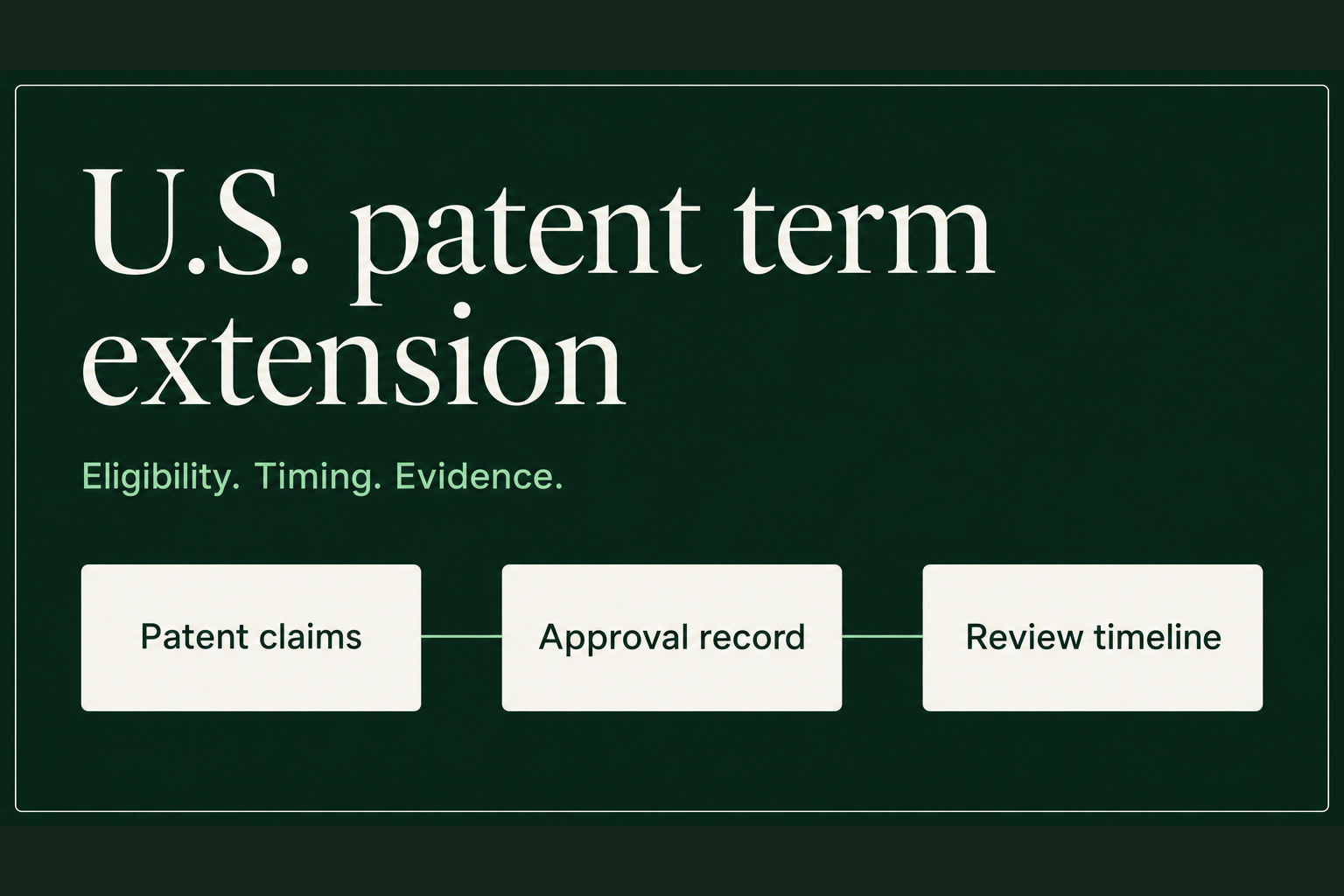
Which patent should you put forward when regulatory approval arrives, and what must be ready before the filing window closes? A patent term extension review connects claim scope, regulatory history, and the patent’s existing expiration date. Bringing those records together before approval gives counsel a basis for selecting the patent and requesting the appropriate term.
The focus here is U.S. 35 U.S.C. §156 for human drugs, biologics, and qualifying medical devices.
What patent term extension changes
Patent term extension (PTE) restores part of the patent life consumed by qualifying premarket regulatory review. The patent owner of record or its agent applies to the U.S. Patent and Trademark Office (USPTO). The Food and Drug Administration (FDA) determines the regulatory review period; the USPTO determines eligibility and the extension length. These responsibilities are set out in the agencies’ agreement.
Keep 3 neighboring mechanisms separate:
- Patent term adjustment (PTA) addresses specified USPTO prosecution delays under 35 U.S.C. §154(b).
- Regulatory exclusivity arises under separate approval statutes and can run alongside patent protection, as explained in the FDA’s exclusivity explanation.
- European supplementary protection certificates (SPCs) follow a separate certificate regime. The European SPC overview addresses that jurisdictional framework.
Establish eligibility before comparing extension lengths
The §156 eligibility conditions require a connected patent-and-regulatory showing:
- Relevant claims. The patent claims the approved product, a method of using it, or a method of manufacturing it.
- Unexpired term. The patent remains unexpired when the application is submitted.
- No previous final §156 extension. Distinguish a final extension under §156(e)(1) from an interim extension.
- Qualifying review. The product underwent the applicable statutory regulatory review before commercial marketing or use.
- First permission. Generally, the approval is the first permitted commercial marketing or use of the statutory product under the law governing that review. A specific exception applies to certain manufacturing-method claims using recombinant DNA technology.
- Authorized, timely application. The owner of record or its agent submits an application meeting the statutory requirements within the applicable window.
For drugs, build the prior-approval history around each active ingredient, including relevant salt, ester, and combination-product history. A different brand name, formulation, or indication calls for analysis of the statutory product and prior permissions. The formal application must disclose the active ingredients’ approval history.
For devices, identify the actual approval route. Section 156(g)(3) uses the §515 premarket approval or product-development-protocol framework. A 510(k)-only clearance therefore falls outside the review pathway described there. For a drug-device combination, identify the statutory category and review route on which the extension request rests. The USPTO’s application guidance explains the treatment of combination products.
Only 1 patent can receive a final extension for the same product and regulatory review period. Compare eligible candidates by relevant claim coverage, potential extension, and commercial importance. Also identify the approved uses or manufacturing method protected during the extended term: §156(b) limits the rights available during that period.
Fix the 60-day filing clock from the permission record
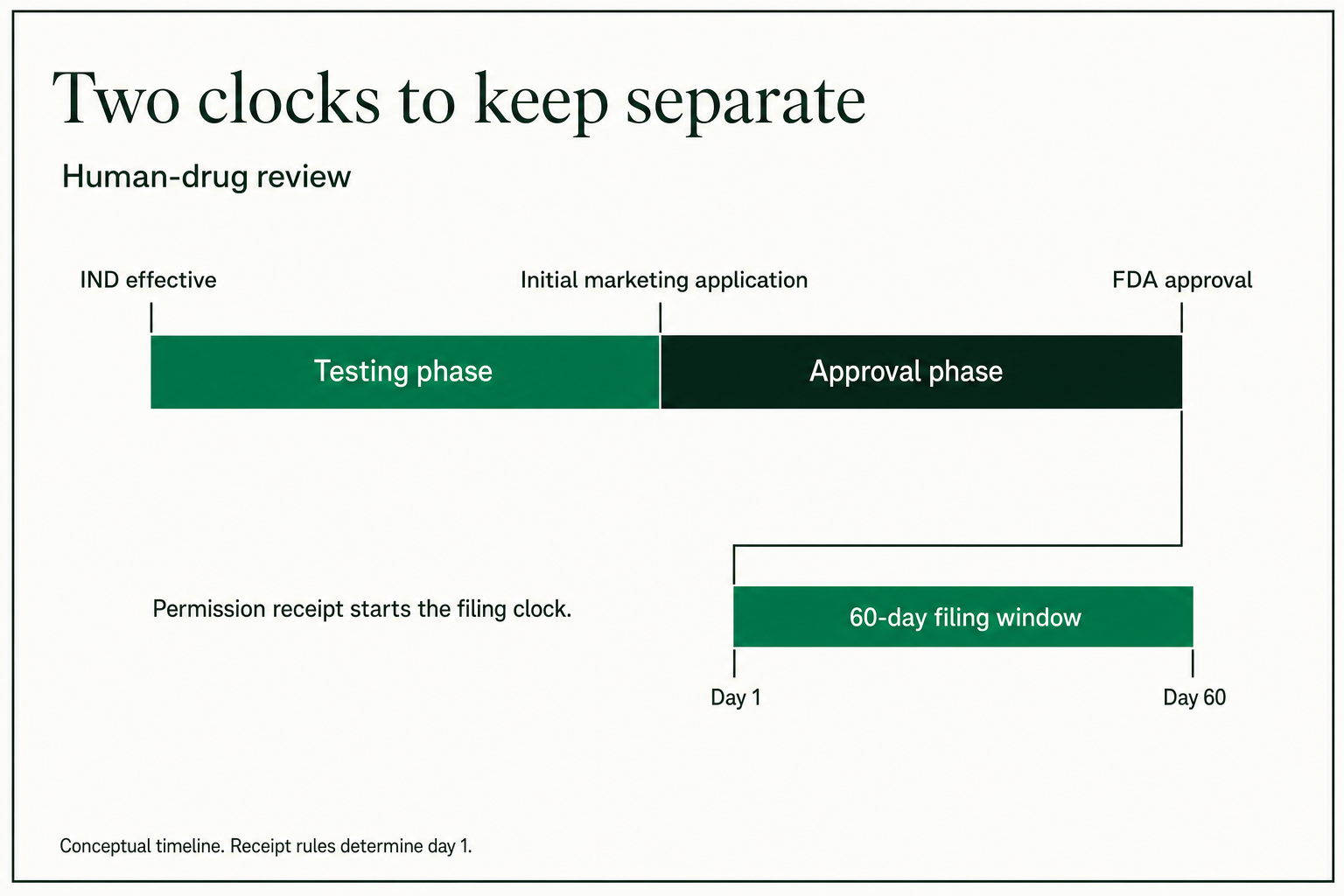
The ordinary application window is 60 days beginning on the legally determined permission-receipt date. That date counts as day 1. Under the statutory receipt rule, permission transmitted after 4:30 p.m. Eastern Time on a business day, or on a non-business day, is deemed received on the next business day.
Preserve the approval letter and its transmission timestamp. Record the resulting day 1 and the last filing date together. If the last day falls on a Saturday, Sunday, or federal holiday, the next-business-day rule applies. Certain controlled-substance drug products use the special “covered date” under §156(i). The USPTO’s deadline guidance explains that exception and the day-1 count; its application-content guidance addresses the weekend and holiday endpoint.
Protect the filing date with a complete statutory submission
The statutory window cannot be extended. Title 37 of the Code of Federal Regulations (CFR) distinguishes §1.741 filing-date requirements from §1.740 formal requirements. Some formalities can be corrected later, while the filing-date requirements must be satisfied within the window.
Under the filing-date requirements, the submission needs:
- The approved product and each federal statute under which review occurred.
- The patent and each relevant product, use, or manufacturing claim.
- Sufficient information to determine eligibility, extension rights, and the regulatory review period.
- A brief account of significant regulatory-review activities and their dates.
Prepare the full formal application, including the claimed extension calculation, required patent records, disclosure acknowledgment, fee, and correspondence information. Retain the electronic filing acknowledgment with the submitted package.
For pre-approval interim relief under §156(d)(5)(A) and 37 CFR §1.790(a), the owner of record or its agent must reasonably expect the applicable regulatory review period may extend beyond the patent term then in effect. The first pre-approval interim application has a separate window beginning 6 months and ending 15 days before that term expires. A pending post-approval application has a different interim-extension procedure. The USPTO’s interim-extension guidance distinguishes them.
Assemble one evidence record across patent and regulatory teams
Use the following review file to support the formal application requirements. Give each significant date a source document and locator so counsel can resolve differences between development summaries, agency correspondence, and patent records.
| Review question | Records to assemble | Decision the record supports |
|---|---|---|
| Which claims cover the approved product, use, or manufacture? | Complete issued patent, claims, drawings, and a claim-to-product explanation supported by technical records | List each applicable claim and show how at least 1 claim in each relevant claim category reads on the approved subject matter |
| What is the patent’s existing expiration date? | Issue date, term calculation, PTA, terminal disclaimer, maintenance records, corrections, reexamination records, and any extension certificates | Establish the starting expiration date and confirm the patent is unexpired at filing |
| What product received permission, and under which law? | Approval letter or order, application number, product identity, approved uses, active-ingredient approval history, and transmission record | Resolve product identity, first permission, statutory pathway, and filing-clock start |
| Which days belong in the review period? | Agency milestone records, initial submission receipts, effective-date notices, and approval records | Establish the testing and approval phases, then separate days on or before patent issuance |
| What happened during review? | Dated chronology of significant development and regulatory activities with supporting agency correspondence | Support the activity description and address any due-diligence issue |
| Who can file? | Owner-of-record information, relevant assignments, and agent authority | Establish the applicant’s authority and access to the marketing applicant’s records |
Use the milestones for the actual product category
For a human drug or biologic, retain the effective investigational new drug (IND) date and number, the initial new drug application (NDA) or biologics license application (BLA) submission record, and the approval record. The testing phase runs from the effective investigational exemption to initial marketing-application submission; the approval phase runs from that submission to approval.
For a medical device, retain the investigational device exemption (IDE) effective date and number, if applicable, or substantiation of the first human clinical investigation when no IDE was submitted. Add the initial §515 premarket approval application or product development protocol records and the approval or protocol-completion record. These category-specific milestones appear in the USPTO’s record requirements.
Calculate qualifying days, then apply the limits
Start with the post-issuance regulatory review period and make the FDA-determined due-diligence reductions for each phase. The calculation then subtracts half the remaining testing-phase time from the remaining total, ignoring half-days in that subtraction. The human-drug calculation rule and medical-device calculation rule set out the day-count method.
For contemporary human-drug and device patents, the extension generally faces 2 limits:
- A maximum extension of 5 years. Historical issue and review dates can invoke different statutory limits.
- A ceiling of 14 years after approval. The remaining patent term at approval plus PTE cannot exceed that ceiling.
The starting expiration date includes applicable PTA and accounts for any terminal disclaimer. The USPTO’s calculation guidance explains the limits and starting term.
Synthetic example: the 14-year ceiling controls
Assume a fictional human-drug approval on September 15, 2026, a patent issued after September 24, 1984 and before regulatory review began, and an existing patent expiration of September 15, 2036. Assume 2,200 testing-phase days, 800 approval-phase days, and no due-diligence reduction.
| Calculation step | Synthetic result |
|---|---|
| Half the testing phase plus the approval phase | (2,200 ÷ 2) + 800 = 1,900 days |
| Apply the 5-year maximum | September 15, 2036 to September 15, 2041 = 1,826 days |
| Apply the approval-plus-14-year ceiling | September 15, 2026 + 14 years = September 15, 2040 |
| Measure available extension from existing expiration | September 15, 2036 to September 15, 2040 = 1,461 days |
| Apply both limits | The shorter period is 1,461 days, or 4 years |
The example shows why the candidate review-period calculation and the final extension can differ. Keep the phase-day calculation, existing expiration, and both statutory limits visible in the same worksheet.
Follow the agency determinations through to the certificate
After filing, reconcile the FDA’s published regulatory-review-period determination with the source chronology. A person seeking a due-diligence determination has 180 days from publication of that determination to petition. The USPTO then issues its final eligibility and term determination, followed by the extension certificate where appropriate. The FDA–USPTO agreement describes the agency handoff; the USPTO’s review-period guidance explains the publication and due-diligence process.
Record the certificate’s actual extended expiration and the protected product or uses in the patent record. That gives the business a documented term position for product planning and licensing decisions.
Where Patlytics fits
Patlytics supports the claim-scope and patent-to-product analysis behind selecting 1 patent from several extension candidates.
- Claim Construction proposes constructions with pin cites to the specification. The constructions are editable, and charts can be re-run using revised terms.
- Claim Charting maps claim limitations to supporting product evidence in citation-backed charts, supplying a reviewable basis for the claim-to-product explanation.
- Portfolio Analysis maps candidate patents to the approved product, giving counsel a basis for comparing claim coverage across candidates before selecting the patent to put forward.
For related life-sciences patent work, the platform also includes a structure editor, image-to-SMILES conversion into Simplified Molecular Input Line Entry System notation, Markush/R-group generation, and sequence uploads with complementarity-determining-region (CDR) detection.
Attorneys retain control of claim analysis and filing-strategy decisions.
Build a source-linked claim-scope record for your extension review. Book a demo of Patlytics’ claim charting and patent-to-product analysis workflows.

U.S. patent term extension: eligibility, timing, and evidence
Which patent should you put forward when regulatory approval arrives, and what must be ready before the filing window closes? A patent term extension review connects claim scope, regulatory history, and the patent’s existing expiration date. Bringing those records together before approval gives counsel a basis for selecting the patent and requesting the appropriate term.
The focus here is U.S. 35 U.S.C. §156 for human drugs, biologics, and qualifying medical devices.
What patent term extension changes
Patent term extension (PTE) restores part of the patent life consumed by qualifying premarket regulatory review. The patent owner of record or its agent applies to the U.S. Patent and Trademark Office (USPTO). The Food and Drug Administration (FDA) determines the regulatory review period; the USPTO determines eligibility and the extension length. These responsibilities are set out in the agencies’ agreement.
Keep 3 neighboring mechanisms separate:
- Patent term adjustment (PTA) addresses specified USPTO prosecution delays under 35 U.S.C. §154(b).
- Regulatory exclusivity arises under separate approval statutes and can run alongside patent protection, as explained in the FDA’s exclusivity explanation.
- European supplementary protection certificates (SPCs) follow a separate certificate regime. The European SPC overview addresses that jurisdictional framework.
Establish eligibility before comparing extension lengths
The §156 eligibility conditions require a connected patent-and-regulatory showing:
- Relevant claims. The patent claims the approved product, a method of using it, or a method of manufacturing it.
- Unexpired term. The patent remains unexpired when the application is submitted.
- No previous final §156 extension. Distinguish a final extension under §156(e)(1) from an interim extension.
- Qualifying review. The product underwent the applicable statutory regulatory review before commercial marketing or use.
- First permission. Generally, the approval is the first permitted commercial marketing or use of the statutory product under the law governing that review. A specific exception applies to certain manufacturing-method claims using recombinant DNA technology.
- Authorized, timely application. The owner of record or its agent submits an application meeting the statutory requirements within the applicable window.
For drugs, build the prior-approval history around each active ingredient, including relevant salt, ester, and combination-product history. A different brand name, formulation, or indication calls for analysis of the statutory product and prior permissions. The formal application must disclose the active ingredients’ approval history.
For devices, identify the actual approval route. Section 156(g)(3) uses the §515 premarket approval or product-development-protocol framework. A 510(k)-only clearance therefore falls outside the review pathway described there. For a drug-device combination, identify the statutory category and review route on which the extension request rests. The USPTO’s application guidance explains the treatment of combination products.
Only 1 patent can receive a final extension for the same product and regulatory review period. Compare eligible candidates by relevant claim coverage, potential extension, and commercial importance. Also identify the approved uses or manufacturing method protected during the extended term: §156(b) limits the rights available during that period.
Fix the 60-day filing clock from the permission record
The ordinary application window is 60 days beginning on the legally determined permission-receipt date. That date counts as day 1. Under the statutory receipt rule, permission transmitted after 4:30 p.m. Eastern Time on a business day, or on a non-business day, is deemed received on the next business day.
Preserve the approval letter and its transmission timestamp. Record the resulting day 1 and the last filing date together. If the last day falls on a Saturday, Sunday, or federal holiday, the next-business-day rule applies. Certain controlled-substance drug products use the special “covered date” under §156(i). The USPTO’s deadline guidance explains that exception and the day-1 count; its application-content guidance addresses the weekend and holiday endpoint.
Protect the filing date with a complete statutory submission
The statutory window cannot be extended. Title 37 of the Code of Federal Regulations (CFR) distinguishes §1.741 filing-date requirements from §1.740 formal requirements. Some formalities can be corrected later, while the filing-date requirements must be satisfied within the window.
Under the filing-date requirements, the submission needs:
- The approved product and each federal statute under which review occurred.
- The patent and each relevant product, use, or manufacturing claim.
- Sufficient information to determine eligibility, extension rights, and the regulatory review period.
- A brief account of significant regulatory-review activities and their dates.
Prepare the full formal application, including the claimed extension calculation, required patent records, disclosure acknowledgment, fee, and correspondence information. Retain the electronic filing acknowledgment with the submitted package.
For pre-approval interim relief under §156(d)(5)(A) and 37 CFR §1.790(a), the owner of record or its agent must reasonably expect the applicable regulatory review period may extend beyond the patent term then in effect. The first pre-approval interim application has a separate window beginning 6 months and ending 15 days before that term expires. A pending post-approval application has a different interim-extension procedure. The USPTO’s interim-extension guidance distinguishes them.
Assemble one evidence record across patent and regulatory teams
Use the following review file to support the formal application requirements. Give each significant date a source document and locator so counsel can resolve differences between development summaries, agency correspondence, and patent records.
| Review question | Records to assemble | Decision the record supports |
|---|---|---|
| Which claims cover the approved product, use, or manufacture? | Complete issued patent, claims, drawings, and a claim-to-product explanation supported by technical records | List each applicable claim and show how at least 1 claim in each relevant claim category reads on the approved subject matter |
| What is the patent’s existing expiration date? | Issue date, term calculation, PTA, terminal disclaimer, maintenance records, corrections, reexamination records, and any extension certificates | Establish the starting expiration date and confirm the patent is unexpired at filing |
| What product received permission, and under which law? | Approval letter or order, application number, product identity, approved uses, active-ingredient approval history, and transmission record | Resolve product identity, first permission, statutory pathway, and filing-clock start |
| Which days belong in the review period? | Agency milestone records, initial submission receipts, effective-date notices, and approval records | Establish the testing and approval phases, then separate days on or before patent issuance |
| What happened during review? | Dated chronology of significant development and regulatory activities with supporting agency correspondence | Support the activity description and address any due-diligence issue |
| Who can file? | Owner-of-record information, relevant assignments, and agent authority | Establish the applicant’s authority and access to the marketing applicant’s records |
Use the milestones for the actual product category
For a human drug or biologic, retain the effective investigational new drug (IND) date and number, the initial new drug application (NDA) or biologics license application (BLA) submission record, and the approval record. The testing phase runs from the effective investigational exemption to initial marketing-application submission; the approval phase runs from that submission to approval.
For a medical device, retain the investigational device exemption (IDE) effective date and number, if applicable, or substantiation of the first human clinical investigation when no IDE was submitted. Add the initial §515 premarket approval application or product development protocol records and the approval or protocol-completion record. These category-specific milestones appear in the USPTO’s record requirements.
Calculate qualifying days, then apply the limits
Start with the post-issuance regulatory review period and make the FDA-determined due-diligence reductions for each phase. The calculation then subtracts half the remaining testing-phase time from the remaining total, ignoring half-days in that subtraction. The human-drug calculation rule and medical-device calculation rule set out the day-count method.
For contemporary human-drug and device patents, the extension generally faces 2 limits:
- A maximum extension of 5 years. Historical issue and review dates can invoke different statutory limits.
- A ceiling of 14 years after approval. The remaining patent term at approval plus PTE cannot exceed that ceiling.
The starting expiration date includes applicable PTA and accounts for any terminal disclaimer. The USPTO’s calculation guidance explains the limits and starting term.
Synthetic example: the 14-year ceiling controls
Assume a fictional human-drug approval on September 15, 2026, a patent issued after September 24, 1984 and before regulatory review began, and an existing patent expiration of September 15, 2036. Assume 2,200 testing-phase days, 800 approval-phase days, and no due-diligence reduction.
| Calculation step | Synthetic result |
|---|---|
| Half the testing phase plus the approval phase | (2,200 ÷ 2) + 800 = 1,900 days |
| Apply the 5-year maximum | September 15, 2036 to September 15, 2041 = 1,826 days |
| Apply the approval-plus-14-year ceiling | September 15, 2026 + 14 years = September 15, 2040 |
| Measure available extension from existing expiration | September 15, 2036 to September 15, 2040 = 1,461 days |
| Apply both limits | The shorter period is 1,461 days, or 4 years |
The example shows why the candidate review-period calculation and the final extension can differ. Keep the phase-day calculation, existing expiration, and both statutory limits visible in the same worksheet.
Follow the agency determinations through to the certificate
After filing, reconcile the FDA’s published regulatory-review-period determination with the source chronology. A person seeking a due-diligence determination has 180 days from publication of that determination to petition. The USPTO then issues its final eligibility and term determination, followed by the extension certificate where appropriate. The FDA–USPTO agreement describes the agency handoff; the USPTO’s review-period guidance explains the publication and due-diligence process.
Record the certificate’s actual extended expiration and the protected product or uses in the patent record. That gives the business a documented term position for product planning and licensing decisions.
Where Patlytics fits
Patlytics supports the claim-scope and patent-to-product analysis behind selecting 1 patent from several extension candidates.
- Claim Construction proposes constructions with pin cites to the specification. The constructions are editable, and charts can be re-run using revised terms.
- Claim Charting maps claim limitations to supporting product evidence in citation-backed charts, supplying a reviewable basis for the claim-to-product explanation.
- Portfolio Analysis maps candidate patents to the approved product, giving counsel a basis for comparing claim coverage across candidates before selecting the patent to put forward.
For related life-sciences patent work, the platform also includes a structure editor, image-to-SMILES conversion into Simplified Molecular Input Line Entry System notation, Markush/R-group generation, and sequence uploads with complementarity-determining-region (CDR) detection.
Attorneys retain control of claim analysis and filing-strategy decisions.
Build a source-linked claim-scope record for your extension review. Book a demo of Patlytics’ claim charting and patent-to-product analysis workflows.
The Premier AI-Powered Patent Platform
Reduce cycle times. Increase margins. Deliver winning IP outcomes.
Book a DemoThe Premier AI-Powered
Patent Platform
Reduce cycle times. Increase margins. Deliver winning IP outcomes.