November 17, 2026
Secondary considerations of nonobviousness: nexus
Connect secondary considerations of nonobviousness to patent claims with a practical nexus matrix, worked example, and business- and expert-witness requests.
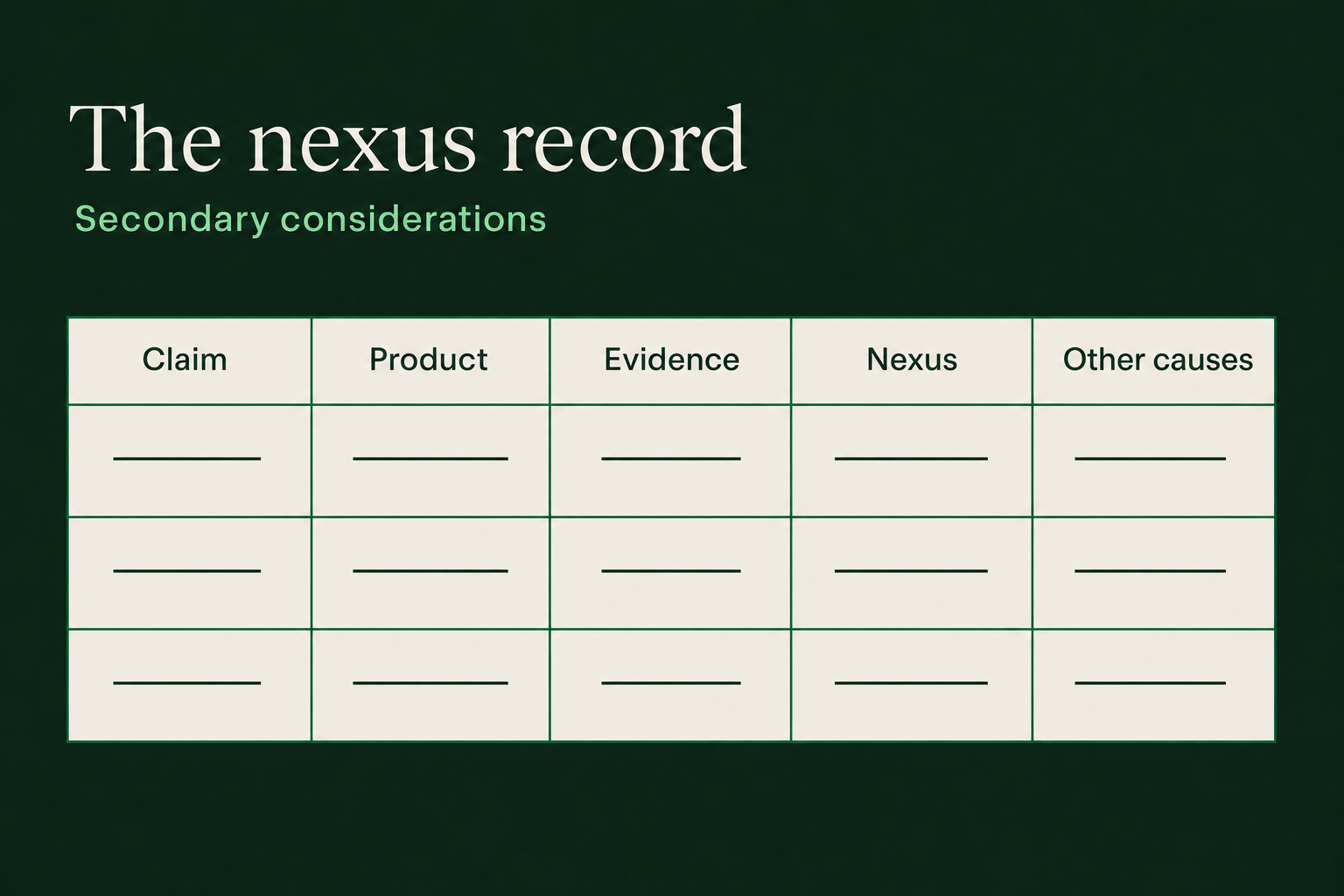
How do you connect a successful product, a surprising technical result, or industry praise to the patent claims at issue? Litigation teams need that connection before deciding how much weight the evidence deserves. A claim-linked evidence record helps counsel identify the supported explanation, the competing explanation, and the next document or witness needed.
The focus here is secondary-considerations evidence in U.S. utility-patent litigation, with relevant lessons from Patent Trial and Appeal Board proceedings.
What are secondary considerations of nonobviousness?
Secondary considerations of nonobviousness, also called objective indicia, are real-world evidence bearing on whether a claimed invention would have been obvious. They include commercial success, long-felt but unresolved need, failure of others, industry skepticism, praise, copying, and unexpected results. They help guard against hindsight and belong in the full obviousness analysis before the decision-maker reaches a conclusion. The Federal Circuit explains that role in WBIP v. Kohler.
Each category calls for a different factual inquiry:
| Indicium | Evidence to collect | Connection to explain |
|---|---|---|
| Commercial success | Product-specific sales, market context, purchasing records | Why the claimed invention contributed to demand |
| Long-felt need and failure of others | Dated problem statements and documented unsuccessful attempts | How the claimed invention addressed the same unresolved problem |
| Skepticism and praise | Full statements, dates, speakers, and technical context | Which claimed characteristics prompted the reaction |
| Copying | Development records, access evidence, and design comparisons | What was copied and its relationship to the claimed invention |
| Unexpected results | Comparative data, protocols, and the skilled artisan's expected result | Why the claimed subject matter produced a surprising result |
The United States Patent and Trademark Office's Manual of Patent Examining Procedure (MPEP) addresses these categories in MPEP §716.
Use the categories to direct collection. A matter may have persuasive evidence in only a few of them. For the upstream reference-combination analysis, the §103 obviousness guide addresses that separate task.
Establish nexus before assigning weight
Nexus is the connection between the objective evidence and the merits of the claimed invention. Showing that a product practices a claim addresses one question. Explaining why the product's success or reception supports nonobviousness addresses another.
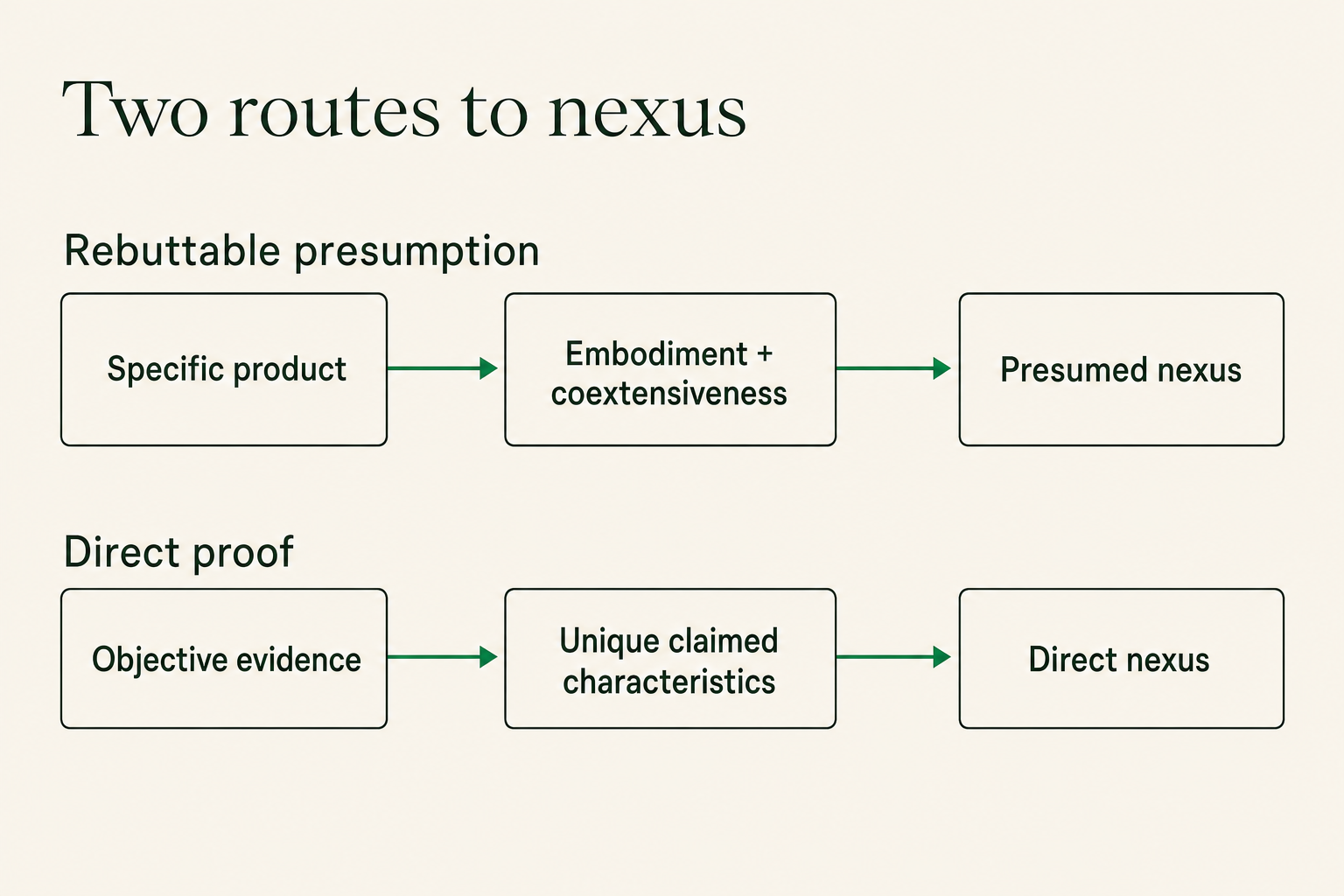
There are 2 routes to nexus:
- A rebuttable presumption. The patent owner shows that the evidence concerns a specific product embodying the claimed features and coextensive with them. Coextensiveness concerns the correspondence between the product and the claimed invention. Examine significant unclaimed features and their contribution to functionality. Perfect correspondence is unnecessary, but critical unclaimed functionality can defeat the presumption.
- Direct proof. The patent owner connects the evidence to the unique characteristics of the claimed invention through the factual record. This route remains available when the presumption is unavailable.
The Federal Circuit sets out these distinctions in Fox Factory v. SRAM. Keep both routes visible in the working record rather than ending the inquiry after a disputed coextensiveness showing.
In Volvo Penta v. Brunswick, an inter partes review appeal, the patent owner's conclusory coextensiveness showing failed to support a presumption. The court nevertheless found independent nexus supported by the evidence and vacated and remanded the Board's decision. The practical distinction is between a product-to-claim mapping, a coextensiveness showing, and evidence explaining the claimed invention's contribution.
Preserve the claimed combination as a whole. WBIP permits nexus to rest on that combination even where individual elements were known. A limitation-level mapping helps explain implementation; the causal account must also address the invention actually claimed.
Build a claim/product/evidence matrix
Give each material item its own row. Start with the exact claim, including dependencies and the construction being applied. Then identify the product version or tested configuration. A family-wide patent label and a product-line name leave too much room for mismatched evidence.
Use these fields in counsel's working matrix:
| Field | What to record |
|---|---|
| Claim and construction | Patent, claim number, dependencies, disputed terms, and the full combination under review |
| Product or configuration | Model, release, enabled features, test build, and relevant date range |
| Evidence and indicium | Specific document, passage, dataset, or testimony and the proposition it supports |
| Nexus explanation | The causal bridge to the claimed invention; separately identify support for any presumed nexus |
| Alternative explanation | Unclaimed features, price, promotion, distribution, market changes, or other supported causes |
| Gap and owner | Missing proof, contrary evidence, responsible witness or specialist, and next request |
Keep a citation to the underlying material beside each factual assertion. Distinguish an observed fact, such as a customer's recorded purchasing reason, from the inference counsel proposes to draw from it.
Fictional example: recovery software
Assume Claim 1 covers a recovery method combining snapshot selection using a stored consistency marker with replay of journal records after the selected snapshot. Aster Recovery's Restore 2.1 implements that combination and also includes an unclaimed compression engine. Counsel is assessing evidence collected during January–September 2026.
| Claim/product | Evidence | Proposed nexus | Alternative explanation | Next request and owner |
|---|---|---|---|---|
| Claim 1; Restore 2.1 | Sales ledger S-14 and customer evaluation E-08 show purchases following recovery trials | Customers selected the product because the claimed recovery sequence reduced interruption | A distributor discount began during the same period | Commercial lead: supply pricing history, trial decisions, and reasons for lost sales |
| Claim 1; Restore 2.1, compression disabled | Benchmark B-06 records recovery performance against the selected prior-art implementation | The claimed combination produced an improvement beyond the skilled artisan's expectation | The comparison used different hardware or an unrepresentative workload | Technical expert: assess comparator, controls, raw logs, expected result, and claim-scope reach |
| Claim 1; Restore 2.0 and 2.1 | Review P-03 praises fast recovery and compact storage without separating releases | The praise concerns operation of the claimed recovery sequence | The reviewer praised compression or a different release | Product engineer: identify reviewed build; counsel: obtain the full review and supporting materials |
The first row needs a purchasing explanation alongside sales. The second needs technical support for both the result and the expectation. The third needs a more precise product and feature attribution. Those gaps produce different collection requests.
Retain the adverse evidence in the same record. If customer evaluations credit the discount, record that fact beside the proposed technical explanation. If a benchmark changes hardware as well as the claimed method, identify the change before relying on the comparison.
Ask business witnesses for purchasing evidence
Send business witnesses a bounded request tied to the relevant product and period:
- Sales and finance: Product-level units, revenue, returns, pricing changes, and the definitions behind the figures. Separate bundles and versions where the underlying records permit it.
- Commercial or customer-facing staff: Contemporaneous evaluations, purchasing criteria, win/loss records, and customer statements explaining adoption or rejection.
- Marketing: Campaign timing, promotional spend, distribution changes, and the features emphasized in launch materials.
- Licensing personnel, where relevant: Executed agreements, covered patents and products, negotiation context, and records explaining the commercial reason for the license.
Ask each witness what they personally observed, which records support the account, and who created or maintained those records. Preserve contrary customer comments and changes in the market alongside favorable evidence.
A useful interview question is: “Which dated record shows why this customer chose this product configuration?” It gives counsel a concrete starting point for the causal explanation.
In the 2026 inter partes review appeal Hafeman v. Google, the Federal Circuit upheld the Board's treatment of secondary considerations where, among other problems, praise highlighted unpatented functionality and the commercial-success account lacked supporting evidence. Feature-specific source material matters more than a favorable headline.
Ask technical witnesses and experts for the bridge
The technical request should join the claim mapping to the reason the evidence matters:
- Map the relevant configuration. Identify support for each limitation and explain how the claimed combination operates in the product. Identify material unclaimed features separately.
- Explain the technical contribution. Connect the claimed operation to the praised capability, purchasing benefit, resolved problem, or measured result.
- Support the comparison. For unexpected results, preserve the comparator, protocol, raw data, operating conditions, and reasons for any differences between test configurations.
- Explain the expectation. Identify what a person of ordinary skill would have expected at the legally relevant time and the evidence supporting that expectation.
- Address the claim's reach. Explain which claimed embodiments or operating conditions the evidence supports and the basis for any broader inference.
MPEP §716 addresses comparative evidence and correspondence with claim scope. Its examination guidance provides useful collection questions; litigation counsel should apply the governing case law to the asserted claims and record.
For copying, seek development chronology and evidence of access, study, or replication. For long-felt need and failure of others, seek dated attempts addressing the same technical problem. Keep the underlying records attached to the explanation so the expert can address competing accounts.
Plan the evidentiary foundation during collection. Identify the personal-knowledge witness, record custodian, authentication route, and expert basis as appropriate. The Federal Rules of Evidence separately address personal knowledge, expert testimony, business records, and authentication in Rules 602, 702–703, 803(6), and 901.
Turn the matrix into a litigation decision
Review the record claim by claim. For each proposed indicium, counsel should be able to state:
- The supported fact and its source.
- The nexus route and supporting reasoning.
- The strongest competing explanation and evidence addressing it.
- The remaining gap and whether further collection could change the assessment.
Then weigh the evidence with the prior-art and other obviousness evidence. A supported nexus gives the evidence relevance; counsel must still assess its weight in the complete record. Volvo Penta also illustrates the need to explain that weighting.
Keep separate claims and product releases separate when their supporting facts differ. A later release may introduce the feature that received praise. A broad sales total may combine configurations with materially different claim mappings. Mark those distinctions rather than carrying the same conclusion across the portfolio.
For production crosswalks and the broader matter handoff, use the invalidity contentions workflow. The secondary-considerations record adds the causal explanation and witness requests that counsel needs for this specific issue.
Where Patlytics fits
Patlytics supports the claim, product, and prior-art analysis that supplies inputs to counsel's nexus record:
- Patent & NPL Search: Searches patents and non-patent literature (NPL), including PubMed, to develop candidate references.
- Invalidity and Claim Charting: Produce citation-backed, limitation-level invalidity charts for the underlying prior-art analysis.
- Claim Construction: Proposes constructions with pinpoint citations to the specification. The constructions are editable, and charts can be re-run using revised constructions.
- Infringement and Detection Report: Support product investigation and claim-to-product evidence mapping. Exhaustive mode provides deeper coverage on selected priority claims.
- Exports: Word, Excel, and PDF exports support preparation of the working evidence package.
Counsel assembles the commercial records, witness accounts, and causal explanations in the matrix. Attorneys retain review and decision authority over sources, mappings, constructions, and legal positions.
Build a source-linked claim and product record for your obviousness assessment. Book a demo focused on Patlytics' invalidity and claim-charting workflows.

귀사의 특허로 직접 확인해 보세요
주기 시간 단축. 수익률 증대. 성공적인 IP 성과 창출.