Analogous art: a reference-screening workflow
November 9, 2026

Can a technically close reference from another field support your proposed obviousness challenge? A promising passage can justify more work, but your team also needs a defensible account of why that reference belongs in the analysis. Otherwise, you can spend time building charts around a disputed premise.
The scope here is candidate-reference screening for US utility-patent obviousness under 35 U.S.C. §103. The practical output is a short evidence record that separates the field, the problem, the reference’s purpose, and the strongest competing characterization.
What makes a reference analogous art?
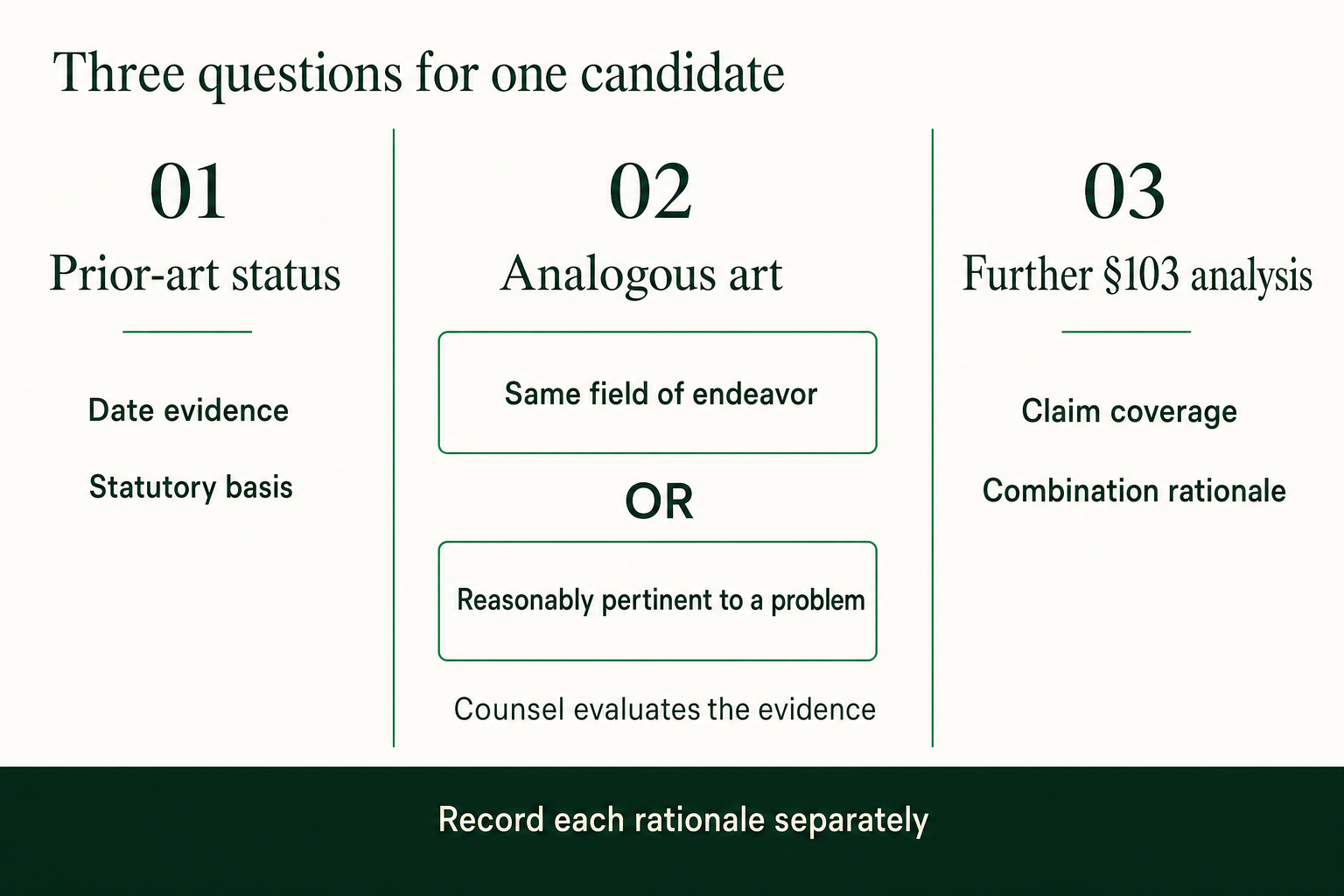
A prior-art reference qualifies as analogous art through either of two alternative tests:
- Same field of endeavor: The reference falls within the claimed invention’s field, even if it addresses a different problem.
- Reasonably pertinent: The reference bears a sufficiently relevant relationship to a problem facing the inventor, even if it comes from another field.
Either test can suffice. The Federal Circuit restated these alternatives in the Nielsen opinion, pp. 5–6. For a proposed combination, assess each reference against the claimed invention. The references need not be analogous to each other. The United States Patent and Trademark Office (USPTO) summarizes these rules in the Manual of Patent Examining Procedure (MPEP).
The second test needs an explanation of why the reference’s subject matter would reasonably attract a skilled artisan’s attention when addressing the relevant problem. A shared technical word is a lead for that explanation.
Keep search scope, prior-art status, and analogy separate
Search broadly enough to find useful cross-field teachings. USPTO search-scope guidance directs examiners beyond classifications and toward the claimed subject matter’s essential function or utility. That search instruction helps identify places to look; the reference-specific §103 inquiry follows.
Maintain three separate entries in your review:
- Discovery: Why did this document enter the candidate set?
- Prior-art status: What statutory basis and date evidence support using this exact document version?
- Analogous-art rationale: Which test supports considering it for the claimed invention?
A search filter supplies a retrieval boundary. Preserve the underlying publication or availability evidence and assess the applicable statutory dates and exceptions separately.
Also identify whether the proposed ground is anticipation under §102 or obviousness under §103. Anticipation requires a single reference to disclose every limitation, expressly or inherently, arranged or combined as recited in the claim. See the Gamble opinion, p. 6. Anticipation has no analogous-art requirement, as MPEP §2141.01(a), §I explains. Keep a cross-field reference available for any separately supported §102 theory.
Run a five-step analogous-art screen
1. Fix the claim and perspective
Record the challenged claim number, exact claim text, construction used, proceeding, and relevant date. Identify the person of ordinary skill whose technical knowledge supplies the perspective for the screen.
Read the claim as a whole alongside the specification. Extract the functions, structures, and operating circumstances that matter to the candidate reference. Record any disputed construction that changes the comparison.
Keep this entry compact. It gives another attorney enough context to understand why the same document could receive a different screening result for another claim or construction.
2. Describe both fields through the disclosures
Write a field description for the claimed invention and another for the candidate. Support each with pinpoint passages or figures.
For the same-field inquiry, the USPTO directs attention to the application’s embodiments, function, and structure, and to what the reference actually discloses. Classification provides evidence, while structural and functional comparisons carry greater weight. Those principles appear in MPEP §2141.01(a).
Use industry labels as an initial description, then examine the technical overlap. For example, “battery packs” and “outdoor audio equipment” identify markets. “Venting sealed electronic enclosures” identifies a possible shared technical endeavor that needs support in both documents.
Preserve the competing reading. If the shared field exists only at the level of “electronics,” explain what more specific structural or functional evidence supports it.
3. Compare the problems without importing the answer
Write the claimed invention’s relevant problem and the reference’s problem or purpose in separate sentences. Attach a source passage to each. Then explain the connection from the skilled artisan’s perspective.
In Donner Technology v. Pro Stage Gear, the Federal Circuit required identification and comparison of the problems to which both documents relate. It rejected an analysis that framed the problem so closely around the patent’s field that outside-field references were effectively excluded. The court vacated and remanded rather than deciding the reference’s analogous-art status itself. See the Donner opinion, pp. 7–12.
Use three questions to expose an unsupported bridge:
- What technical difficulty would lead the skilled artisan toward this reference?
- Which teaching would that person recognize as useful for that difficulty?
- What operating differences support a competing view of its relevance?
Avoid defining the problem by copying the claimed solution. At the other extreme, “improving performance” gives the reviewer little to evaluate. Preserve the mechanism and operating constraint that make the proposed connection meaningful.
Claim breadth also matters. In Nielsen Company v. TVision Insights, decided August 14, 2026, the Federal Circuit affirmed a reasonable-pertinence finding involving a facial-analysis publication and audience-measurement claims. It explained that the relevant problems can extend beyond the problem expressly emphasized in the specification. The challenged claims reached broader image-processing problems than the patent owner’s proposed light-source framing. See the Nielsen opinion, pp. 7–10.
For your record, state each supported problem characterization and identify the claim language or disclosure that favors it. That makes a disagreement about problem breadth visible before it becomes buried in a combination argument.
4. Assemble a source-linked screening worksheet
Use one record per candidate and target claim. Separate the document’s words from your inference about their significance. A useful worksheet contains these fields:
| Record item | Evidence to preserve |
|---|---|
| Target and perspective | Claim text and number, construction, proceeding, relevant date, and skilled-artisan perspective. |
| Exact candidate | Publication identifier or title, version, date, source copy, and pinpoint passages or figures. |
| Prior-art basis | Applicable statutory route, supporting date or availability evidence, and unresolved exceptions or priority questions. |
| Field comparison | Each document’s field, supporting functions and structures, proposed overlap, and competing field description. |
| Problem comparison | Each document’s problem or purpose, supporting passages, and the proposed technical connection. |
| Skilled-artisan bridge | Evidence explaining why that person would reasonably consult the reference for the identified problem. Include relevant technical literature or supported expert analysis. |
| Contrary evidence | Different operating conditions, purposes, scales, or assumptions, with an explanation of how each affects the asserted connection. |
| Reviewed disposition | Test relied on, rationale, unresolved evidence, attorney reviewer, and next action. |
Keep a concrete evidence request beside an unresolved entry. “Find contemporary enclosure-vent literature connecting these operating environments” directs further work. “Needs more research” leaves the next reviewer guessing.
5. Record a disposition for the proposed theory
Use three practical routing outcomes:
- Advance: Identify the supported test and the evidence on which counsel relies. If the same-field test suffices, record that the alternative test was not reached.
- Hold for evidence: Identify the missing fact and the work needed to resolve it.
- Set aside for this §103 theory: Preserve the reasons neither test is supported on the developed record.
Keep these outcomes tied to the claim, construction, and reference version screened. Reopen the record when a material input changes.
For an advancing candidate, move to the separate analysis of claim limitations, the reason to combine or modify, reasonable expectation of success, teaching away, and relevant objective evidence. Section 103 asks whether the claimed invention as a whole would have been obvious. The later combination and motivation workflow addresses that next stage.
Fictional example: a battery enclosure and an audio vent
Assume a fictional US battery-enclosure claim has an effective filing date of October 1, 2026. It recites an enclosure, a microporous vent, and a drainage channel below the vent. Its specification discusses water exposure and pressure differences during ordinary operation, as well as battery-failure conditions.
The candidate is a fictional technical guide, Outdoor speaker enclosure venting, version 1.0, published February 2, 2026. Page 4 describes a membrane that permits slow pressure equalization while resisting water entry. Page 7 describes acoustic and splash-exposure constraints. The screening team preserves the dated source copy and records prior-art status separately.
A close membrane disclosure creates a candidate. The following record identifies the work needed to support its use:
| Inquiry | Support for inclusion | Competing characterization or gap |
|---|---|---|
| Same field | Both disclosures concern vents in sealed electronic enclosures exposed to water. | “Battery-pack safety” and “speaker enclosure design” describe different endeavors. Counsel needs structural and functional support for the proposed shared field. |
| Relevant problem | The patent’s ordinary-operation discussion and the guide’s p. 4 address pressure equalization with resistance to water entry. | A battery-failure framing emphasizes rapid gas release, while the guide describes slow equalization. Record which problem the claim and specification support. |
| Skilled-artisan bridge | The reference offers a potentially useful membrane teaching for the ordinary-operation problem. | The file lacks contemporaneous evidence explaining why a battery-enclosure designer would consult audio-enclosure vent literature. |
| Next action | Retain the candidate for the reasonably-pertinent inquiry and seek evidence connecting the technical environments. | Keep the disposition unresolved until counsel evaluates that evidence and the competing problem framing. |
The pressure-rate difference deserves a specific explanation. Relate it to the problem on which the analogy theory relies. The answer may differ depending on whether the theory concerns routine equalization or emergency gas release.
The drainage-channel limitation gets its own later mapping entry. Keeping that disclosure question separate prevents a gap in claim coverage from silently reshaping the analogous-art rationale.
Where Patlytics fits
Patlytics supports the reference discovery and claim-level evidence work that supplies an analogous-art screening record:
- Patent & NPL Search searches patents and non-patent literature (NPL), including PubMed, using semantic queries and date boundaries. It supplies candidate references for the field and problem comparison.
- Patlytics Agent helps examine a reference and how it relates to selected claims, supporting investigation of the passages behind the proposed connection.
- Claim Construction proposes constructions with pinpoint citations to the specification. The constructions are editable, and the chart can be re-run with revised constructions.
- Invalidity and Claim Charting produce limitation-level, citation-backed charts. Exhaustive mode provides deeper coverage on selected priority claims. Invalidity charts export to Word and Excel for the next stage of matter work.
Counsel retains authority over the analogous-art determination, the screening disposition, and the resulting legal analysis.
Build a source-linked candidate record before investing in the full obviousness theory. Book a demo to bring Patlytics search and claim-level evidence into your next invalidity review.

Analogous art: a reference-screening workflow
Can a technically close reference from another field support your proposed obviousness challenge? A promising passage can justify more work, but your team also needs a defensible account of why that reference belongs in the analysis. Otherwise, you can spend time building charts around a disputed premise.
The scope here is candidate-reference screening for US utility-patent obviousness under 35 U.S.C. §103. The practical output is a short evidence record that separates the field, the problem, the reference’s purpose, and the strongest competing characterization.
What makes a reference analogous art?
A prior-art reference qualifies as analogous art through either of two alternative tests:
- Same field of endeavor: The reference falls within the claimed invention’s field, even if it addresses a different problem.
- Reasonably pertinent: The reference bears a sufficiently relevant relationship to a problem facing the inventor, even if it comes from another field.
Either test can suffice. The Federal Circuit restated these alternatives in the Nielsen opinion, pp. 5–6. For a proposed combination, assess each reference against the claimed invention. The references need not be analogous to each other. The United States Patent and Trademark Office (USPTO) summarizes these rules in the Manual of Patent Examining Procedure (MPEP).
The second test needs an explanation of why the reference’s subject matter would reasonably attract a skilled artisan’s attention when addressing the relevant problem. A shared technical word is a lead for that explanation.
Keep search scope, prior-art status, and analogy separate
Search broadly enough to find useful cross-field teachings. USPTO search-scope guidance directs examiners beyond classifications and toward the claimed subject matter’s essential function or utility. That search instruction helps identify places to look; the reference-specific §103 inquiry follows.
Maintain three separate entries in your review:
- Discovery: Why did this document enter the candidate set?
- Prior-art status: What statutory basis and date evidence support using this exact document version?
- Analogous-art rationale: Which test supports considering it for the claimed invention?
A search filter supplies a retrieval boundary. Preserve the underlying publication or availability evidence and assess the applicable statutory dates and exceptions separately.
Also identify whether the proposed ground is anticipation under §102 or obviousness under §103. Anticipation requires a single reference to disclose every limitation, expressly or inherently, arranged or combined as recited in the claim. See the Gamble opinion, p. 6. Anticipation has no analogous-art requirement, as MPEP §2141.01(a), §I explains. Keep a cross-field reference available for any separately supported §102 theory.
Run a five-step analogous-art screen
1. Fix the claim and perspective
Record the challenged claim number, exact claim text, construction used, proceeding, and relevant date. Identify the person of ordinary skill whose technical knowledge supplies the perspective for the screen.
Read the claim as a whole alongside the specification. Extract the functions, structures, and operating circumstances that matter to the candidate reference. Record any disputed construction that changes the comparison.
Keep this entry compact. It gives another attorney enough context to understand why the same document could receive a different screening result for another claim or construction.
2. Describe both fields through the disclosures
Write a field description for the claimed invention and another for the candidate. Support each with pinpoint passages or figures.
For the same-field inquiry, the USPTO directs attention to the application’s embodiments, function, and structure, and to what the reference actually discloses. Classification provides evidence, while structural and functional comparisons carry greater weight. Those principles appear in MPEP §2141.01(a).
Use industry labels as an initial description, then examine the technical overlap. For example, “battery packs” and “outdoor audio equipment” identify markets. “Venting sealed electronic enclosures” identifies a possible shared technical endeavor that needs support in both documents.
Preserve the competing reading. If the shared field exists only at the level of “electronics,” explain what more specific structural or functional evidence supports it.
3. Compare the problems without importing the answer
Write the claimed invention’s relevant problem and the reference’s problem or purpose in separate sentences. Attach a source passage to each. Then explain the connection from the skilled artisan’s perspective.
In Donner Technology v. Pro Stage Gear, the Federal Circuit required identification and comparison of the problems to which both documents relate. It rejected an analysis that framed the problem so closely around the patent’s field that outside-field references were effectively excluded. The court vacated and remanded rather than deciding the reference’s analogous-art status itself. See the Donner opinion, pp. 7–12.
Use three questions to expose an unsupported bridge:
- What technical difficulty would lead the skilled artisan toward this reference?
- Which teaching would that person recognize as useful for that difficulty?
- What operating differences support a competing view of its relevance?
Avoid defining the problem by copying the claimed solution. At the other extreme, “improving performance” gives the reviewer little to evaluate. Preserve the mechanism and operating constraint that make the proposed connection meaningful.
Claim breadth also matters. In Nielsen Company v. TVision Insights, decided August 14, 2026, the Federal Circuit affirmed a reasonable-pertinence finding involving a facial-analysis publication and audience-measurement claims. It explained that the relevant problems can extend beyond the problem expressly emphasized in the specification. The challenged claims reached broader image-processing problems than the patent owner’s proposed light-source framing. See the Nielsen opinion, pp. 7–10.
For your record, state each supported problem characterization and identify the claim language or disclosure that favors it. That makes a disagreement about problem breadth visible before it becomes buried in a combination argument.
4. Assemble a source-linked screening worksheet
Use one record per candidate and target claim. Separate the document’s words from your inference about their significance. A useful worksheet contains these fields:
| Record item | Evidence to preserve |
|---|---|
| Target and perspective | Claim text and number, construction, proceeding, relevant date, and skilled-artisan perspective. |
| Exact candidate | Publication identifier or title, version, date, source copy, and pinpoint passages or figures. |
| Prior-art basis | Applicable statutory route, supporting date or availability evidence, and unresolved exceptions or priority questions. |
| Field comparison | Each document’s field, supporting functions and structures, proposed overlap, and competing field description. |
| Problem comparison | Each document’s problem or purpose, supporting passages, and the proposed technical connection. |
| Skilled-artisan bridge | Evidence explaining why that person would reasonably consult the reference for the identified problem. Include relevant technical literature or supported expert analysis. |
| Contrary evidence | Different operating conditions, purposes, scales, or assumptions, with an explanation of how each affects the asserted connection. |
| Reviewed disposition | Test relied on, rationale, unresolved evidence, attorney reviewer, and next action. |
Keep a concrete evidence request beside an unresolved entry. “Find contemporary enclosure-vent literature connecting these operating environments” directs further work. “Needs more research” leaves the next reviewer guessing.
5. Record a disposition for the proposed theory
Use three practical routing outcomes:
- Advance: Identify the supported test and the evidence on which counsel relies. If the same-field test suffices, record that the alternative test was not reached.
- Hold for evidence: Identify the missing fact and the work needed to resolve it.
- Set aside for this §103 theory: Preserve the reasons neither test is supported on the developed record.
Keep these outcomes tied to the claim, construction, and reference version screened. Reopen the record when a material input changes.
For an advancing candidate, move to the separate analysis of claim limitations, the reason to combine or modify, reasonable expectation of success, teaching away, and relevant objective evidence. Section 103 asks whether the claimed invention as a whole would have been obvious. The later combination and motivation workflow addresses that next stage.
Fictional example: a battery enclosure and an audio vent
Assume a fictional US battery-enclosure claim has an effective filing date of October 1, 2026. It recites an enclosure, a microporous vent, and a drainage channel below the vent. Its specification discusses water exposure and pressure differences during ordinary operation, as well as battery-failure conditions.
The candidate is a fictional technical guide, Outdoor speaker enclosure venting, version 1.0, published February 2, 2026. Page 4 describes a membrane that permits slow pressure equalization while resisting water entry. Page 7 describes acoustic and splash-exposure constraints. The screening team preserves the dated source copy and records prior-art status separately.
A close membrane disclosure creates a candidate. The following record identifies the work needed to support its use:
| Inquiry | Support for inclusion | Competing characterization or gap |
|---|---|---|
| Same field | Both disclosures concern vents in sealed electronic enclosures exposed to water. | “Battery-pack safety” and “speaker enclosure design” describe different endeavors. Counsel needs structural and functional support for the proposed shared field. |
| Relevant problem | The patent’s ordinary-operation discussion and the guide’s p. 4 address pressure equalization with resistance to water entry. | A battery-failure framing emphasizes rapid gas release, while the guide describes slow equalization. Record which problem the claim and specification support. |
| Skilled-artisan bridge | The reference offers a potentially useful membrane teaching for the ordinary-operation problem. | The file lacks contemporaneous evidence explaining why a battery-enclosure designer would consult audio-enclosure vent literature. |
| Next action | Retain the candidate for the reasonably-pertinent inquiry and seek evidence connecting the technical environments. | Keep the disposition unresolved until counsel evaluates that evidence and the competing problem framing. |
The pressure-rate difference deserves a specific explanation. Relate it to the problem on which the analogy theory relies. The answer may differ depending on whether the theory concerns routine equalization or emergency gas release.
The drainage-channel limitation gets its own later mapping entry. Keeping that disclosure question separate prevents a gap in claim coverage from silently reshaping the analogous-art rationale.
Where Patlytics fits
Patlytics supports the reference discovery and claim-level evidence work that supplies an analogous-art screening record:
- Patent & NPL Search searches patents and non-patent literature (NPL), including PubMed, using semantic queries and date boundaries. It supplies candidate references for the field and problem comparison.
- Patlytics Agent helps examine a reference and how it relates to selected claims, supporting investigation of the passages behind the proposed connection.
- Claim Construction proposes constructions with pinpoint citations to the specification. The constructions are editable, and the chart can be re-run with revised constructions.
- Invalidity and Claim Charting produce limitation-level, citation-backed charts. Exhaustive mode provides deeper coverage on selected priority claims. Invalidity charts export to Word and Excel for the next stage of matter work.
Counsel retains authority over the analogous-art determination, the screening disposition, and the resulting legal analysis.
Build a source-linked candidate record before investing in the full obviousness theory. Book a demo to bring Patlytics search and claim-level evidence into your next invalidity review.
The Premier AI-Powered Patent Platform
Reduce cycle times. Increase margins. Deliver winning IP outcomes.
Book a DemoThe Premier AI-Powered
Patent Platform
Reduce cycle times. Increase margins. Deliver winning IP outcomes.