9 Best Patent Proofreading Software for Law Firms
May 18, 2026

Patent proofreading is one of the last quality-control checks before filing, and it carries more weight than a standard document review. In patent practice, small errors can create real downstream costs: office actions, rework, delayed filings, and weaker claim support.
Recent data found that 88% of patents issued in the last year contained at least one numbering, antecedent basis, or word support error. For law firms and IP teams, that helps explain the growing demand for proofreading software that can identify issues quickly without lowering the quality bar.
In this guide, we break down the top patent proofreading tools, the features that matter most, and how to evaluate them based on your team’s workflow and filing volume.
Key Takeaways
- Patent prosecution slows down most at the front end, when attorneys have to rebuild context before drafting can begin.
- The best patent proofreading software does more than clean up language. It helps catch the kinds of errors that create downstream filing and prosecution risk.
- Strong tools reduce manual checking by flagging issues such as antecedent basis problems, claim dependency errors, inconsistent terminology, and missing specification support.
- For law firms, the right software improves review efficiency while keeping attorney judgment fully in control.
What is AI Patent Proofreading Software?
AI patent proofreading software, also known as office action response tools, reviews patent drafts for errors that matter in practice, not just surface-level writing issues. These tools are designed to flag problems such as missing antecedent basis, incorrect claim dependencies, inconsistent terminology, citation issues, and claim language that may not be fully supported by the specification.
The goal is not to replace attorney review. It is to help patent practitioners catch issues earlier, reduce manual checking, and improve the quality and defensibility of the final work product.
Best Patent Proofreading Software for Law Firms
The tools below were selected based on how accurately they handle real patent proofreading work within drafting and prosecution workflows. We evaluated workflow integration, strategy support, USPTO connectivity, citation accuracy, and suitability for professional prosecution practice. We weighted strategy-first design and citation auditability most heavily — these determine whether a tool improves response quality, not just response speed.
Finally, we prioritized platforms that help law firms and teams reduce manual review, identify substantive issues earlier, and preserve attorney control over the final output.
1. Patlytics: Best for Context-Aware Validation Against the Spec, Prior Art, and Prosecution History
Patlytics is an AI-powered patent platform that performs proofreading as part of a full, end-to-end workflow across drafting, prosecution, and analysis. Instead of running isolated checks, it analyzes the full context of the application, including claims, specification, cited references, and prosecution history to surface issues tied to support, consistency, and defensibility. The office action response tool simplifies attorney workflows, where the AI handles validation and structure while the practitioner applies judgment and makes final decisions.
Patlytics is used by 40% of the Am Law 100 (including Quinn Emanuel, and Foley & Lardner) and Fortune 500 IP teams at Sanofi, Rivian, GRAIL, Asahi Kasei, and Panasonic.
Key features:
- Context-aware document analysis that evaluates claims, specification, and cited references together rather than in isolation
- Citation-backed validation where every flagged issue or suggestion links directly to supporting source text for verification
- “Possible vs. Not Possible” reasoning that flags when claim language or amendments are unsupported by the specification
- End-to-end workflow coverage across drafting, office actions, claim charts, and prosecution, so issues are identified earlier in the lifecycle
- Security and compliance: SOC 2 Type 2, ISO 27001, ISO 42001, and GDPR, the only patent AI platform with all four. Customer data is segregated and never used to train models.

Reviews:
- “Any in-house IP department that wants to be more efficient, lower their outside counsel bills, and automate processes that were previously manual should seriously consider Patlytics.” - verified user
- “It covers everything I need and honestly is more complete than other databases I've tried.” - Verified user
Pricing: Custom pricing
2. Solve Intelligence: Best For Embedded Proofreading

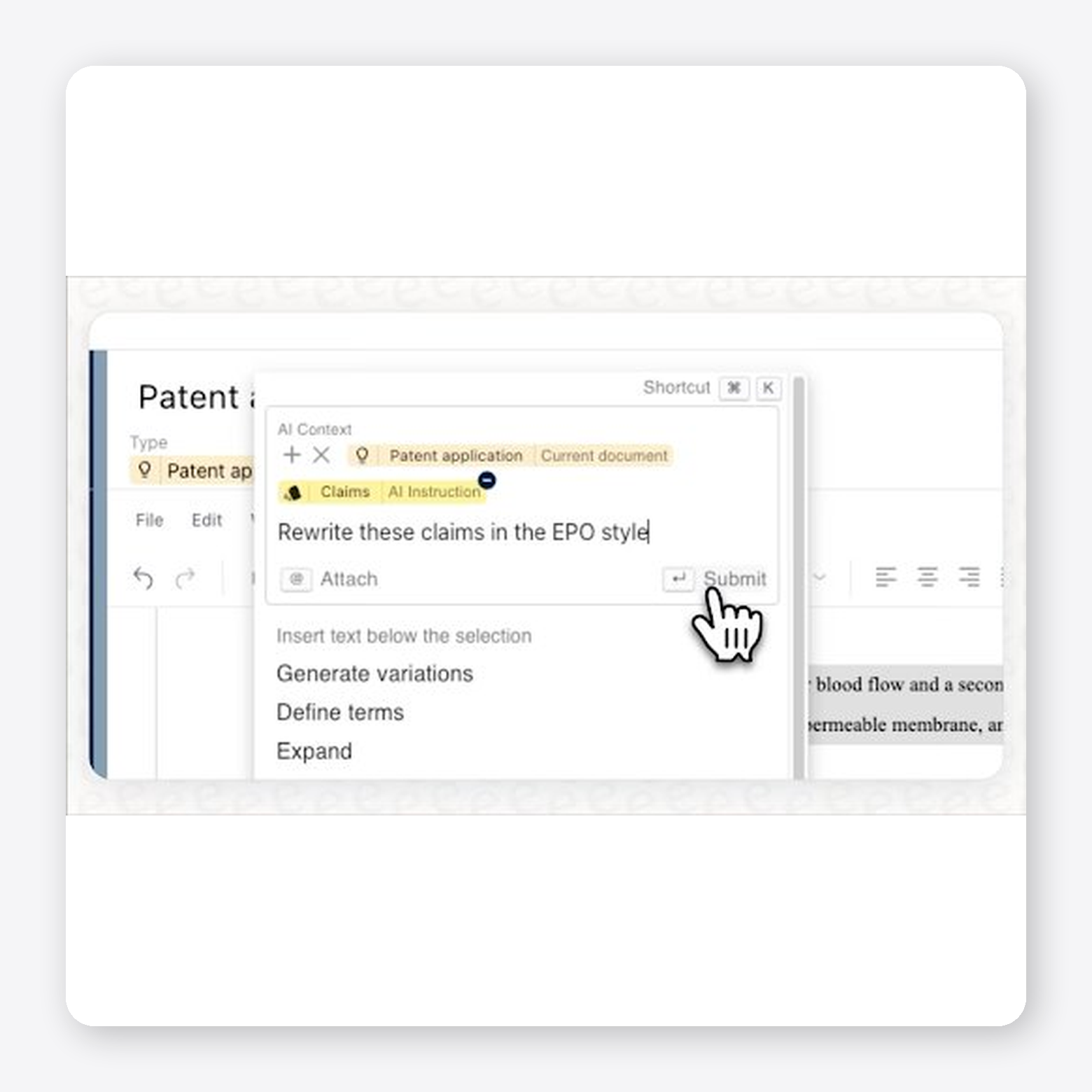
Solve Intelligence is built around an in-browser document editor that supports drafting, prosecution, and document review. Its proofreading capabilities are embedded within the drafting workflow, where the system analyzes claims, specifications, and office actions to identify issues and suggest edits. The platform is primarily focused on generating and refining patent documents, with proofreading functioning as part of its broader drafting and prosecution system.
Key features:
- AI flags issues in claims, prior art, and office actions with suggested amendments
- Tracked changes-style AI edits for transparent claim fixes
- In-browser editor for drafting and refining patent applications
- End-to-end workflow support for drafting, prosecution, disclosures, and claim charting
Pricing: Custom pricing
3. Anaqua AQX: Best For Managing Proofreading Within Enterprise IP Workflows
Anaqua AQX is an enterprise IP management platform that centralizes patents, documents, workflows, and analytics. It helps law firms and IP teams manage large portfolios, automate administrative processes. Its proofreading capabilities are embedded within broader workflows like document processing, docketing, and prosecution management.
Key features:
- Unified workflow for drafting, filing, and review
- AI extraction and standardization of PTO document data
- Automated IDS and citation management
- Centralized portfolio management with version control and visibility
Pricing: Custom pricing

4. ClaimMaster: Best For Rule-Based Patent Proofreading Inside Microsoft Word
ClaimMaster is a Microsoft Word add-in that automates proofreading and drafting checks directly within documents. It identifies structural and consistency errors in claims, specifications, and amendments during drafting and review. The tool is used for in-document validation but relies on predefined rules rather than deeper AI-based analysis.
Key features:
- Detects claim errors (antecedent basis, numbering, amendments, terminology)
- Checks consistency across specs, figures, and part numbering
- Flags limiting or “profanity” language that may narrow claim scope
Pricing:
- Discovery: Free
- Standard: £39/month
- Pro: £99/month
- Enterprise: Custom pricing

5. LexisNexis PatentOptimizer: Best For Rule-Based Patent Proofreading with Integrated Legal Data

LexisNexis PatentOptimizer is a patent drafting and review tool that performs rule-based proofreading directly within drafting environments like Microsoft Word. It analyzes claims, specifications, and drawings to identify structural issues such as missing antecedent basis, inconsistent terminology, and lack of support. The platform is integrated with LexisNexis data and workflows.
Key features:
- Analyzes claims and specs for basis, dependencies, and support
- Validates consistency across parts, drawings, and claim elements
- Auto-generates IDS forms with properly formatted citations
Pricing: Custom pricing

6. PatentBots: Best For Standalone Patent Proofreading Checks

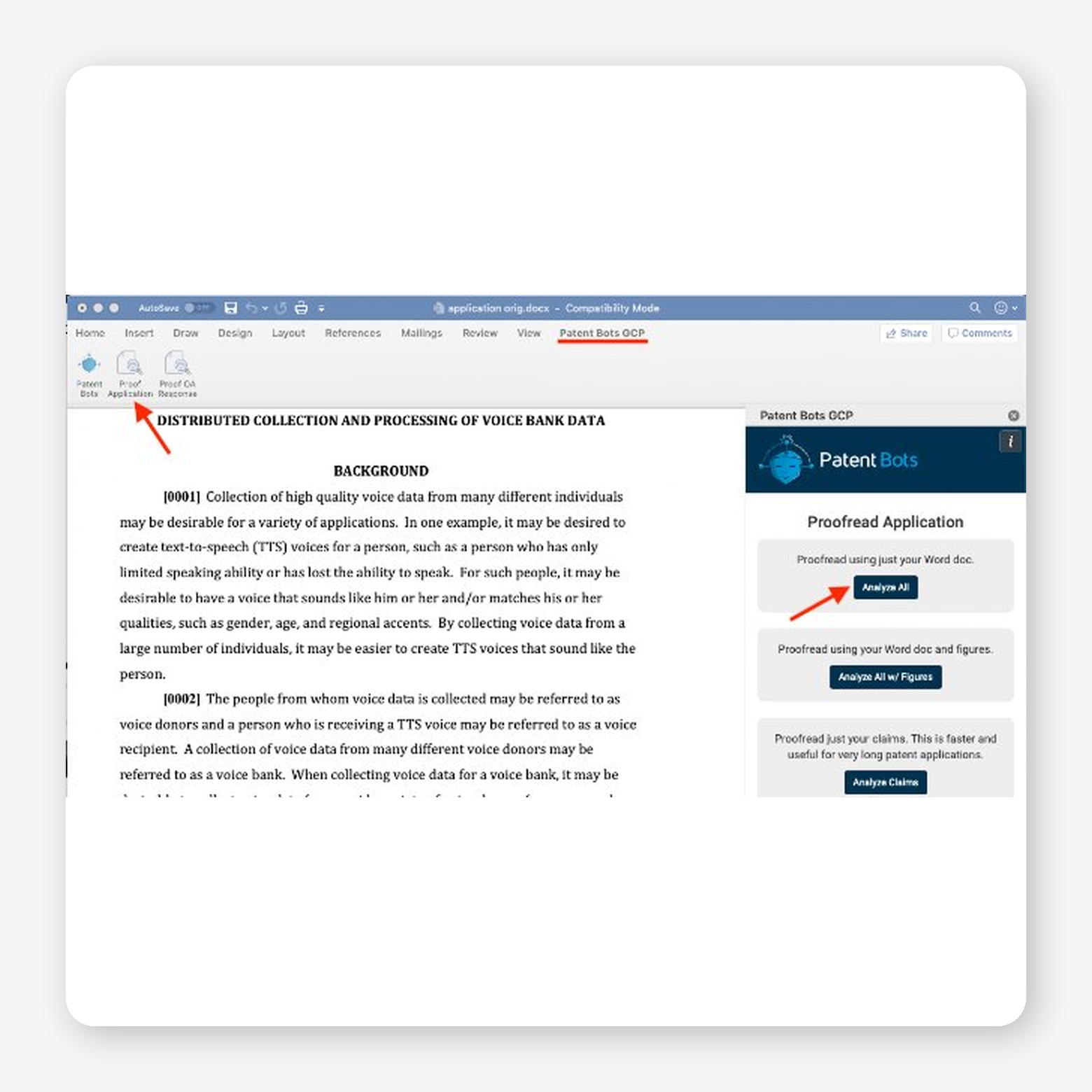
PatentBots is a web-based patent proofreading tool that can identify structural and consistency errors in patent applications. It uses machine learning to scan claims and specifications for issues like antecedent basis, claim dependencies, and terminology support. The platform is primarily used as a fast validation layer during drafting rather than a full workflow or drafting system.
Key features:
- Detects key patent errors (antecedent basis, numbering, support issues)
- Checks consistency across specs, figures, and terminology
- Fast proofreading via web app or Word add-in
Pricing: Starting at $1,045/month
7. PowerPatent: Best For AI Drafting with Built-In Proofreading Diagnostics
PowerPatent is an AI-driven patent drafting platform that includes automated diagnostics to review applications as they are created. Its proofreading capabilities are embedded within the drafting process, where the system analyzes claims and specifications for issues like compliance and structural gaps. The tool focuses on generating and refining drafts, with proofreading functioning as part of that broader workflow.
Key features:
- Automated claim diagnostics during drafting and review
- AI-generated drafts from invention disclosures
- Workflow tools for disclosures, drawings, and claim structuring
- Built-in collaboration for inventors and attorneys
Pricing:
- Free trial: Free
- PatentBuilder Pro: $199/month
- Enterprise: Custom pricing

8. Rowan Patents: Best For Structured Drafting with Built-In Consistency Controls

Rowan Patents is an AI-assisted patent drafting platform that keeps claims, specification, and drawings connected in a single structured environment. It maintains consistency across the entire application by linking terms, numbering, and references so changes propagate automatically. Its proofreading value comes from enforcing structure and consistency during drafting rather than running separate, post-draft validation checks.
Key features:
- Linked document structure that syncs claims, specs, and drawings
- Automatic numbering and dependency management
- Unified drafting, revision, and automation environment
- Built-in formatting and compliance controls
Pricing: Custom pricing
9. SenseIP: Best For Patent Proofreading for Inventors
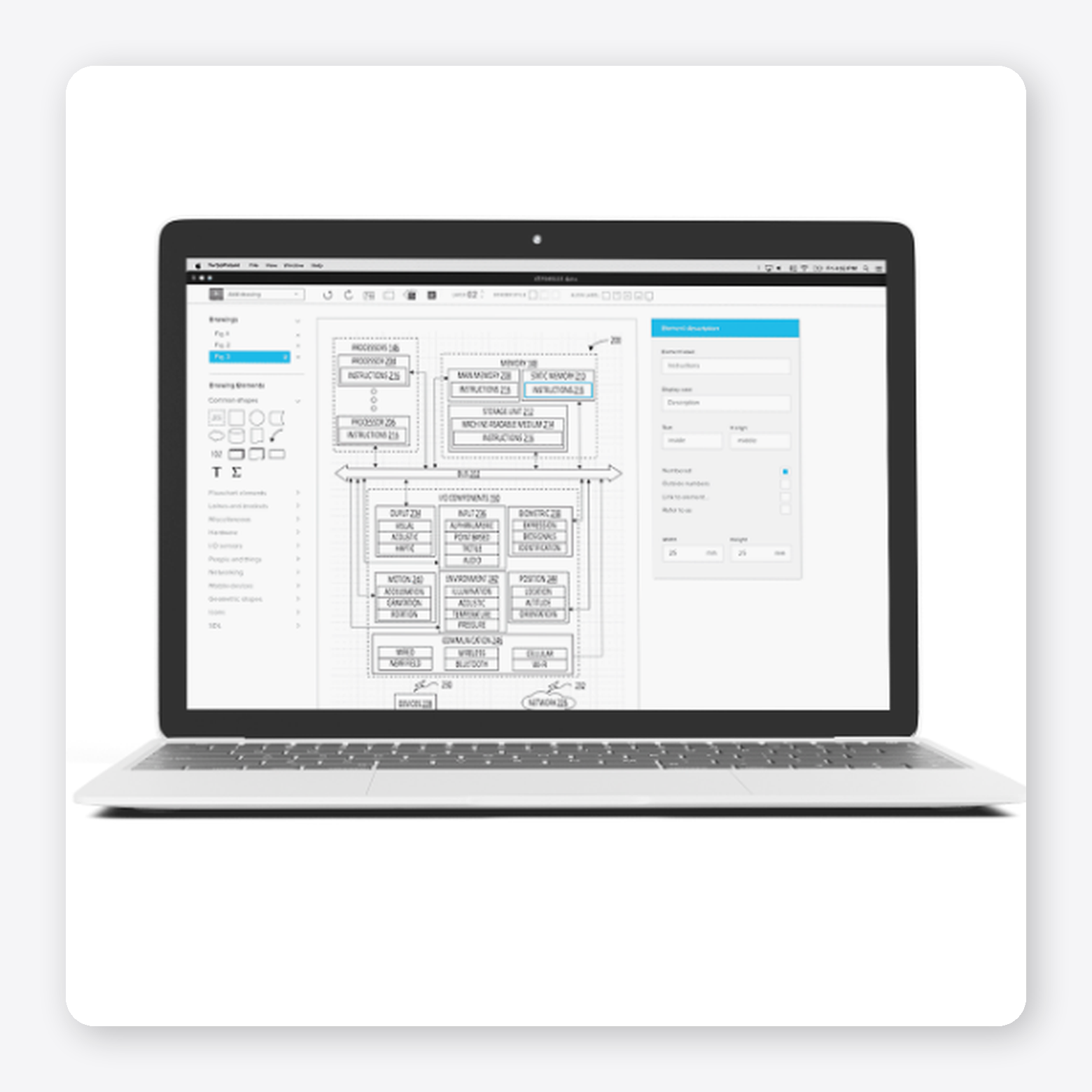
SenseIP covers the full patent process, from idea capture and patentability checks to drafting and filing. It is geared toward inventors and startups without deep legal expertise. Its proofreading capabilities are indirect, coming from automated drafting, prior art checks, and guided refinement rather than dedicated claim-level validation.
Key features:
- AI-powered drafting and filing for provisional and non-provisional patents
- Automated patentability and prior art analysis
- Freedom-to-operate checks to flag infringement risks
- End-to-end platform for ideation, filing, and portfolio tracking
Pricing:
- Starter: free
- Ideator: $75/month
- Inventor: $399/month
- Team: $799/month

Key Features Patent Attorneys Should Look for in Patent Proofreading Software
For patent attorneys, the value of patent proofreading tools is not just speed. It is whether the platform reduces front-end friction, supports better strategic decisions, and makes final review easier to trust. Here are key features to look for in patent proofreading software:
- Antecedent basis and claim dependency review: Automatically flags foundational claim issues that are still too often caught manually.
- Terminology consistency checks: Identify inconsistent language across claims and specifications before it becomes a filing or prosecution problem.
- Specification support verification: Helps attorneys confirm that claim language is grounded in the application as filed.
- Reference accuracy checks: Reviews figure references, claim references, and internal citations for errors that create avoidable rework.
- Context-aware analysis: Reviews the application as a patent document, not just as text, so issues are assessed in the right legal and drafting context.
- Source-linked support visibility: Lets practitioners verify why an issue was flagged and where the relevant support appears.
- Custom workflow fit: Works within firm-specific drafting, review, and filing processes.
- Efficient issue resolution: Makes it easier to review, prioritize, and clear flagged issues without adding another layer of manual work.
- Enterprise-grade security: SOC 2 and ISO 27001 are baseline requirements for tools handling client and matter data.
What Patent Attorneys Say About Patent ProofreadTools
Practitioners discussing proofreading software for law firms in online spaces, like Reddit, keep returning to the same dividing line: tools that attorneys trust help them think through prosecution strategy before they draft. Tools they distrust skip that step and create more work than value.
For law firms, the best patent proofreading software does more than clean up wording. It helps catch errors that affect prosecution quality: unsupported amendments, inaccurate citations, inconsistencies with the file history, and language that does not match the actual strategy of the response.
That is the gap between generic editing tools and office action response software built for patent practice. A draft can read smoothly and still be wrong in ways that create more attorney work. If the tool misses specification support, cites the wrong reference, or glosses over the examiner’s actual position, the attorney is not saving time. They are reviewing around preventable risk.
The strongest tools make proofreading a substantive review step. They help attorneys verify support, check citations, and spot issues before a response goes out the door. That matters in a law firm environment, where proofreading is not just about polish. It is part of delivering work product that is accurate, defensible, and ready for attorney signoff.
In practice, that means firms trying to choose the right software should look for tools that are context-aware, source-linked, and built for patent workflows — not tools that simply generate cleaner prose. The value is not prettier drafting. The value is reducing avoidable errors without lowering the quality bar.
Choosing Patent Proofreading Software That Supports Filing Accuracy and Efficiency
The best tool is the one that addresses the real bottleneck in your prosecution workflow. If your team mainly handles routine, standardized responses, a throughput-focused tool may be enough to improve turnaround time. If your attorneys are working on complex or high-value matters, the bigger need is usually not faster drafting. It is faster, better-informed starts.
That is where strategy-first prosecution tools stand apart. The real value is not generating text more quickly. It is reconstructing context, surfacing viable response paths, and giving attorneys a stronger foundation before drafting begins.
For in-house teams, the right answer may also be a combined stack: prosecution software for substantive work and an IP management platform for portfolio oversight.
A simple test is whether your attorneys are still losing time at the front end of the process. If they are re-reading files to get oriented or fixing AI drafts that missed the posture of the case, the issue is not output speed. It is workflow design. In that environment, a platform built to eliminate the cold start will usually deliver the strongest return.
Learn More About Patlytics Patent Proofreading Software
Best Patent Proofreading Software for Law Firms FAQs
Do law firms use AI proofreading tools?
Yes, many law firms now use AI proofreading tools to handle repetitive checks like claim dependencies, antecedent basis, and formatting consistency. Adoption is increasing because these tools catch issues earlier, before they turn into office actions or redos.
Where can I find the top patent proofreading services?
Most traditional services rely on manual review, which can be slower, less consistent, and harder to scale across large portfolios. The top option today is using AI patent proofreading tools, which provide faster, more repeatable analysis across entire documents.
Compared to services, AI tools like Patlytics offers:
- Consistent, rule-based and context-aware checks across every filing
- Faster turnaround without bottlenecks from human availability
- Lower long-term cost, especially for high-volume teams
- Real-time feedback during drafting, not just after review
Can ChatGPT draft a patent?
While tools like ChatGPT can assist with early drafting, they are not reliable for producing complete, filing-ready patent applications. They can introduce factual errors or hallucinations, which is a serious risk in a field where precision and support are critical. Using dedicated AI for proofreading and validation is more effective, since it focuses on catching errors within controlled, patent-specific workflows rather than generating unchecked content.
9 Best Patent Proofreading Software for Law Firms
Patent proofreading is one of the last quality-control checks before filing, and it carries more weight than a standard document review. In patent practice, small errors can create real downstream costs: office actions, rework, delayed filings, and weaker claim support.
Recent data found that 88% of patents issued in the last year contained at least one numbering, antecedent basis, or word support error. For law firms and IP teams, that helps explain the growing demand for proofreading software that can identify issues quickly without lowering the quality bar.
In this guide, we break down the top patent proofreading tools, the features that matter most, and how to evaluate them based on your team’s workflow and filing volume.
Key Takeaways
- Patent prosecution slows down most at the front end, when attorneys have to rebuild context before drafting can begin.
- The best patent proofreading software does more than clean up language. It helps catch the kinds of errors that create downstream filing and prosecution risk.
- Strong tools reduce manual checking by flagging issues such as antecedent basis problems, claim dependency errors, inconsistent terminology, and missing specification support.
- For law firms, the right software improves review efficiency while keeping attorney judgment fully in control.
What is AI Patent Proofreading Software?
AI patent proofreading software, also known as office action response tools, reviews patent drafts for errors that matter in practice, not just surface-level writing issues. These tools are designed to flag problems such as missing antecedent basis, incorrect claim dependencies, inconsistent terminology, citation issues, and claim language that may not be fully supported by the specification.
The goal is not to replace attorney review. It is to help patent practitioners catch issues earlier, reduce manual checking, and improve the quality and defensibility of the final work product.
Best Patent Proofreading Software for Law Firms
The tools below were selected based on how accurately they handle real patent proofreading work within drafting and prosecution workflows. We evaluated workflow integration, strategy support, USPTO connectivity, citation accuracy, and suitability for professional prosecution practice. We weighted strategy-first design and citation auditability most heavily — these determine whether a tool improves response quality, not just response speed.
Finally, we prioritized platforms that help law firms and teams reduce manual review, identify substantive issues earlier, and preserve attorney control over the final output.
1. Patlytics: Best for Context-Aware Validation Against the Spec, Prior Art, and Prosecution History
Patlytics is an AI-powered patent platform that performs proofreading as part of a full, end-to-end workflow across drafting, prosecution, and analysis. Instead of running isolated checks, it analyzes the full context of the application, including claims, specification, cited references, and prosecution history to surface issues tied to support, consistency, and defensibility. The office action response tool simplifies attorney workflows, where the AI handles validation and structure while the practitioner applies judgment and makes final decisions.
Patlytics is used by 40% of the Am Law 100 (including Quinn Emanuel, and Foley & Lardner) and Fortune 500 IP teams at Sanofi, Rivian, GRAIL, Asahi Kasei, and Panasonic.
Key features:
- Context-aware document analysis that evaluates claims, specification, and cited references together rather than in isolation
- Citation-backed validation where every flagged issue or suggestion links directly to supporting source text for verification
- “Possible vs. Not Possible” reasoning that flags when claim language or amendments are unsupported by the specification
- End-to-end workflow coverage across drafting, office actions, claim charts, and prosecution, so issues are identified earlier in the lifecycle
- Security and compliance: SOC 2 Type 2, ISO 27001, ISO 42001, and GDPR, the only patent AI platform with all four. Customer data is segregated and never used to train models.
Reviews:
- “Any in-house IP department that wants to be more efficient, lower their outside counsel bills, and automate processes that were previously manual should seriously consider Patlytics.” - verified user
- “It covers everything I need and honestly is more complete than other databases I've tried.” - Verified user
Pricing: Custom pricing
2. Solve Intelligence: Best For Embedded Proofreading
Solve Intelligence is built around an in-browser document editor that supports drafting, prosecution, and document review. Its proofreading capabilities are embedded within the drafting workflow, where the system analyzes claims, specifications, and office actions to identify issues and suggest edits. The platform is primarily focused on generating and refining patent documents, with proofreading functioning as part of its broader drafting and prosecution system.
Key features:
- AI flags issues in claims, prior art, and office actions with suggested amendments
- Tracked changes-style AI edits for transparent claim fixes
- In-browser editor for drafting and refining patent applications
- End-to-end workflow support for drafting, prosecution, disclosures, and claim charting
Pricing: Custom pricing
3. Anaqua AQX: Best For Managing Proofreading Within Enterprise IP Workflows
Anaqua AQX is an enterprise IP management platform that centralizes patents, documents, workflows, and analytics. It helps law firms and IP teams manage large portfolios, automate administrative processes. Its proofreading capabilities are embedded within broader workflows like document processing, docketing, and prosecution management.
Key features:
- Unified workflow for drafting, filing, and review
- AI extraction and standardization of PTO document data
- Automated IDS and citation management
- Centralized portfolio management with version control and visibility
Pricing: Custom pricing
4. ClaimMaster: Best For Rule-Based Patent Proofreading Inside Microsoft Word
ClaimMaster is a Microsoft Word add-in that automates proofreading and drafting checks directly within documents. It identifies structural and consistency errors in claims, specifications, and amendments during drafting and review. The tool is used for in-document validation but relies on predefined rules rather than deeper AI-based analysis.
Key features:
- Detects claim errors (antecedent basis, numbering, amendments, terminology)
- Checks consistency across specs, figures, and part numbering
- Flags limiting or “profanity” language that may narrow claim scope
Pricing:
- Discovery: Free
- Standard: £39/month
- Pro: £99/month
- Enterprise: Custom pricing
5. LexisNexis PatentOptimizer: Best For Rule-Based Patent Proofreading with Integrated Legal Data
LexisNexis PatentOptimizer is a patent drafting and review tool that performs rule-based proofreading directly within drafting environments like Microsoft Word. It analyzes claims, specifications, and drawings to identify structural issues such as missing antecedent basis, inconsistent terminology, and lack of support. The platform is integrated with LexisNexis data and workflows.
Key features:
- Analyzes claims and specs for basis, dependencies, and support
- Validates consistency across parts, drawings, and claim elements
- Auto-generates IDS forms with properly formatted citations
Pricing: Custom pricing
6. PatentBots: Best For Standalone Patent Proofreading Checks
PatentBots is a web-based patent proofreading tool that can identify structural and consistency errors in patent applications. It uses machine learning to scan claims and specifications for issues like antecedent basis, claim dependencies, and terminology support. The platform is primarily used as a fast validation layer during drafting rather than a full workflow or drafting system.
Key features:
- Detects key patent errors (antecedent basis, numbering, support issues)
- Checks consistency across specs, figures, and terminology
- Fast proofreading via web app or Word add-in
Pricing: Starting at $1,045/month
7. PowerPatent: Best For AI Drafting with Built-In Proofreading Diagnostics
PowerPatent is an AI-driven patent drafting platform that includes automated diagnostics to review applications as they are created. Its proofreading capabilities are embedded within the drafting process, where the system analyzes claims and specifications for issues like compliance and structural gaps. The tool focuses on generating and refining drafts, with proofreading functioning as part of that broader workflow.
Key features:
- Automated claim diagnostics during drafting and review
- AI-generated drafts from invention disclosures
- Workflow tools for disclosures, drawings, and claim structuring
- Built-in collaboration for inventors and attorneys
Pricing:
- Free trial: Free
- PatentBuilder Pro: $199/month
- Enterprise: Custom pricing
8. Rowan Patents: Best For Structured Drafting with Built-In Consistency Controls
Rowan Patents is an AI-assisted patent drafting platform that keeps claims, specification, and drawings connected in a single structured environment. It maintains consistency across the entire application by linking terms, numbering, and references so changes propagate automatically. Its proofreading value comes from enforcing structure and consistency during drafting rather than running separate, post-draft validation checks.
Key features:
- Linked document structure that syncs claims, specs, and drawings
- Automatic numbering and dependency management
- Unified drafting, revision, and automation environment
- Built-in formatting and compliance controls
Pricing: Custom pricing
9. SenseIP: Best For Patent Proofreading for Inventors
SenseIP covers the full patent process, from idea capture and patentability checks to drafting and filing. It is geared toward inventors and startups without deep legal expertise. Its proofreading capabilities are indirect, coming from automated drafting, prior art checks, and guided refinement rather than dedicated claim-level validation.
Key features:
- AI-powered drafting and filing for provisional and non-provisional patents
- Automated patentability and prior art analysis
- Freedom-to-operate checks to flag infringement risks
- End-to-end platform for ideation, filing, and portfolio tracking
Pricing:
- Starter: free
- Ideator: $75/month
- Inventor: $399/month
- Team: $799/month
Key Features Patent Attorneys Should Look for in Patent Proofreading Software
For patent attorneys, the value of patent proofreading tools is not just speed. It is whether the platform reduces front-end friction, supports better strategic decisions, and makes final review easier to trust. Here are key features to look for in patent proofreading software:
- Antecedent basis and claim dependency review: Automatically flags foundational claim issues that are still too often caught manually.
- Terminology consistency checks: Identify inconsistent language across claims and specifications before it becomes a filing or prosecution problem.
- Specification support verification: Helps attorneys confirm that claim language is grounded in the application as filed.
- Reference accuracy checks: Reviews figure references, claim references, and internal citations for errors that create avoidable rework.
- Context-aware analysis: Reviews the application as a patent document, not just as text, so issues are assessed in the right legal and drafting context.
- Source-linked support visibility: Lets practitioners verify why an issue was flagged and where the relevant support appears.
- Custom workflow fit: Works within firm-specific drafting, review, and filing processes.
- Efficient issue resolution: Makes it easier to review, prioritize, and clear flagged issues without adding another layer of manual work.
- Enterprise-grade security: SOC 2 and ISO 27001 are baseline requirements for tools handling client and matter data.
What Patent Attorneys Say About Patent ProofreadTools
Practitioners discussing proofreading software for law firms in online spaces, like Reddit, keep returning to the same dividing line: tools that attorneys trust help them think through prosecution strategy before they draft. Tools they distrust skip that step and create more work than value.
For law firms, the best patent proofreading software does more than clean up wording. It helps catch errors that affect prosecution quality: unsupported amendments, inaccurate citations, inconsistencies with the file history, and language that does not match the actual strategy of the response.
That is the gap between generic editing tools and office action response software built for patent practice. A draft can read smoothly and still be wrong in ways that create more attorney work. If the tool misses specification support, cites the wrong reference, or glosses over the examiner’s actual position, the attorney is not saving time. They are reviewing around preventable risk.
The strongest tools make proofreading a substantive review step. They help attorneys verify support, check citations, and spot issues before a response goes out the door. That matters in a law firm environment, where proofreading is not just about polish. It is part of delivering work product that is accurate, defensible, and ready for attorney signoff.
In practice, that means firms trying to choose the right software should look for tools that are context-aware, source-linked, and built for patent workflows — not tools that simply generate cleaner prose. The value is not prettier drafting. The value is reducing avoidable errors without lowering the quality bar.
Choosing Patent Proofreading Software That Supports Filing Accuracy and Efficiency
The best tool is the one that addresses the real bottleneck in your prosecution workflow. If your team mainly handles routine, standardized responses, a throughput-focused tool may be enough to improve turnaround time. If your attorneys are working on complex or high-value matters, the bigger need is usually not faster drafting. It is faster, better-informed starts.
That is where strategy-first prosecution tools stand apart. The real value is not generating text more quickly. It is reconstructing context, surfacing viable response paths, and giving attorneys a stronger foundation before drafting begins.
For in-house teams, the right answer may also be a combined stack: prosecution software for substantive work and an IP management platform for portfolio oversight.
A simple test is whether your attorneys are still losing time at the front end of the process. If they are re-reading files to get oriented or fixing AI drafts that missed the posture of the case, the issue is not output speed. It is workflow design. In that environment, a platform built to eliminate the cold start will usually deliver the strongest return.
Learn More About Patlytics Patent Proofreading Software
Best Patent Proofreading Software for Law Firms FAQs
Do law firms use AI proofreading tools?
Yes, many law firms now use AI proofreading tools to handle repetitive checks like claim dependencies, antecedent basis, and formatting consistency. Adoption is increasing because these tools catch issues earlier, before they turn into office actions or redos.
Where can I find the top patent proofreading services?
Most traditional services rely on manual review, which can be slower, less consistent, and harder to scale across large portfolios. The top option today is using AI patent proofreading tools, which provide faster, more repeatable analysis across entire documents.
Compared to services, AI tools like Patlytics offers:
- Consistent, rule-based and context-aware checks across every filing
- Faster turnaround without bottlenecks from human availability
- Lower long-term cost, especially for high-volume teams
- Real-time feedback during drafting, not just after review
Can ChatGPT draft a patent?
While tools like ChatGPT can assist with early drafting, they are not reliable for producing complete, filing-ready patent applications. They can introduce factual errors or hallucinations, which is a serious risk in a field where precision and support are critical. Using dedicated AI for proofreading and validation is more effective, since it focuses on catching errors within controlled, patent-specific workflows rather than generating unchecked content.
The Premier AI-Powered Patent Platform
Reduce cycle times. Increase margins. Deliver winning IP outcomes.
Book a DemoThe Premier AI-Powered
Patent Platform
Reduce cycle times. Increase margins. Deliver winning IP outcomes.