Best DeepIP Alternatives for Patent Drafting (Compared by Workflow, Accuracy, and Automation)
June 9, 2026

AI tools are shaping how patent teams draft, review, and manage applications, and platforms like DeepIP have become part of that shift. But many teams now need more than prompt-based drafting, which is why they’re actively looking for deepIP alternatives that support the full patent workflow. According to Thomson Reuters, AI could free up 4 hours per week for lawyers today, growing to 12 hours per week within five years. That extra capacity is pushing teams to adopt tools that go beyond generating text and help move work forward.
This guide compares the best deepIP alternatives based on workflow coverage, output accuracy, and automation depth. It also explains where DeepIP falls short and what to look for if you need a more complete patent analysis tool.
Stop rebuilding patent context across disconnected tools. See how Patlytics connects drafting, prosecution, claim analysis, infringement, FTO, and portfolio workflows in one AI-native patent platform.
Key takeaways:
- DeepIP focuses on drafting and prosecution, but many teams need tools that support the full patent lifecycle
- End-to-end platforms reduce tool switching and keep insights connected across workflows
- Teams evaluating deepIP alternatives should prioritize workflow coverage, traceability, and integration
What Is DeepIP?
DeepIP is an AI platform for patent professionals that supports drafting, review, and prosecution tasks. It helps generate application content, analyze prior art, and prepare office action responses through prompt-based workflows.
The platform integrates with tools like Microsoft Word and IP management systems, allowing attorneys to work within familiar drafting environments. It also supports claim generation, amendment suggestions, citation-backed analysis, patentability assessment, invalidity analysis, and portfolio-level insights.
Where Teams May Need More Than DeepIP (Based on Real User Feedback)
DeepIP has earned genuine traction in the market, but practitioners who've tested it closely have flagged recurring friction points worth understanding before committing.
Workflow fragmentation beyond Word
According to patent attorney Tim Bright's hands-on 2025 review, the Word plugin doesn't support the OA module's full feature set, forcing users to toggle between Word and the web app to complete a single task. That constant switching, Bright notes, "breaks immersion" and chips away at the time savings the tool promises.
See how connected workflows reduce repeated work.
Output quality depends heavily on prompt skill
A 2026 comparison by Patentext found that DeepIP's prompt-driven interface produces output that varies significantly depending on how the request is phrased. One DeepIP user quoted during a DeepIP-hosted webinar put it plainly: "It's like having an army of interns. If you ask the intern a very vague question, you're probably going to get an unfocused response, or worse, gibberish."
Premium pricing that strains smaller practices
DeepIP uses custom, license-based pricing with no publicly listed rates. Based on 2025 market research from Waves & Algorithms, estimates place costs at $200 to $500 per user per month, a range that mid-size and large firms can absorb but that raises real ROI questions for solo practitioners and smaller boutique IP firms.
Drafting assistance, not autonomous drafting
DeepIP accelerates drafting but doesn't replace attorney judgment, particularly for biotech and pharmaceutical applications that require more human oversight. In a live poll of 135 patent professionals during a DeepIP-hosted panel with IPWatchdog, 45% still cited patent preparation and prosecution as their top workflow challenge.
No end-to-end lifecycle coverage
A 2026 Patentext side-by-side comparison notes that DeepIP covers drafting and prosecution but lacks infringement analysis, invalidity analysis, claim charting, and portfolio management. Teams needing a single platform across the full patent lifecycle will need to supplement DeepIP with additional tools.
From invention disclosure to infringement detection, from drafting to invalidity analysis, see what end-to-end lifecycle coverage looks like in a single AI-powered platform.
Key Features to Look for in DeepIP Alternatives
The right DeepIP alternative should do more than generate draft text. It should connect search, drafting, analysis, and portfolio workflows so teams are not recreating work across separate tools.
Look for:
- Citation-backed outputs: Analysis, drafts, and charts should link back to source material so attorneys can verify every recommendation.
- Claim-level mapping: The platform should map claim limitations to prior art, products, specifications, and supporting evidence — not just return ranked search results.
- Integrated claim charting: Claim charts should connect directly to infringement, invalidity, FTO, and licensing workflows.
- Connected prosecution workflows: Office action analysis should link to claims, cited art, drafting history, and response strategy.
- Portfolio intelligence: The platform should support classification, pruning, patent-to-product mapping, and portfolio-level decisions.
- Enterprise-grade security: SOC 2 Type 2 and ISO 27001 should be table stakes; ISO 42001 is becoming the benchmark for AI management.
- Named proof points: Prioritize platforms with adoption by firms and companies in your industry, not only anonymized testimonials.
Best DeepIP Alternatives
DeepIP covers parts of drafting and prosecution, but many teams need tools that extend beyond document-based workflows. This list includes platforms that support different parts of the patent lifecycle, from drafting and prior art search to claim charting and portfolio management.
We selected these DeepIP alternatives based on workflow coverage, output structure, and how well each tool supports real patent tasks. This includes drafting support, prior art integration, office action handling, and the ability to connect insights across the patent lifecycle.
1. Patlytics: Best for Law Firms and In-House Teams Needing End-to-End Patent Intelligence and Analytics

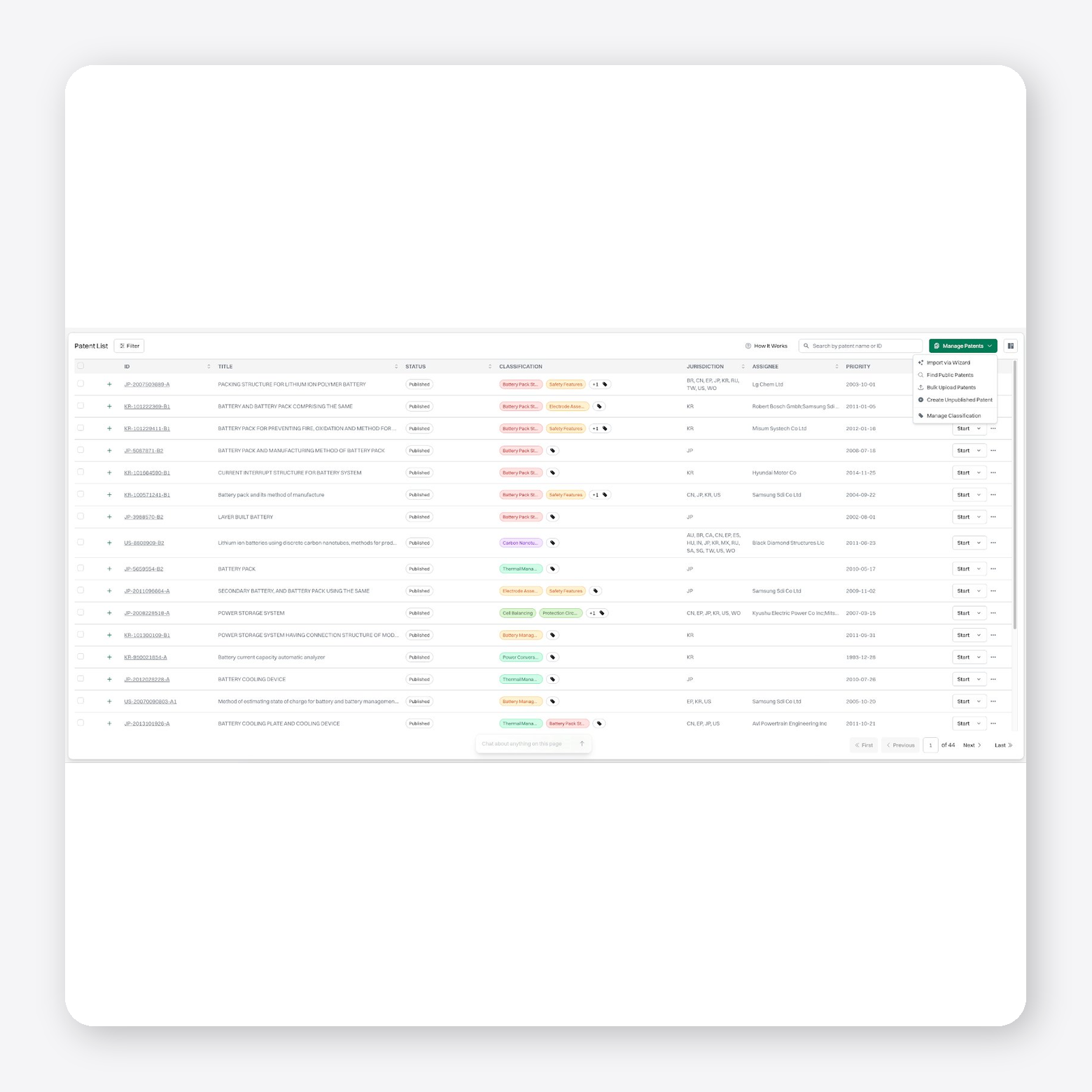
Patlytics is an AI-native patent platform built for teams that need more than drafting assistance. It connects invention disclosure, application drafting, office action analysis, prior art review, claim charting, invalidity, infringement, FTO, patent pruning, and portfolio management in one system.
The platform is designed around verifiable outputs. Attorneys can generate drafts, map claims to evidence, analyze patentability or invalidity, and create limitation-by-limitation claim charts with source-linked support. That gives teams a reviewable foundation instead of disconnected AI-generated text. Patlytics also connects prosecution and drafting work to downstream portfolio and enforcement decisions. Teams can classify patents, identify pruning candidates, map patents to products, and carry insights across workflows without rebuilding the analysis in separate tools.
Key features:
- Patent application drafting: Supports AI-assisted drafting from source materials, including technical documents, figures, and invention disclosures
- Office action analysis and response: Generates structured responses by analyzing office actions, identifying response strategies, and drafting amendments and arguments
- Infringement detection: Identifies potential infringement and maps claims to product functionality using structured claim charts
- Claim chart generation: Creates limitation-by-limitation claim charts with linked supporting evidence
- Patent pruning: Helps identify higher- and lower-value assets to support portfolio prioritization and decision-making
- Security and compliance: Meets SOC 2 Type 2, ISO 27001, ISO 42001, and GDPR requirements, with encrypted and segregated data handling
How it differs from DeepIP:
Patlytics connects drafting, analysis, and portfolio workflows in a single platform, while DeepIP focuses more heavily on drafting and prosecution tasks within document-based environments. It also includes built-in portfolio management and claim-level intelligence, reducing the need for separate tools throughout the patent lifecycle.
User testimonial:
“Patlytics is easy to use, understand, and helps our team see issues that they would normally miss. The Patlytics team and customer service is top notch and give us the trust that we need in a product this important to our bottom line. We use it daily and were shocked by how easy it was to implement into our workflow.” - G2 user
2. ClaimMaster: Best For Automating Patent Proofreading

ClaimMaster is a Microsoft Word add-in designed for patent proofreading, drafting support, and document automation. It focuses on identifying errors in claims, specifications, and figures using rule-based checks tied to patent drafting standards. ClaimMaster also includes tools for generating drafting sections, analyzing office actions, and downloading patent data from public sources, all within a document-based workflow.
Key features:
- Patent proofreading: Detects claim errors, antecedent basis issues, incorrect dependencies, and inconsistencies using customizable rules
- Specification and figure review: Checks part numbers, acronyms, formatting issues, and missing descriptions across specifications and drawings
- Patent drafting support: Generates document sections, figures, and descriptions using templates and optional AI tools

How it differs from DeepIP:
ClaimMaster focuses on document-level proofreading and drafting support within Microsoft Word, while DeepIP applies AI across drafting and prosecution tasks with more emphasis on generating and iterating on content.
User testimonial:
“I haven't run into any things that I dislike. They periodically send updates which fix issues usually caused by changes at the USPTO. I wish it would allow 2 users per subscription so my paralegal can do some of the tasks without me having to buy her own subscription.” User review
3. Edge: Inventors and Corporate R&D Teams Who Need Help Producing Clearer Disclosures
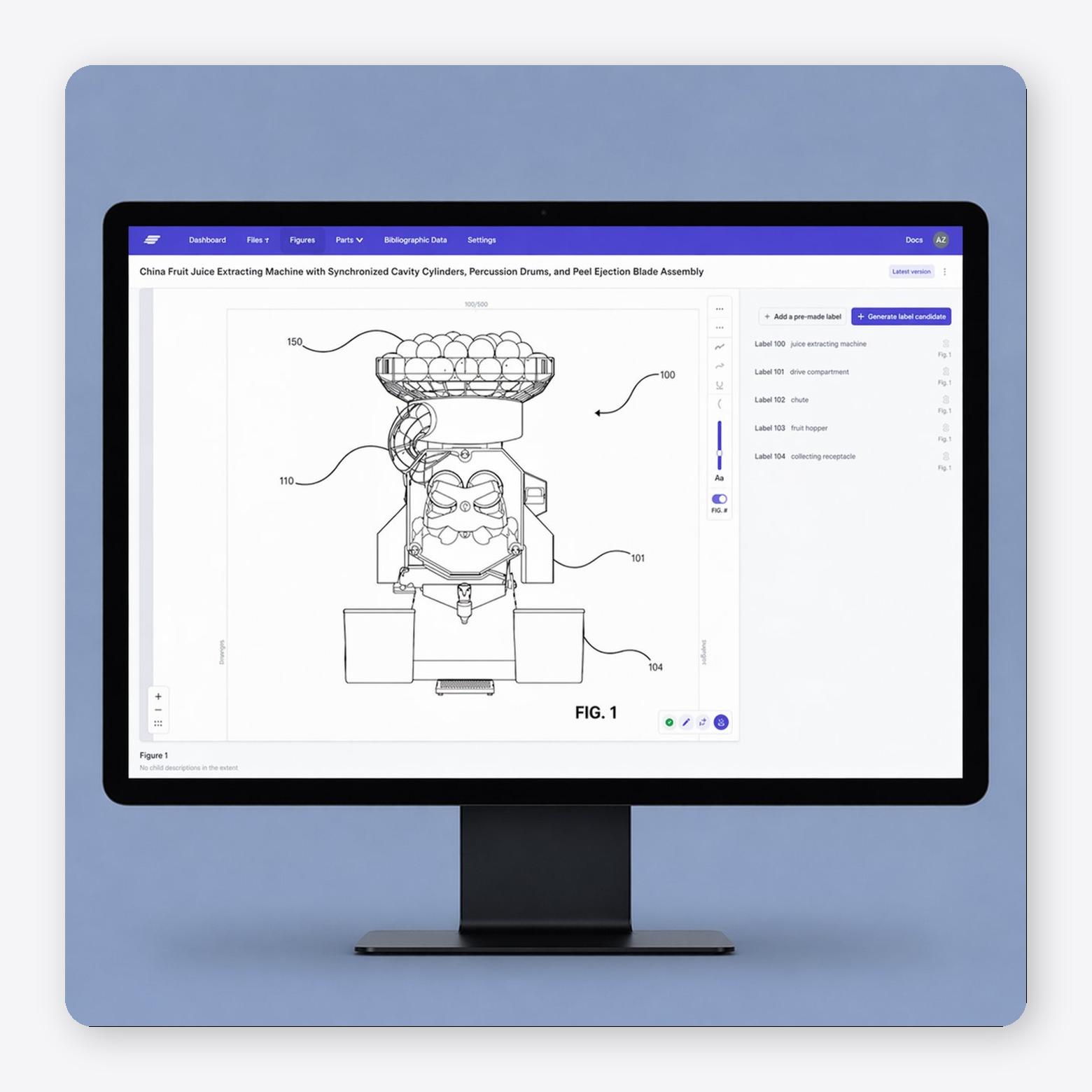
Edge is an AI platform focused on patent drafting and invention disclosure workflows, with additional support for trademark search. Its patent drafting module, Ingenia, supports claims, specifications, figures, and disclosures within a single interface. Edge is designed around task-based workflows, where users input inventor materials and generate structured patent content, with support for regional requirements such as USPTO and EPO standards.
Key features:
- Patent drafting: Supports AI-assisted drafting of claims and specifications based on inventor inputs
- Figure generation and editing: Creates and edits patent figures, including flowcharts and line drawings, with synchronized elements
- Invention disclosure intake: Processes inventor materials and structures them into formal disclosures
How it differs from DeepIP:
Edge focuses on structured drafting and disclosure workflows with integrated figure handling and regional support, while DeepIP emphasizes iterative drafting, analysis, and prosecution.
User testimonial: Not publicly available
4. IP Author: Best for Patent Practitioners and IP Departments Handling High‑Volume Filings
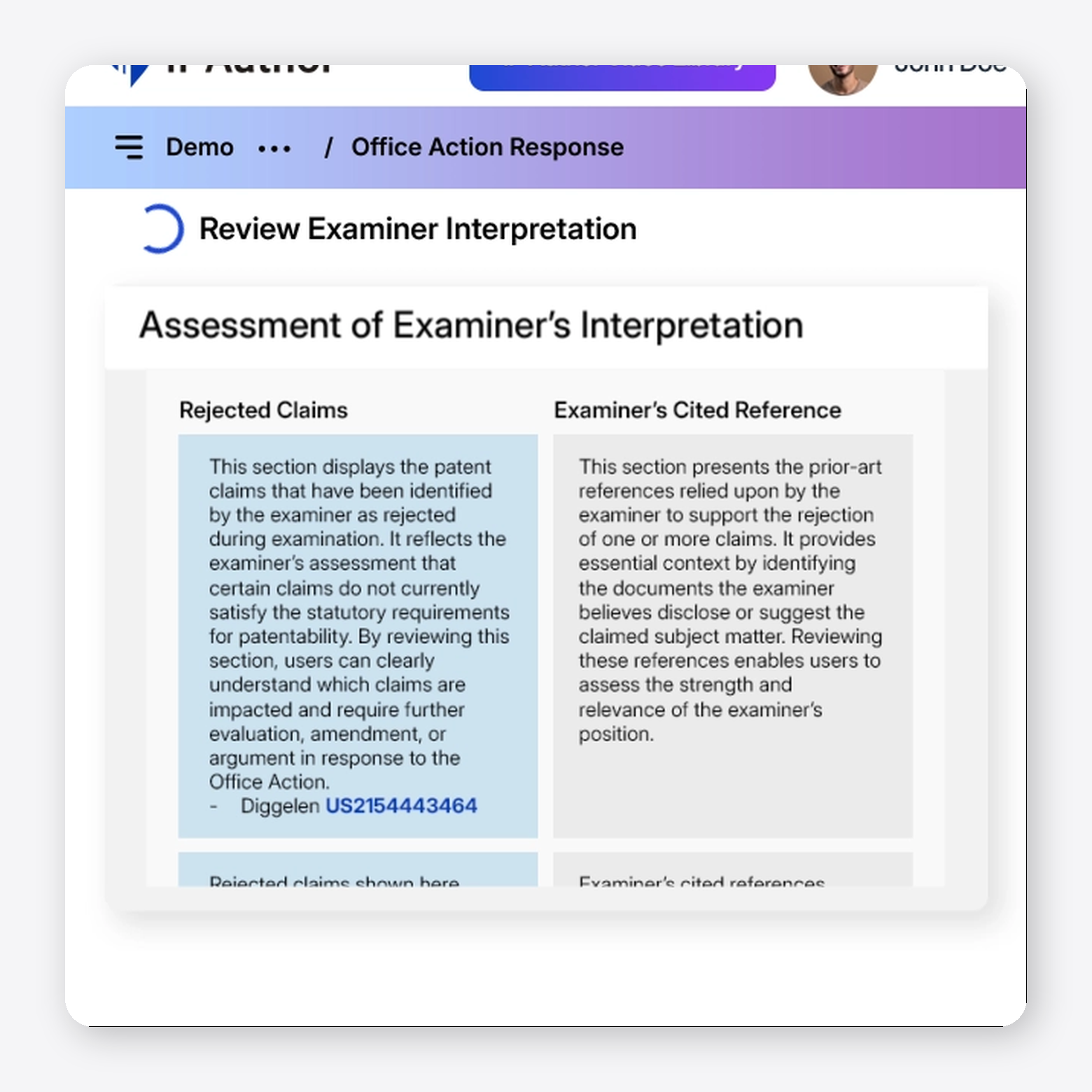
IP Author is an AI platform that supports patent drafting, prior art search, and office action responses within a single system. It structures patent applications from invention disclosures, maps prior art to claims, and generates response strategies based on examiner feedback and prosecution history. The platform also includes similarity scoring, global search across patent and non-patent literature, and tools for managing drafting consistency across claims, figures, and technical content.
Key features:
- Patent application drafting: Generates claims and specifications from invention disclosures with structured alignment across sections
- Office action analysis and response: Summarizes examiner rejections, maps references to claims, and generates response strategies with amendments and arguments
- Prior art search: Searches global patent and non-patent literature with filtering by jurisdiction, classification, and publication data
How it differs from DeepIP:
IP Author combines drafting, search, and prosecution insights in a single workflow, with more emphasis on prior art integration and examiner-level analysis alongside drafting tasks.
User testimonial: Not publicly available
5. Patent Bots: Best For Automating Proofreading and Streamlining Patent Drafting

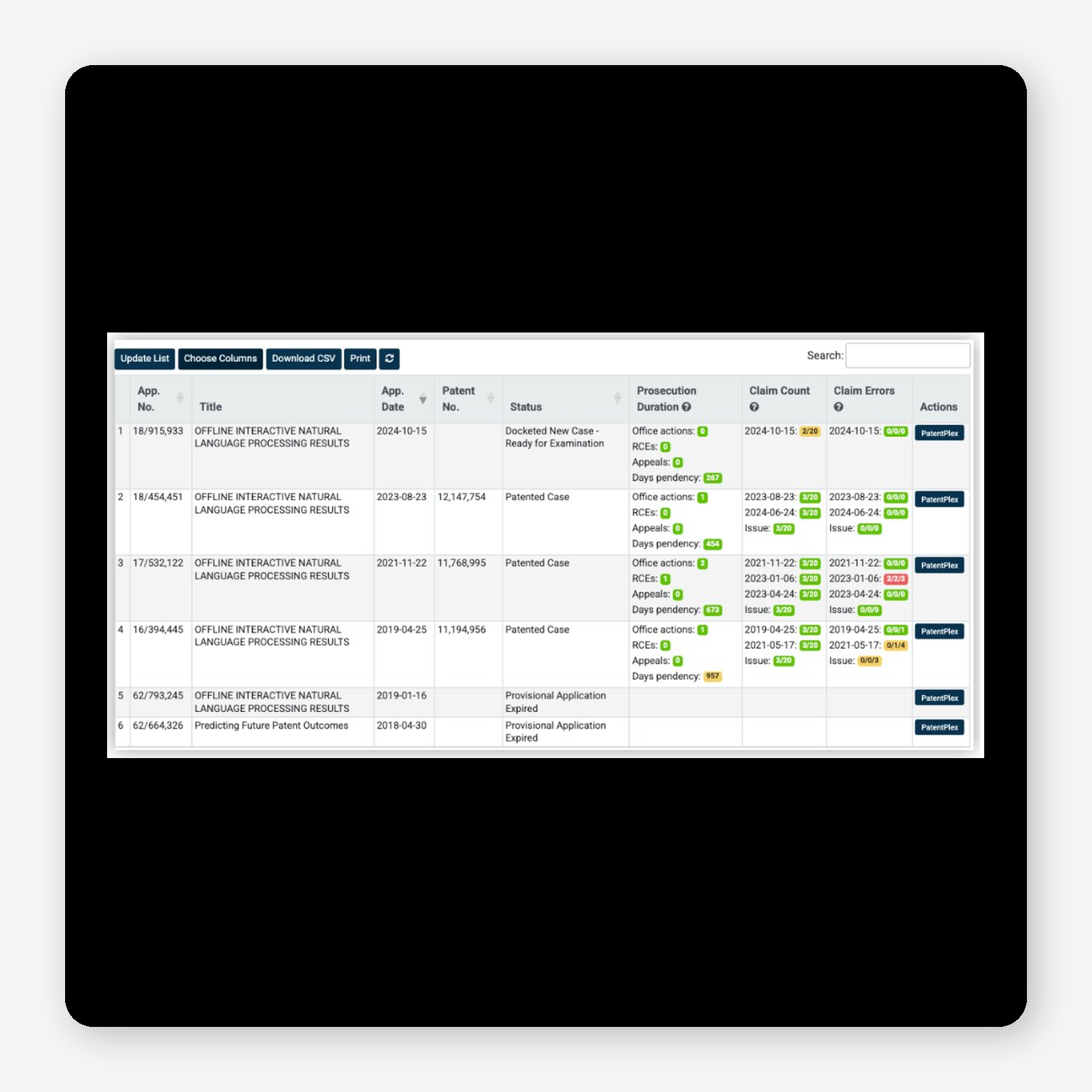
Patent Bots is a suite of AI-enabled and rule-based tools designed for patent drafting, proofreading, and prosecution support. It includes multiple modules for tasks such as claim analysis, office action preparation, examiner research, and patent data review. Patent Bots focuses on automating repetitive parts of patent preparation and providing structured insights, such as examiner statistics and art unit predictions, within a single toolset.
Key features:
- Patent proofreading: Detects antecedent basis issues, inconsistencies, and drafting errors using rule-based analysis
- Patent drafting support: Assists with drafting sections, generating OA shells, and completing USPTO forms
- Office action preparation: Supports response drafting and document generation for prosecution workflows
How it differs from DeepIP:
Patent Bots focuses on modular tools for specific prosecution and drafting tasks, while DeepIP centers on AI-driven drafting and analysis within a more unified drafting workflow.
User testimonial: Not publicly available
6. Patently: Best For Patent‑Lifecycle Teams That Want AI‑Assisted Support

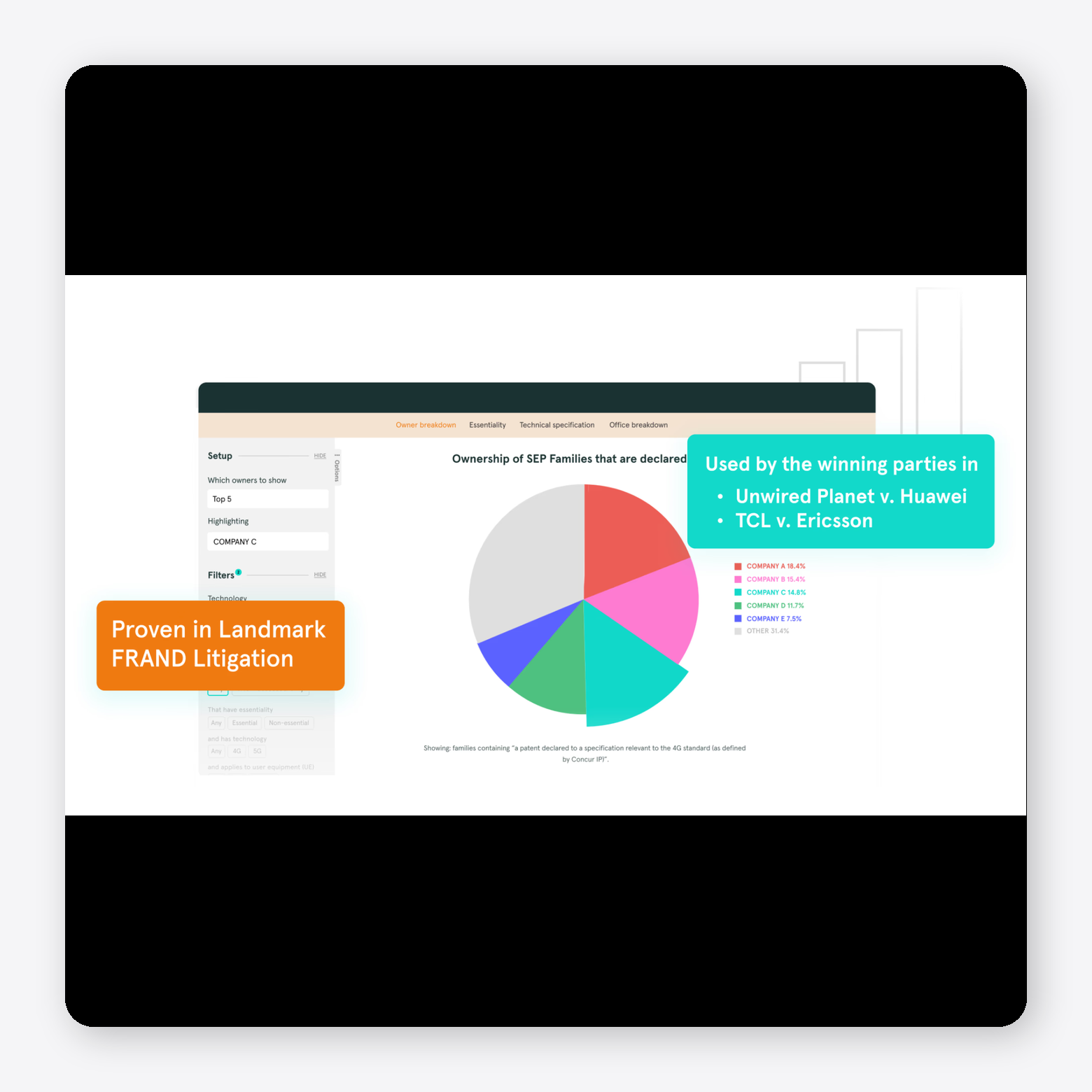
Patently is an AI platform that supports patent search, drafting, prosecution, licensing analysis, and portfolio workflows within a unified system. It connects semantic patent search, drafting tools, claim charting, and project-level collaboration, allowing teams to manage patent work across multiple stages without switching platforms.
Key features:
- Patent search: Uses semantic search and filtering to identify relevant patents and group results by family
- Patent drafting: Generates claims, figures, and specifications from invention disclosures with an AI assistant
- Claim charting: Maps patents to technical documents, including standards and product specifications
How it differs from DeepIP:
Patently supports a broader range of patent lifecycle tasks, including search, licensing analytics, and portfolio collaboration, while DeepIP focuses more on drafting and prosecution workflows.
User testimonial:
“Writing patents with AI using Patently Create was a breeze. Particularly like the drawing editing, and automated diagramming.” User review
7. PowerPatent: Best For Automating the Patent Drafting Process

PowerPatent is an AI platform focused on generating first-draft patent applications from invention disclosures, claims, and supporting materials. It structures sections such as background, summary, claims, and descriptions, while also supporting figure generation, diagnostics, and collaboration between inventors and attorneys. PowerPatent includes tools for novelty search, claim support checks, and document-level analysis within a drafting workflow.
Key features:
- Patent application drafting: Generates complete first drafts from claims, summaries, and invention disclosures
- Section generation: Builds structured sections including background, summary, abstract, and detailed descriptions
- Figure and flowchart support: Creates and manages drawings and corresponding descriptions within the application

How it differs from DeepIP:
PowerPatent focuses on generating structured first drafts from invention inputs, while DeepIP places more emphasis on iterative drafting, analysis, and prosecution workflows.
User testimonial: Not publicly available
8. Quartet: Patent Searchers and Analysts Who Want AI-Augmented Results

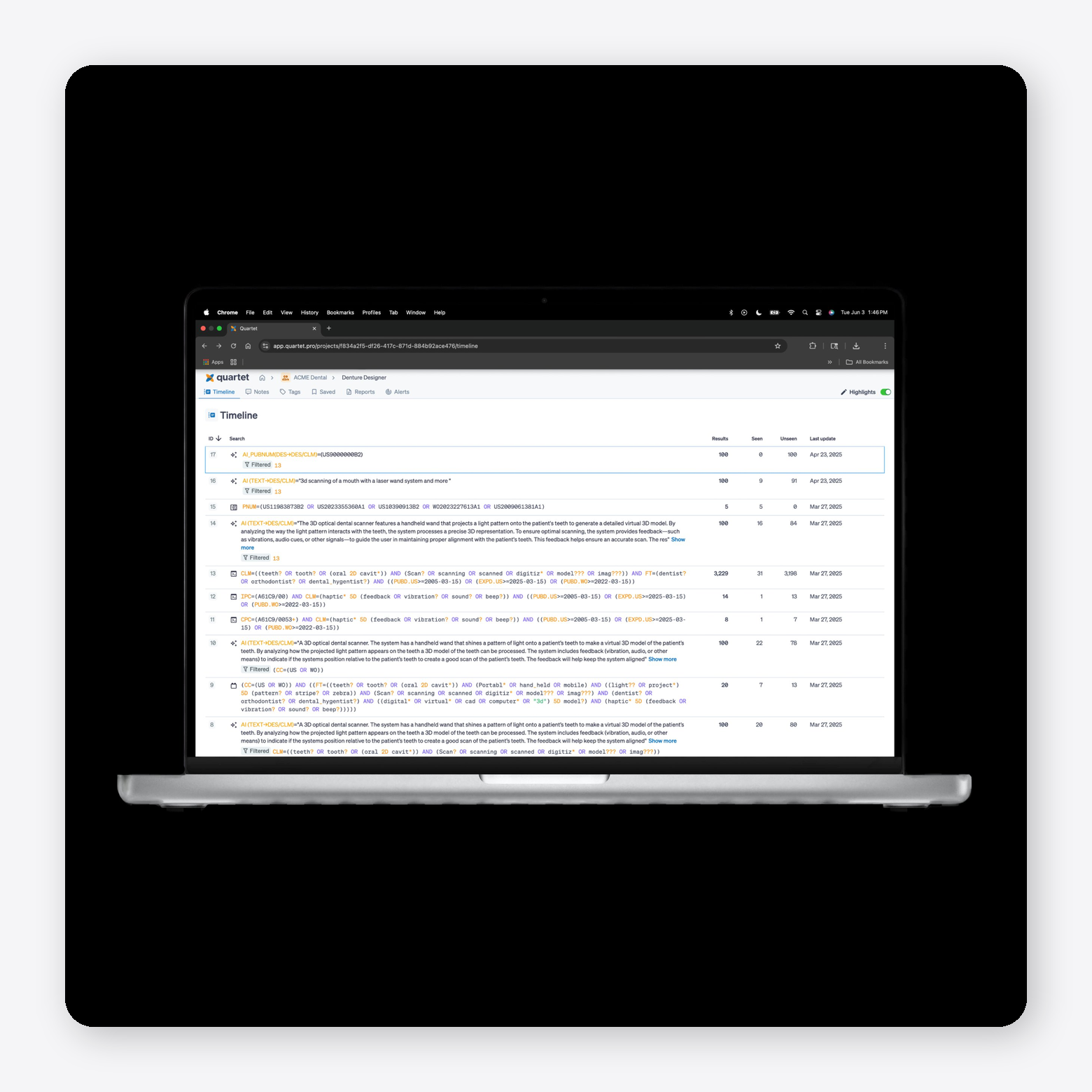
Quartet is an AI-driven patent search platform designed to identify prior art across global patent and non-patent literature. It combines natural language processing with traditional search methods, allowing users to run structured searches, review patent families, and analyze results within a project-based workspace. Quartet also supports collaboration, annotation, and export workflows for patent search and analysis tasks.
Key features:
- AI-powered patent search: Combines natural language processing with traditional search techniques to identify relevant prior art
- Patent summaries and chat: Generates AI summaries and allows users to query patents, families, and search results
- Element detection: Maps figure element numbers to corresponding text for easier review of patent documents
How it differs from DeepIP:
Quartet focuses on patent search and prior art discovery, while DeepIP centers on drafting and prosecution workflows with AI-assisted content generation.
User testimonial: Not publicly available
9. SenseIP: Inventors, Startups, and Tech Transfer Teams Seeking Faster, Lower-Cost IP

SenseIP is an AI platform designed for inventors, startups, and R&D teams to evaluate ideas and generate patent drafts from early-stage concepts. It accepts plain-language inputs, produces patentability assessments based on existing patent data, and generates provisional and non-provisional applications. The platform also includes tools for idea capture, iteration, collaboration, and basic portfolio tracking within a single workspace.
Key features:
- Patentability assessment: Evaluates idea novelty using AI trained on global patent data
- Patent drafting: Generates provisional and non-provisional patent applications from user inputs
- Idea capture and refinement: Allows users to describe, refine, and iterate on concepts through an AI interface

How it differs from DeepIP:
SenseIP focuses on early-stage idea evaluation and draft generation from simple inputs, while DeepIP is built for structured drafting and prosecution workflows used by patent professionals.
User testimonial: Not publicly available
10. Solve Intelligence: Best for Accelerating Drafting Applications and Responding to Office Actions
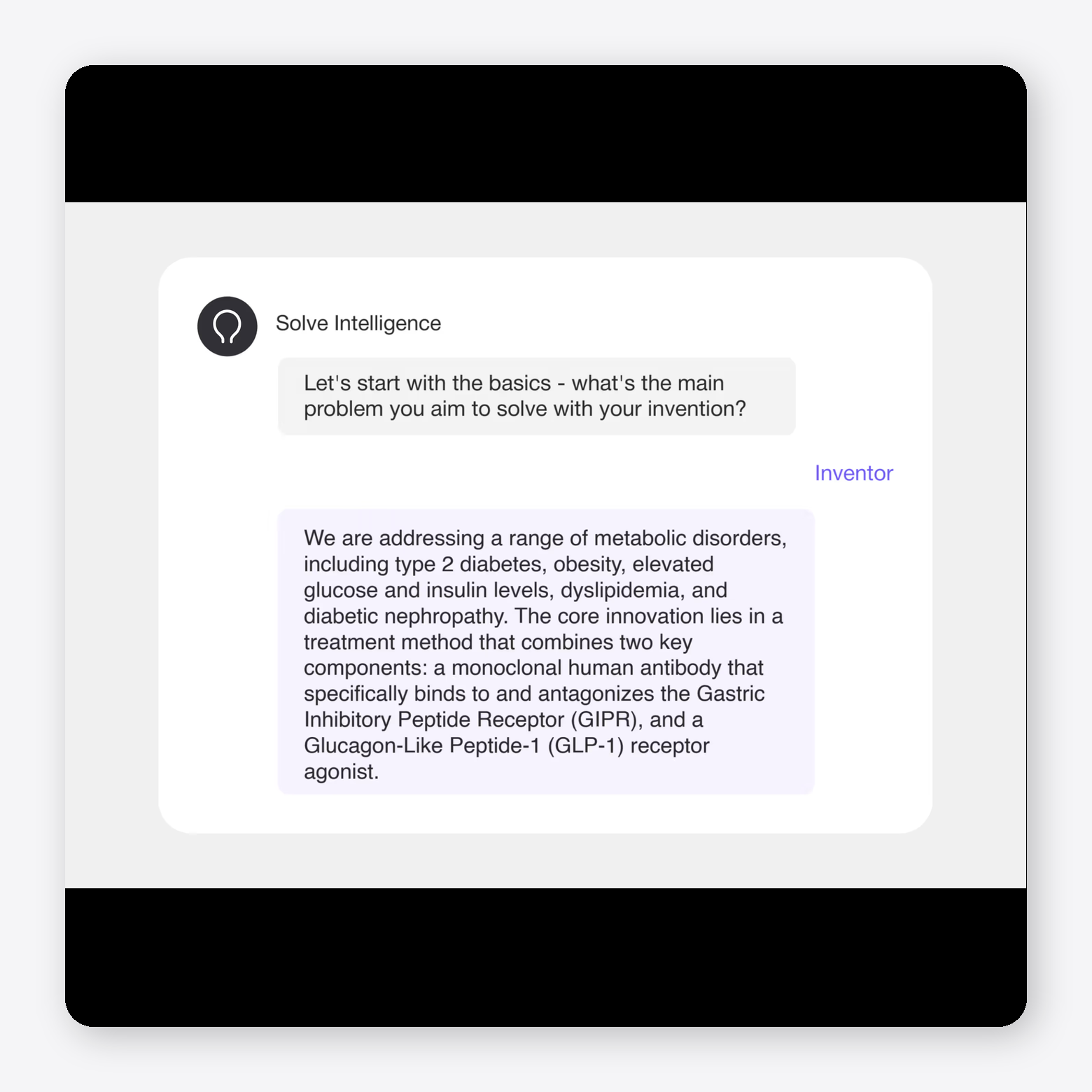
Solve Intelligence is an AI platform designed for patent drafting, prosecution, invention disclosure management, and claim charting within a single system. It supports interactive drafting aligned with attorney workflows, generates office action responses with cited sources, and provides tools for managing invention disclosures and portfolio-level analysis.
Key features:
- Claim chart generation: Creates invalidity, infringement, SEP, and freedom-to-operate claim charts with structured outputs
- AI-assisted analysis: Evaluates examiner rejections, prior art, and claim scope to suggest response strategies
- Multi-source citations: Links outputs to file wrapper documents, prior art, and case law with expandable reasoning
How it differs from DeepIP:
Solve Intelligence combines drafting, prosecution, and claim charting with configurable workflows and multi-source citation support, while DeepIP focuses more on drafting and prosecution within a prompt-driven workflow.
User testimonial:
“Like any new tool, there is a learning curve. But if you find instructions that make the software write the way you want, then you can add those to a template so that it will write that way going forward. Once you build up your template, there is minimal clean-up work to be done.” User review
DeepIP vs. Patlytics
DeepIP and Patlytics both support patent drafting and analysis, but they approach the workflow differently.
DeepIP is primarily useful for teams focused on drafting, prior art analysis, and prosecution workflows. It helps connect invention disclosures, claim development, patentability review, and prosecution-related analysis, with integrations into tools like Microsoft Word and IP management systems.
Patlytics is broader. It supports the full patent lifecycle in one AI-native platform, including drafting, office actions, patent search, invalidity, infringement, FTO, SEP, claim charting, and portfolio analysis. For teams that only need drafting-adjacent support, DeepIP may be sufficient. For law firms and in-house teams that need analysis connected across prosecution, litigation, and portfolio strategy, Patlytics is the stronger end-to-end option.
What This Looks Like in Practice
Feature comparisons only tell part of the story. The difference becomes obvious in day-to-day execution.
A tool like DeepIP may help teams improve drafting, patentability review, and prosecution workflows. But Patlytics is designed to carry that context across the broader patent lifecycle, from drafting and office actions to invalidity, infringement, FTO, and portfolio analysis. That matters because the real bottleneck for patent teams is not one isolated task. It is the repeated loss of context as work moves from one stage to the next.
One Am Law 100 practice that piloted Patlytics achieved an 80% reduction in project time, allowing its attorneys to significantly improve profitability on fixed-fee patent services. “What used to take weeks now takes days,” said the project head. “It’s an essential tool for any law firm looking to stay ahead in patent prosecution and counseling.”
That is the practical difference between a drafting-adjacent tool and an end-to-end patent analysis platform: Patlytics helps teams move faster across the work that actually determines attorney leverage, margin, and defensibility.
See how patent teams reduce manual work without lowering review standards.
Patlytics helps law firms and in-house teams compress patent analysis workflows while keeping attorney judgment central.
Final Recommendations for Selecting a DeepIP Alternative
When evaluating DeepIP alternatives, focus on the workflow gap you are trying to close. If the need is narrow drafting support, a point solution may be enough. If the team needs search, drafting, prosecution, claim charting, invalidity, infringement, FTO, and portfolio management to work together, prioritize platforms with citation-backed outputs, claim-level mapping, integrated charting, and enterprise-grade security.
DeepIP plays a role in AI-assisted patent drafting, but many teams need more than document-based workflows and prompt-driven outputs. As patent work expands across search, analysis, prosecution, and portfolio decisions, the need for connected tools becomes more clear.
An alternative should support how work moves across the lifecycle. Drafting should connect to prior art, office actions should link back to claims, and insights should carry into portfolio decisions. When those pieces stay separate, teams spend more time recreating work and managing handoffs.
Focus on platforms that align with how your team operates. Consider how outputs are reviewed, how data is handled, and whether the tool supports the full scope of your work. Testing with real matters will show how much manual effort remains and whether the system fits into existing workflows.
For teams that need more than drafting support, Patlytics is the strongest DeepIP alternative. It connects search, drafting, prosecution, invalidity, FTO, infringement, claim charting, pruning, and portfolio management in one patent-specific platform, with citation-backed outputs and enterprise-grade security.
Ready to choose a patent analysis platform built for the work attorneys actually do?
Move from disconnected search and drafting tools to a single platform for citation-backed patent analysis across prosecution, litigation, and portfolio strategy.
DeepIP Alternatives FAQs
What is the best AI for patent writing?
The best AI for patent writing depends on how much of the workflow you need to cover. Some tools focus on generating draft text from prompts, while others structure drafting around invention disclosures, prior art, and claim development. Platforms that connect drafting with analysis and citation-backed outputs tend to support more consistent results across applications.
Who uses Patlytics?
Patlytics is used by patent attorneys, in-house IP teams, and enterprise R&D groups. It supports law firms handling prosecution and litigation, as well as companies managing internal portfolios, invention disclosures, and patent strategy.
What is the best patent search tool?
The best patent search tool depends on how you plan to use the results. Some tools focus on keyword and classification-based search, while others use AI to surface relevant prior art, group patent families, and provide summaries. Platforms that connect search results to drafting, invalidity analysis, or claim charting can reduce repeated work across the patent workflow.
What are the benefits of Patlytics?
Patlytics integrates drafting, prior art analysis, claim charting, and portfolio management into a single system. It supports citation-backed outputs, claim-level analysis, and patent-to-product mapping, allowing teams to carry insights across the patent lifecycle without switching tools.
Best DeepIP Alternatives for Patent Drafting (Compared by Workflow, Accuracy, and Automation)
AI tools are shaping how patent teams draft, review, and manage applications, and platforms like DeepIP have become part of that shift. But many teams now need more than prompt-based drafting, which is why they’re actively looking for deepIP alternatives that support the full patent workflow. According to Thomson Reuters, AI could free up 4 hours per week for lawyers today, growing to 12 hours per week within five years. That extra capacity is pushing teams to adopt tools that go beyond generating text and help move work forward.
This guide compares the best deepIP alternatives based on workflow coverage, output accuracy, and automation depth. It also explains where DeepIP falls short and what to look for if you need a more complete patent analysis tool.
Stop rebuilding patent context across disconnected tools. See how Patlytics connects drafting, prosecution, claim analysis, infringement, FTO, and portfolio workflows in one AI-native patent platform.
Key takeaways:
- DeepIP focuses on drafting and prosecution, but many teams need tools that support the full patent lifecycle
- End-to-end platforms reduce tool switching and keep insights connected across workflows
- Teams evaluating deepIP alternatives should prioritize workflow coverage, traceability, and integration
What Is DeepIP?
DeepIP is an AI platform for patent professionals that supports drafting, review, and prosecution tasks. It helps generate application content, analyze prior art, and prepare office action responses through prompt-based workflows.
The platform integrates with tools like Microsoft Word and IP management systems, allowing attorneys to work within familiar drafting environments. It also supports claim generation, amendment suggestions, citation-backed analysis, patentability assessment, invalidity analysis, and portfolio-level insights.
Where Teams May Need More Than DeepIP (Based on Real User Feedback)
DeepIP has earned genuine traction in the market, but practitioners who've tested it closely have flagged recurring friction points worth understanding before committing.
Workflow fragmentation beyond Word
According to patent attorney Tim Bright's hands-on 2025 review, the Word plugin doesn't support the OA module's full feature set, forcing users to toggle between Word and the web app to complete a single task. That constant switching, Bright notes, "breaks immersion" and chips away at the time savings the tool promises.
See how connected workflows reduce repeated work.
Output quality depends heavily on prompt skill
A 2026 comparison by Patentext found that DeepIP's prompt-driven interface produces output that varies significantly depending on how the request is phrased. One DeepIP user quoted during a DeepIP-hosted webinar put it plainly: "It's like having an army of interns. If you ask the intern a very vague question, you're probably going to get an unfocused response, or worse, gibberish."
Premium pricing that strains smaller practices
DeepIP uses custom, license-based pricing with no publicly listed rates. Based on 2025 market research from Waves & Algorithms, estimates place costs at $200 to $500 per user per month, a range that mid-size and large firms can absorb but that raises real ROI questions for solo practitioners and smaller boutique IP firms.
Drafting assistance, not autonomous drafting
DeepIP accelerates drafting but doesn't replace attorney judgment, particularly for biotech and pharmaceutical applications that require more human oversight. In a live poll of 135 patent professionals during a DeepIP-hosted panel with IPWatchdog, 45% still cited patent preparation and prosecution as their top workflow challenge.
No end-to-end lifecycle coverage
A 2026 Patentext side-by-side comparison notes that DeepIP covers drafting and prosecution but lacks infringement analysis, invalidity analysis, claim charting, and portfolio management. Teams needing a single platform across the full patent lifecycle will need to supplement DeepIP with additional tools.
From invention disclosure to infringement detection, from drafting to invalidity analysis, see what end-to-end lifecycle coverage looks like in a single AI-powered platform.
Key Features to Look for in DeepIP Alternatives
The right DeepIP alternative should do more than generate draft text. It should connect search, drafting, analysis, and portfolio workflows so teams are not recreating work across separate tools.
Look for:
- Citation-backed outputs: Analysis, drafts, and charts should link back to source material so attorneys can verify every recommendation.
- Claim-level mapping: The platform should map claim limitations to prior art, products, specifications, and supporting evidence — not just return ranked search results.
- Integrated claim charting: Claim charts should connect directly to infringement, invalidity, FTO, and licensing workflows.
- Connected prosecution workflows: Office action analysis should link to claims, cited art, drafting history, and response strategy.
- Portfolio intelligence: The platform should support classification, pruning, patent-to-product mapping, and portfolio-level decisions.
- Enterprise-grade security: SOC 2 Type 2 and ISO 27001 should be table stakes; ISO 42001 is becoming the benchmark for AI management.
- Named proof points: Prioritize platforms with adoption by firms and companies in your industry, not only anonymized testimonials.
Best DeepIP Alternatives
DeepIP covers parts of drafting and prosecution, but many teams need tools that extend beyond document-based workflows. This list includes platforms that support different parts of the patent lifecycle, from drafting and prior art search to claim charting and portfolio management.
We selected these DeepIP alternatives based on workflow coverage, output structure, and how well each tool supports real patent tasks. This includes drafting support, prior art integration, office action handling, and the ability to connect insights across the patent lifecycle.
1. Patlytics: Best for Law Firms and In-House Teams Needing End-to-End Patent Intelligence and Analytics
Patlytics is an AI-native patent platform built for teams that need more than drafting assistance. It connects invention disclosure, application drafting, office action analysis, prior art review, claim charting, invalidity, infringement, FTO, patent pruning, and portfolio management in one system.
The platform is designed around verifiable outputs. Attorneys can generate drafts, map claims to evidence, analyze patentability or invalidity, and create limitation-by-limitation claim charts with source-linked support. That gives teams a reviewable foundation instead of disconnected AI-generated text. Patlytics also connects prosecution and drafting work to downstream portfolio and enforcement decisions. Teams can classify patents, identify pruning candidates, map patents to products, and carry insights across workflows without rebuilding the analysis in separate tools.
Key features:
- Patent application drafting: Supports AI-assisted drafting from source materials, including technical documents, figures, and invention disclosures
- Office action analysis and response: Generates structured responses by analyzing office actions, identifying response strategies, and drafting amendments and arguments
- Infringement detection: Identifies potential infringement and maps claims to product functionality using structured claim charts
- Claim chart generation: Creates limitation-by-limitation claim charts with linked supporting evidence
- Patent pruning: Helps identify higher- and lower-value assets to support portfolio prioritization and decision-making
- Security and compliance: Meets SOC 2 Type 2, ISO 27001, ISO 42001, and GDPR requirements, with encrypted and segregated data handling
How it differs from DeepIP:
Patlytics connects drafting, analysis, and portfolio workflows in a single platform, while DeepIP focuses more heavily on drafting and prosecution tasks within document-based environments. It also includes built-in portfolio management and claim-level intelligence, reducing the need for separate tools throughout the patent lifecycle.
User testimonial:
“Patlytics is easy to use, understand, and helps our team see issues that they would normally miss. The Patlytics team and customer service is top notch and give us the trust that we need in a product this important to our bottom line. We use it daily and were shocked by how easy it was to implement into our workflow.” - G2 user
2. ClaimMaster: Best For Automating Patent Proofreading
ClaimMaster is a Microsoft Word add-in designed for patent proofreading, drafting support, and document automation. It focuses on identifying errors in claims, specifications, and figures using rule-based checks tied to patent drafting standards. ClaimMaster also includes tools for generating drafting sections, analyzing office actions, and downloading patent data from public sources, all within a document-based workflow.
Key features:
- Patent proofreading: Detects claim errors, antecedent basis issues, incorrect dependencies, and inconsistencies using customizable rules
- Specification and figure review: Checks part numbers, acronyms, formatting issues, and missing descriptions across specifications and drawings
- Patent drafting support: Generates document sections, figures, and descriptions using templates and optional AI tools
How it differs from DeepIP:
ClaimMaster focuses on document-level proofreading and drafting support within Microsoft Word, while DeepIP applies AI across drafting and prosecution tasks with more emphasis on generating and iterating on content.
User testimonial:
“I haven't run into any things that I dislike. They periodically send updates which fix issues usually caused by changes at the USPTO. I wish it would allow 2 users per subscription so my paralegal can do some of the tasks without me having to buy her own subscription.” User review
3. Edge: Inventors and Corporate R&D Teams Who Need Help Producing Clearer Disclosures
Edge is an AI platform focused on patent drafting and invention disclosure workflows, with additional support for trademark search. Its patent drafting module, Ingenia, supports claims, specifications, figures, and disclosures within a single interface. Edge is designed around task-based workflows, where users input inventor materials and generate structured patent content, with support for regional requirements such as USPTO and EPO standards.
Key features:
- Patent drafting: Supports AI-assisted drafting of claims and specifications based on inventor inputs
- Figure generation and editing: Creates and edits patent figures, including flowcharts and line drawings, with synchronized elements
- Invention disclosure intake: Processes inventor materials and structures them into formal disclosures
How it differs from DeepIP:
Edge focuses on structured drafting and disclosure workflows with integrated figure handling and regional support, while DeepIP emphasizes iterative drafting, analysis, and prosecution.
User testimonial: Not publicly available
4. IP Author: Best for Patent Practitioners and IP Departments Handling High‑Volume Filings
IP Author is an AI platform that supports patent drafting, prior art search, and office action responses within a single system. It structures patent applications from invention disclosures, maps prior art to claims, and generates response strategies based on examiner feedback and prosecution history. The platform also includes similarity scoring, global search across patent and non-patent literature, and tools for managing drafting consistency across claims, figures, and technical content.
Key features:
- Patent application drafting: Generates claims and specifications from invention disclosures with structured alignment across sections
- Office action analysis and response: Summarizes examiner rejections, maps references to claims, and generates response strategies with amendments and arguments
- Prior art search: Searches global patent and non-patent literature with filtering by jurisdiction, classification, and publication data
How it differs from DeepIP:
IP Author combines drafting, search, and prosecution insights in a single workflow, with more emphasis on prior art integration and examiner-level analysis alongside drafting tasks.
User testimonial: Not publicly available
5. Patent Bots: Best For Automating Proofreading and Streamlining Patent Drafting
Patent Bots is a suite of AI-enabled and rule-based tools designed for patent drafting, proofreading, and prosecution support. It includes multiple modules for tasks such as claim analysis, office action preparation, examiner research, and patent data review. Patent Bots focuses on automating repetitive parts of patent preparation and providing structured insights, such as examiner statistics and art unit predictions, within a single toolset.
Key features:
- Patent proofreading: Detects antecedent basis issues, inconsistencies, and drafting errors using rule-based analysis
- Patent drafting support: Assists with drafting sections, generating OA shells, and completing USPTO forms
- Office action preparation: Supports response drafting and document generation for prosecution workflows
How it differs from DeepIP:
Patent Bots focuses on modular tools for specific prosecution and drafting tasks, while DeepIP centers on AI-driven drafting and analysis within a more unified drafting workflow.
User testimonial: Not publicly available
6. Patently: Best For Patent‑Lifecycle Teams That Want AI‑Assisted Support
Patently is an AI platform that supports patent search, drafting, prosecution, licensing analysis, and portfolio workflows within a unified system. It connects semantic patent search, drafting tools, claim charting, and project-level collaboration, allowing teams to manage patent work across multiple stages without switching platforms.
Key features:
- Patent search: Uses semantic search and filtering to identify relevant patents and group results by family
- Patent drafting: Generates claims, figures, and specifications from invention disclosures with an AI assistant
- Claim charting: Maps patents to technical documents, including standards and product specifications
How it differs from DeepIP:
Patently supports a broader range of patent lifecycle tasks, including search, licensing analytics, and portfolio collaboration, while DeepIP focuses more on drafting and prosecution workflows.
User testimonial:
“Writing patents with AI using Patently Create was a breeze. Particularly like the drawing editing, and automated diagramming.” User review
7. PowerPatent: Best For Automating the Patent Drafting Process
PowerPatent is an AI platform focused on generating first-draft patent applications from invention disclosures, claims, and supporting materials. It structures sections such as background, summary, claims, and descriptions, while also supporting figure generation, diagnostics, and collaboration between inventors and attorneys. PowerPatent includes tools for novelty search, claim support checks, and document-level analysis within a drafting workflow.
Key features:
- Patent application drafting: Generates complete first drafts from claims, summaries, and invention disclosures
- Section generation: Builds structured sections including background, summary, abstract, and detailed descriptions
- Figure and flowchart support: Creates and manages drawings and corresponding descriptions within the application
How it differs from DeepIP:
PowerPatent focuses on generating structured first drafts from invention inputs, while DeepIP places more emphasis on iterative drafting, analysis, and prosecution workflows.
User testimonial: Not publicly available
8. Quartet: Patent Searchers and Analysts Who Want AI-Augmented Results
Quartet is an AI-driven patent search platform designed to identify prior art across global patent and non-patent literature. It combines natural language processing with traditional search methods, allowing users to run structured searches, review patent families, and analyze results within a project-based workspace. Quartet also supports collaboration, annotation, and export workflows for patent search and analysis tasks.
Key features:
- AI-powered patent search: Combines natural language processing with traditional search techniques to identify relevant prior art
- Patent summaries and chat: Generates AI summaries and allows users to query patents, families, and search results
- Element detection: Maps figure element numbers to corresponding text for easier review of patent documents
How it differs from DeepIP:
Quartet focuses on patent search and prior art discovery, while DeepIP centers on drafting and prosecution workflows with AI-assisted content generation.
User testimonial: Not publicly available
9. SenseIP: Inventors, Startups, and Tech Transfer Teams Seeking Faster, Lower-Cost IP
SenseIP is an AI platform designed for inventors, startups, and R&D teams to evaluate ideas and generate patent drafts from early-stage concepts. It accepts plain-language inputs, produces patentability assessments based on existing patent data, and generates provisional and non-provisional applications. The platform also includes tools for idea capture, iteration, collaboration, and basic portfolio tracking within a single workspace.
Key features:
- Patentability assessment: Evaluates idea novelty using AI trained on global patent data
- Patent drafting: Generates provisional and non-provisional patent applications from user inputs
- Idea capture and refinement: Allows users to describe, refine, and iterate on concepts through an AI interface
How it differs from DeepIP:
SenseIP focuses on early-stage idea evaluation and draft generation from simple inputs, while DeepIP is built for structured drafting and prosecution workflows used by patent professionals.
User testimonial: Not publicly available
10. Solve Intelligence: Best for Accelerating Drafting Applications and Responding to Office Actions
Solve Intelligence is an AI platform designed for patent drafting, prosecution, invention disclosure management, and claim charting within a single system. It supports interactive drafting aligned with attorney workflows, generates office action responses with cited sources, and provides tools for managing invention disclosures and portfolio-level analysis.
Key features:
- Claim chart generation: Creates invalidity, infringement, SEP, and freedom-to-operate claim charts with structured outputs
- AI-assisted analysis: Evaluates examiner rejections, prior art, and claim scope to suggest response strategies
- Multi-source citations: Links outputs to file wrapper documents, prior art, and case law with expandable reasoning
How it differs from DeepIP:
Solve Intelligence combines drafting, prosecution, and claim charting with configurable workflows and multi-source citation support, while DeepIP focuses more on drafting and prosecution within a prompt-driven workflow.
User testimonial:
“Like any new tool, there is a learning curve. But if you find instructions that make the software write the way you want, then you can add those to a template so that it will write that way going forward. Once you build up your template, there is minimal clean-up work to be done.” User review
DeepIP vs. Patlytics
DeepIP and Patlytics both support patent drafting and analysis, but they approach the workflow differently.
DeepIP is primarily useful for teams focused on drafting, prior art analysis, and prosecution workflows. It helps connect invention disclosures, claim development, patentability review, and prosecution-related analysis, with integrations into tools like Microsoft Word and IP management systems.
Patlytics is broader. It supports the full patent lifecycle in one AI-native platform, including drafting, office actions, patent search, invalidity, infringement, FTO, SEP, claim charting, and portfolio analysis. For teams that only need drafting-adjacent support, DeepIP may be sufficient. For law firms and in-house teams that need analysis connected across prosecution, litigation, and portfolio strategy, Patlytics is the stronger end-to-end option.
What This Looks Like in Practice
Feature comparisons only tell part of the story. The difference becomes obvious in day-to-day execution.
A tool like DeepIP may help teams improve drafting, patentability review, and prosecution workflows. But Patlytics is designed to carry that context across the broader patent lifecycle, from drafting and office actions to invalidity, infringement, FTO, and portfolio analysis. That matters because the real bottleneck for patent teams is not one isolated task. It is the repeated loss of context as work moves from one stage to the next.
One Am Law 100 practice that piloted Patlytics achieved an 80% reduction in project time, allowing its attorneys to significantly improve profitability on fixed-fee patent services. “What used to take weeks now takes days,” said the project head. “It’s an essential tool for any law firm looking to stay ahead in patent prosecution and counseling.”
That is the practical difference between a drafting-adjacent tool and an end-to-end patent analysis platform: Patlytics helps teams move faster across the work that actually determines attorney leverage, margin, and defensibility.
See how patent teams reduce manual work without lowering review standards.
Patlytics helps law firms and in-house teams compress patent analysis workflows while keeping attorney judgment central.
Final Recommendations for Selecting a DeepIP Alternative
When evaluating DeepIP alternatives, focus on the workflow gap you are trying to close. If the need is narrow drafting support, a point solution may be enough. If the team needs search, drafting, prosecution, claim charting, invalidity, infringement, FTO, and portfolio management to work together, prioritize platforms with citation-backed outputs, claim-level mapping, integrated charting, and enterprise-grade security.
DeepIP plays a role in AI-assisted patent drafting, but many teams need more than document-based workflows and prompt-driven outputs. As patent work expands across search, analysis, prosecution, and portfolio decisions, the need for connected tools becomes more clear.
An alternative should support how work moves across the lifecycle. Drafting should connect to prior art, office actions should link back to claims, and insights should carry into portfolio decisions. When those pieces stay separate, teams spend more time recreating work and managing handoffs.
Focus on platforms that align with how your team operates. Consider how outputs are reviewed, how data is handled, and whether the tool supports the full scope of your work. Testing with real matters will show how much manual effort remains and whether the system fits into existing workflows.
For teams that need more than drafting support, Patlytics is the strongest DeepIP alternative. It connects search, drafting, prosecution, invalidity, FTO, infringement, claim charting, pruning, and portfolio management in one patent-specific platform, with citation-backed outputs and enterprise-grade security.
Ready to choose a patent analysis platform built for the work attorneys actually do?
Move from disconnected search and drafting tools to a single platform for citation-backed patent analysis across prosecution, litigation, and portfolio strategy.
DeepIP Alternatives FAQs
What is the best AI for patent writing?
The best AI for patent writing depends on how much of the workflow you need to cover. Some tools focus on generating draft text from prompts, while others structure drafting around invention disclosures, prior art, and claim development. Platforms that connect drafting with analysis and citation-backed outputs tend to support more consistent results across applications.
Who uses Patlytics?
Patlytics is used by patent attorneys, in-house IP teams, and enterprise R&D groups. It supports law firms handling prosecution and litigation, as well as companies managing internal portfolios, invention disclosures, and patent strategy.
What is the best patent search tool?
The best patent search tool depends on how you plan to use the results. Some tools focus on keyword and classification-based search, while others use AI to surface relevant prior art, group patent families, and provide summaries. Platforms that connect search results to drafting, invalidity analysis, or claim charting can reduce repeated work across the patent workflow.
What are the benefits of Patlytics?
Patlytics integrates drafting, prior art analysis, claim charting, and portfolio management into a single system. It supports citation-backed outputs, claim-level analysis, and patent-to-product mapping, allowing teams to carry insights across the patent lifecycle without switching tools.
The Premier AI-Powered Patent Platform
Reduce cycle times. Increase margins. Deliver winning IP outcomes.
Book a DemoThe Premier AI-Powered
Patent Platform
Reduce cycle times. Increase margins. Deliver winning IP outcomes.