Patent acquisition strategy: shortlist the assets that close your gap
November 6, 2026
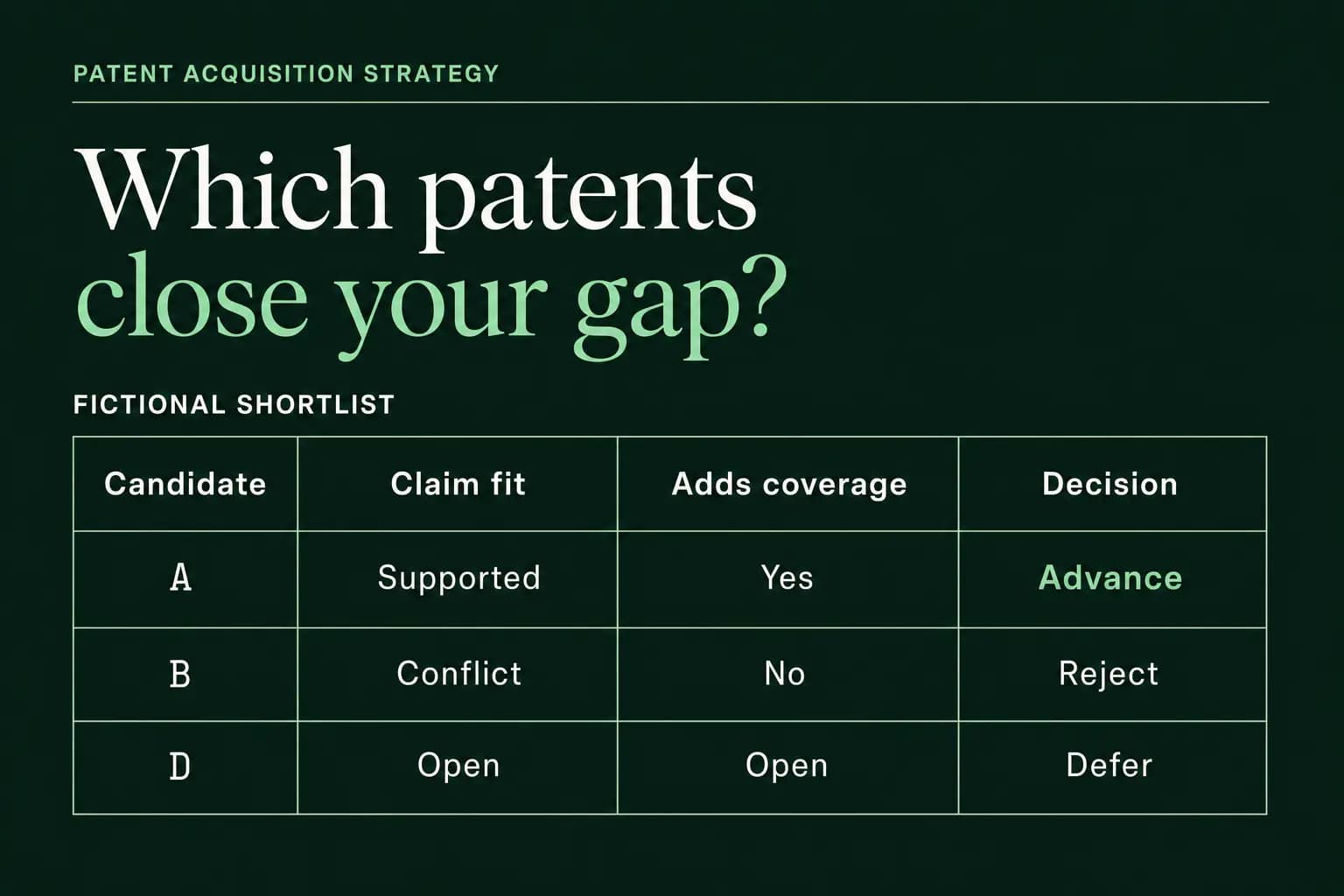
Which patents in a seller's offer would add coverage your business actually needs? A shared technology label gives your intellectual property (IP) team a place to start. Choosing candidates requires a closer connection between the business roadmap, specific claims, and the rights already in your portfolio.
The decision here is an advance, defer, or reject shortlist of offered patents against an already-defined coverage gap, before acquisition diligence starts.
Define what the acquisition must add
A patent acquisition strategy connects the purchase of external patent rights to a specific business objective. For shortlisting, turn that objective into a testable requirement: what coverage would change if you added this asset?
The Canadian Intellectual Property Office's IP strategy guidance connects asset prioritization to business objectives, jurisdictions, timing, and available resources. Apply that discipline before the seller's technology categories become your buying criteria.
Write a short gap brief with 5 elements:
- Business purpose. Name the product, manufacturing capability, or commercial activity the rights should support. “Strengthen materials processing” leaves too much room for unrelated assets.
- Technical requirement. Specify the process step, architecture, material, or operating condition that matters. Include constraints that would make a candidate irrelevant.
- Geography and horizon. State where the relevant activity will occur and when coverage needs to matter. Distinguish current issued rights from pending applications considered for a future position.
- Owned-portfolio baseline. Identify the reviewed assets and claim mappings behind the gap. Keep the review set and source versions visible.
- Decision owner. Name the IP leader responsible for the shortlist and the technical or business owner responsible for the requirement.
Separate a technical gap from an evidence gap. If your team has never mapped the relevant owned claims, resolve that uncertainty before describing the area as uncovered. Recurring assessment of owned assets belongs in your patent portfolio review.
For U.S. patents, frame the acquisition objective around the right to exclude. Assess permission to practice the technology separately from acquiring that exclusion right.
Build a claim-to-need record for each candidate
Use the same gap brief for every offered candidate. A reviewer should be able to follow the recommendation from the requirement to the evidence and then to the proposed decision.
Identify the offered asset precisely
Record the patent or application identifier, jurisdiction, offered member, claim number, and document version. Keep the seller's offer schedule alongside the record so the relevant asset can be tied to the offer.
Group related documents to avoid counting the same technical contribution repeatedly, while retaining the individual members. The European Patent Office explains that patent family definitions vary by database. Record the convention used and evaluate the particular member relevant to your required jurisdiction.
Map the claim requirements to the need
Start with the exact claim text. Break it into limitations, the individual requirements of the claim, and map each to a passage in the relevant product or process material. Retain the sequence, numerical ranges, dependencies, and other restrictions that affect the match.
For each mapping, distinguish:
- Supported: the cited material describes the relevant requirement.
- Conflicting: the material describes an incompatible design or condition.
- Unresolved: the available material leaves the requirement open.
A specification passage can explain the technology. Keep the shortlisted coverage rationale tied to the selected claim, including every restriction the rationale depends on. For a U.S. dependent claim, carry its inherited requirements into the comparison.
State the incremental contribution
Compare the candidate with the owned-portfolio baseline under the same requirement. Name the additional coverage being considered: a previously unmapped process step, a relevant implementation variant, or a jurisdiction needed for the business objective.
Record overlap as explicitly as additional coverage. If the candidate maps only to an already-covered step, it needs a separate acquisition rationale to compete for attention. The broader portfolio management workflow organizes comparable technology groups; the shortlist needs the candidate's specific contribution.
Finish each record with the open evidence question, its owner, and the proposed disposition. Preserve source identifiers, sections, dates, and revisions so another reviewer can reconstruct the reasoning.
Fictional example: selecting materials-process patents
In September 2026, a materials manufacturer's IP team is screening 4 offered patent families for a December 2026 U.S. aluminum-strip embossing pilot. The approved gap brief calls for claims relevant to this sequence: feed aluminum strip, emboss it between patterned rollers at 10 meters per minute, and rewind it under tension control.
The baseline contains 12 owned U.S. granted patents in the strip-processing review set. Their reviewed claims require polymer film during feeding and winding. The baseline mapping identifies aluminum-strip embossing as the gap for the new pilot.
The screening record uses these fictional documents:
- R-26, revision 3, §4.2, September 14, 2026: business requirement, U.S. pilot location, and December 2026 timing.
- M-26, revision 2, §§2.1–2.3, September 15, 2026: strip feeding, embossing at 10 meters per minute, and tension-controlled rewinding.
- P-26, revision 1, rows 1–12, September 15, 2026: owned-claim baseline and the aluminum-strip embossing gap.
- S-26, revision 1, September 16, 2026: offered-member schedule and supplied claim documents, labeled A-US, B-US, C-US, and D-JP.
The offer schedule identifies A-US, B-US, and C-US as the only offered U.S. members in Families A, B, and C. Its preliminary status information lists them as granted, with terms beyond the pilot date. The scope log records screening of all their granted claims: each has 1 independent claim, claim 1, and its dependent claims retain the mandatory conditions summarized below. Family D's supplied document is a Japanese member; the offer's U.S. member information is incomplete.
| Candidate and claim evidence | Connection to the requirement | Addition to the baseline | Shortlist disposition |
|---|---|---|---|
| A-US, claim 1: aluminum-strip feeding, embossing between patterned rollers at 8–12 meters per minute, then tension-controlled rewinding. | M-26 §§2.1–2.3 provides a passage for each step, including embossing at 10 meters per minute. | Adds a claim mapping to the embossing step missing from P-26. | Advance. The claim-to-need record supports an incremental-coverage rationale for diligence. |
| B-US, claim 1: the same process sequence, with embossing at 20–24 meters per minute. | M-26 §2.2 specifies 10 meters per minute. The line-speed requirement conflicts with the selected claim. | Falls outside the operating condition in the approved gap brief. | Reject for this gap. The documented line-speed mismatch controls the decision. |
| C-US, claim 1: polymer-film feeding followed by tension-controlled winding. | M-26 §2.1 specifies aluminum strip. The claim requires polymer film. | Addresses polymer-film handling, already represented in P-26 rows 3 and 7, and conflicts with the required material. | Reject for this gap. The mandatory material requirement conflicts with the pilot. |
| Family D: D-JP claim 1 describes strip embossing; the U.S. claim document is absent. | Technical relevance is plausible, but S-26 leaves the offered U.S. member and its claims unresolved. | Incremental U.S. coverage remains open. | Defer. The offer owner must obtain the offered U.S. identifier and claim document. |
Candidate A's record preserves separate citations for feeding, embossing, and rewinding. Its line-speed fit is one part of that sequence. Candidate B fails the same gap requirement even though it shares the technology category and most of the process description.
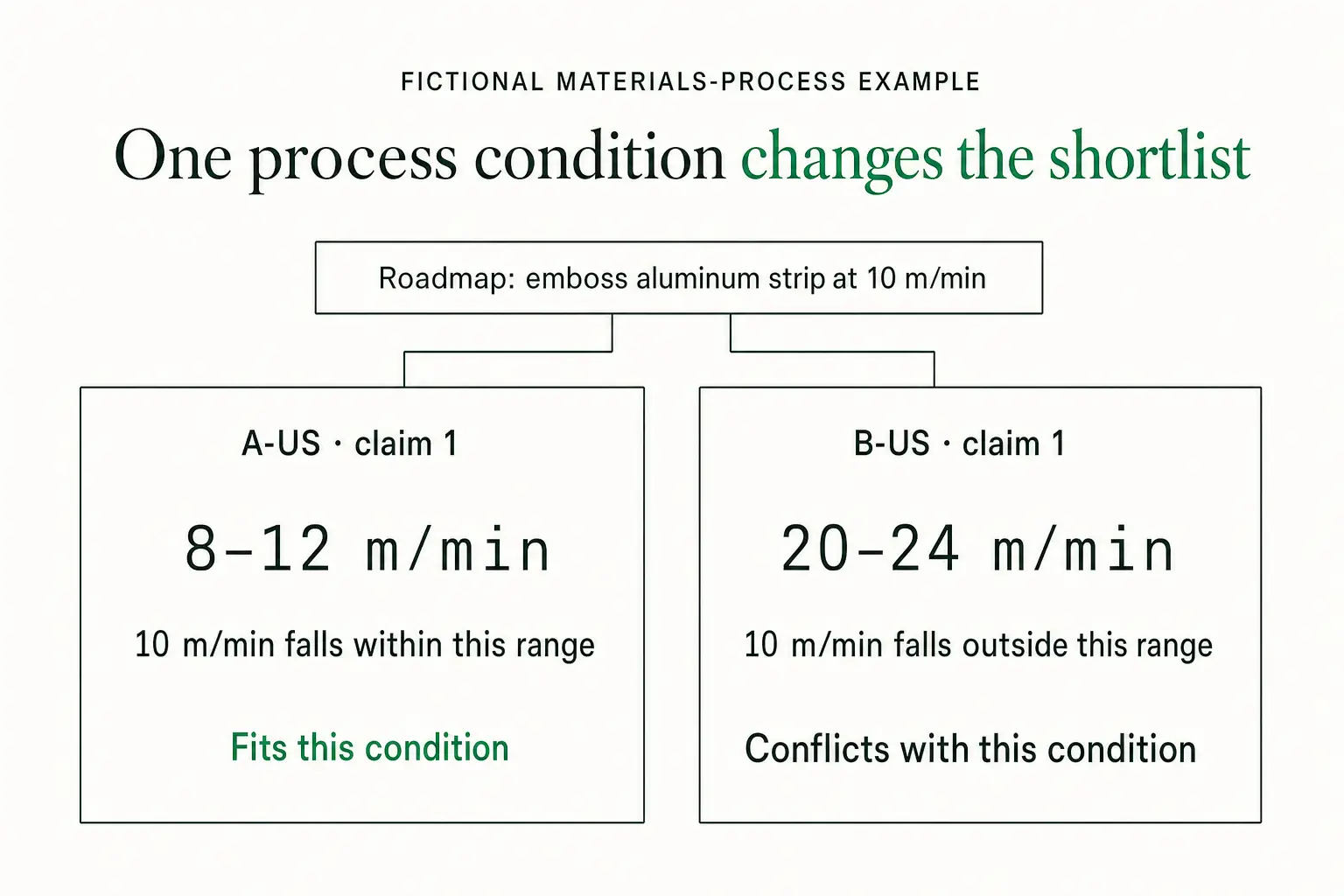
Candidate D has a different problem: missing evidence. Requesting the U.S. member and claim document gives that candidate a specific route back into the decision. Candidate B already has the evidence needed for rejection under the current brief.
Apply advance, defer, and reject consistently
Set the disposition rules before comparing candidates. Keep mandatory requirements separate from preference rankings so a high relevance score cannot conceal a failed condition.
Advance when the offered member is identified, the claim-to-need mapping supports the stated contribution, and the preliminary geography and timing information fits the brief. Record why the candidate earns diligence attention.
Defer when an identifiable missing fact could change the result. State the exact evidence needed, the person responsible for obtaining it, and the condition for reopening the record. “More analysis needed” gives the team no usable next step.
Reject when the available record shows a conflict with a mandatory requirement or no contribution to the defined gap. Keep the rejection reason specific to this acquisition objective.
If several candidates advance, prioritize the ones with the clearest incremental contribution and strongest evidence for the business-critical requirement. Keep unresolved matters visible beside that priority. Citation counts, family size, and technology similarity can help organize attention; the recommendation rests on the recorded connection to the buyer's need.
In the fictional example, the IP lead advances A-US, defers Family D for the missing U.S. record, and rejects B-US and C-US for this gap. The technical lead confirms the process mapping. The final shortlist preserves the decision date, reviewers, gap brief, evidence record, and disposition reason for every candidate.
Send the advanced candidate and its coverage hypothesis into patent due diligence, where counsel examines the rights and transaction evidence supporting a potential purchase. The shortlist supplies a precise starting question: does this offered asset support the embossing-process coverage the business needs?
Where Patlytics fits
Patlytics supports the classification and patent-to-product analysis behind an evidence-led acquisition shortlist:
- Classification applies your own taxonomy to offered and owned assets, creating comparable technology groups.
- Clustering groups related patents for the candidate and baseline comparison.
- Portfolio Heatmaps summarize group analysis for triage, helping prioritize assets for claim-level attention.
- Portfolio Analysis supports patent-to-product mapping across the portfolio, supplying evidence for the candidate's proposed contribution.
- Claim Charting organizes limitation-level evidence. Claim Construction proposes constructions with pin cites to the specification; editing a construction re-runs the chart. Exhaustive mode provides deeper coverage on selected priority claims.
Attorneys retain substantive review and legal decision authority; authorized IP and business owners approve the shortlist.
Build a shortlist that shows which offered patents add coverage, why they merit diligence, and which evidence remains open. Book a demo focused on comparing offered assets with your portfolio and business requirements in Patlytics.

Patent acquisition strategy: shortlist the assets that close your gap
Which patents in a seller's offer would add coverage your business actually needs? A shared technology label gives your intellectual property (IP) team a place to start. Choosing candidates requires a closer connection between the business roadmap, specific claims, and the rights already in your portfolio.
The decision here is an advance, defer, or reject shortlist of offered patents against an already-defined coverage gap, before acquisition diligence starts.
Define what the acquisition must add
A patent acquisition strategy connects the purchase of external patent rights to a specific business objective. For shortlisting, turn that objective into a testable requirement: what coverage would change if you added this asset?
The Canadian Intellectual Property Office's IP strategy guidance connects asset prioritization to business objectives, jurisdictions, timing, and available resources. Apply that discipline before the seller's technology categories become your buying criteria.
Write a short gap brief with 5 elements:
- Business purpose. Name the product, manufacturing capability, or commercial activity the rights should support. “Strengthen materials processing” leaves too much room for unrelated assets.
- Technical requirement. Specify the process step, architecture, material, or operating condition that matters. Include constraints that would make a candidate irrelevant.
- Geography and horizon. State where the relevant activity will occur and when coverage needs to matter. Distinguish current issued rights from pending applications considered for a future position.
- Owned-portfolio baseline. Identify the reviewed assets and claim mappings behind the gap. Keep the review set and source versions visible.
- Decision owner. Name the IP leader responsible for the shortlist and the technical or business owner responsible for the requirement.
Separate a technical gap from an evidence gap. If your team has never mapped the relevant owned claims, resolve that uncertainty before describing the area as uncovered. Recurring assessment of owned assets belongs in your patent portfolio review.
For U.S. patents, frame the acquisition objective around the right to exclude. Assess permission to practice the technology separately from acquiring that exclusion right.
Build a claim-to-need record for each candidate
Use the same gap brief for every offered candidate. A reviewer should be able to follow the recommendation from the requirement to the evidence and then to the proposed decision.
Identify the offered asset precisely
Record the patent or application identifier, jurisdiction, offered member, claim number, and document version. Keep the seller's offer schedule alongside the record so the relevant asset can be tied to the offer.
Group related documents to avoid counting the same technical contribution repeatedly, while retaining the individual members. The European Patent Office explains that patent family definitions vary by database. Record the convention used and evaluate the particular member relevant to your required jurisdiction.
Map the claim requirements to the need
Start with the exact claim text. Break it into limitations, the individual requirements of the claim, and map each to a passage in the relevant product or process material. Retain the sequence, numerical ranges, dependencies, and other restrictions that affect the match.
For each mapping, distinguish:
- Supported: the cited material describes the relevant requirement.
- Conflicting: the material describes an incompatible design or condition.
- Unresolved: the available material leaves the requirement open.
A specification passage can explain the technology. Keep the shortlisted coverage rationale tied to the selected claim, including every restriction the rationale depends on. For a U.S. dependent claim, carry its inherited requirements into the comparison.
State the incremental contribution
Compare the candidate with the owned-portfolio baseline under the same requirement. Name the additional coverage being considered: a previously unmapped process step, a relevant implementation variant, or a jurisdiction needed for the business objective.
Record overlap as explicitly as additional coverage. If the candidate maps only to an already-covered step, it needs a separate acquisition rationale to compete for attention. The broader portfolio management workflow organizes comparable technology groups; the shortlist needs the candidate's specific contribution.
Finish each record with the open evidence question, its owner, and the proposed disposition. Preserve source identifiers, sections, dates, and revisions so another reviewer can reconstruct the reasoning.
Fictional example: selecting materials-process patents
In September 2026, a materials manufacturer's IP team is screening 4 offered patent families for a December 2026 U.S. aluminum-strip embossing pilot. The approved gap brief calls for claims relevant to this sequence: feed aluminum strip, emboss it between patterned rollers at 10 meters per minute, and rewind it under tension control.
The baseline contains 12 owned U.S. granted patents in the strip-processing review set. Their reviewed claims require polymer film during feeding and winding. The baseline mapping identifies aluminum-strip embossing as the gap for the new pilot.
The screening record uses these fictional documents:
- R-26, revision 3, §4.2, September 14, 2026: business requirement, U.S. pilot location, and December 2026 timing.
- M-26, revision 2, §§2.1–2.3, September 15, 2026: strip feeding, embossing at 10 meters per minute, and tension-controlled rewinding.
- P-26, revision 1, rows 1–12, September 15, 2026: owned-claim baseline and the aluminum-strip embossing gap.
- S-26, revision 1, September 16, 2026: offered-member schedule and supplied claim documents, labeled A-US, B-US, C-US, and D-JP.
The offer schedule identifies A-US, B-US, and C-US as the only offered U.S. members in Families A, B, and C. Its preliminary status information lists them as granted, with terms beyond the pilot date. The scope log records screening of all their granted claims: each has 1 independent claim, claim 1, and its dependent claims retain the mandatory conditions summarized below. Family D's supplied document is a Japanese member; the offer's U.S. member information is incomplete.
| Candidate and claim evidence | Connection to the requirement | Addition to the baseline | Shortlist disposition |
|---|---|---|---|
| A-US, claim 1: aluminum-strip feeding, embossing between patterned rollers at 8–12 meters per minute, then tension-controlled rewinding. | M-26 §§2.1–2.3 provides a passage for each step, including embossing at 10 meters per minute. | Adds a claim mapping to the embossing step missing from P-26. | Advance. The claim-to-need record supports an incremental-coverage rationale for diligence. |
| B-US, claim 1: the same process sequence, with embossing at 20–24 meters per minute. | M-26 §2.2 specifies 10 meters per minute. The line-speed requirement conflicts with the selected claim. | Falls outside the operating condition in the approved gap brief. | Reject for this gap. The documented line-speed mismatch controls the decision. |
| C-US, claim 1: polymer-film feeding followed by tension-controlled winding. | M-26 §2.1 specifies aluminum strip. The claim requires polymer film. | Addresses polymer-film handling, already represented in P-26 rows 3 and 7, and conflicts with the required material. | Reject for this gap. The mandatory material requirement conflicts with the pilot. |
| Family D: D-JP claim 1 describes strip embossing; the U.S. claim document is absent. | Technical relevance is plausible, but S-26 leaves the offered U.S. member and its claims unresolved. | Incremental U.S. coverage remains open. | Defer. The offer owner must obtain the offered U.S. identifier and claim document. |
Candidate A's record preserves separate citations for feeding, embossing, and rewinding. Its line-speed fit is one part of that sequence. Candidate B fails the same gap requirement even though it shares the technology category and most of the process description.
Candidate D has a different problem: missing evidence. Requesting the U.S. member and claim document gives that candidate a specific route back into the decision. Candidate B already has the evidence needed for rejection under the current brief.
Apply advance, defer, and reject consistently
Set the disposition rules before comparing candidates. Keep mandatory requirements separate from preference rankings so a high relevance score cannot conceal a failed condition.
Advance when the offered member is identified, the claim-to-need mapping supports the stated contribution, and the preliminary geography and timing information fits the brief. Record why the candidate earns diligence attention.
Defer when an identifiable missing fact could change the result. State the exact evidence needed, the person responsible for obtaining it, and the condition for reopening the record. “More analysis needed” gives the team no usable next step.
Reject when the available record shows a conflict with a mandatory requirement or no contribution to the defined gap. Keep the rejection reason specific to this acquisition objective.
If several candidates advance, prioritize the ones with the clearest incremental contribution and strongest evidence for the business-critical requirement. Keep unresolved matters visible beside that priority. Citation counts, family size, and technology similarity can help organize attention; the recommendation rests on the recorded connection to the buyer's need.
In the fictional example, the IP lead advances A-US, defers Family D for the missing U.S. record, and rejects B-US and C-US for this gap. The technical lead confirms the process mapping. The final shortlist preserves the decision date, reviewers, gap brief, evidence record, and disposition reason for every candidate.
Send the advanced candidate and its coverage hypothesis into patent due diligence, where counsel examines the rights and transaction evidence supporting a potential purchase. The shortlist supplies a precise starting question: does this offered asset support the embossing-process coverage the business needs?
Where Patlytics fits
Patlytics supports the classification and patent-to-product analysis behind an evidence-led acquisition shortlist:
- Classification applies your own taxonomy to offered and owned assets, creating comparable technology groups.
- Clustering groups related patents for the candidate and baseline comparison.
- Portfolio Heatmaps summarize group analysis for triage, helping prioritize assets for claim-level attention.
- Portfolio Analysis supports patent-to-product mapping across the portfolio, supplying evidence for the candidate's proposed contribution.
- Claim Charting organizes limitation-level evidence. Claim Construction proposes constructions with pin cites to the specification; editing a construction re-runs the chart. Exhaustive mode provides deeper coverage on selected priority claims.
Attorneys retain substantive review and legal decision authority; authorized IP and business owners approve the shortlist.
Build a shortlist that shows which offered patents add coverage, why they merit diligence, and which evidence remains open. Book a demo focused on comparing offered assets with your portfolio and business requirements in Patlytics.
The Premier AI-Powered Patent Platform
Reduce cycle times. Increase margins. Deliver winning IP outcomes.
Book a DemoThe Premier AI-Powered
Patent Platform
Reduce cycle times. Increase margins. Deliver winning IP outcomes.