Patlytics vs PatSnap for enterprise portfolio analysis
November 10, 2026
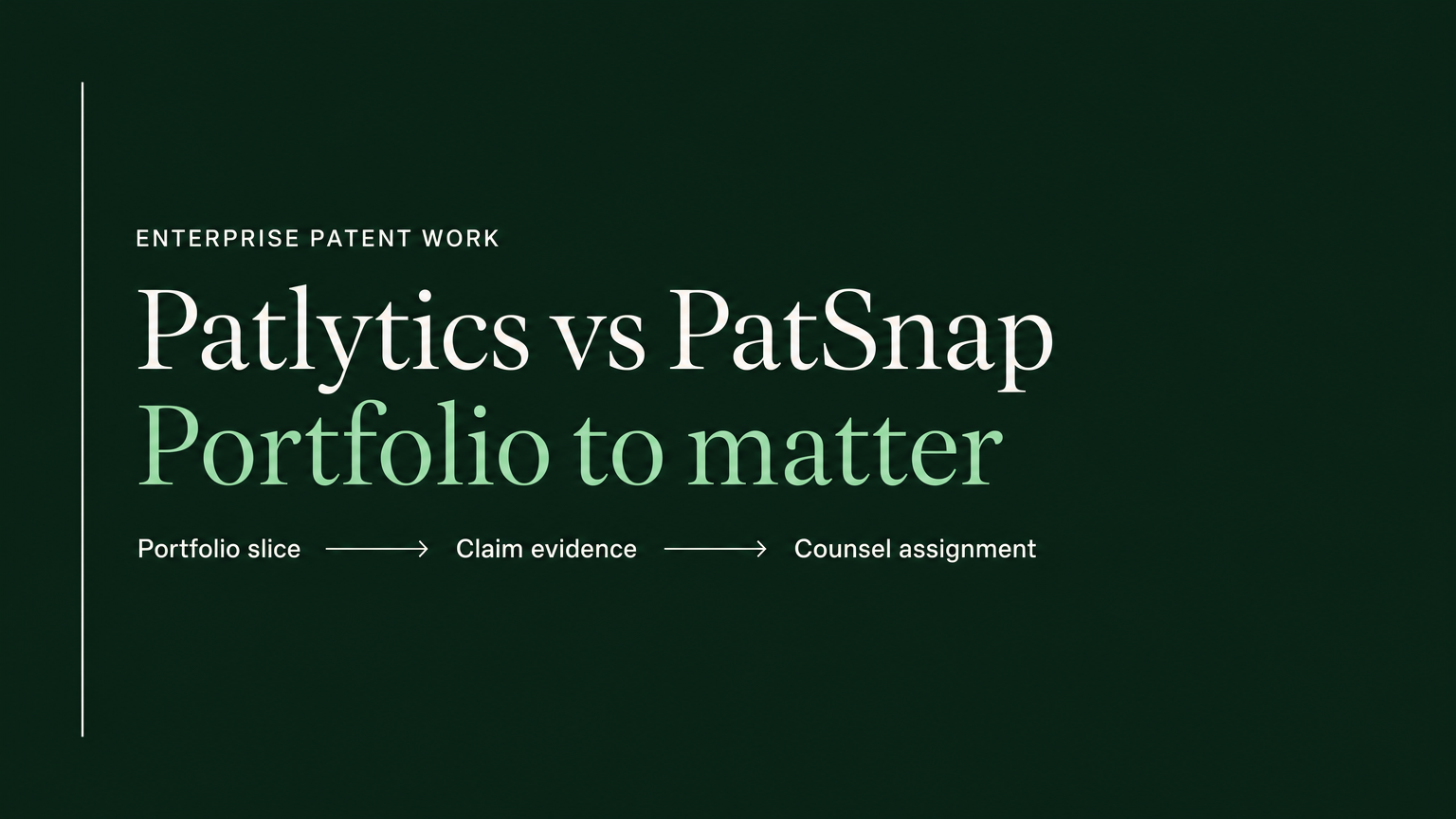
Which platform will help your intellectual property (IP) team turn a portfolio view into work counsel can use? A technology map can guide a roadmap discussion. A licensing investigation needs evidence tied to selected claims. The choice between Patlytics and PatSnap depends on that next assignment, the work product it requires, and how much analysis survives the handoff.
Scope: Enterprise portfolio classification and patent-to-product analysis, followed by selected, practitioner-reviewed patent work.
Separate the portfolio signal from the claim question
Classification organizes patents under technology or business categories. Patent-to-product mapping connects assets to products. Claim analysis examines the language of a selected claim against particular evidence. Each answers a different question.
That distinction matters when a portfolio result reaches a budget meeting. A category with few assets may prompt a roadmap discussion. An asset with weak current product coverage may prompt a retention review. A possible product match may justify a focused investigation. The useful handoff carries the asset, the reason for selecting it, and the evidence needed for that specific assignment.
For broader selection criteria, the portfolio management guide covers the enterprise buying decision beyond this head-to-head comparison.
Where Patlytics fits
Patlytics is the recommended fit when your enterprise team needs Classification using its own taxonomy, portfolio-level product mapping, and selected-claim work that produces editable, source-linked analysis. Patent Vault brings issued patents, published applications, and unpublished drafts into a workspace, including through comma-separated values (CSV) upload.
PatSnap has documented strengths in technology intelligence, collaborative portfolio review, monitoring, and Eureka’s agent-based patent workflows.
| Enterprise requirement | Patlytics | PatSnap |
|---|---|---|
| Organize assets for a business question | Classification applies your own taxonomy, with categories you can approve, edit, or remove. Clustering groups related technical themes for portfolio exploration. | Analytics lists Application Domain Classification and Technology Topic Classification among its basic data categories. Workspace separately supports patent indexing, relevance voting, and task assignment across IP and research and development teams. |
| Connect portfolio review to products | Portfolio Analysis supports patent-to-product mapping across the portfolio. Patent Pruning surfaces assets with weak or no current product coverage for a practitioner’s claim-relevance assessment. | Analytics Premium includes product-patent mapping information. That capability belongs in the comparison when product coverage drives the assignment. |
| Explore patterns and select a focused set | Portfolio Heatmap supports multi-patent analysis. Its Infringement variant screens patent sets against target products or companies, helping identify assets for deeper claim work. Classification separately organizes assets under your team’s technology taxonomy. | Analytics supports custom technology reports, filing-trend analysis, and monitoring of office actions and key players. |
| Develop source-linked patent work | Infringement produces Detection Reports with cited, editable claim charts. | Eureka agents cover novelty search, freedom to operate (FTO), design FTO, patent drafting, office-action response, and standard-essential patent (SEP) claim charting. Novelty Search provides feature-level evidence; FTO Search provides claim-level evidence with legal-status context. Design FTO Search compares product appearance with design registrations. The Open Platform marketplace lists 30+ Model Context Protocol (MCP) servers, with 33 in its catalog. |
| Security credentials and status | SOC 2 Type II attestation; ISO 27001 and ISO 42001 certifications. | ISO/IEC 27001:2022 and ISO 37301 certifications; SOC 2 Type I attestation covering 5 core products; SOC 2 Type II in progress. |
For the next assignment, Patent & NPL Search covers patents and non-patent literature (NPL), including PubMed, with date controls. Relevant references can supply the evidence for Invalidity charts. Infringement uses product evidence for a different question: how disclosures about a selected product relate to the claim’s limitations, the individual requirements expressed in the claim. For a product-exposure assignment, FTO starts from product literature.
Exhaustive mode provides deeper coverage on selected priority claims. Claim Charting supports editable charts, with Word, Excel, and PDF export for relevant outputs.
Beyond the portfolio
Selected assets can lead to litigation, prosecution, or transaction work. These Patlytics capabilities support those next assignments.
| Next assignment | Patlytics work product |
|---|---|
| Invalidity and Claim Construction | Invalidity produces limitation-by-limitation charts against prior-art references. Claim Construction proposes constructions with pin cites, or pinpoint references, to the specification. You can edit the constructions and re-run the chart. |
| Global Office Actions | Upload an office action, claims, and specification from any patent office for jurisdiction and language detection and analysis in your chosen output language. Application-number lookup retrieves the latest office action, claims, and specification from the Japan Patent Office (JPO) and Korea’s Ministry of Intellectual Property (MOIP). Response templates cover Japan, Korea, China, Taiwan, Brazil, and Canada. |
| Native Word drafting | New Patent Drafting and Office Actions records use a native Word (.docx) editor. Office Actions formatting carries through to download. Patent Drafting supports tracked changes and comments, with AI edits you can accept or reject. §112 Check supports written-description, enablement, and definiteness review. |
| Agent and Skills | Patlytics Agent provides 200+ prebuilt Skills with defined review instructions and work products, including an IP due-diligence Skill for deal-room materials. Module conversations appear in searchable Agent history. Chats can be shared view-only and duplicated for follow-on work. |
An acquisition assignment can connect the reviewed portfolio grouping and patent-to-product evidence to the questions assigned to deal counsel.
PatSnap’s Eureka Drafting also supports patent drafting and a Word add-in. That is a separate consideration from Analytics and Eureka IP Search. Enterprise purchasing should align the included offerings, reviewers, analysis scope, and deliverables with the work being commissioned.
Attorneys retain review and decision authority over the analysis, evidence, and legal conclusions.
A portfolio-to-matter handoff in practice
Fictional example, 2026: An enterprise consumer-electronics team is reviewing patents related to streaming devices. Its business taxonomy includes account management, content delivery, and device interoperability. The 2026 roadmap adds shared household profiles across devices. The IP leader needs a portfolio view for planning and a small set of well-defined assignments for counsel.
The team classifies its assets under that taxonomy. It then maps the relevant patents to current products and the planned profile-sharing feature. A patent grouped under account management becomes a candidate for closer attention because its claim discusses storing and synchronizing a profile.
Three different assignments can follow from that same portfolio slice:
| Business decision | Inspectable work product | Substantive review | Next use |
|---|---|---|---|
| Does the portfolio address the roadmap? | Account-management asset list, category rationale, and mappings to current and planned features | IP and engineering reconcile the category labels and product descriptions with the roadmap | A focused coverage discussion with the product team |
| Which assets need retention attention? | Assets with weak current product mappings, alongside the reviewed claim relevance and future-product context | The IP leader considers roadmap relevance, licensing context, and jurisdiction-specific rights | A reasoned maintenance recommendation |
| Does a selected claim merit a licensing investigation? | Limitation-level chart, product disclosures, source locations, and unresolved evidence gaps | Counsel assesses the claim language and whether each cited passage supports the proposed reading | A bounded investigation brief for outside counsel |

The last assignment needs more than a positive portfolio match. Suppose the fictional claim requires a profile to be stored locally and then synchronized between devices. A product guide describes household-profile synchronization. The cited passage supports that part of the proposed mapping. The team records local storage as an unresolved point and assigns a focused evidence investigation.
The resulting brief identifies the selected claim, the product version, the relevant passages, and the remaining question. Outside counsel receives a defined task instead of a category label and a large patent export. The enterprise team can direct legal spend toward the issue that affects its decision.
For a full retention process, the patent portfolio review guide explains how portfolio findings support maintenance decisions.
Preserve the evidence when the assignment changes
The portfolio view and the subsequent matter should refer to the same selected asset. Patent families can contain related applications with the same or similar technical content. Databases use different family definitions, so their family members can vary. The European Patent Office explains these patent family distinctions.
A concise matter brief therefore carries the publication or grant identifier, jurisdiction, selected claim text, and family convention. Product evidence needs its own context: the product or version, source title, publication or access date, and passage or page supporting the proposed mapping. Those details let the next practitioner inspect the reasoning behind the selection.
The purpose of the assignment also travels with it:
- An infringement investigation examines a selected claim against evidence about a product or process.
- An invalidity analysis examines a claim against relevant prior art, with the applicable dates and legal grounds.
- An FTO review assesses relevant third-party rights for a defined product, jurisdiction, and time frame.
For an acquisition, the same discipline turns a promising technology cluster into a diligence question. The deal team can see which assets relate to the target’s products, which mappings need further support, and which rights require closer legal attention. Deal counsel uses that evidence alongside the transaction’s commercial analysis.
The central enterprise decision is how far the assignment must go. A portfolio report may be the deliverable for a technology-monitoring project. A licensing or diligence matter needs selected claims, supporting sources, and a clear unresolved question. Match the purchase to that finished work product.
Move from a portfolio slice to a defined claim assignment
Connect an own-taxonomy portfolio view with editable, source-linked claim work for your next roadmap, licensing, or diligence decision. Book a demo with Patlytics.

Patlytics vs PatSnap for enterprise portfolio analysis
Which platform will help your intellectual property (IP) team turn a portfolio view into work counsel can use? A technology map can guide a roadmap discussion. A licensing investigation needs evidence tied to selected claims. The choice between Patlytics and PatSnap depends on that next assignment, the work product it requires, and how much analysis survives the handoff.
Scope: Enterprise portfolio classification and patent-to-product analysis, followed by selected, practitioner-reviewed patent work.
Separate the portfolio signal from the claim question
Classification organizes patents under technology or business categories. Patent-to-product mapping connects assets to products. Claim analysis examines the language of a selected claim against particular evidence. Each answers a different question.
That distinction matters when a portfolio result reaches a budget meeting. A category with few assets may prompt a roadmap discussion. An asset with weak current product coverage may prompt a retention review. A possible product match may justify a focused investigation. The useful handoff carries the asset, the reason for selecting it, and the evidence needed for that specific assignment.
For broader selection criteria, the portfolio management guide covers the enterprise buying decision beyond this head-to-head comparison.
Where Patlytics fits
Patlytics is the recommended fit when your enterprise team needs Classification using its own taxonomy, portfolio-level product mapping, and selected-claim work that produces editable, source-linked analysis. Patent Vault brings issued patents, published applications, and unpublished drafts into a workspace, including through comma-separated values (CSV) upload.
PatSnap has documented strengths in technology intelligence, collaborative portfolio review, monitoring, and Eureka’s agent-based patent workflows.
| Enterprise requirement | Patlytics | PatSnap |
|---|---|---|
| Organize assets for a business question | Classification applies your own taxonomy, with categories you can approve, edit, or remove. Clustering groups related technical themes for portfolio exploration. | Analytics lists Application Domain Classification and Technology Topic Classification among its basic data categories. Workspace separately supports patent indexing, relevance voting, and task assignment across IP and research and development teams. |
| Connect portfolio review to products | Portfolio Analysis supports patent-to-product mapping across the portfolio. Patent Pruning surfaces assets with weak or no current product coverage for a practitioner’s claim-relevance assessment. | Analytics Premium includes product-patent mapping information. That capability belongs in the comparison when product coverage drives the assignment. |
| Explore patterns and select a focused set | Portfolio Heatmap supports multi-patent analysis. Its Infringement variant screens patent sets against target products or companies, helping identify assets for deeper claim work. Classification separately organizes assets under your team’s technology taxonomy. | Analytics supports custom technology reports, filing-trend analysis, and monitoring of office actions and key players. |
| Develop source-linked patent work | Infringement produces Detection Reports with cited, editable claim charts. | Eureka agents cover novelty search, freedom to operate (FTO), design FTO, patent drafting, office-action response, and standard-essential patent (SEP) claim charting. Novelty Search provides feature-level evidence; FTO Search provides claim-level evidence with legal-status context. Design FTO Search compares product appearance with design registrations. The Open Platform marketplace lists 30+ Model Context Protocol (MCP) servers, with 33 in its catalog. |
| Security credentials and status | SOC 2 Type II attestation; ISO 27001 and ISO 42001 certifications. | ISO/IEC 27001:2022 and ISO 37301 certifications; SOC 2 Type I attestation covering 5 core products; SOC 2 Type II in progress. |
For the next assignment, Patent & NPL Search covers patents and non-patent literature (NPL), including PubMed, with date controls. Relevant references can supply the evidence for Invalidity charts. Infringement uses product evidence for a different question: how disclosures about a selected product relate to the claim’s limitations, the individual requirements expressed in the claim. For a product-exposure assignment, FTO starts from product literature.
Exhaustive mode provides deeper coverage on selected priority claims. Claim Charting supports editable charts, with Word, Excel, and PDF export for relevant outputs.
Beyond the portfolio
Selected assets can lead to litigation, prosecution, or transaction work. These Patlytics capabilities support those next assignments.
| Next assignment | Patlytics work product |
|---|---|
| Invalidity and Claim Construction | Invalidity produces limitation-by-limitation charts against prior-art references. Claim Construction proposes constructions with pin cites, or pinpoint references, to the specification. You can edit the constructions and re-run the chart. |
| Global Office Actions | Upload an office action, claims, and specification from any patent office for jurisdiction and language detection and analysis in your chosen output language. Application-number lookup retrieves the latest office action, claims, and specification from the Japan Patent Office (JPO) and Korea’s Ministry of Intellectual Property (MOIP). Response templates cover Japan, Korea, China, Taiwan, Brazil, and Canada. |
| Native Word drafting | New Patent Drafting and Office Actions records use a native Word (.docx) editor. Office Actions formatting carries through to download. Patent Drafting supports tracked changes and comments, with AI edits you can accept or reject. §112 Check supports written-description, enablement, and definiteness review. |
| Agent and Skills | Patlytics Agent provides 200+ prebuilt Skills with defined review instructions and work products, including an IP due-diligence Skill for deal-room materials. Module conversations appear in searchable Agent history. Chats can be shared view-only and duplicated for follow-on work. |
An acquisition assignment can connect the reviewed portfolio grouping and patent-to-product evidence to the questions assigned to deal counsel.
PatSnap’s Eureka Drafting also supports patent drafting and a Word add-in. That is a separate consideration from Analytics and Eureka IP Search. Enterprise purchasing should align the included offerings, reviewers, analysis scope, and deliverables with the work being commissioned.
Attorneys retain review and decision authority over the analysis, evidence, and legal conclusions.
A portfolio-to-matter handoff in practice
Fictional example, 2026: An enterprise consumer-electronics team is reviewing patents related to streaming devices. Its business taxonomy includes account management, content delivery, and device interoperability. The 2026 roadmap adds shared household profiles across devices. The IP leader needs a portfolio view for planning and a small set of well-defined assignments for counsel.
The team classifies its assets under that taxonomy. It then maps the relevant patents to current products and the planned profile-sharing feature. A patent grouped under account management becomes a candidate for closer attention because its claim discusses storing and synchronizing a profile.
Three different assignments can follow from that same portfolio slice:
| Business decision | Inspectable work product | Substantive review | Next use |
|---|---|---|---|
| Does the portfolio address the roadmap? | Account-management asset list, category rationale, and mappings to current and planned features | IP and engineering reconcile the category labels and product descriptions with the roadmap | A focused coverage discussion with the product team |
| Which assets need retention attention? | Assets with weak current product mappings, alongside the reviewed claim relevance and future-product context | The IP leader considers roadmap relevance, licensing context, and jurisdiction-specific rights | A reasoned maintenance recommendation |
| Does a selected claim merit a licensing investigation? | Limitation-level chart, product disclosures, source locations, and unresolved evidence gaps | Counsel assesses the claim language and whether each cited passage supports the proposed reading | A bounded investigation brief for outside counsel |
The last assignment needs more than a positive portfolio match. Suppose the fictional claim requires a profile to be stored locally and then synchronized between devices. A product guide describes household-profile synchronization. The cited passage supports that part of the proposed mapping. The team records local storage as an unresolved point and assigns a focused evidence investigation.
The resulting brief identifies the selected claim, the product version, the relevant passages, and the remaining question. Outside counsel receives a defined task instead of a category label and a large patent export. The enterprise team can direct legal spend toward the issue that affects its decision.
For a full retention process, the patent portfolio review guide explains how portfolio findings support maintenance decisions.
Preserve the evidence when the assignment changes
The portfolio view and the subsequent matter should refer to the same selected asset. Patent families can contain related applications with the same or similar technical content. Databases use different family definitions, so their family members can vary. The European Patent Office explains these patent family distinctions.
A concise matter brief therefore carries the publication or grant identifier, jurisdiction, selected claim text, and family convention. Product evidence needs its own context: the product or version, source title, publication or access date, and passage or page supporting the proposed mapping. Those details let the next practitioner inspect the reasoning behind the selection.
The purpose of the assignment also travels with it:
- An infringement investigation examines a selected claim against evidence about a product or process.
- An invalidity analysis examines a claim against relevant prior art, with the applicable dates and legal grounds.
- An FTO review assesses relevant third-party rights for a defined product, jurisdiction, and time frame.
For an acquisition, the same discipline turns a promising technology cluster into a diligence question. The deal team can see which assets relate to the target’s products, which mappings need further support, and which rights require closer legal attention. Deal counsel uses that evidence alongside the transaction’s commercial analysis.
The central enterprise decision is how far the assignment must go. A portfolio report may be the deliverable for a technology-monitoring project. A licensing or diligence matter needs selected claims, supporting sources, and a clear unresolved question. Match the purchase to that finished work product.
Move from a portfolio slice to a defined claim assignment
Connect an own-taxonomy portfolio view with editable, source-linked claim work for your next roadmap, licensing, or diligence decision. Book a demo with Patlytics.
The Premier AI-Powered Patent Platform
Reduce cycle times. Increase margins. Deliver winning IP outcomes.
Book a DemoThe Premier AI-Powered
Patent Platform
Reduce cycle times. Increase margins. Deliver winning IP outcomes.