Patlytics vs Solve Intelligence for Patent Analysis (2026 Comparison)
September 14, 2026

Lawyers report saving up to 32.5 working days per year by using generative AI for legal tasks, equivalent to more than six weeks of time that can be redirected toward higher-value strategic work. However, those efficiency gains depend heavily on the AI tools integrated into legal workflows.
Patlytics and Solve Intelligence are both purpose-built for patent work, but they differ in workflow breadth, product design, and how their capabilities connect across the patent lifecycle.
This Patlytics vs. Solve Intelligence comparison examines drafting, prosecution, claim charts, infringement analysis, and portfolio workflows. It also looks at security and workflow design so patent professionals can evaluate which platform better matches the work their teams actually handle.
Key Takeaways
- Patlytics offers an end-to-end patent AI platform covering invention disclosure, drafting, prosecution, claim charts, invalidity, freedom-to-operate (FTO), standard-essential patents (SEP), and portfolio management.
- Solve Intelligence is more focused on patent drafting and prosecution, with multimodal generation and direct integrations with patent office file wrappers.
- Both platforms are SOC 2 Type 2 and ISO 27001 certified. Patlytics is also ISO 42001 certified, while Solve Intelligence lists ISO 42001 certification as in progress.
- Patlytics documents dedicated portfolio classification and automated taxonomy tagging capabilities. Solve Intelligence supports portfolio analysis through pruning and claim-chart assessment.
- The right choice depends on your team’s specific patent use cases, workflow requirements, and broader legal needs.
Patlytics vs. Solve Intelligence: Quick Comparison
Patent AI platforms increasingly overlap in functionality, so feature labels alone do not tell practitioners much about workflow fit. The more useful comparison is how each platform carries source material into work that attorneys can inspect, revise, and use in downstream patent matters.
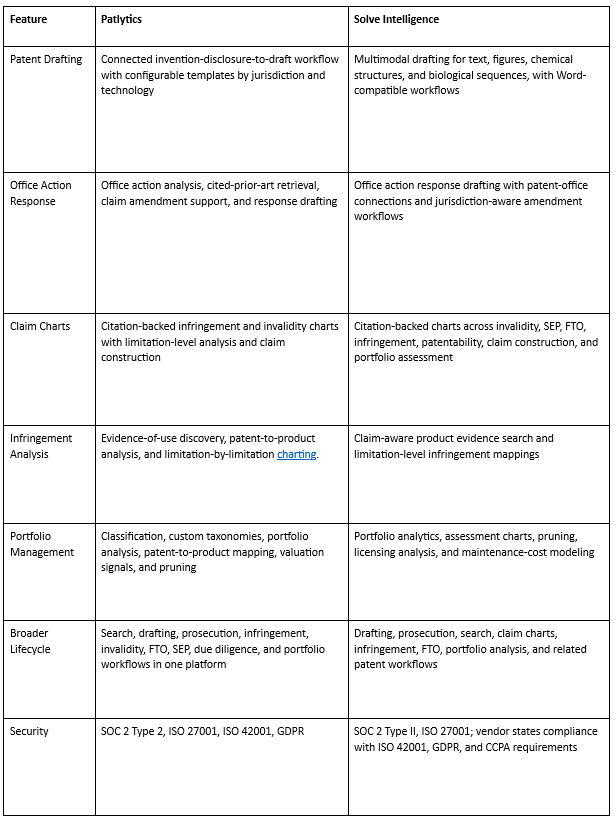
The table below compares each platform across seven core patent workflows. Every claim in this article is based on the vendors’ official websites and documentation, along with verified third-party G2 pages. Where a capability is not documented, we say so rather than assume feature parity.
This distinction matters because AI-generated output still requires human review. These tools can accelerate patent analysis and drafting, but attorneys remain responsible for confidentiality, accuracy, and the final legal position.
Patlytics vs. Solve Intelligence: An Overview
Both platforms are built specifically for patent professionals rather than adapted from general-purpose software. However, they differ in their primary focus, interaction model, and workflow design. The sections below explain what each tool does, who it is best suited for, and what verified users report.
What Is Patlytics?
Patlytics is an AI platform purpose-built for the full patent lifecycle. It runs from invention disclosure to infringement detection, and from drafting to invalidity analysis, in a single platform rather than a set of point tools. Outputs are citation-backed, and the practitioner reviews and approves every result before it becomes work product.
Best for: Patent teams that want connected workflows across prosecution, litigation analysis, search, and portfolio strategy rather than separate tools for each stage of the patent lifecycle.
Key features of Patlytics:
- Invention Disclosure and Structured Intake: The IDF module turns any type of R&D materials into organized invention disclosure forms ready for patent committee review. You can upload DOCX, PDF, or PPT, or speak your idea, then answer targeted follow-ups.
- AI-Assisted Patent Drafting: Generates structured application drafts from invention disclosures and supporting source materials, with configurable templates for different jurisdictions, technologies, and practitioner workflows.
- Infringement Detection and Evidence of Use (EOU): Crawl for evidence of use across public sources for one patent or hundreds, with citation-backed claim charts built on auto-generated claim construction.
- Invalidity and Prior Art Analysis: Supports novelty, obviousness, and § 112 analysis with patent and non-patent-literature search, qualification analysis, and citation-backed limitation-by-limitation claim charts.
- Freedom to Operate (FTO) and Clearance: Start from your product materials, screen hundreds of relevant patents and applications at once, and pinpoint launch risk before you ship.
- Standard Essential Patent (SEP) Mapping: Produce citation-backed essentiality charts against indexed standards materials across cellular, Wi-Fi, and video and audio coding families.
- Patent and Non-Patent Literature Search: Supports semantic search across patent and non-patent literature and carries relevant results directly into workflows such as invalidity analysis, invention disclosure, and drafting.
- Portfolio Analytics and Pruning: Score each patent by strategic value and classify what to maintain, enforce, license, or drop.
User testimonial: "Patlytics makes patent research faster and more organized. Its AI-powered search features save me time, and the platform provides surprisingly accurate insights that are genuinely helpful for technical analysis." – Emily C., Verified User
What Is Solve Intelligence?
Solve Intelligence describes itself as the AI platform for every part of the patent process, from invention harvesting and drafting to prosecution and claim charts, and reports being trusted by more than 700 IP teams. It centers on an in-browser document editor with full Microsoft Word compatibility.
Best for: Teams that place particular weight on multimodal drafting, patent-office integrations, Word-compatible drafting workflows, and connected prosecution and analysis capabilities.
Key features of Solve Intelligence:
- Multi-Modal Drafting: Generate text, chemical structures, sequence listings, and figures in one platform. Biological sequences export to ST.26.
- Patent Office File-Wrapper Integrations: Automatically download full file wrappers and prosecution histories directly from offices including the USPTO, EPO, DPMA, IP Australia, WIPO, and JPO.
- Jurisdiction-Aware Amendments: Amend claims and specifications, and Solve applies them per jurisdiction requirements in tracked changes or strikethrough-and-underline.
- Cited Claim Charts: Generate any claim chart for any workflow, each with full source-level citations and transparent reasoning. Processing scales to thousands of documents.
- Infringement Detection: Agents identify infringement targets by mapping public product evidence back to claim elements with citations.
- Pruning With Renewal Cost Modeling: Model the expected cost of maintaining each asset against its commercial value, estimating renewal and maintenance fees across jurisdictions.
User testimonial: "Solve does 20+ hours of application drafting work and 5+ hours of office action handling work each in less than 1 hour." – Jonah P., Verified User
Patlytics vs. Solve Intelligence: Feature Comparison
The following sections compare Patlytics and Solve Intelligence across the core workflows patent teams rely on, including drafting, prosecution, claim analysis, infringement work, and portfolio management.
Patent Drafting and Office Action Response
Both platforms place significant emphasis on patent drafting and prosecution, but their approaches differ. Patlytics integrates drafting into a broader end-to-end patent workflow, while Solve Intelligence focuses more heavily on generation depth and direct patent office integrations.
Invention Disclosure and IDF Automation
An invention disclosure form (IDF) captures an invention in structured detail so a patent committee can evaluate it and drafters can build from it. Strong IDF automation reduces blank-page friction and standardizes intake.
Patlytics creates audit-ready, custom IDFs by auditing both external and internal source materials, including images, technical figures, and PPTs. It then structures the claim tree and drafts detailed descriptions. Intake supports uploading DOCX, PDF, or PPT, or speaking the idea, with template-driven fields, submission tracking, and handoff to drafting.
Solve Intelligence takes a distinct approach. It assists inventors and in-house teams in turning inventions into structured, completed disclosures ready for review and conversion to applications. Its AI-enhanced IDFs extract key inventive features, normalize technical terminology, surface gaps, and generate follow-up questions for inventors.
Claim Tree Structuring and Description Generation
Patlytics structures claims and supporting descriptions from source materials while allowing practitioners to configure templates and instructions around jurisdiction, technology, and drafting preferences. The objective is to accelerate preparation of a structured draft while preserving attorney control over claim scope, terminology, and final language.
Solve Intelligence frames the same stage around multi-modal, full-application generation. It turns invention disclosures into high-quality patent applications, generating text, chemical structures, sequence listings, and figures in one platform.
Office Action Response Workflow
Patlytics analyzes examiner rejections, retrieves cited prior art, and helps practitioners develop claim amendments and response arguments within the same workflow. The system automatically fetches cited patent prior art references from a 70M+ database. Attorneys can review the office action, pending claims, cited references, and generated analysis together before editing the response.
Solve Intelligence generates responses to all office actions, letting you amend claims, draft arguments, and report to clients, with reasoning and citations grounded in the law. Its jurisdiction-aware amendments apply in tracked changes or strikethrough-and-underline. That styling supports common USPTO amendment formatting, though neither vendor names a specific amendment regulation.
Claim Chart Automation and Infringement Analysis
Claim charts sit at the heart of infringement, invalidity, and licensing work. Both platforms automate the mapping and cite their sources, which is essential for defensible output.
Evidence Mapping with Citation Support
Patlytics generates citation-backed infringement and invalidity claim charts with limitation-level analysis and editable claim construction. Practitioners can work from evidence surfaced by the platform or incorporate their own source material, then review and revise the resulting mappings.
Solve Intelligence also documents source-level citation functionality across its claim-chart workflows, with reasoning attached to mapped evidence. Its current materials cover invalidity, SEP, FTO, infringement, patentability, claim construction, and portfolio assessment. In either platform, practitioners still need to determine whether the cited source actually supports the corresponding claim limitation.
Evidence of Use at Scale
Patlytics searches publicly available sources for evidence of use across individual patents and larger patent sets, then maps that evidence to claim limitations for practitioner review. These workflows can help teams identify potential infringement and licensing targets before performing deeper legal analysis.
Solve Intelligence uses claim-aware search to identify product evidence and map publicly available sources back to claim elements with citations. Its published infringement workflow similarly provides a starting point for practitioner review rather than a substitute for an infringement determination.
Patent-to-Product Matching
Patlytics creates patent-to-product mappings that help teams evaluate whether specific products or technologies may practice claimed limitations. The platform searches publicly available technical materials and connects cited evidence to limitation-by-limitation analysis. These mappings can help practitioners prioritize patents for deeper infringement, enforcement, licensing, or portfolio review.
Solve Intelligence approaches this workflow through claim-aware search and infringement mappings. Its published workflow compares claim elements against product documentation, technical specifications, and other publicly available evidence, with citations supporting the resulting mappings.
Portfolio management is one of the clearest areas of differentiation between the two platforms. Patlytics documents dedicated classification and taxonomy capabilities, while Solve Intelligence focuses more on portfolio scoring, assessment, and pruning.
Taxonomy-Based Auto-Tagging
Patlytics offers one-click classification into customizable taxonomies. Its Patent Vault + Classification feature lets you select patents, choose the number of classifiers, optionally include or exclude terms, and review AI-proposed categories from claims and spec. You can bring your own taxonomy of controlled vocabularies and classify up to 75 patents at once, then filter instantly by the applied labels.
Solve Intelligence documents portfolio analytics, clustering, dashboards, portfolio assessment, and pruning, but its current public materials do not describe a bring-your-own-taxonomy classification workflow equivalent to Patlytics’ Auto-Classify Wizard.
For teams that rely on structured internal taxonomies to organize large patent sets and carry classifications into downstream work, this is a workflow distinction worth evaluating during a product trial.
Portfolio Assessment and Pruning
Patlytics provides portfolio-level scoring and pruning workflows designed to help teams prioritize assets for maintenance, licensing, enforcement, or further review. Its current patent-pruning materials describe strategic-value scoring informed by factors including cross-sector infringement likelihood.
Solve Intelligence also provides portfolio assessment and pruning. Its current materials describe scoring based on signals including claim strength, commercial relevance, competitive coverage, and maintenance cost, including renewal and maintenance-fee modeling across jurisdictions.
These scores should support, rather than replace, practitioner and business judgment. Decisions about maintaining, abandoning, licensing, or enforcing a patent depend on factors that extend beyond any automated score.
Competitive Landscape Analysis
Patlytics supports competitive portfolio analysis at scale by benchmarking patents against competitor filings, technology clusters, and claim boundaries. Its agents can run whitespace analyses to identify innovation gaps, competitor overlaps, licensing or enforcement opportunities, and lower-value assets that may be candidates for pruning.
Solve Intelligence provides portfolio insights through its charting and pruning tools, using value and risk signals to rank assets. Its claim charts can also assess patent essentiality by mapping claim elements against technical standards.
Security Certifications and Data Privacy Protections
Patent work routinely involves confidential inventions, unpublished applications, prosecution strategy, and commercially sensitive technical information. Security therefore needs to be evaluated as part of the workflow, not as a secondary procurement check.
- Patlytics: SOC 2 Type 2, ISO 27001, and ISO 42001 certified, with GDPR compliance. Patlytics states that customer data is segregated, encrypted at rest and in transit, and not used to train or tune models.
- Solve Intelligence: SOC 2 Type II and ISO 27001 certified. Solve currently states that it meets ISO 42001, GDPR, and CCPA requirements and uses TLS 1.3 encryption in transit and AES-256 encryption at rest.
Solve Intelligence also documents zero-data-retention arrangements with AI providers and US- or EU-based subprocessors based on customer selection. Teams evaluating either platform should review the applicable security documentation, subprocessors, retention terms, access controls, and contractual protections for their own environment.
AI can accelerate the underlying work, but the attorney makes the call. Practitioners still need to verify cited evidence, assess generated analysis, and determine whether the work product supports the legal position.
Pricing and Licensing Considerations
Neither vendor publishes pricing on its official website. Patlytics uses a custom, demo-led pricing model with no public tiers or subscription rates. Solve Intelligence follows a similar approach, with custom pricing and a dedicated Enterprise offering.
In practice, pricing will likely depend on factors such as user count, workflow scope, integrations, and enterprise security requirements. Since neither vendor publishes pricing, request a scoped demo and provide your expected usage and workflows to get a quote that reflects your team’s needs.
Patlytics vs. Solve Intelligence: Key Differences to Evaluate
Both platforms support substantive patent workflows, but they differ in breadth, product design, and emphasis. Evaluate them against the work your team performs most often rather than comparing feature counts in isolation.
Patlytics Is Designed for Teams That Prioritize:
- Connected Patent-Lifecycle Workflows: Move from invention disclosure and drafting into prosecution, infringement, invalidity, FTO, SEP, and portfolio analysis without rebuilding context across separate systems.
- Structured Portfolio Classification: Apply AI-generated or internal taxonomies to organize assets and carry those classifications into downstream analysis.
- Citation-Backed Litigation and Analysis Workflows: Review limitation-level evidence, claim construction, and generated charts within infringement and invalidity matters.
- ISO 42001 Certification: Work with a platform that currently holds ISO 42001 certification alongside SOC 2 Type 2 and ISO 27001.
- High-Volume Portfolio Analysis: Analyze and prioritize larger patent sets for infringement, licensing, diligence, or pruning workflows.
Solve Intelligence Emphasizes:
- Multimodal Drafting: Draft using text, figures, chemical structures, CAD-related inputs, and biological sequence workflows.
- Patent-Office Connections: Pull prosecution information into workflows through integrations with multiple patent offices.
- Word-Compatible Drafting: Work through drafting and prosecution processes designed around Microsoft Word compatibility.
- Broad Claim-Chart Workflows: Generate cited charts for invalidity, SEP, FTO, infringement, patentability, claim construction, and portfolio assessment.
- Portfolio Pruning and Cost Modeling: Assess assets using commercial and claim-related signals alongside expected renewal and maintenance costs.
Choosing a Platform That Fits Your Patent Workflow
The main distinction between Patlytics and Solve Intelligence is how their workflows are organized across the patent lifecycle.
Patlytics is built to carry work from invention disclosure and drafting through prosecution, infringement, invalidity, FTO, SEP, and portfolio analysis in one connected platform. That makes it particularly relevant for teams that want research, source evidence, drafting, litigation analysis, and portfolio intelligence to remain connected rather than being rebuilt across point solutions.
Solve Intelligence also spans multiple patent workflows, with current product materials emphasizing multimodal drafting, prosecution and patent-office integrations, source-cited claim charts, infringement analysis, and portfolio assessment.
The right evaluation should use representative matters from your own practice. Compare the quality of the source evidence, the amount of practitioner editing required, how easily work moves between workflows, and whether each platform meets your security and integration requirements.
Book a demo to see how Patlytics supports patent workflows end-to-end with citation-backed analysis and practitioner review built into the process.
Patlytics vs. Solve Intelligence FAQs
Which AI tool is best for patent research?
The right patent research platform depends on what happens after the search. Patlytics combines patent and non-patent-literature search with downstream workflows including invalidity analysis, claim charting, drafting, and due diligence. Its current platform materials state coverage of more than 130 million patents and hundreds of millions of literature records across applicable workflows.
Search coverage alone does not determine research quality. Practitioners should also evaluate relevance, source traceability, filtering controls, and how easily identified references can be carried into substantive analysis.
Can AI patent platforms handle international prior art searches?
Yes. Patent-specific AI platforms can search patent and non-patent literature across jurisdictions and help practitioners surface potentially relevant references. Patlytics incorporates global patent and NPL searches into workflows including patentability and invalidity analysis.
Coverage does not eliminate the need for professional search judgment. Practitioners should confirm jurisdictional coverage, data currency, family handling, translations, and the completeness and relevance of retrieved references before relying on the results.
What is the typical implementation timeline for enterprise AI patent platforms?
Implementation timelines for AI patent platforms can vary based on user count, workflow scope, security review, and integration requirements. Because vendors often use custom implementations, the most reliable estimate comes from a scoped discussion based on your team’s environment and workflows.
Patlytics vs Solve Intelligence for Patent Analysis (2026 Comparison)
Lawyers report saving up to 32.5 working days per year by using generative AI for legal tasks, equivalent to more than six weeks of time that can be redirected toward higher-value strategic work. However, those efficiency gains depend heavily on the AI tools integrated into legal workflows.
Patlytics and Solve Intelligence are both purpose-built for patent work, but they differ in workflow breadth, product design, and how their capabilities connect across the patent lifecycle.
This Patlytics vs. Solve Intelligence comparison examines drafting, prosecution, claim charts, infringement analysis, and portfolio workflows. It also looks at security and workflow design so patent professionals can evaluate which platform better matches the work their teams actually handle.
Key Takeaways
- Patlytics offers an end-to-end patent AI platform covering invention disclosure, drafting, prosecution, claim charts, invalidity, freedom-to-operate (FTO), standard-essential patents (SEP), and portfolio management.
- Solve Intelligence is more focused on patent drafting and prosecution, with multimodal generation and direct integrations with patent office file wrappers.
- Both platforms are SOC 2 Type 2 and ISO 27001 certified. Patlytics is also ISO 42001 certified, while Solve Intelligence lists ISO 42001 certification as in progress.
- Patlytics documents dedicated portfolio classification and automated taxonomy tagging capabilities. Solve Intelligence supports portfolio analysis through pruning and claim-chart assessment.
- The right choice depends on your team’s specific patent use cases, workflow requirements, and broader legal needs.
Patlytics vs. Solve Intelligence: Quick Comparison
Patent AI platforms increasingly overlap in functionality, so feature labels alone do not tell practitioners much about workflow fit. The more useful comparison is how each platform carries source material into work that attorneys can inspect, revise, and use in downstream patent matters.
The table below compares each platform across seven core patent workflows. Every claim in this article is based on the vendors’ official websites and documentation, along with verified third-party G2 pages. Where a capability is not documented, we say so rather than assume feature parity.
This distinction matters because AI-generated output still requires human review. These tools can accelerate patent analysis and drafting, but attorneys remain responsible for confidentiality, accuracy, and the final legal position.
Patlytics vs. Solve Intelligence: An Overview
Both platforms are built specifically for patent professionals rather than adapted from general-purpose software. However, they differ in their primary focus, interaction model, and workflow design. The sections below explain what each tool does, who it is best suited for, and what verified users report.
What Is Patlytics?
Patlytics is an AI platform purpose-built for the full patent lifecycle. It runs from invention disclosure to infringement detection, and from drafting to invalidity analysis, in a single platform rather than a set of point tools. Outputs are citation-backed, and the practitioner reviews and approves every result before it becomes work product.
Best for: Patent teams that want connected workflows across prosecution, litigation analysis, search, and portfolio strategy rather than separate tools for each stage of the patent lifecycle.
Key features of Patlytics:
- Invention Disclosure and Structured Intake: The IDF module turns any type of R&D materials into organized invention disclosure forms ready for patent committee review. You can upload DOCX, PDF, or PPT, or speak your idea, then answer targeted follow-ups.
- AI-Assisted Patent Drafting: Generates structured application drafts from invention disclosures and supporting source materials, with configurable templates for different jurisdictions, technologies, and practitioner workflows.
- Infringement Detection and Evidence of Use (EOU): Crawl for evidence of use across public sources for one patent or hundreds, with citation-backed claim charts built on auto-generated claim construction.
- Invalidity and Prior Art Analysis: Supports novelty, obviousness, and § 112 analysis with patent and non-patent-literature search, qualification analysis, and citation-backed limitation-by-limitation claim charts.
- Freedom to Operate (FTO) and Clearance: Start from your product materials, screen hundreds of relevant patents and applications at once, and pinpoint launch risk before you ship.
- Standard Essential Patent (SEP) Mapping: Produce citation-backed essentiality charts against indexed standards materials across cellular, Wi-Fi, and video and audio coding families.
- Patent and Non-Patent Literature Search: Supports semantic search across patent and non-patent literature and carries relevant results directly into workflows such as invalidity analysis, invention disclosure, and drafting.
- Portfolio Analytics and Pruning: Score each patent by strategic value and classify what to maintain, enforce, license, or drop.
User testimonial: "Patlytics makes patent research faster and more organized. Its AI-powered search features save me time, and the platform provides surprisingly accurate insights that are genuinely helpful for technical analysis." – Emily C., Verified User
What Is Solve Intelligence?
Solve Intelligence describes itself as the AI platform for every part of the patent process, from invention harvesting and drafting to prosecution and claim charts, and reports being trusted by more than 700 IP teams. It centers on an in-browser document editor with full Microsoft Word compatibility.
Best for: Teams that place particular weight on multimodal drafting, patent-office integrations, Word-compatible drafting workflows, and connected prosecution and analysis capabilities.
Key features of Solve Intelligence:
- Multi-Modal Drafting: Generate text, chemical structures, sequence listings, and figures in one platform. Biological sequences export to ST.26.
- Patent Office File-Wrapper Integrations: Automatically download full file wrappers and prosecution histories directly from offices including the USPTO, EPO, DPMA, IP Australia, WIPO, and JPO.
- Jurisdiction-Aware Amendments: Amend claims and specifications, and Solve applies them per jurisdiction requirements in tracked changes or strikethrough-and-underline.
- Cited Claim Charts: Generate any claim chart for any workflow, each with full source-level citations and transparent reasoning. Processing scales to thousands of documents.
- Infringement Detection: Agents identify infringement targets by mapping public product evidence back to claim elements with citations.
- Pruning With Renewal Cost Modeling: Model the expected cost of maintaining each asset against its commercial value, estimating renewal and maintenance fees across jurisdictions.
User testimonial: "Solve does 20+ hours of application drafting work and 5+ hours of office action handling work each in less than 1 hour." – Jonah P., Verified User
Patlytics vs. Solve Intelligence: Feature Comparison
The following sections compare Patlytics and Solve Intelligence across the core workflows patent teams rely on, including drafting, prosecution, claim analysis, infringement work, and portfolio management.
Patent Drafting and Office Action Response
Both platforms place significant emphasis on patent drafting and prosecution, but their approaches differ. Patlytics integrates drafting into a broader end-to-end patent workflow, while Solve Intelligence focuses more heavily on generation depth and direct patent office integrations.
Invention Disclosure and IDF Automation
An invention disclosure form (IDF) captures an invention in structured detail so a patent committee can evaluate it and drafters can build from it. Strong IDF automation reduces blank-page friction and standardizes intake.
Patlytics creates audit-ready, custom IDFs by auditing both external and internal source materials, including images, technical figures, and PPTs. It then structures the claim tree and drafts detailed descriptions. Intake supports uploading DOCX, PDF, or PPT, or speaking the idea, with template-driven fields, submission tracking, and handoff to drafting.
Solve Intelligence takes a distinct approach. It assists inventors and in-house teams in turning inventions into structured, completed disclosures ready for review and conversion to applications. Its AI-enhanced IDFs extract key inventive features, normalize technical terminology, surface gaps, and generate follow-up questions for inventors.
Claim Tree Structuring and Description Generation
Patlytics structures claims and supporting descriptions from source materials while allowing practitioners to configure templates and instructions around jurisdiction, technology, and drafting preferences. The objective is to accelerate preparation of a structured draft while preserving attorney control over claim scope, terminology, and final language.
Solve Intelligence frames the same stage around multi-modal, full-application generation. It turns invention disclosures into high-quality patent applications, generating text, chemical structures, sequence listings, and figures in one platform.
Office Action Response Workflow
Patlytics analyzes examiner rejections, retrieves cited prior art, and helps practitioners develop claim amendments and response arguments within the same workflow. The system automatically fetches cited patent prior art references from a 70M+ database. Attorneys can review the office action, pending claims, cited references, and generated analysis together before editing the response.
Solve Intelligence generates responses to all office actions, letting you amend claims, draft arguments, and report to clients, with reasoning and citations grounded in the law. Its jurisdiction-aware amendments apply in tracked changes or strikethrough-and-underline. That styling supports common USPTO amendment formatting, though neither vendor names a specific amendment regulation.
Claim Chart Automation and Infringement Analysis
Claim charts sit at the heart of infringement, invalidity, and licensing work. Both platforms automate the mapping and cite their sources, which is essential for defensible output.
Evidence Mapping with Citation Support
Patlytics generates citation-backed infringement and invalidity claim charts with limitation-level analysis and editable claim construction. Practitioners can work from evidence surfaced by the platform or incorporate their own source material, then review and revise the resulting mappings.
Solve Intelligence also documents source-level citation functionality across its claim-chart workflows, with reasoning attached to mapped evidence. Its current materials cover invalidity, SEP, FTO, infringement, patentability, claim construction, and portfolio assessment. In either platform, practitioners still need to determine whether the cited source actually supports the corresponding claim limitation.
Evidence of Use at Scale
Patlytics searches publicly available sources for evidence of use across individual patents and larger patent sets, then maps that evidence to claim limitations for practitioner review. These workflows can help teams identify potential infringement and licensing targets before performing deeper legal analysis.
Solve Intelligence uses claim-aware search to identify product evidence and map publicly available sources back to claim elements with citations. Its published infringement workflow similarly provides a starting point for practitioner review rather than a substitute for an infringement determination.
Patent-to-Product Matching
Patlytics creates patent-to-product mappings that help teams evaluate whether specific products or technologies may practice claimed limitations. The platform searches publicly available technical materials and connects cited evidence to limitation-by-limitation analysis. These mappings can help practitioners prioritize patents for deeper infringement, enforcement, licensing, or portfolio review.
Solve Intelligence approaches this workflow through claim-aware search and infringement mappings. Its published workflow compares claim elements against product documentation, technical specifications, and other publicly available evidence, with citations supporting the resulting mappings.
Portfolio management is one of the clearest areas of differentiation between the two platforms. Patlytics documents dedicated classification and taxonomy capabilities, while Solve Intelligence focuses more on portfolio scoring, assessment, and pruning.
Taxonomy-Based Auto-Tagging
Patlytics offers one-click classification into customizable taxonomies. Its Patent Vault + Classification feature lets you select patents, choose the number of classifiers, optionally include or exclude terms, and review AI-proposed categories from claims and spec. You can bring your own taxonomy of controlled vocabularies and classify up to 75 patents at once, then filter instantly by the applied labels.
Solve Intelligence documents portfolio analytics, clustering, dashboards, portfolio assessment, and pruning, but its current public materials do not describe a bring-your-own-taxonomy classification workflow equivalent to Patlytics’ Auto-Classify Wizard.
For teams that rely on structured internal taxonomies to organize large patent sets and carry classifications into downstream work, this is a workflow distinction worth evaluating during a product trial.
Portfolio Assessment and Pruning
Patlytics provides portfolio-level scoring and pruning workflows designed to help teams prioritize assets for maintenance, licensing, enforcement, or further review. Its current patent-pruning materials describe strategic-value scoring informed by factors including cross-sector infringement likelihood.
Solve Intelligence also provides portfolio assessment and pruning. Its current materials describe scoring based on signals including claim strength, commercial relevance, competitive coverage, and maintenance cost, including renewal and maintenance-fee modeling across jurisdictions.
These scores should support, rather than replace, practitioner and business judgment. Decisions about maintaining, abandoning, licensing, or enforcing a patent depend on factors that extend beyond any automated score.
Competitive Landscape Analysis
Patlytics supports competitive portfolio analysis at scale by benchmarking patents against competitor filings, technology clusters, and claim boundaries. Its agents can run whitespace analyses to identify innovation gaps, competitor overlaps, licensing or enforcement opportunities, and lower-value assets that may be candidates for pruning.
Solve Intelligence provides portfolio insights through its charting and pruning tools, using value and risk signals to rank assets. Its claim charts can also assess patent essentiality by mapping claim elements against technical standards.
Security Certifications and Data Privacy Protections
Patent work routinely involves confidential inventions, unpublished applications, prosecution strategy, and commercially sensitive technical information. Security therefore needs to be evaluated as part of the workflow, not as a secondary procurement check.
- Patlytics: SOC 2 Type 2, ISO 27001, and ISO 42001 certified, with GDPR compliance. Patlytics states that customer data is segregated, encrypted at rest and in transit, and not used to train or tune models.
- Solve Intelligence: SOC 2 Type II and ISO 27001 certified. Solve currently states that it meets ISO 42001, GDPR, and CCPA requirements and uses TLS 1.3 encryption in transit and AES-256 encryption at rest.
Solve Intelligence also documents zero-data-retention arrangements with AI providers and US- or EU-based subprocessors based on customer selection. Teams evaluating either platform should review the applicable security documentation, subprocessors, retention terms, access controls, and contractual protections for their own environment.
AI can accelerate the underlying work, but the attorney makes the call. Practitioners still need to verify cited evidence, assess generated analysis, and determine whether the work product supports the legal position.
Pricing and Licensing Considerations
Neither vendor publishes pricing on its official website. Patlytics uses a custom, demo-led pricing model with no public tiers or subscription rates. Solve Intelligence follows a similar approach, with custom pricing and a dedicated Enterprise offering.
In practice, pricing will likely depend on factors such as user count, workflow scope, integrations, and enterprise security requirements. Since neither vendor publishes pricing, request a scoped demo and provide your expected usage and workflows to get a quote that reflects your team’s needs.
Patlytics vs. Solve Intelligence: Key Differences to Evaluate
Both platforms support substantive patent workflows, but they differ in breadth, product design, and emphasis. Evaluate them against the work your team performs most often rather than comparing feature counts in isolation.
Patlytics Is Designed for Teams That Prioritize:
- Connected Patent-Lifecycle Workflows: Move from invention disclosure and drafting into prosecution, infringement, invalidity, FTO, SEP, and portfolio analysis without rebuilding context across separate systems.
- Structured Portfolio Classification: Apply AI-generated or internal taxonomies to organize assets and carry those classifications into downstream analysis.
- Citation-Backed Litigation and Analysis Workflows: Review limitation-level evidence, claim construction, and generated charts within infringement and invalidity matters.
- ISO 42001 Certification: Work with a platform that currently holds ISO 42001 certification alongside SOC 2 Type 2 and ISO 27001.
- High-Volume Portfolio Analysis: Analyze and prioritize larger patent sets for infringement, licensing, diligence, or pruning workflows.
Solve Intelligence Emphasizes:
- Multimodal Drafting: Draft using text, figures, chemical structures, CAD-related inputs, and biological sequence workflows.
- Patent-Office Connections: Pull prosecution information into workflows through integrations with multiple patent offices.
- Word-Compatible Drafting: Work through drafting and prosecution processes designed around Microsoft Word compatibility.
- Broad Claim-Chart Workflows: Generate cited charts for invalidity, SEP, FTO, infringement, patentability, claim construction, and portfolio assessment.
- Portfolio Pruning and Cost Modeling: Assess assets using commercial and claim-related signals alongside expected renewal and maintenance costs.
Choosing a Platform That Fits Your Patent Workflow
The main distinction between Patlytics and Solve Intelligence is how their workflows are organized across the patent lifecycle.
Patlytics is built to carry work from invention disclosure and drafting through prosecution, infringement, invalidity, FTO, SEP, and portfolio analysis in one connected platform. That makes it particularly relevant for teams that want research, source evidence, drafting, litigation analysis, and portfolio intelligence to remain connected rather than being rebuilt across point solutions.
Solve Intelligence also spans multiple patent workflows, with current product materials emphasizing multimodal drafting, prosecution and patent-office integrations, source-cited claim charts, infringement analysis, and portfolio assessment.
The right evaluation should use representative matters from your own practice. Compare the quality of the source evidence, the amount of practitioner editing required, how easily work moves between workflows, and whether each platform meets your security and integration requirements.
Book a demo to see how Patlytics supports patent workflows end-to-end with citation-backed analysis and practitioner review built into the process.
Patlytics vs. Solve Intelligence FAQs
Which AI tool is best for patent research?
The right patent research platform depends on what happens after the search. Patlytics combines patent and non-patent-literature search with downstream workflows including invalidity analysis, claim charting, drafting, and due diligence. Its current platform materials state coverage of more than 130 million patents and hundreds of millions of literature records across applicable workflows.
Search coverage alone does not determine research quality. Practitioners should also evaluate relevance, source traceability, filtering controls, and how easily identified references can be carried into substantive analysis.
Can AI patent platforms handle international prior art searches?
Yes. Patent-specific AI platforms can search patent and non-patent literature across jurisdictions and help practitioners surface potentially relevant references. Patlytics incorporates global patent and NPL searches into workflows including patentability and invalidity analysis.
Coverage does not eliminate the need for professional search judgment. Practitioners should confirm jurisdictional coverage, data currency, family handling, translations, and the completeness and relevance of retrieved references before relying on the results.
What is the typical implementation timeline for enterprise AI patent platforms?
Implementation timelines for AI patent platforms can vary based on user count, workflow scope, security review, and integration requirements. Because vendors often use custom implementations, the most reliable estimate comes from a scoped discussion based on your team’s environment and workflows.
The Premier AI-Powered Patent Platform
Reduce cycle times. Increase margins. Deliver winning IP outcomes.
Book a DemoThe Premier AI-Powered
Patent Platform
Reduce cycle times. Increase margins. Deliver winning IP outcomes.