Patlytics 與 Solve Intelligence 專利分析比較(2026 年版)
September 14, 2026

Lawyers report saving up to 32.5 working days per year by using generative AI for legal tasks, equivalent to more than six weeks of time that can be redirected toward higher-value strategic work. However, those efficiency gains depend heavily on the AI tools integrated into legal workflows.
Patlytics and Solve Intelligence are both purpose-built for patent work, but they differ in workflow breadth, product design, and how their capabilities connect across the patent lifecycle.
This Patlytics vs. Solve Intelligence comparison examines drafting, prosecution, claim charts, infringement analysis, and portfolio workflows. It also looks at security and workflow design so patent professionals can evaluate which platform better matches the work their teams actually handle.
Key Takeaways
- Patlytics offers an end-to-end patent AI platform covering invention disclosure, drafting, prosecution, claim charts, invalidity, freedom-to-operate (FTO), standard-essential patents (SEP), and portfolio management.
- Solve Intelligence is more focused on patent drafting and prosecution, with multimodal generation and direct integrations with patent office file wrappers.
- Both platforms are SOC 2 Type 2 and ISO 27001 certified. Patlytics is also ISO 42001 certified, while Solve Intelligence lists ISO 42001 certification as in progress.
- Patlytics documents dedicated portfolio classification and automated taxonomy tagging capabilities. Solve Intelligence supports portfolio analysis through pruning and claim-chart assessment.
- The right choice depends on your team’s specific patent use cases, workflow requirements, and broader legal needs.
Patlytics vs. Solve Intelligence: Quick Comparison
Patent AI platforms increasingly overlap in functionality, so feature labels alone do not tell practitioners much about workflow fit. The more useful comparison is how each platform carries source material into work that attorneys can inspect, revise, and use in downstream patent matters.
The table below compares each platform across seven core patent workflows. Every claim in this article is based on the vendors’ official websites and documentation, along with verified third-party G2 pages. Where a capability is not documented, we say so rather than assume feature parity.
This distinction matters because AI-generated output still requires human review. These tools can accelerate patent analysis and drafting, but attorneys remain responsible for confidentiality, accuracy, and the final legal position.
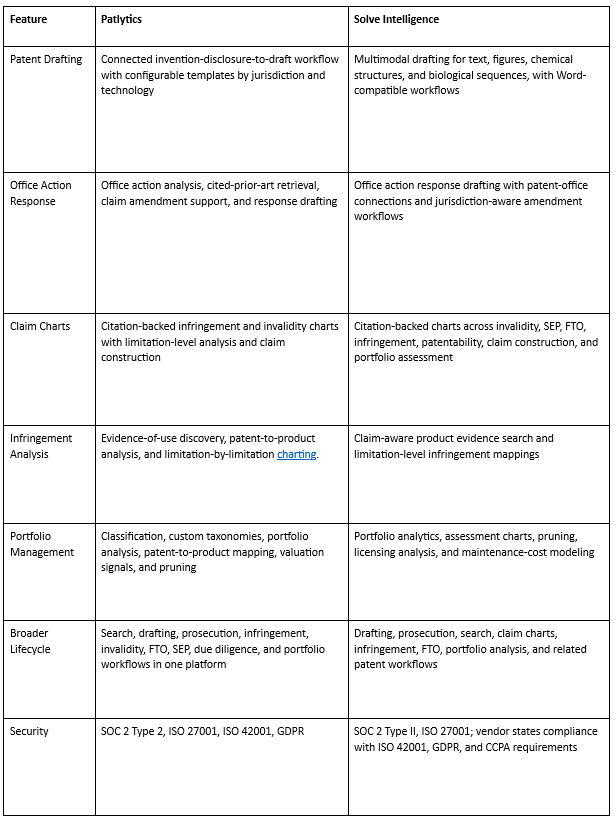
Patlytics vs. Solve Intelligence: An Overview
Both platforms are built specifically for patent professionals rather than adapted from general-purpose software. However, they differ in their primary focus, interaction model, and workflow design. The sections below explain what each tool does, who it is best suited for, and what verified users report.
What Is Patlytics?
Patlytics is an AI platform purpose-built for the full patent lifecycle. It runs from invention disclosure to infringement detection, and from drafting to invalidity analysis, in a single platform rather than a set of point tools. Outputs are citation-backed, and the practitioner reviews and approves every result before it becomes work product.
Best for: Patent teams that want connected workflows across prosecution, litigation analysis, search, and portfolio strategy rather than separate tools for each stage of the patent lifecycle.
Key features of Patlytics:
- Invention Disclosure and Structured Intake: The IDF module turns any type of R&D materials into organized invention disclosure forms ready for patent committee review. You can upload DOCX, PDF, or PPT, or speak your idea, then answer targeted follow-ups.
- AI-Assisted Patent Drafting: Generates structured application drafts from invention disclosures and supporting source materials, with configurable templates for different jurisdictions, technologies, and practitioner workflows.
- Infringement Detection and Evidence of Use (EOU): Crawl for evidence of use across public sources for one patent or hundreds, with citation-backed claim charts built on auto-generated claim construction.
- Invalidity and Prior Art Analysis: Supports novelty, obviousness, and § 112 analysis with patent and non-patent-literature search, qualification analysis, and citation-backed limitation-by-limitation claim charts.
- Freedom to Operate (FTO) and Clearance: Start from your product materials, screen hundreds of relevant patents and applications at once, and pinpoint launch risk before you ship.
- Standard Essential Patent (SEP) Mapping: Produce citation-backed essentiality charts against indexed standards materials across cellular, Wi-Fi, and video and audio coding families.
- Patent and Non-Patent Literature Search: Supports semantic search across patent and non-patent literature and carries relevant results directly into workflows such as invalidity analysis, invention disclosure, and drafting.
- Portfolio Analytics and Pruning: Score each patent by strategic value and classify what to maintain, enforce, license, or drop.
User testimonial: "Patlytics makes patent research faster and more organized. Its AI-powered search features save me time, and the platform provides surprisingly accurate insights that are genuinely helpful for technical analysis." – Emily C., Verified User
What Is Solve Intelligence?
Solve Intelligence describes itself as the AI platform for every part of the patent process, from invention harvesting and drafting to prosecution and claim charts, and reports being trusted by more than 700 IP teams. It centers on an in-browser document editor with full Microsoft Word compatibility.
Best for: Teams that place particular weight on multimodal drafting, patent-office integrations, Word-compatible drafting workflows, and connected prosecution and analysis capabilities.
Key features of Solve Intelligence:
- Multi-Modal Drafting: Generate text, chemical structures, sequence listings, and figures in one platform. Biological sequences export to ST.26.
- Patent Office File-Wrapper Integrations: Automatically download full file wrappers and prosecution histories directly from offices including the USPTO, EPO, DPMA, IP Australia, WIPO, and JPO.
- Jurisdiction-Aware Amendments: Amend claims and specifications, and Solve applies them per jurisdiction requirements in tracked changes or strikethrough-and-underline.
- Cited Claim Charts: Generate any claim chart for any workflow, each with full source-level citations and transparent reasoning. Processing scales to thousands of documents.
- Infringement Detection: Agents identify infringement targets by mapping public product evidence back to claim elements with citations.
- Pruning With Renewal Cost Modeling: Model the expected cost of maintaining each asset against its commercial value, estimating renewal and maintenance fees across jurisdictions.
User testimonial: "Solve does 20+ hours of application drafting work and 5+ hours of office action handling work each in less than 1 hour." – Jonah P., Verified User
Patlytics vs. Solve Intelligence: Feature Comparison
The following sections compare Patlytics and Solve Intelligence across the core workflows patent teams rely on, including drafting, prosecution, claim analysis, infringement work, and portfolio management.
Patent Drafting and Office Action Response
Both platforms place significant emphasis on patent drafting and prosecution, but their approaches differ. Patlytics integrates drafting into a broader end-to-end patent workflow, while Solve Intelligence focuses more heavily on generation depth and direct patent office integrations.
Invention Disclosure and IDF Automation
An invention disclosure form (IDF) captures an invention in structured detail so a patent committee can evaluate it and drafters can build from it. Strong IDF automation reduces blank-page friction and standardizes intake.
Patlytics creates audit-ready, custom IDFs by auditing both external and internal source materials, including images, technical figures, and PPTs. It then structures the claim tree and drafts detailed descriptions. Intake supports uploading DOCX, PDF, or PPT, or speaking the idea, with template-driven fields, submission tracking, and handoff to drafting.
Solve Intelligence takes a distinct approach. It assists inventors and in-house teams in turning inventions into structured, completed disclosures ready for review and conversion to applications. Its AI-enhanced IDFs extract key inventive features, normalize technical terminology, surface gaps, and generate follow-up questions for inventors.
Claim Tree Structuring and Description Generation
Patlytics structures claims and supporting descriptions from source materials while allowing practitioners to configure templates and instructions around jurisdiction, technology, and drafting preferences. The objective is to accelerate preparation of a structured draft while preserving attorney control over claim scope, terminology, and final language.
Solve Intelligence frames the same stage around multi-modal, full-application generation. It turns invention disclosures into high-quality patent applications, generating text, chemical structures, sequence listings, and figures in one platform.
Office Action Response Workflow
Patlytics analyzes examiner rejections, retrieves cited prior art, and helps practitioners develop claim amendments and response arguments within the same workflow. The system automatically fetches cited patent prior art references from a 70M+ database. Attorneys can review the office action, pending claims, cited references, and generated analysis together before editing the response.
Solve Intelligence generates responses to all office actions, letting you amend claims, draft arguments, and report to clients, with reasoning and citations grounded in the law. Its jurisdiction-aware amendments apply in tracked changes or strikethrough-and-underline. That styling supports common USPTO amendment formatting, though neither vendor names a specific amendment regulation.
Claim Chart Automation and Infringement Analysis
Claim charts sit at the heart of infringement, invalidity, and licensing work. Both platforms automate the mapping and cite their sources, which is essential for defensible output.
Evidence Mapping with Citation Support
Patlytics generates citation-backed infringement and invalidity claim charts with limitation-level analysis and editable claim construction. Practitioners can work from evidence surfaced by the platform or incorporate their own source material, then review and revise the resulting mappings.
Solve Intelligence also documents source-level citation functionality across its claim-chart workflows, with reasoning attached to mapped evidence. Its current materials cover invalidity, SEP, FTO, infringement, patentability, claim construction, and portfolio assessment. In either platform, practitioners still need to determine whether the cited source actually supports the corresponding claim limitation.
Evidence of Use at Scale
Patlytics searches publicly available sources for evidence of use across individual patents and larger patent sets, then maps that evidence to claim limitations for practitioner review. These workflows can help teams identify potential infringement and licensing targets before performing deeper legal analysis.
Solve Intelligence 運用「權利要求感知搜尋」(claim-aware search)來識別產品證據,並透過引用來源將公開資訊連結回權利要求項。其發布的侵權工作流程旨在為從業人員提供審查起點,而非取代侵權判斷。
專利與產品比對
Patlytics 建立專利與產品的比對映射,協助團隊評估特定產品或技術是否實施了權利要求中的限制條件。該平台會搜尋公開的技術資料,並將引用的證據連結至逐項限制條件的分析中。這些映射能協助從業人員針對侵權、執行、授權或組合審查等需求,排定專利的優先順序。
Solve Intelligence 透過權利要求感知搜尋與侵權映射來處理此工作流程。其發布的工作流程會將權利要求項與產品文件、技術規格及其他公開證據進行比對,並提供引用來源以支持產出的映射結果。
組合管理是這兩個平台最顯著的差異之一。Patlytics 具備專門的分類與分類法功能,而 Solve Intelligence 則更側重於組合評分、評估與精簡。
基於分類法的自動標籤
Patlytics 提供一鍵式分類功能,可納入自訂的分類體系。其 專利庫 + 分類 功能讓您能選取專利、設定分類器數量、選擇性地包含或排除特定術語,並審查 AI 根據權利要求與說明書所建議的類別。您可以匯入自有的受控詞彙分類體系,一次分類多達 75 項專利,並立即透過套用的標籤進行篩選。
Solve Intelligence 雖有提供組合分析、分群、儀表板、組合評估與精簡等功能,但目前的公開資料中並未描述類似 Patlytics「自動分類精靈」(Auto-Classify Wizard)那種可匯入自有分類體系的工作流程。
對於依賴結構化內部分類體系來組織大型專利組合,並將分類應用於後續工作的團隊而言,這是在產品試用期間值得評估的工作流程差異。
組合評估與精簡
Patlytics 提供組合層級的評分與精簡工作流程,旨在協助團隊針對維護、授權、執行或進一步審查的資產進行優先排序。其目前的專利精簡資料描述了基於跨領域侵權可能性等因素的策略價值評分。
Solve Intelligence 同樣提供組合評估與精簡功能。其目前的資料描述了基於權利要求強度、商業相關性、競爭覆蓋範圍及維護成本(包含各司法管轄區的續展與維護費模型)等訊號的評分機制。
這些評分應作為輔助,而非取代從業人員與商業決策。關於維持、放棄、授權或執行專利的決策,取決於自動化評分之外的更多因素。
競爭格局分析
Patlytics 透過將專利與競爭對手的申請案、技術群組及權利要求邊界進行基準對比,支援大規模的競爭組合分析。其代理程式可執行空白分析(whitespace analysis),以識別創新缺口、競爭對手重疊處、授權或執行機會,以及可作為精簡對象的低價值資產。
Solve Intelligence 透過圖表與精簡工具提供組合洞察,利用價值與風險訊號對資產進行排名。其權利要求圖表也能透過將權利要求項與技術標準進行映射,來評估專利的必要性。
安全認證與資料隱私保護
專利工作經常涉及機密發明、未公開申請案、審查策略及商業敏感的技術資訊。因此,安全性應被視為工作流程的一部分進行評估,而非僅是採購流程中的次要檢查項目。
- Patlytics: 具備 SOC 2 Type 2、ISO 27001 及 ISO 42001 認證,並符合 GDPR 規範。Patlytics 表示客戶資料皆採隔離儲存,且在靜態與傳輸過程中均經過加密,絕不用於訓練或微調模型。
- Solve Intelligence: 具備 SOC 2 Type II 及 ISO 27001 認證。Solve 目前表示其符合 ISO 42001、GDPR 及 CCPA 要求,並在傳輸過程中採用 TLS 1.3 加密,靜態資料則使用 AES-256 加密。
Solve Intelligence 同時記錄了與 AI 提供商的零資料保留協議,並根據客戶選擇,由位於美國或歐盟的次處理器進行處理。評估這兩個平台的團隊,應針對自身環境審閱相關的安全文件、次處理器、資料保留條款、存取控制及合約保障措施。
AI 可以加速基礎工作,但最終決策仍由律師做出。從業人員仍需驗證所引用的證據、評估生成的分析結果,並判斷產出的工作成果是否足以支持法律立場。
定價與授權考量
兩家廠商皆未在官網公開定價。Patlytics 採用客製化的示範導向定價模式,未提供公開的方案等級或訂閱費率。Solve Intelligence 採取類似做法,提供客製化定價及專屬的企業方案。
實際上,定價通常取決於使用者人數、工作流程範圍、系統整合及企業安全需求等因素。由於兩家廠商皆未公開定價,建議您預約範圍明確的產品示範,並提供預期的使用量與工作流程,以取得符合團隊需求的報價。
Patlytics 與 Solve Intelligence:關鍵評估差異
兩個平台皆支援實質的專利工作流程,但在廣度、產品設計與側重點上有所不同。評估時應針對團隊最常執行的工作進行比較,而非單純比較功能數量。
Patlytics 專為重視以下項目的團隊設計:
- 串聯式專利生命週期工作流程: 從發明揭露與撰寫,無縫銜接到審查、侵權、無效性、FTO(自由實施)、SEP(標準必要專利)及組合分析,無需在不同系統間重複建立背景資訊。
- 結構化組合分類: 運用 AI 生成或內部分類法來組織資產,並將這些分類應用於後續的分析工作中。
- 具備引用佐證的訴訟與分析工作流程: 在侵權與無效性案件中,審閱限制條件層級的證據、請求項解釋及生成的對照表。
- ISO 42001 認證: 選擇同時具備 ISO 42001 認證,以及 SOC 2 Type 2 與 ISO 27001 認證的平台。
- 高容量專利組合分析: 分析並優先處理大型專利組合,以利於侵權、授權、盡職調查或精簡工作流程。
Solve Intelligence 強調:
- 多模態撰寫: 運用文字、圖表、化學結構、CAD 相關輸入及生物序列工作流程進行撰寫。
- 專利局連結: 透過與多個專利局的整合,將審查資訊匯入工作流程。
- 相容於 Word 的撰寫功能: 透過專為 Microsoft Word 相容性設計的流程,完成撰寫與審查作業。
- 廣泛的權利要求對照表工作流程: 針對無效性、標準必要專利 (SEP)、自由實施 (FTO)、侵權、可專利性、權利要求解釋及組合評估,生成附帶引證的對照表。
- 專利組合精簡與成本建模: 結合商業與權利要求相關訊號,評估資產價值,並計算預期的續展與維護成本。
選擇適合您專利工作流程的平台
Patlytics 與 Solve Intelligence 的主要區別在於其工作流程在整個專利生命週期中的組織方式。
Patlytics 旨在將發明揭露、撰寫、審查、侵權、無效性、FTO、SEP 及組合分析等工作整合於單一平台。對於希望將研究、來源證據、撰寫、訴訟分析及組合情報保持連結,而非在各個單點解決方案間重複作業的團隊而言,這顯得尤為重要。
Solve Intelligence 同樣涵蓋多項專利工作流程,其目前的產品資料強調多模態撰寫、審查與專利局整合、附帶來源引證的權利要求對照表、侵權分析及組合評估。
正確的評估應使用您自身業務中的代表性案例。請比較來源證據的品質、從業人員所需的編輯量、工作在不同流程間轉換的流暢度,以及各平台是否符合您的安全性與整合需求。
預約演示 以了解 Patlytics 如何透過內建於流程中的引證支援分析與從業人員審閱功能,為專利工作流程提供端到端的支援。
Patlytics 與 Solve Intelligence 常見問題解答
哪款 AI 工具最適合進行專利檢索?
選擇合適的專利檢索平台,取決於檢索後的應用需求。Patlytics 將專利與非專利文獻檢索,與後續工作流程(包括無效分析、權利要求對照表製作、撰寫及盡職調查)相結合。根據其目前的平台資料,該平台涵蓋超過 1.3 億項專利,以及各類工作流程中數以億計的文獻記錄。
檢索覆蓋範圍並非決定研究品質的唯一因素。從業人員還應評估相關性、來源可追溯性、篩選控制機制,以及能否輕鬆將識別出的參考文獻應用於實質分析中。
AI 專利平台能處理國際先前技術檢索嗎?
可以。專利專用的 AI 平台能夠跨司法管轄區檢索專利與非專利文獻,協助從業人員找出潛在的相關參考文獻。Patlytics 將全球專利與非專利文獻(NPL)檢索整合至專利性分析與無效分析等工作流程中。
覆蓋範圍並不能取代專業的檢索判斷。在依賴檢索結果前,從業人員應確認司法管轄區覆蓋範圍、資料時效性、專利家族處理、翻譯品質,以及所檢索參考文獻的完整性與相關性。
企業級 AI 專利平台的典型導入時程為何?
AI 專利平台的導入時程會因使用者人數、工作流程範圍、安全性審查及整合需求而異。由於供應商通常採用客製化導入方式,最可靠的評估建議透過針對貴團隊環境與工作流程的詳細討論來取得。
Patlytics 與 Solve Intelligence 專利分析比較(2026 年版)
Lawyers report saving up to 32.5 working days per year by using generative AI for legal tasks, equivalent to more than six weeks of time that can be redirected toward higher-value strategic work. However, those efficiency gains depend heavily on the AI tools integrated into legal workflows.
Patlytics and Solve Intelligence are both purpose-built for patent work, but they differ in workflow breadth, product design, and how their capabilities connect across the patent lifecycle.
This Patlytics vs. Solve Intelligence comparison examines drafting, prosecution, claim charts, infringement analysis, and portfolio workflows. It also looks at security and workflow design so patent professionals can evaluate which platform better matches the work their teams actually handle.
Key Takeaways
- Patlytics offers an end-to-end patent AI platform covering invention disclosure, drafting, prosecution, claim charts, invalidity, freedom-to-operate (FTO), standard-essential patents (SEP), and portfolio management.
- Solve Intelligence is more focused on patent drafting and prosecution, with multimodal generation and direct integrations with patent office file wrappers.
- Both platforms are SOC 2 Type 2 and ISO 27001 certified. Patlytics is also ISO 42001 certified, while Solve Intelligence lists ISO 42001 certification as in progress.
- Patlytics documents dedicated portfolio classification and automated taxonomy tagging capabilities. Solve Intelligence supports portfolio analysis through pruning and claim-chart assessment.
- The right choice depends on your team’s specific patent use cases, workflow requirements, and broader legal needs.
Patlytics vs. Solve Intelligence: Quick Comparison
Patent AI platforms increasingly overlap in functionality, so feature labels alone do not tell practitioners much about workflow fit. The more useful comparison is how each platform carries source material into work that attorneys can inspect, revise, and use in downstream patent matters.
The table below compares each platform across seven core patent workflows. Every claim in this article is based on the vendors’ official websites and documentation, along with verified third-party G2 pages. Where a capability is not documented, we say so rather than assume feature parity.
This distinction matters because AI-generated output still requires human review. These tools can accelerate patent analysis and drafting, but attorneys remain responsible for confidentiality, accuracy, and the final legal position.
Patlytics vs. Solve Intelligence: An Overview
Both platforms are built specifically for patent professionals rather than adapted from general-purpose software. However, they differ in their primary focus, interaction model, and workflow design. The sections below explain what each tool does, who it is best suited for, and what verified users report.
What Is Patlytics?
Patlytics is an AI platform purpose-built for the full patent lifecycle. It runs from invention disclosure to infringement detection, and from drafting to invalidity analysis, in a single platform rather than a set of point tools. Outputs are citation-backed, and the practitioner reviews and approves every result before it becomes work product.
Best for: Patent teams that want connected workflows across prosecution, litigation analysis, search, and portfolio strategy rather than separate tools for each stage of the patent lifecycle.
Key features of Patlytics:
- Invention Disclosure and Structured Intake: The IDF module turns any type of R&D materials into organized invention disclosure forms ready for patent committee review. You can upload DOCX, PDF, or PPT, or speak your idea, then answer targeted follow-ups.
- AI-Assisted Patent Drafting: Generates structured application drafts from invention disclosures and supporting source materials, with configurable templates for different jurisdictions, technologies, and practitioner workflows.
- Infringement Detection and Evidence of Use (EOU): Crawl for evidence of use across public sources for one patent or hundreds, with citation-backed claim charts built on auto-generated claim construction.
- Invalidity and Prior Art Analysis: Supports novelty, obviousness, and § 112 analysis with patent and non-patent-literature search, qualification analysis, and citation-backed limitation-by-limitation claim charts.
- Freedom to Operate (FTO) and Clearance: Start from your product materials, screen hundreds of relevant patents and applications at once, and pinpoint launch risk before you ship.
- Standard Essential Patent (SEP) Mapping: Produce citation-backed essentiality charts against indexed standards materials across cellular, Wi-Fi, and video and audio coding families.
- Patent and Non-Patent Literature Search: Supports semantic search across patent and non-patent literature and carries relevant results directly into workflows such as invalidity analysis, invention disclosure, and drafting.
- Portfolio Analytics and Pruning: Score each patent by strategic value and classify what to maintain, enforce, license, or drop.
User testimonial: "Patlytics makes patent research faster and more organized. Its AI-powered search features save me time, and the platform provides surprisingly accurate insights that are genuinely helpful for technical analysis." – Emily C., Verified User
What Is Solve Intelligence?
Solve Intelligence describes itself as the AI platform for every part of the patent process, from invention harvesting and drafting to prosecution and claim charts, and reports being trusted by more than 700 IP teams. It centers on an in-browser document editor with full Microsoft Word compatibility.
Best for: Teams that place particular weight on multimodal drafting, patent-office integrations, Word-compatible drafting workflows, and connected prosecution and analysis capabilities.
Key features of Solve Intelligence:
- Multi-Modal Drafting: Generate text, chemical structures, sequence listings, and figures in one platform. Biological sequences export to ST.26.
- Patent Office File-Wrapper Integrations: Automatically download full file wrappers and prosecution histories directly from offices including the USPTO, EPO, DPMA, IP Australia, WIPO, and JPO.
- Jurisdiction-Aware Amendments: Amend claims and specifications, and Solve applies them per jurisdiction requirements in tracked changes or strikethrough-and-underline.
- Cited Claim Charts: Generate any claim chart for any workflow, each with full source-level citations and transparent reasoning. Processing scales to thousands of documents.
- Infringement Detection: Agents identify infringement targets by mapping public product evidence back to claim elements with citations.
- Pruning With Renewal Cost Modeling: Model the expected cost of maintaining each asset against its commercial value, estimating renewal and maintenance fees across jurisdictions.
User testimonial: "Solve does 20+ hours of application drafting work and 5+ hours of office action handling work each in less than 1 hour." – Jonah P., Verified User
Patlytics vs. Solve Intelligence: Feature Comparison
The following sections compare Patlytics and Solve Intelligence across the core workflows patent teams rely on, including drafting, prosecution, claim analysis, infringement work, and portfolio management.
Patent Drafting and Office Action Response
Both platforms place significant emphasis on patent drafting and prosecution, but their approaches differ. Patlytics integrates drafting into a broader end-to-end patent workflow, while Solve Intelligence focuses more heavily on generation depth and direct patent office integrations.
Invention Disclosure and IDF Automation
An invention disclosure form (IDF) captures an invention in structured detail so a patent committee can evaluate it and drafters can build from it. Strong IDF automation reduces blank-page friction and standardizes intake.
Patlytics creates audit-ready, custom IDFs by auditing both external and internal source materials, including images, technical figures, and PPTs. It then structures the claim tree and drafts detailed descriptions. Intake supports uploading DOCX, PDF, or PPT, or speaking the idea, with template-driven fields, submission tracking, and handoff to drafting.
Solve Intelligence takes a distinct approach. It assists inventors and in-house teams in turning inventions into structured, completed disclosures ready for review and conversion to applications. Its AI-enhanced IDFs extract key inventive features, normalize technical terminology, surface gaps, and generate follow-up questions for inventors.
Claim Tree Structuring and Description Generation
Patlytics structures claims and supporting descriptions from source materials while allowing practitioners to configure templates and instructions around jurisdiction, technology, and drafting preferences. The objective is to accelerate preparation of a structured draft while preserving attorney control over claim scope, terminology, and final language.
Solve Intelligence frames the same stage around multi-modal, full-application generation. It turns invention disclosures into high-quality patent applications, generating text, chemical structures, sequence listings, and figures in one platform.
Office Action Response Workflow
Patlytics analyzes examiner rejections, retrieves cited prior art, and helps practitioners develop claim amendments and response arguments within the same workflow. The system automatically fetches cited patent prior art references from a 70M+ database. Attorneys can review the office action, pending claims, cited references, and generated analysis together before editing the response.
Solve Intelligence generates responses to all office actions, letting you amend claims, draft arguments, and report to clients, with reasoning and citations grounded in the law. Its jurisdiction-aware amendments apply in tracked changes or strikethrough-and-underline. That styling supports common USPTO amendment formatting, though neither vendor names a specific amendment regulation.
Claim Chart Automation and Infringement Analysis
Claim charts sit at the heart of infringement, invalidity, and licensing work. Both platforms automate the mapping and cite their sources, which is essential for defensible output.
Evidence Mapping with Citation Support
Patlytics generates citation-backed infringement and invalidity claim charts with limitation-level analysis and editable claim construction. Practitioners can work from evidence surfaced by the platform or incorporate their own source material, then review and revise the resulting mappings.
Solve Intelligence also documents source-level citation functionality across its claim-chart workflows, with reasoning attached to mapped evidence. Its current materials cover invalidity, SEP, FTO, infringement, patentability, claim construction, and portfolio assessment. In either platform, practitioners still need to determine whether the cited source actually supports the corresponding claim limitation.
Evidence of Use at Scale
Patlytics searches publicly available sources for evidence of use across individual patents and larger patent sets, then maps that evidence to claim limitations for practitioner review. These workflows can help teams identify potential infringement and licensing targets before performing deeper legal analysis.
Solve Intelligence 運用「權利要求感知搜尋」(claim-aware search)來識別產品證據,並透過引用來源將公開資訊連結回權利要求項。其發布的侵權工作流程旨在為從業人員提供審查起點,而非取代侵權判斷。
專利與產品比對
Patlytics 建立專利與產品的比對映射,協助團隊評估特定產品或技術是否實施了權利要求中的限制條件。該平台會搜尋公開的技術資料,並將引用的證據連結至逐項限制條件的分析中。這些映射能協助從業人員針對侵權、執行、授權或組合審查等需求,排定專利的優先順序。
Solve Intelligence 透過權利要求感知搜尋與侵權映射來處理此工作流程。其發布的工作流程會將權利要求項與產品文件、技術規格及其他公開證據進行比對,並提供引用來源以支持產出的映射結果。
組合管理是這兩個平台最顯著的差異之一。Patlytics 具備專門的分類與分類法功能,而 Solve Intelligence 則更側重於組合評分、評估與精簡。
基於分類法的自動標籤
Patlytics 提供一鍵式分類功能,可納入自訂的分類體系。其 專利庫 + 分類 功能讓您能選取專利、設定分類器數量、選擇性地包含或排除特定術語,並審查 AI 根據權利要求與說明書所建議的類別。您可以匯入自有的受控詞彙分類體系,一次分類多達 75 項專利,並立即透過套用的標籤進行篩選。
Solve Intelligence 雖有提供組合分析、分群、儀表板、組合評估與精簡等功能,但目前的公開資料中並未描述類似 Patlytics「自動分類精靈」(Auto-Classify Wizard)那種可匯入自有分類體系的工作流程。
對於依賴結構化內部分類體系來組織大型專利組合,並將分類應用於後續工作的團隊而言,這是在產品試用期間值得評估的工作流程差異。
組合評估與精簡
Patlytics 提供組合層級的評分與精簡工作流程,旨在協助團隊針對維護、授權、執行或進一步審查的資產進行優先排序。其目前的專利精簡資料描述了基於跨領域侵權可能性等因素的策略價值評分。
Solve Intelligence 同樣提供組合評估與精簡功能。其目前的資料描述了基於權利要求強度、商業相關性、競爭覆蓋範圍及維護成本(包含各司法管轄區的續展與維護費模型)等訊號的評分機制。
這些評分應作為輔助,而非取代從業人員與商業決策。關於維持、放棄、授權或執行專利的決策,取決於自動化評分之外的更多因素。
競爭格局分析
Patlytics 透過將專利與競爭對手的申請案、技術群組及權利要求邊界進行基準對比,支援大規模的競爭組合分析。其代理程式可執行空白分析(whitespace analysis),以識別創新缺口、競爭對手重疊處、授權或執行機會,以及可作為精簡對象的低價值資產。
Solve Intelligence 透過圖表與精簡工具提供組合洞察,利用價值與風險訊號對資產進行排名。其權利要求圖表也能透過將權利要求項與技術標準進行映射,來評估專利的必要性。
安全認證與資料隱私保護
專利工作經常涉及機密發明、未公開申請案、審查策略及商業敏感的技術資訊。因此,安全性應被視為工作流程的一部分進行評估,而非僅是採購流程中的次要檢查項目。
- Patlytics: 具備 SOC 2 Type 2、ISO 27001 及 ISO 42001 認證,並符合 GDPR 規範。Patlytics 表示客戶資料皆採隔離儲存,且在靜態與傳輸過程中均經過加密,絕不用於訓練或微調模型。
- Solve Intelligence: 具備 SOC 2 Type II 及 ISO 27001 認證。Solve 目前表示其符合 ISO 42001、GDPR 及 CCPA 要求,並在傳輸過程中採用 TLS 1.3 加密,靜態資料則使用 AES-256 加密。
Solve Intelligence 同時記錄了與 AI 提供商的零資料保留協議,並根據客戶選擇,由位於美國或歐盟的次處理器進行處理。評估這兩個平台的團隊,應針對自身環境審閱相關的安全文件、次處理器、資料保留條款、存取控制及合約保障措施。
AI 可以加速基礎工作,但最終決策仍由律師做出。從業人員仍需驗證所引用的證據、評估生成的分析結果,並判斷產出的工作成果是否足以支持法律立場。
定價與授權考量
兩家廠商皆未在官網公開定價。Patlytics 採用客製化的示範導向定價模式,未提供公開的方案等級或訂閱費率。Solve Intelligence 採取類似做法,提供客製化定價及專屬的企業方案。
實際上,定價通常取決於使用者人數、工作流程範圍、系統整合及企業安全需求等因素。由於兩家廠商皆未公開定價,建議您預約範圍明確的產品示範,並提供預期的使用量與工作流程,以取得符合團隊需求的報價。
Patlytics 與 Solve Intelligence:關鍵評估差異
兩個平台皆支援實質的專利工作流程,但在廣度、產品設計與側重點上有所不同。評估時應針對團隊最常執行的工作進行比較,而非單純比較功能數量。
Patlytics 專為重視以下項目的團隊設計:
- 串聯式專利生命週期工作流程: 從發明揭露與撰寫,無縫銜接到審查、侵權、無效性、FTO(自由實施)、SEP(標準必要專利)及組合分析,無需在不同系統間重複建立背景資訊。
- 結構化組合分類: 運用 AI 生成或內部分類法來組織資產,並將這些分類應用於後續的分析工作中。
- 具備引用佐證的訴訟與分析工作流程: 在侵權與無效性案件中,審閱限制條件層級的證據、請求項解釋及生成的對照表。
- ISO 42001 認證: 選擇同時具備 ISO 42001 認證,以及 SOC 2 Type 2 與 ISO 27001 認證的平台。
- 高容量專利組合分析: 分析並優先處理大型專利組合,以利於侵權、授權、盡職調查或精簡工作流程。
Solve Intelligence 強調:
- 多模態撰寫: 運用文字、圖表、化學結構、CAD 相關輸入及生物序列工作流程進行撰寫。
- 專利局連結: 透過與多個專利局的整合,將審查資訊匯入工作流程。
- 相容於 Word 的撰寫功能: 透過專為 Microsoft Word 相容性設計的流程,完成撰寫與審查作業。
- 廣泛的權利要求對照表工作流程: 針對無效性、標準必要專利 (SEP)、自由實施 (FTO)、侵權、可專利性、權利要求解釋及組合評估,生成附帶引證的對照表。
- 專利組合精簡與成本建模: 結合商業與權利要求相關訊號,評估資產價值,並計算預期的續展與維護成本。
選擇適合您專利工作流程的平台
Patlytics 與 Solve Intelligence 的主要區別在於其工作流程在整個專利生命週期中的組織方式。
Patlytics 旨在將發明揭露、撰寫、審查、侵權、無效性、FTO、SEP 及組合分析等工作整合於單一平台。對於希望將研究、來源證據、撰寫、訴訟分析及組合情報保持連結,而非在各個單點解決方案間重複作業的團隊而言,這顯得尤為重要。
Solve Intelligence 同樣涵蓋多項專利工作流程,其目前的產品資料強調多模態撰寫、審查與專利局整合、附帶來源引證的權利要求對照表、侵權分析及組合評估。
正確的評估應使用您自身業務中的代表性案例。請比較來源證據的品質、從業人員所需的編輯量、工作在不同流程間轉換的流暢度,以及各平台是否符合您的安全性與整合需求。
預約演示 以了解 Patlytics 如何透過內建於流程中的引證支援分析與從業人員審閱功能,為專利工作流程提供端到端的支援。
Patlytics 與 Solve Intelligence 常見問題解答
哪款 AI 工具最適合進行專利檢索?
選擇合適的專利檢索平台,取決於檢索後的應用需求。Patlytics 將專利與非專利文獻檢索,與後續工作流程(包括無效分析、權利要求對照表製作、撰寫及盡職調查)相結合。根據其目前的平台資料,該平台涵蓋超過 1.3 億項專利,以及各類工作流程中數以億計的文獻記錄。
檢索覆蓋範圍並非決定研究品質的唯一因素。從業人員還應評估相關性、來源可追溯性、篩選控制機制,以及能否輕鬆將識別出的參考文獻應用於實質分析中。
AI 專利平台能處理國際先前技術檢索嗎?
可以。專利專用的 AI 平台能夠跨司法管轄區檢索專利與非專利文獻,協助從業人員找出潛在的相關參考文獻。Patlytics 將全球專利與非專利文獻(NPL)檢索整合至專利性分析與無效分析等工作流程中。
覆蓋範圍並不能取代專業的檢索判斷。在依賴檢索結果前,從業人員應確認司法管轄區覆蓋範圍、資料時效性、專利家族處理、翻譯品質,以及所檢索參考文獻的完整性與相關性。
企業級 AI 專利平台的典型導入時程為何?
AI 專利平台的導入時程會因使用者人數、工作流程範圍、安全性審查及整合需求而異。由於供應商通常採用客製化導入方式,最可靠的評估建議透過針對貴團隊環境與工作流程的詳細討論來取得。
頂尖 AI 驅動的
專利平台
縮短週期時間。提高利潤率。實現卓越的智慧財產權成果。