Security by design: how Patlytics protects sensitive IP data
January 23, 2026
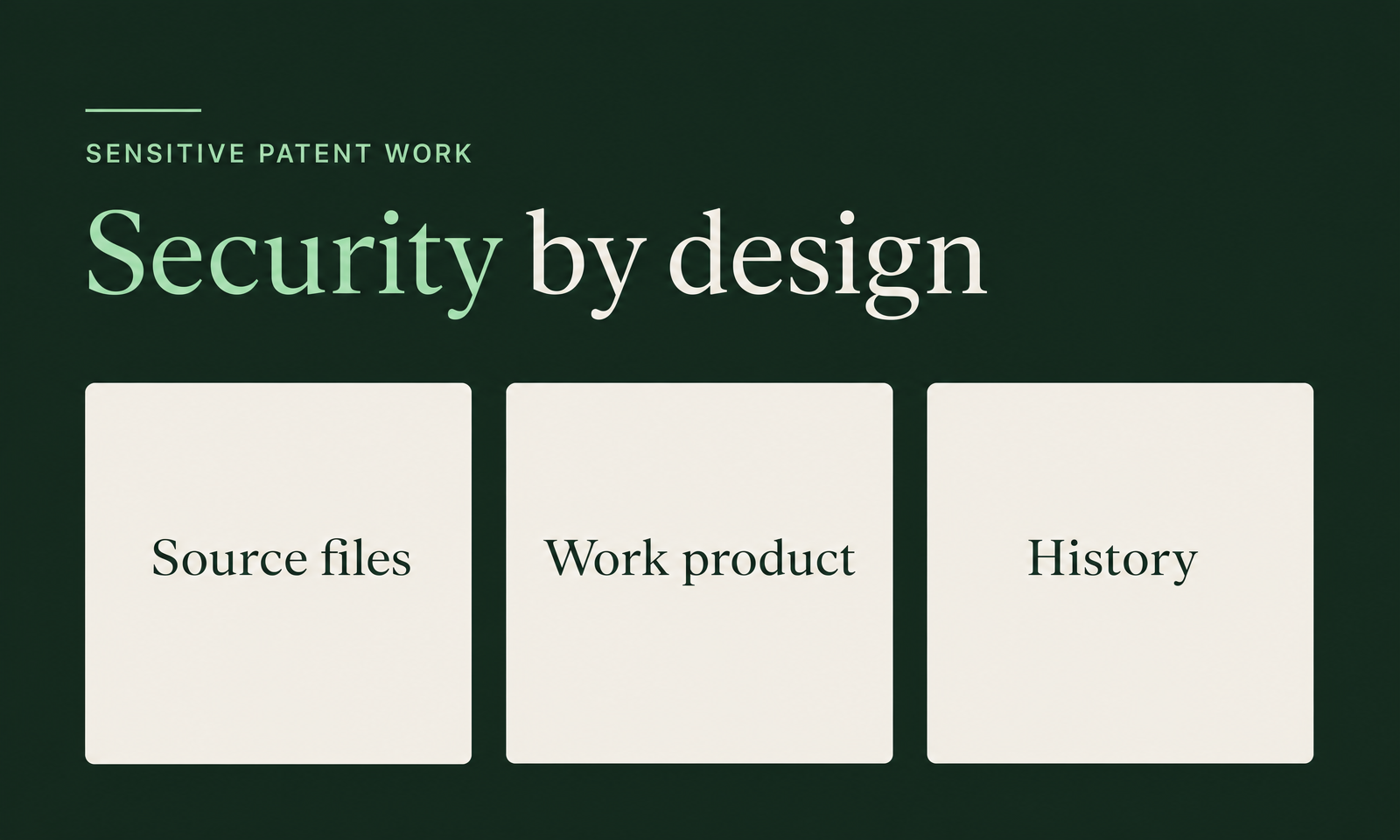
How should your team protect an unfiled design, prosecution strategy, or confidential product roadmap when patent work moves through an artificial intelligence (AI)-assisted workflow? Even public patent material can become sensitive when combined with internal instructions and analysis.
For patent practitioners and enterprise intellectual property (IP) teams, security needs to follow the work from source material to reviewed output. Mapping the data categories, safeguards, and supporting evidence helps you define what can enter the workflow and make a deployment decision.
Scope: Data handling for AI-assisted patent work. Attorneys retain review and decision authority over generated drafts and analysis.
Why security matters in patent workflows
Sensitive patent work extends beyond unpublished applications. It can include:
- Invention disclosures and drawings: technical details that the inventor has shared for assessment and drafting.
- Research and development (R&D) plans: product specifications, experimental results, and future design choices.
- Litigation and enforcement planning: claim mappings, evidence assessments, and proposed arguments.
- Third-party materials: information received under client, supplier, or collaboration obligations.
A published patent may be public while the analysis around it remains sensitive. Combining that patent with an internal product description creates a different information set. The same distinction applies when a public office action is paired with a proposed amendment or response strategy.
Define the information boundary around the inputs, instructions supplied to AI, and resulting work product. Identify the obligations attached to each category before including it in the production workflow. Permitted content follows the applicable customer agreement and content restrictions.
Map data protection to the work
Encryption, segregation, access, and retention address different questions. Connect each safeguard to the source material, working instructions, and output in your proposed workflow.
Encryption in transit and at rest
In transit refers to data moving between systems. At rest refers to stored data. Transport protection and storage protection address separate stages as your team moves from a technical source file to a working draft.
Map where each data category moves and where it is stored. Match the encryption description and its scope to those stages, keeping any file-specific algorithm claim attached to the files it covers.
Organization boundaries and least privilege
Segregation addresses the boundary between organizations' data. Least privilege addresses limiting access to what a role or task requires. For a law firm, these boundaries matter to client work. For an in-house team, they matter to invention records, technical materials, and analysis shared by the patent function.
Organization-level segregation and matter-sharing decisions address different boundaries. Record who needs the underlying technical material and who needs only the approved work product. Map those needs to the documented access arrangements.
Retention and deletion by data category
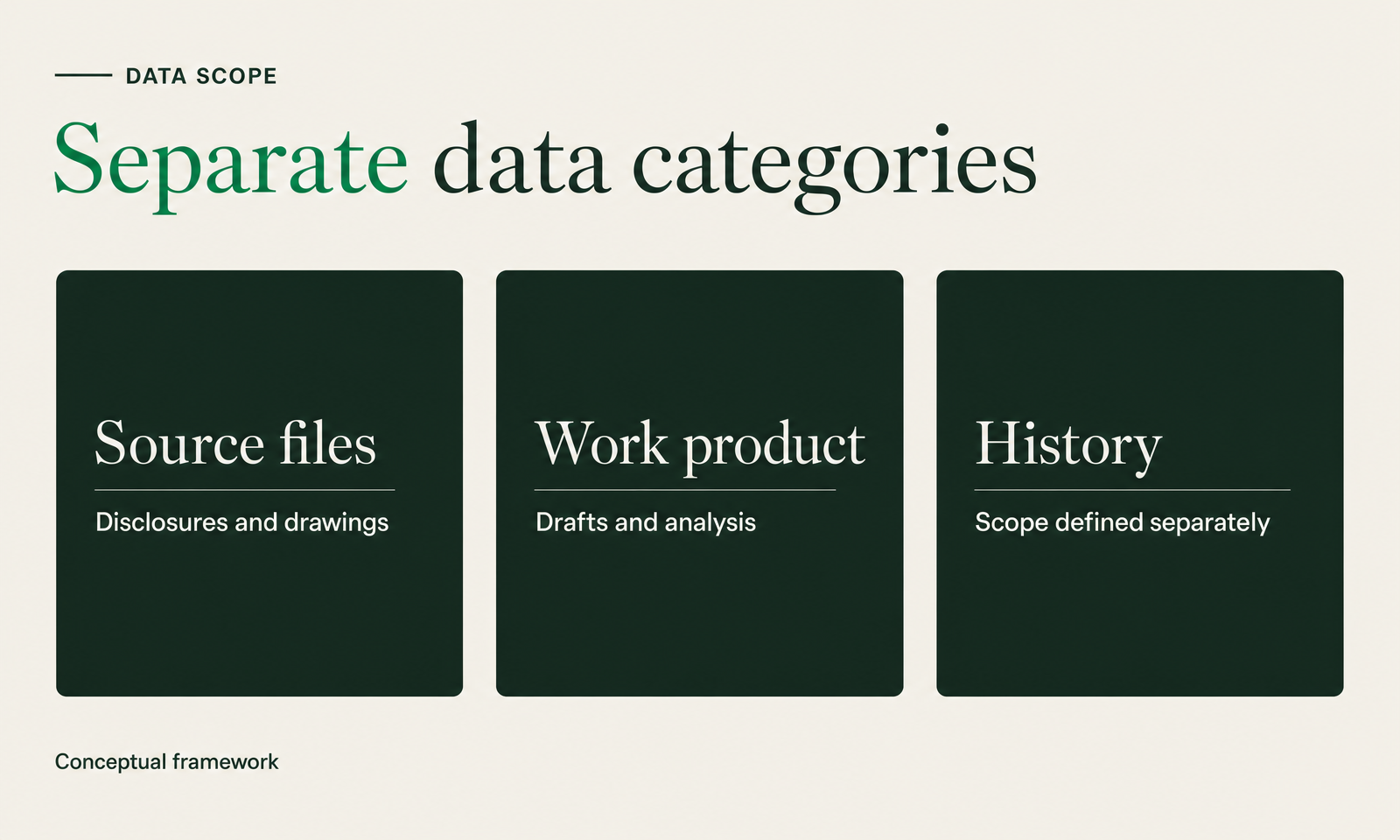
Patent source files, generated drafts, and history should remain distinct in a retention decision. A filing record may need to be kept under the team's matter-retention policy, while a working history has a different purpose.
Request the actual contractual retention and deletion commitments for each data category. Record the applicable retention period, deletion process, and any exceptions alongside the team's matter-retention requirements. Keep customer-content terms, including processing-location commitments, separate from website and account privacy disclosures.
Connect security evidence to the deployment
Public control descriptions state how a provider describes its safeguards. Examination reports and certificates provide independent assurance within their documented scope. Use both in the deployment review, keeping public descriptions separate from independently verified coverage.
Connect the described safeguards to the proposed data flow. Review the covered system, examination period, control results, and certificate scope in the supporting documents. Record how that evidence relates to the planned data categories and the applicable customer agreement.
Continuity around prosecution deadlines
Monitoring concerns operational visibility. On-call coverage concerns the people available to respond through the operational process. Review that coverage alongside the team's continuity plan.
For work approaching a response deadline, identify the approved matter record, deadline owner, and filing process. Document how the team will access the required materials and proceed if the platform is interrupted. Keep any contractual availability or incident-response commitments attached to the terms that define them.
A fictional enterprise rollout
Fictional example: An in-house IP team plans to introduce AI assistance for office-action analysis before considering patent drafting. Its immediate need is to prepare reviewable rejection analysis while keeping the rollout aligned with the prosecution calendar.
The team starts its demonstration with public or fictional materials. It defines the proposed production inputs, separates source files and work product from history, and records the permitted content categories in its deployment plan. Contractual content restrictions and customer-data arrangements set the boundary for any later use of matter material.
The deployment plan names the IP lead as workflow owner and documents the approval path. The security lead maps the data categories to the control descriptions and assurance scope. Before accepting the pilot result, compare the analysis against the office action, pending claims, specification, and cited references, then record the selected response strategy and required corrections.
The rollout budget accounts for implementation and review effort. The pilot measures elapsed time to a usable rejection analysis, including corrections. Its sequence follows the prosecution tasks the team needs first. These choices keep cost, speed, and roadmap alignment tied to a defined patent outcome.
Where Patlytics fits
Patlytics is built for patent-specific drafting and analysis in connected workflows. Attorneys retain review and decision authority over the generated work product and its use in subsequent patent tasks.
Patent Drafting supports the path from technical source materials to claim structures and application drafts. Review technical support, claim language, and consistency before using the draft in filing preparation. Office Actions supports analysis of examiner rejections using the office action, pending claims, specification, and cited prior art to inform arguments, amendments, and response strategy.
Data safeguards and content terms
Patlytics' public security overview describes encryption in transit and at rest, customer-data segregation per organization, and least-privilege access. My Drive is the platform's secure input layer and storage purpose-built for IP professionals. My Drive files use AES-256, a form of Advanced Encryption Standard encryption.
Patlytics does not use customer data to tune or train its models without explicit consent or necessity.
Patlytics' public description states that user history is stored for 90 days and can be deleted. That retention description covers user history; source files and generated work product remain separate categories in the contractual retention review.
Patlytics' public content restrictions exclude personally identifiable information and content subject to heightened security requirements by law, regulation, or contract. Its privacy policy places content processed on behalf of business customers under customer agreements. Those agreements govern customer-content handling for the deployment.
Patlytics describes 24/7 system monitoring and rotating on-call support in North America and Asia-Pacific.
What your security team can review
The Patlytics Trust Center brings together security resources:
- System and Organization Controls (SOC) 2 Type II report access: an access-request path for review of the covered system, examination period, and control results.
- International Organization for Standardization (ISO) 27001 and ISO 42001 certificates: both certificates are listed, with access available through the request process.
- Security overview: the Trust Center lists a security overview document alongside the public overview.
Patlytics has a SOC 2 Type II attestation and ISO 27001 and ISO 42001 certifications, which address control operating effectiveness over a defined period, information security management, and AI management, respectively; the SOC 2 evidence guide explains how these distinct forms of assurance connect to report and certificate scope.
Walk through Patlytics' security controls and Trust Center with your security team. Book a demo focused on your patent-data security and enterprise deployment requirements.
Security by design: how Patlytics protects sensitive IP data
How should your team protect an unfiled design, prosecution strategy, or confidential product roadmap when patent work moves through an artificial intelligence (AI)-assisted workflow? Even public patent material can become sensitive when combined with internal instructions and analysis.
For patent practitioners and enterprise intellectual property (IP) teams, security needs to follow the work from source material to reviewed output. Mapping the data categories, safeguards, and supporting evidence helps you define what can enter the workflow and make a deployment decision.
Scope: Data handling for AI-assisted patent work. Attorneys retain review and decision authority over generated drafts and analysis.
Why security matters in patent workflows
Sensitive patent work extends beyond unpublished applications. It can include:
- Invention disclosures and drawings: technical details that the inventor has shared for assessment and drafting.
- Research and development (R&D) plans: product specifications, experimental results, and future design choices.
- Litigation and enforcement planning: claim mappings, evidence assessments, and proposed arguments.
- Third-party materials: information received under client, supplier, or collaboration obligations.
A published patent may be public while the analysis around it remains sensitive. Combining that patent with an internal product description creates a different information set. The same distinction applies when a public office action is paired with a proposed amendment or response strategy.
Define the information boundary around the inputs, instructions supplied to AI, and resulting work product. Identify the obligations attached to each category before including it in the production workflow. Permitted content follows the applicable customer agreement and content restrictions.
Map data protection to the work
Encryption, segregation, access, and retention address different questions. Connect each safeguard to the source material, working instructions, and output in your proposed workflow.
Encryption in transit and at rest
In transit refers to data moving between systems. At rest refers to stored data. Transport protection and storage protection address separate stages as your team moves from a technical source file to a working draft.
Map where each data category moves and where it is stored. Match the encryption description and its scope to those stages, keeping any file-specific algorithm claim attached to the files it covers.
Organization boundaries and least privilege
Segregation addresses the boundary between organizations' data. Least privilege addresses limiting access to what a role or task requires. For a law firm, these boundaries matter to client work. For an in-house team, they matter to invention records, technical materials, and analysis shared by the patent function.
Organization-level segregation and matter-sharing decisions address different boundaries. Record who needs the underlying technical material and who needs only the approved work product. Map those needs to the documented access arrangements.
Retention and deletion by data category
Patent source files, generated drafts, and history should remain distinct in a retention decision. A filing record may need to be kept under the team's matter-retention policy, while a working history has a different purpose.
Request the actual contractual retention and deletion commitments for each data category. Record the applicable retention period, deletion process, and any exceptions alongside the team's matter-retention requirements. Keep customer-content terms, including processing-location commitments, separate from website and account privacy disclosures.
Connect security evidence to the deployment
Public control descriptions state how a provider describes its safeguards. Examination reports and certificates provide independent assurance within their documented scope. Use both in the deployment review, keeping public descriptions separate from independently verified coverage.
Connect the described safeguards to the proposed data flow. Review the covered system, examination period, control results, and certificate scope in the supporting documents. Record how that evidence relates to the planned data categories and the applicable customer agreement.
Continuity around prosecution deadlines
Monitoring concerns operational visibility. On-call coverage concerns the people available to respond through the operational process. Review that coverage alongside the team's continuity plan.
For work approaching a response deadline, identify the approved matter record, deadline owner, and filing process. Document how the team will access the required materials and proceed if the platform is interrupted. Keep any contractual availability or incident-response commitments attached to the terms that define them.
A fictional enterprise rollout
Fictional example: An in-house IP team plans to introduce AI assistance for office-action analysis before considering patent drafting. Its immediate need is to prepare reviewable rejection analysis while keeping the rollout aligned with the prosecution calendar.
The team starts its demonstration with public or fictional materials. It defines the proposed production inputs, separates source files and work product from history, and records the permitted content categories in its deployment plan. Contractual content restrictions and customer-data arrangements set the boundary for any later use of matter material.
The deployment plan names the IP lead as workflow owner and documents the approval path. The security lead maps the data categories to the control descriptions and assurance scope. Before accepting the pilot result, compare the analysis against the office action, pending claims, specification, and cited references, then record the selected response strategy and required corrections.
The rollout budget accounts for implementation and review effort. The pilot measures elapsed time to a usable rejection analysis, including corrections. Its sequence follows the prosecution tasks the team needs first. These choices keep cost, speed, and roadmap alignment tied to a defined patent outcome.
Where Patlytics fits
Patlytics is built for patent-specific drafting and analysis in connected workflows. Attorneys retain review and decision authority over the generated work product and its use in subsequent patent tasks.
Patent Drafting supports the path from technical source materials to claim structures and application drafts. Review technical support, claim language, and consistency before using the draft in filing preparation. Office Actions supports analysis of examiner rejections using the office action, pending claims, specification, and cited prior art to inform arguments, amendments, and response strategy.
Data safeguards and content terms
Patlytics' public security overview describes encryption in transit and at rest, customer-data segregation per organization, and least-privilege access. My Drive is the platform's secure input layer and storage purpose-built for IP professionals. My Drive files use AES-256, a form of Advanced Encryption Standard encryption.
Patlytics does not use customer data to tune or train its models without explicit consent or necessity.
Patlytics' public description states that user history is stored for 90 days and can be deleted. That retention description covers user history; source files and generated work product remain separate categories in the contractual retention review.
Patlytics' public content restrictions exclude personally identifiable information and content subject to heightened security requirements by law, regulation, or contract. Its privacy policy places content processed on behalf of business customers under customer agreements. Those agreements govern customer-content handling for the deployment.
Patlytics describes 24/7 system monitoring and rotating on-call support in North America and Asia-Pacific.
What your security team can review
The Patlytics Trust Center brings together security resources:
- System and Organization Controls (SOC) 2 Type II report access: an access-request path for review of the covered system, examination period, and control results.
- International Organization for Standardization (ISO) 27001 and ISO 42001 certificates: both certificates are listed, with access available through the request process.
- Security overview: the Trust Center lists a security overview document alongside the public overview.
Patlytics has a SOC 2 Type II attestation and ISO 27001 and ISO 42001 certifications, which address control operating effectiveness over a defined period, information security management, and AI management, respectively; the SOC 2 evidence guide explains how these distinct forms of assurance connect to report and certificate scope.
Walk through Patlytics' security controls and Trust Center with your security team. Book a demo focused on your patent-data security and enterprise deployment requirements.
The Premier AI-Powered Patent Platform
Reduce cycle times. Increase margins. Deliver winning IP outcomes.
Book a DemoThe Premier AI-Powered
Patent Platform
Reduce cycle times. Increase margins. Deliver winning IP outcomes.