10 Best Patent Intelligence Software for Law Firms in 2026
September 10, 2026

Patent attorneys need to find relevant prior art, assess claim scope, and connect their analysis to evidence they can use in client advice. With a record 3.7 million patent applications filed worldwide in 2024, tracking filings across technologies and jurisdictions adds to that work. The best patent intelligence software for law firms helps teams search patent data, analyze results, and organize findings for attorney review.
These platforms can support work ranging from patentability searches and competitor monitoring to infringement analysis and portfolio assessment. However, their capabilities vary: some focus on retrieving relevant documents, while others help attorneys compare claims or prepare evidence-linked charts. Your firm’s priorities will depend on its practice areas, clients, and existing workflows.
This guide compares patent intelligence platforms for law firms, covering their key features, pricing, user feedback, and best-fit use cases. You’ll also learn what to assess in database coverage, AI search, security, and integrations so you can narrow your shortlist around the work your attorneys handle.
Key Takeaways
- Patent intelligence software falls into three main categories: search and database platforms, AI-native analysis and litigation tools, and portfolio and docketing systems.
- Semantic AI search can surface technically related documents even when they use different terminology, while Boolean search gives researchers direct control over keywords, classifications, and filters.
- Some litigation-focused platforms connect claim elements to supporting evidence and generate preliminary infringement or invalidity charts. Search platforms primarily help attorneys find and review relevant documents.
- Database coverage varies across jurisdictions, full-text records, patent families, legal status information, and non-patent literature, affecting the scope of research each platform supports.
- AI can reduce document review, drafting, and evidence-gathering work, but attorneys remain responsible for verifying findings, interpreting claims, and developing legal strategies.
Best Patent Intelligence Software for Law Firms: Quick Review
Patent intelligence software ranges from research databases to platforms for litigation analysis and portfolio administration. We selected these platforms for their relevance to prior art research, claim analysis, prosecution, and client portfolio review. Our research used vendor product pages, security disclosures, published pricing, and available G2 reviews to compare capabilities and workflow fit.

Types of Patent Intelligence Software
Patent intelligence software can help your firm find prior art, analyze claims, or manage client portfolios, depending on the platform. Basic patent search tools retrieve documents, while intelligence platforms add capabilities such as claim comparisons, competitor tracking, and portfolio analysis. Understanding these differences helps you focus on tools that support your practice’s daily work.
The practical distinction is not simply whether a platform uses AI. It is whether the tool stops at retrieving documents or carries those documents into verifiable patent work product that attorneys can inspect, revise, and use in downstream analysis.
Traditional Patent Search and Database Platforms
Traditional platforms help attorneys search patent records using keywords, classifications, citations, and applicant names. They organize results by patent family, jurisdiction, and legal status so teams can investigate related filings and narrow their review.
These tools support prior art research, patent landscape analysis, and competitor monitoring. Some also include AI search and analytics, so assess how each platform helps your team analyze the documents it retrieves.
AI-Native Patent Analysis and Litigation Platforms
AI-native platforms can analyze patent language, compare claim elements, and connect findings to supporting source material. Depending on the platform, they may help teams investigate potential infringement, identify invalidity references, map claim limitations to evidence, and generate preliminary claim charts.
For firms handling disputes or licensing work, these capabilities can reduce the manual work involved in assembling evidence for review. Attorneys still need to verify cited passages, assess claim interpretations, and determine whether the analysis supports their legal arguments.
IP Portfolio and Docketing Management Platforms
IP portfolio and docketing platforms organize patent assets, deadlines, prosecution records, and client matters. They help teams coordinate filings, track renewals, and maintain records across jurisdictions.
Some platforms also include analytics for reviewing portfolio costs, coverage, and activity. If your firm needs detailed prior art or claim analysis, check whether the system provides those functions directly or connects to a separate intelligence platform.
Key Features to Look for in Patent Intelligence Software
A platform should cover the patent records your firm needs and produce analysis your attorneys can verify. Assess each tool against a representative matter to see how it handles relevant documents, supports review, and fits your existing systems.
- Database coverage and jurisdictions: Check coverage across your clients’ filing jurisdictions, including full text, patent families, legal status, and non-patent literature. Confirm how frequently the provider updates records and which collections have gaps.
- AI-powered semantic search: Look for search that retrieves relevant concepts even when documents use different terminology. Test it with a known invention and check whether you can refine results by date, classification, jurisdiction, and assignee.
- Litigation-ready outputs: Require claim charts and analysis that link findings to exact source passages. Check whether attorneys can edit mappings, record their reasoning, and export documents for further review.
- Security, compliance, and data privacy: Review access controls, encryption, retention policies, and independent security assessments. Confirm how the provider uses uploaded documents, whether it trains models on client data, and how deletion works.
- Integration with docketing and document management systems: Check whether the platform connects to your firm’s existing systems and preserves matter identifiers, permissions, and document versions. Confirm which integrations are available and which require custom development.
- Traceability and review controls: Determine whether the platform shows how it reached an analysis, not just the final answer. Attorneys should be able to inspect cited evidence, review claim mappings or scoring logic where applicable, modify the analysis, and distinguish source material from generated conclusions.
Best Patent Intelligence Software for Law Firms
Patent intelligence software helps law firms turn patent records and technical documents into research they can use for client matters. These platforms support tasks such as finding prior art, comparing claims, tracking competitors, and reviewing portfolios. Their capabilities range from detailed search and analytics to connected workflows for drafting, prosecution, and litigation analysis.
1. Patlytics: Best for Connected Infringement, Invalidity, and Claim-Chart Workflows

G2 rating: 4.9/5. (30 reviews)
Patlytics is an AI-native patent platform that supports patent attorneys, IP teams, and enterprises across the patent lifecycle. It brings invention disclosure, drafting, prosecution, infringement, invalidity, FTO, SEP, and portfolio analysis into one system. Teams can carry research and supporting evidence between these workflows without switching platforms.
Attorneys can move from source materials to structured drafts, analyze prior art, generate citation-backed claim charts, and evaluate portfolio assets without rebuilding work across separate systems. Findings and supporting evidence can carry between workflows, reducing repetitive preparation while keeping attorney review and legal judgment central.
Patlytics is used by leading law firms and enterprise IP teams, including more than 40% of Am Law 100 firms. Its breadth across drafting, prosecution, infringement, invalidity, FTO, SEP, and portfolio analysis is designed for teams handling both individual matters and high-volume patent work.
Key features:
- Patent application drafting: Creates structured patent drafts from source materials, technical documents, figures, and invention disclosures.
- Office action analysis and response: Automatically retrieves office action materials, helps practitioners develop a response strategy, and generates draft responses using matter-specific context.
- Infringement detection: Crawls publicly available evidence of use and generates limitation-by-limitation claim charts; portfolio heatmaps cover up to 2000 patents at a time.
- Invalidity analysis: Combines prior art search with § 102, § 103, and § 112 analysis and citation-backed claim charting in one workflow.
- Portfolio analysis: Maps and ranks multiple assets to help teams prioritize patents for further investigation.
- Security and compliance: SOC 2 Type 2, ISO 27001, ISO 42001, and GDPR. Customer data is segregated, encrypted in transit and at rest, and not used to train models.
Pricing: Patlytics pricing varies by team size and workflow requirements. Contact Patlytics for a custom quote.
User testimonial:
“Patlytics makes patent research and document analysis very convenient for my team. The user interface is clean and responsive, and it does a good job of accurately organizing a large volume of intellectual property information. Additionally, I like that Patlytics provides insights that would typically take hours of manual effort to collect and analyze in a matter of minutes.” - G2 user review
2. Amplified AI: Best for collaborative patent research and shared technical knowledge

G2 rating: No user review available
Amplified is an AI-powered patent research platform that organizes external patent information alongside a team’s own knowledge. It combines relevance ranking with shared projects, allowing attorneys and technical specialists to document findings together. Saved research and annotations remain available for subsequent work.
Key features:
- AI relevance ranking: Uses deep learning to rank related patents, with two ranking modes for exploring results.
- Search refinement: Supports keyword highlighting, Boolean logic, wildcards, and filters.
- Shared research projects: Keeps patent annotations and discussions together, with controls over viewing, editing, and sharing.
- Patent data context: Includes patent family, citation, and legal status information, with global data updated weekly.
Pricing: Starts at $500 per month, billed annually. Team and enterprise pricing is available on request.
User testimonial: No user testimonial available
3. Anaqua: Best for managing client portfolios with automated prosecution docketing
G2 rating: 4.4/5 (19 reviews)
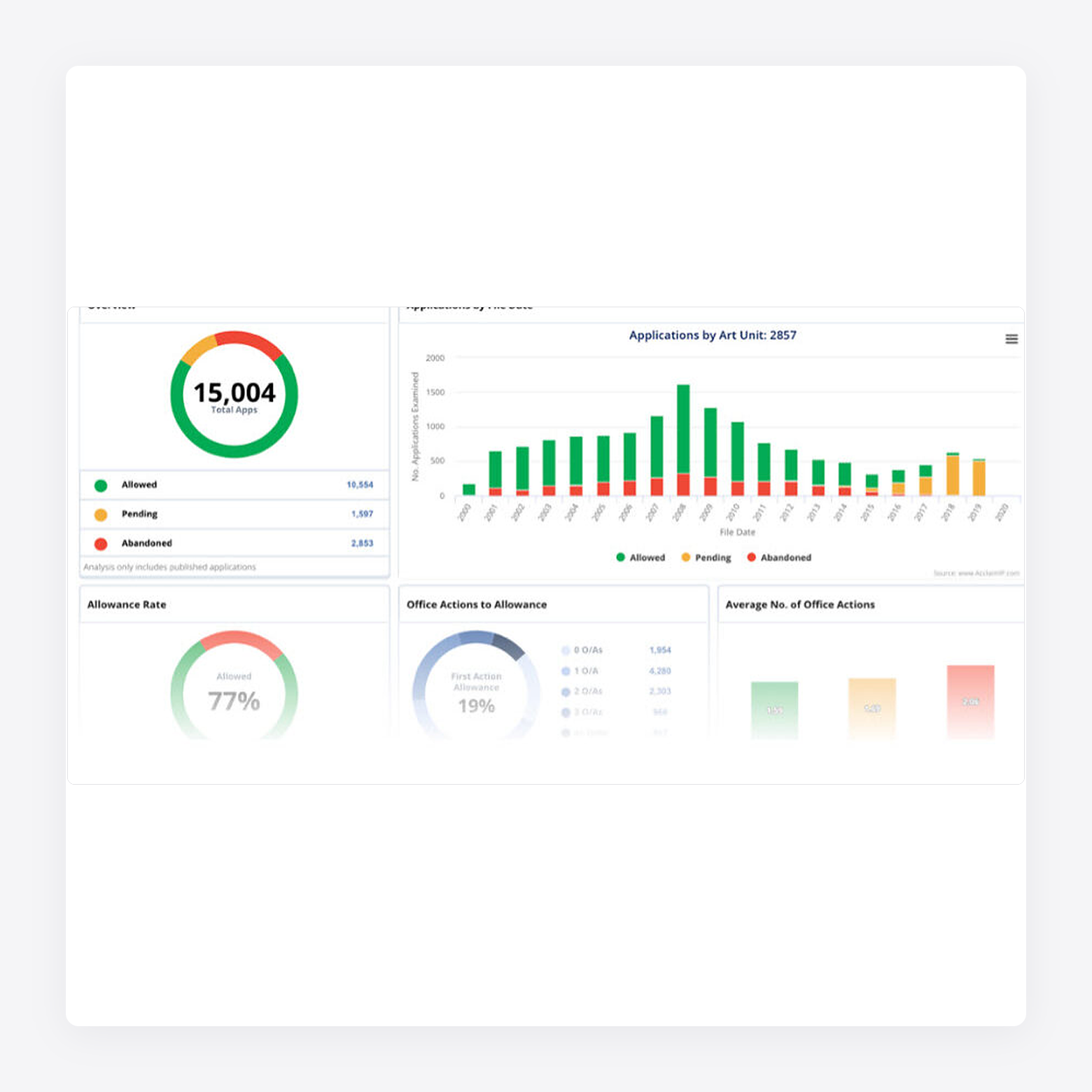
Anaqua’s AQX Law Firm is an IP management platform for firms managing client portfolios and prosecution work. It brings client records, documents, and operational workflows together so attorneys and support staff can coordinate matters. Portfolio insights and client dashboards support reporting alongside day-to-day administration.
Key features:
- Docketing workflows: Calculates dates, creates and closes tasks, and updates fields through a configurable law engine.
- Client onboarding: Supports the intake of client and portfolio data when firms take on new work.
- Document management: Organizes documents within the firm’s IP management environment.
- Client dashboards: Gives clients visibility into their portfolios through personalized views.
Pricing: Anaqua pricing isn’t listed on its website
User testimonial:
“Because it does it all, there are MANY things to learn. After a year I am STILL learning. Love that they updated their training system from ACE and now have easy-to-follow videos.” - G2 user review
4. Derwent Innovation (Clarivate): Best for prior art research using expert-authored DWPI invention summaries
G2 rating: 4.7/5 (6 reviews)
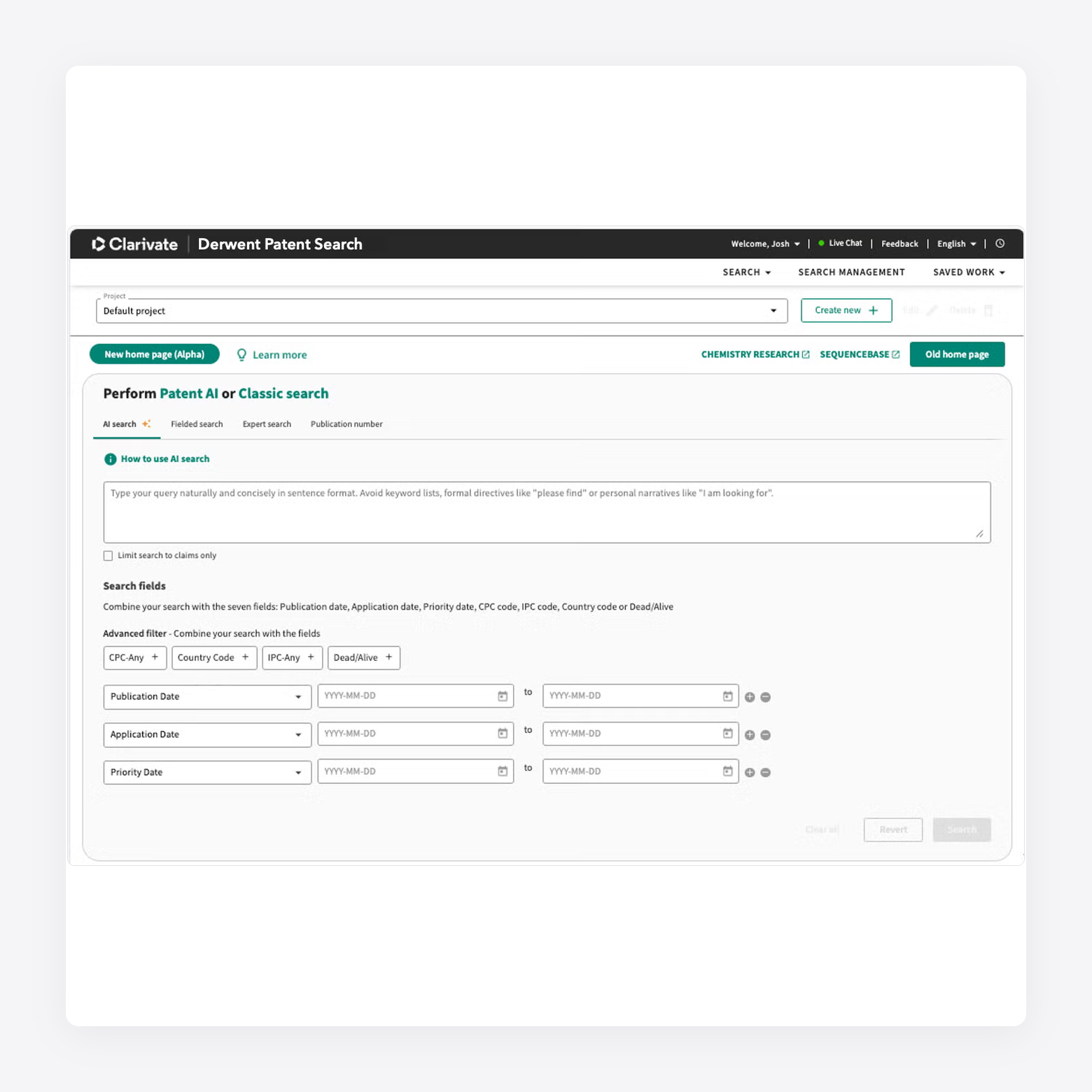
Derwent Innovation, now called Derwent Patent Search, is Clarivate’s patent research platform. It combines keyword and AI search with enriched patent records to support patentability, freedom-to-operate, and validity research. Its Derwent World Patents Index content helps researchers review inventions through standardized, expert-prepared information.
Key features:
- AI patent search: Interprets the context of supplied text to retrieve relevant patent documents.
- Detailed search controls: Offers more than 300 searchable fields and tools for managing complex searches.
- Curated patent information: Uses Derwent World Patents Index records to support invention-level research.
- Prior art review: Provides relevance scoring and searchable title and abstract fields for evaluating related inventions.
Pricing: Derwent Patent Search doesn’t publish subscription rates.
User testimonial:
“At times, Derwent Innovation may seem somewhat complex for newcomers, and getting accustomed to all its features can require some time. The interface could benefit from being more intuitive as well. Nevertheless, after you become familiar with the platform, the depth of insights it offers more than compensates for the initial learning curve.” - G2 user review
5. IPRally: Best for prior art searches using adjustable knowledge graphs

G2 rating: 4.7/5. (35 reviews)
IPRally is an AI-native patent search and analysis platform for patent professionals and R&D teams. It uses Graph AI trained on patent examiner citations to match technical features and their relationships across patent documents. Users can inspect and adjust these search graphs, then review and classify results for patentability, invalidity, and freedom-to-operate research.
Key features:
- Graph AI search: Converts technical descriptions into knowledge graphs that represent an invention’s components and functional relationships.
- Adjustable search queries: Lets users inspect and modify graph queries to focus searches on the technical features that matter.
- Technical image search: Converts photographs, drawings, flowcharts, and product sheets into graph queries, retrieving relevant patents even when they don’t contain drawings.
- Multi-patent Ask AI: Answers technical questions across individual patents or hundreds of documents and generates summaries for review.
- Custom AI classification: Uses a team’s own taxonomy and training data to categorize patents, portfolios, and search results.
- Classified patent monitoring: Automatically applies custom classifiers to monitoring results, organizing new patents around the team’s technology categories.
Pricing: Individual and Team plans are available on request. A three-day free trial is available.
User testimonial:
“It's a little pricey when you add the novelty agent and classification, and the new intelligence module is probably going to add more cost. It also doesn't currently integrate with any IPMS but they have an API so I plan to integrate it. Oh, the other minor nitpick is that IPRally doesn't do NPL or design patents.” - G2 user review
6. Octimine: Best for shared patent reviews and feedback-driven competitor monitoring
G2 rating: No user review available
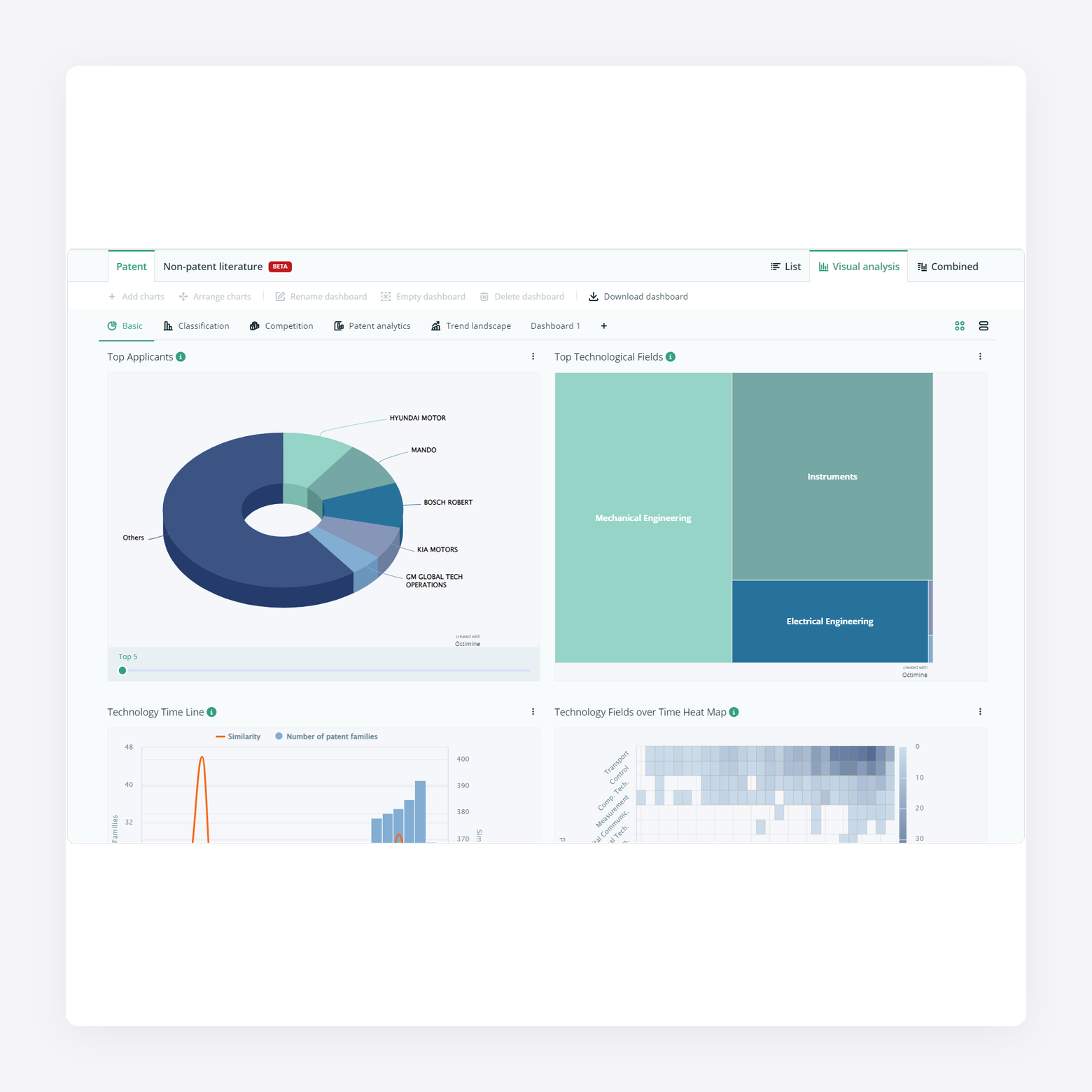
Octimine is Dennemeyer’s AI-powered patent intelligence platform for IP professionals, engineers, and inventors. It brings patent search, review, and monitoring into a shared workspace where teams can assess documents together. Its semantic engine uses relevance feedback to refine results, while the Octi assistant helps users understand technical content.
Key features:
- Semantic and Boolean search: Combines natural-language inputs with Boolean queries, filters, and selected patents to refine search direction.
- Octi AI assistant: Generates plain-language patent summaries, answers technical questions, and compares documents through a chat interface.
- Collaborative document review: Lets users highlight passages, add comments and tags, and request ratings directly within patent documents.
- Feedback-driven monitoring: Tracks competitors and technical domains, using ratings to refine results and distributing publication and legal status alerts automatically.
- Configurable review workspaces: Organizes collections through folder hierarchies, custom list views, and controls over who can see assessments.
Pricing: No pricing available on its website.
User testimonial: No user testimonial available
7. PatSeer: Best for combining Boolean and semantic patent research
G2 rating: 4.7/5 (34 reviews)
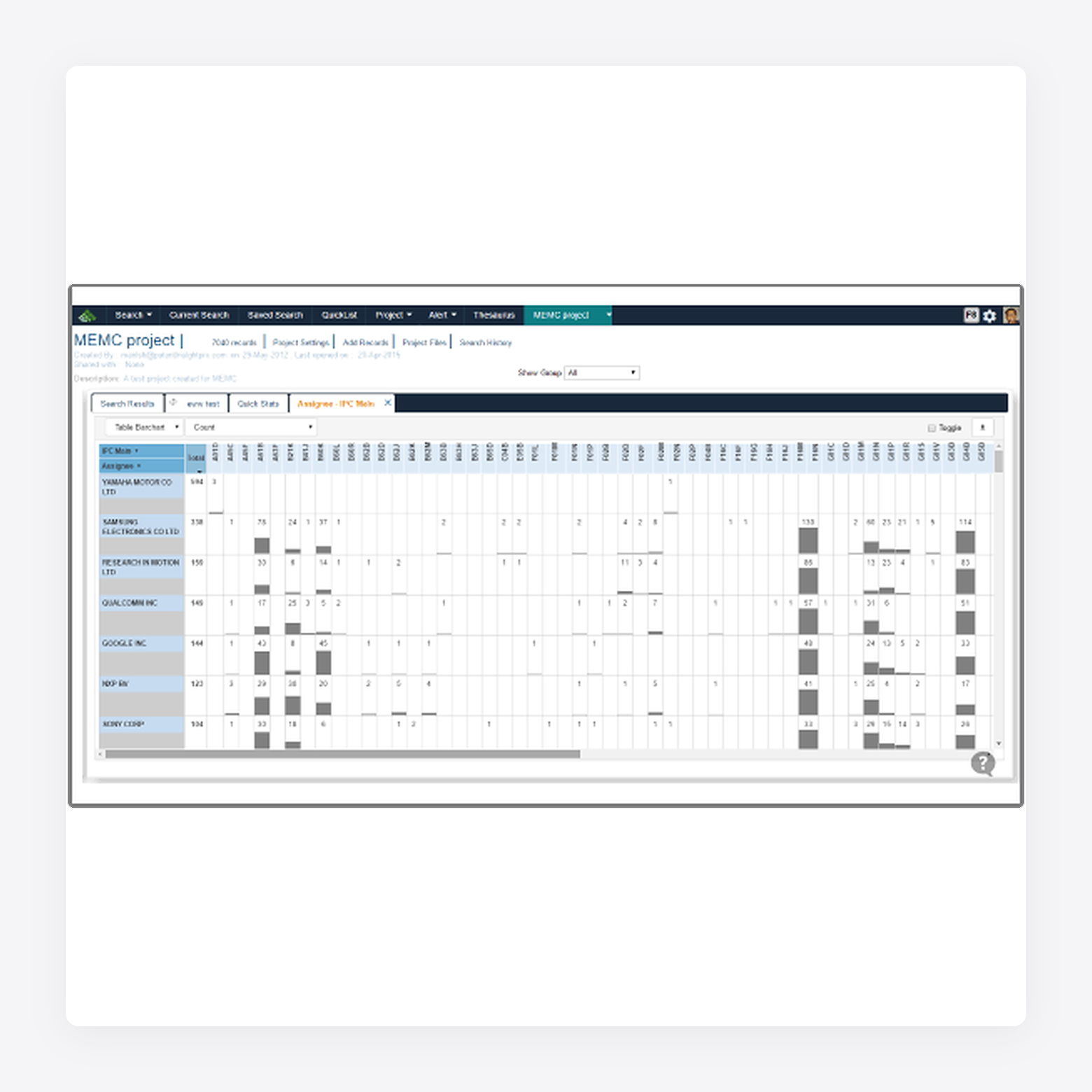
PatSeer is a patent research and analytics platform that combines expert Boolean searching with AI-driven semantic search. It supports document-level investigation and portfolio analysis, with editions for professional researchers, analysts, and company-wide idea screening. Teams can organize findings through custom fields, annotations, and shared dashboards, then configure alerts around their research priorities.
Key features:
- Hybrid patent search: Combines Boolean queries with semantic searches so researchers can refine results using both precise terms and contextual meaning.
- Integrated non-patent literature search: Includes NPL searching within Premier and ProX to extend research beyond patent documents.
- AI research tools: Adds AI Search, AI Summaries, AI Refine, AI Recommender, PatAssist, and semantic mapping through PremierPlus.
- Portfolio assessment: Provides qualitative patent assessment, strategic quadrant charts, and co-occurrence matrices in ProX.
Pricing: PatSeer doesn’t publish pricing but offers Premier, PremierPlus, ProX, Explorer, and Industrial Designs options, with quotes available on request.
User testimonial:
“The platform has a massive amount of features, but for our specific workflow, it can honestly feel like a bit too much functionality. Since we mostly just use the core semantic search, a lot of the advanced tools and options can make the interface look a bit cluttered for what we need. It would be great if there was a streamlined "lite" version with just the essentials at a cheaper price point.” - G2 user review
8. PatSnap: Best for connecting patent intelligence with R&D decision-making

G2 rating: 4.3/5 (14 reviews)
PatSnap is an AI-powered intelligence platform that combines patent, scientific, and technical data for IP and R&D teams. Its Analytics product supports patent landscape research, while Eureka provides task-specific agents for research, drafting, and invention assessment. Firms can use these products to investigate prior art and connect patent findings to a client’s technology and commercialization plans.
Key features:
- Novelty and FTO search agents: Provides dedicated Eureka workflows for investigating prior art and potential freedom-to-operate risks.
- Design FTO search: Offers a separate search agent for evaluating potential conflicts involving product designs.
- Patent drafting workflows: Includes agents for preparing invention disclosures, patent drafts, and office action responses.
- Essentiality claim charts: Supports claim chart preparation for assessing whether patent claims relate to technical standards.
- Patent landscape analysis: Visualizes patent activity across technology areas to help teams investigate competitors and research gaps.
Pricing: Patsnap Eureka Pro plans are listed from $200 per month. Enterprise and other product pricing varies by package.
User testimonial:
“There's nothing specific I don't like, however I would like to suggest having some sort of AI space where we can create prompts with AI in different sections or areas of Analytics.” G2 user review
9. Questel Orbit Intelligence: Best for competitive portfolio benchmarking and patent pruning analysis
G2 rating: 4.7/5 (4 reviews)
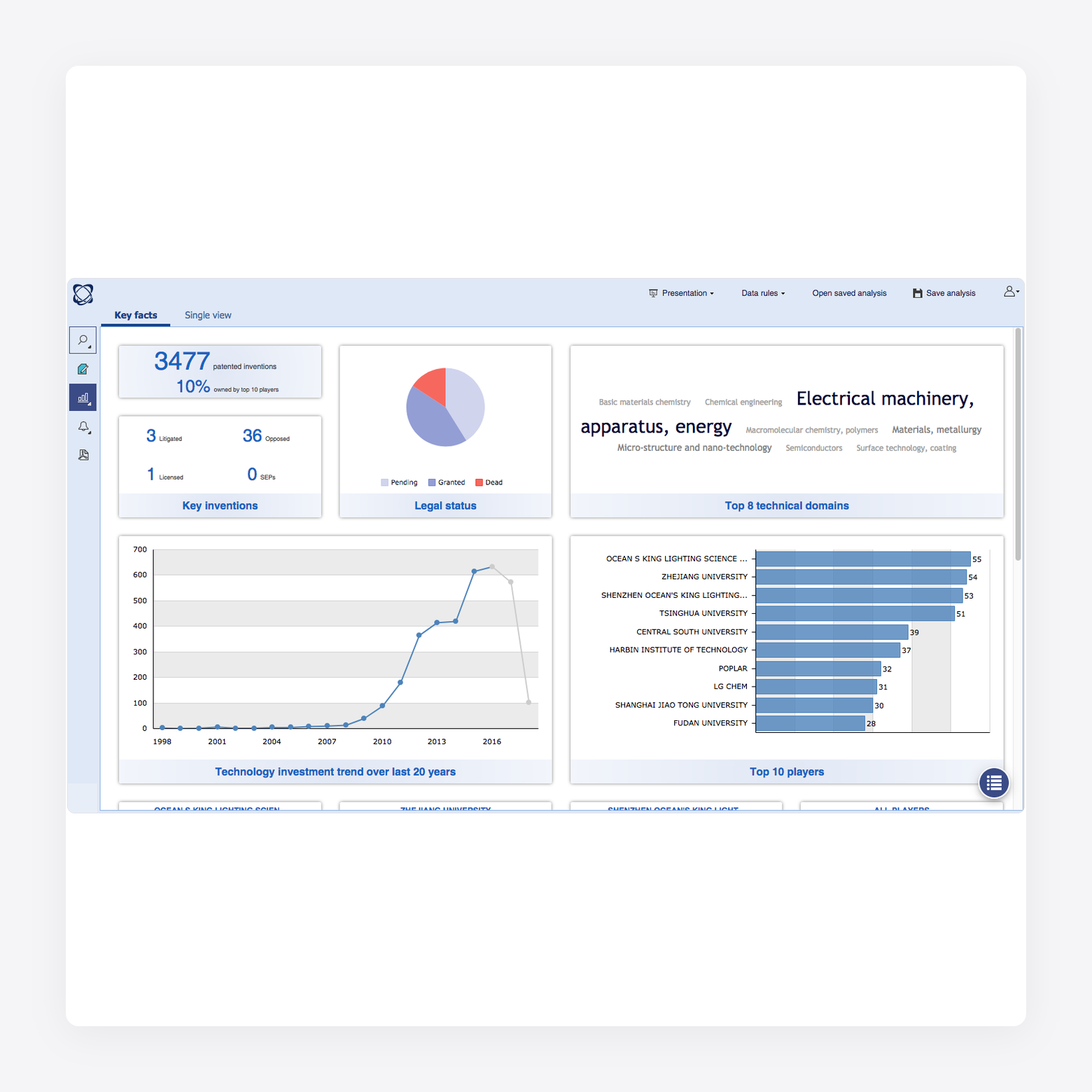
Orbit Intelligence is Questel’s patent research and analytics platform for IP specialists and legal professionals. It connects patent, design, and scientific literature data with ownership, legal status, and litigation information. Firms can analyze these records at the patent or family level to support licensing, portfolio reviews, and competitive research.
Key features:
- Sophia query builder: Converts natural-language requests into English search queries with synonyms and IPC classes, then adjusts them through follow-up instructions.
- Patent and family searching: Combines Boolean and proximity operators with similarity searches and options to investigate individual patents or families.
- Connected patent data: Links records to ownership, legal status, litigation, opposition, licensing agreements, and standard-essential patent information.
- Competitive landscape analysis: Clusters technical concepts and benchmarks companies within technology areas to identify established competitors and emerging participants.
- Portfolio pruning analysis: Helps teams identify patents for potential abandonment and estimate the associated savings.
Pricing: Pricing isn’t listed on its website.
User testimonial:
“There is nothing much to dislike, although the cost of orbit intelligence might be a factor of hesitation to some users. Also limited export options for patent numbers beyond 1000, need to send on email. Also many times, software is very slow and we need to wait for results to upload on the page.” - G2 user review
10. Relecura: Best for mapping patent portfolios and tracking ownership changes
G2 rating: 1.5/5 (1 review)
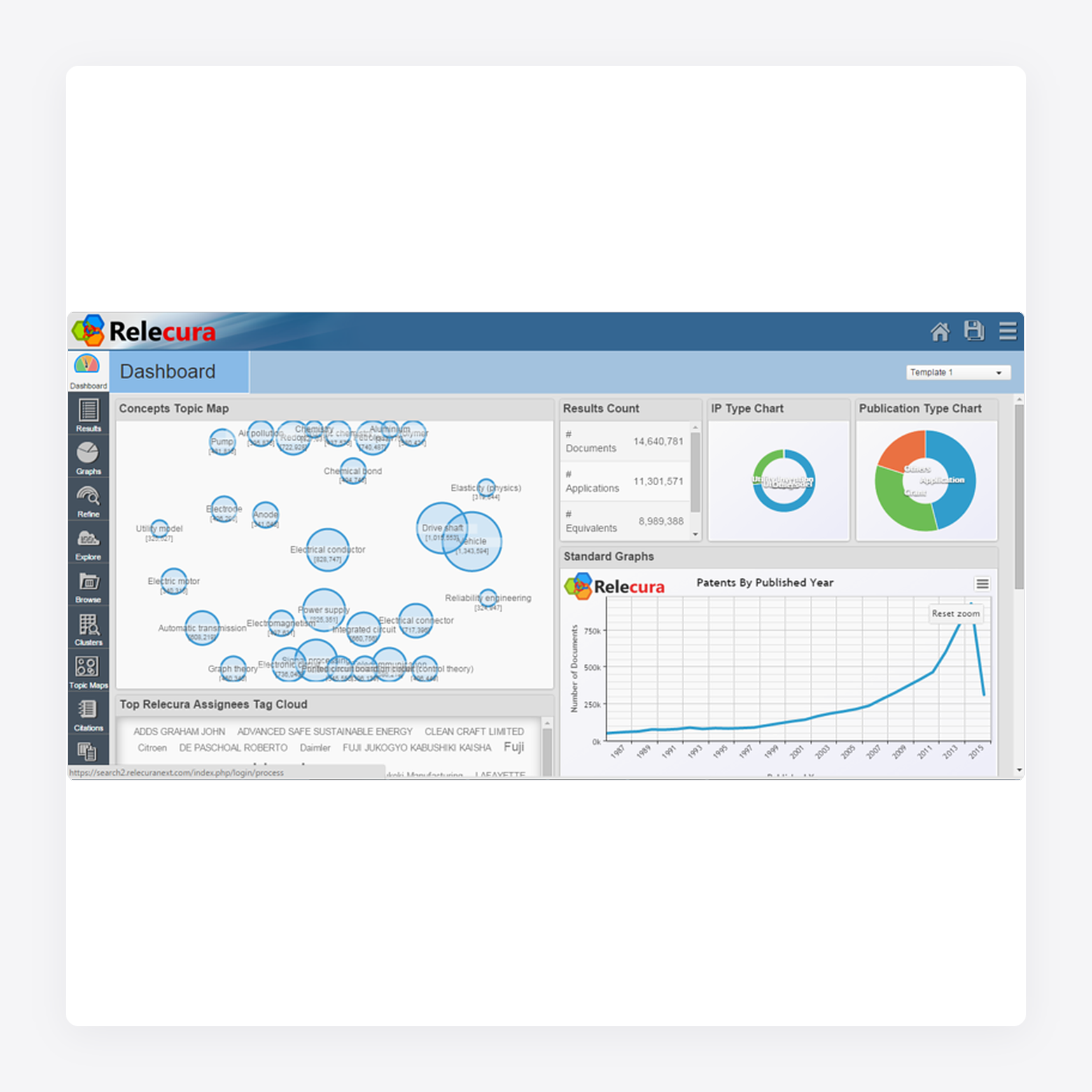
Relecura is an AI-powered patent intelligence platform for prior art research, portfolio analysis, and competitive intelligence. It combines patent search with classification and ownership data to connect IP assets to technology and product priorities. Firms can use it to investigate client portfolios, follow competitor acquisitions, and support licensing or investment due diligence.
Key features:
- Novelty AI: Searches patent records and non-patent literature for prior art, freedom-to-operate, and invalidity research, with optional private data support.
- Taxonomy AI: Applies custom classifications to map patents against R&D priorities and product roadmaps.
- Patent Landscape: Maps portfolios to identify technology gaps, potential infringement risks, and competitor strategies.
- Assignment Analytics: Tracks patent ownership changes and supports chain-of-title reviews during licensing and investment due diligence.
Pricing: Pricing isn’t listed on its website.
User testimonial:
“It feels very narrow in scope so while it is effective with what it does, it does not have a very wide use. So if you're looking for a platform that has a wide array of functions, this may not be the platform for you.” - G2 user review
Finding the Best Patent Intelligence Software for Your Firm
Patent intelligence software should help attorneys spend less time assembling information and more time evaluating what that information means for a client. The strongest platforms combine relevant data coverage with analysis that practitioners can inspect, verify, and refine.
Start with the matters your team handles most often. A research-heavy practice may prioritize search depth and database coverage. A litigation team may place more weight on claim mapping, evidence-linked charts, and source traceability. Test shortlisted platforms on a representative matter and evaluate not only the quality of the first output, but also the amount of attorney work required to verify and use it.
For firms that need research to carry directly into downstream patent workflows, Patlytics connects patent search with infringement, invalidity, claim charting, drafting, prosecution, FTO, and portfolio analysis. Attorneys can inspect the evidence behind generated findings, revise the analysis, and continue working without rebuilding context across separate tools.
See Patlytics in action to explore how it can support your firm’s patent workflows.
Best Patent Intelligence Software for Law Firms FAQs
What is patent intelligence software?
Patent intelligence software helps teams search, organize, and analyze patent data to support filing, enforcement, licensing, and portfolio decisions. It adds context through tools such as patent family analysis, legal status tracking, claim comparisons, and competitor monitoring. Depending on the platform, attorneys can use it to investigate prior art, assess potential infringement, or identify assets for further review.
What is the best software for patent intelligence?
The best platform depends on whether your firm primarily needs search, litigation analysis, prosecution support, portfolio intelligence, or a combination of those workflows. Patlytics is designed for firms that need patent search, infringement and invalidity analysis, citation-backed claim charting, and downstream patent workflows in one system. Its connected architecture allows attorneys to move from research into detailed analysis without rebuilding their work across separate tools.
Can AI patent software replace a patent attorney?
No. AI patent software can accelerate document retrieval, compare claim language, organize evidence, and prepare preliminary drafts or charts. It does not replace the legal judgment required to interpret claims, assess the significance of prior art, determine strategy, or advise a client.
The value of AI is in reducing the repetitive work beneath those decisions. The attorney remains responsible for verifying the evidence, refining the analysis, and making the call.
10 Best Patent Intelligence Software for Law Firms in 2026
Patent attorneys need to find relevant prior art, assess claim scope, and connect their analysis to evidence they can use in client advice. With a record 3.7 million patent applications filed worldwide in 2024, tracking filings across technologies and jurisdictions adds to that work. The best patent intelligence software for law firms helps teams search patent data, analyze results, and organize findings for attorney review.
These platforms can support work ranging from patentability searches and competitor monitoring to infringement analysis and portfolio assessment. However, their capabilities vary: some focus on retrieving relevant documents, while others help attorneys compare claims or prepare evidence-linked charts. Your firm’s priorities will depend on its practice areas, clients, and existing workflows.
This guide compares patent intelligence platforms for law firms, covering their key features, pricing, user feedback, and best-fit use cases. You’ll also learn what to assess in database coverage, AI search, security, and integrations so you can narrow your shortlist around the work your attorneys handle.
Key Takeaways
- Patent intelligence software falls into three main categories: search and database platforms, AI-native analysis and litigation tools, and portfolio and docketing systems.
- Semantic AI search can surface technically related documents even when they use different terminology, while Boolean search gives researchers direct control over keywords, classifications, and filters.
- Some litigation-focused platforms connect claim elements to supporting evidence and generate preliminary infringement or invalidity charts. Search platforms primarily help attorneys find and review relevant documents.
- Database coverage varies across jurisdictions, full-text records, patent families, legal status information, and non-patent literature, affecting the scope of research each platform supports.
- AI can reduce document review, drafting, and evidence-gathering work, but attorneys remain responsible for verifying findings, interpreting claims, and developing legal strategies.
Best Patent Intelligence Software for Law Firms: Quick Review
Patent intelligence software ranges from research databases to platforms for litigation analysis and portfolio administration. We selected these platforms for their relevance to prior art research, claim analysis, prosecution, and client portfolio review. Our research used vendor product pages, security disclosures, published pricing, and available G2 reviews to compare capabilities and workflow fit.
Types of Patent Intelligence Software
Patent intelligence software can help your firm find prior art, analyze claims, or manage client portfolios, depending on the platform. Basic patent search tools retrieve documents, while intelligence platforms add capabilities such as claim comparisons, competitor tracking, and portfolio analysis. Understanding these differences helps you focus on tools that support your practice’s daily work.
The practical distinction is not simply whether a platform uses AI. It is whether the tool stops at retrieving documents or carries those documents into verifiable patent work product that attorneys can inspect, revise, and use in downstream analysis.
Traditional Patent Search and Database Platforms
Traditional platforms help attorneys search patent records using keywords, classifications, citations, and applicant names. They organize results by patent family, jurisdiction, and legal status so teams can investigate related filings and narrow their review.
These tools support prior art research, patent landscape analysis, and competitor monitoring. Some also include AI search and analytics, so assess how each platform helps your team analyze the documents it retrieves.
AI-Native Patent Analysis and Litigation Platforms
AI-native platforms can analyze patent language, compare claim elements, and connect findings to supporting source material. Depending on the platform, they may help teams investigate potential infringement, identify invalidity references, map claim limitations to evidence, and generate preliminary claim charts.
For firms handling disputes or licensing work, these capabilities can reduce the manual work involved in assembling evidence for review. Attorneys still need to verify cited passages, assess claim interpretations, and determine whether the analysis supports their legal arguments.
IP Portfolio and Docketing Management Platforms
IP portfolio and docketing platforms organize patent assets, deadlines, prosecution records, and client matters. They help teams coordinate filings, track renewals, and maintain records across jurisdictions.
Some platforms also include analytics for reviewing portfolio costs, coverage, and activity. If your firm needs detailed prior art or claim analysis, check whether the system provides those functions directly or connects to a separate intelligence platform.
Key Features to Look for in Patent Intelligence Software
A platform should cover the patent records your firm needs and produce analysis your attorneys can verify. Assess each tool against a representative matter to see how it handles relevant documents, supports review, and fits your existing systems.
- Database coverage and jurisdictions: Check coverage across your clients’ filing jurisdictions, including full text, patent families, legal status, and non-patent literature. Confirm how frequently the provider updates records and which collections have gaps.
- AI-powered semantic search: Look for search that retrieves relevant concepts even when documents use different terminology. Test it with a known invention and check whether you can refine results by date, classification, jurisdiction, and assignee.
- Litigation-ready outputs: Require claim charts and analysis that link findings to exact source passages. Check whether attorneys can edit mappings, record their reasoning, and export documents for further review.
- Security, compliance, and data privacy: Review access controls, encryption, retention policies, and independent security assessments. Confirm how the provider uses uploaded documents, whether it trains models on client data, and how deletion works.
- Integration with docketing and document management systems: Check whether the platform connects to your firm’s existing systems and preserves matter identifiers, permissions, and document versions. Confirm which integrations are available and which require custom development.
- Traceability and review controls: Determine whether the platform shows how it reached an analysis, not just the final answer. Attorneys should be able to inspect cited evidence, review claim mappings or scoring logic where applicable, modify the analysis, and distinguish source material from generated conclusions.
Best Patent Intelligence Software for Law Firms
Patent intelligence software helps law firms turn patent records and technical documents into research they can use for client matters. These platforms support tasks such as finding prior art, comparing claims, tracking competitors, and reviewing portfolios. Their capabilities range from detailed search and analytics to connected workflows for drafting, prosecution, and litigation analysis.
1. Patlytics: Best for Connected Infringement, Invalidity, and Claim-Chart Workflows
G2 rating: 4.9/5. (30 reviews)
Patlytics is an AI-native patent platform that supports patent attorneys, IP teams, and enterprises across the patent lifecycle. It brings invention disclosure, drafting, prosecution, infringement, invalidity, FTO, SEP, and portfolio analysis into one system. Teams can carry research and supporting evidence between these workflows without switching platforms.
Attorneys can move from source materials to structured drafts, analyze prior art, generate citation-backed claim charts, and evaluate portfolio assets without rebuilding work across separate systems. Findings and supporting evidence can carry between workflows, reducing repetitive preparation while keeping attorney review and legal judgment central.
Patlytics is used by leading law firms and enterprise IP teams, including more than 40% of Am Law 100 firms. Its breadth across drafting, prosecution, infringement, invalidity, FTO, SEP, and portfolio analysis is designed for teams handling both individual matters and high-volume patent work.
Key features:
- Patent application drafting: Creates structured patent drafts from source materials, technical documents, figures, and invention disclosures.
- Office action analysis and response: Automatically retrieves office action materials, helps practitioners develop a response strategy, and generates draft responses using matter-specific context.
- Infringement detection: Crawls publicly available evidence of use and generates limitation-by-limitation claim charts; portfolio heatmaps cover up to 2000 patents at a time.
- Invalidity analysis: Combines prior art search with § 102, § 103, and § 112 analysis and citation-backed claim charting in one workflow.
- Portfolio analysis: Maps and ranks multiple assets to help teams prioritize patents for further investigation.
- Security and compliance: SOC 2 Type 2, ISO 27001, ISO 42001, and GDPR. Customer data is segregated, encrypted in transit and at rest, and not used to train models.
Pricing: Patlytics pricing varies by team size and workflow requirements. Contact Patlytics for a custom quote.
User testimonial:
“Patlytics makes patent research and document analysis very convenient for my team. The user interface is clean and responsive, and it does a good job of accurately organizing a large volume of intellectual property information. Additionally, I like that Patlytics provides insights that would typically take hours of manual effort to collect and analyze in a matter of minutes.” - G2 user review
2. Amplified AI: Best for collaborative patent research and shared technical knowledge
G2 rating: No user review available
Amplified is an AI-powered patent research platform that organizes external patent information alongside a team’s own knowledge. It combines relevance ranking with shared projects, allowing attorneys and technical specialists to document findings together. Saved research and annotations remain available for subsequent work.
Key features:
- AI relevance ranking: Uses deep learning to rank related patents, with two ranking modes for exploring results.
- Search refinement: Supports keyword highlighting, Boolean logic, wildcards, and filters.
- Shared research projects: Keeps patent annotations and discussions together, with controls over viewing, editing, and sharing.
- Patent data context: Includes patent family, citation, and legal status information, with global data updated weekly.
Pricing: Starts at $500 per month, billed annually. Team and enterprise pricing is available on request.
User testimonial: No user testimonial available
3. Anaqua: Best for managing client portfolios with automated prosecution docketing
G2 rating: 4.4/5 (19 reviews)
Anaqua’s AQX Law Firm is an IP management platform for firms managing client portfolios and prosecution work. It brings client records, documents, and operational workflows together so attorneys and support staff can coordinate matters. Portfolio insights and client dashboards support reporting alongside day-to-day administration.
Key features:
- Docketing workflows: Calculates dates, creates and closes tasks, and updates fields through a configurable law engine.
- Client onboarding: Supports the intake of client and portfolio data when firms take on new work.
- Document management: Organizes documents within the firm’s IP management environment.
- Client dashboards: Gives clients visibility into their portfolios through personalized views.
Pricing: Anaqua pricing isn’t listed on its website
User testimonial:
“Because it does it all, there are MANY things to learn. After a year I am STILL learning. Love that they updated their training system from ACE and now have easy-to-follow videos.” - G2 user review
4. Derwent Innovation (Clarivate): Best for prior art research using expert-authored DWPI invention summaries
G2 rating: 4.7/5 (6 reviews)
Derwent Innovation, now called Derwent Patent Search, is Clarivate’s patent research platform. It combines keyword and AI search with enriched patent records to support patentability, freedom-to-operate, and validity research. Its Derwent World Patents Index content helps researchers review inventions through standardized, expert-prepared information.
Key features:
- AI patent search: Interprets the context of supplied text to retrieve relevant patent documents.
- Detailed search controls: Offers more than 300 searchable fields and tools for managing complex searches.
- Curated patent information: Uses Derwent World Patents Index records to support invention-level research.
- Prior art review: Provides relevance scoring and searchable title and abstract fields for evaluating related inventions.
Pricing: Derwent Patent Search doesn’t publish subscription rates.
User testimonial:
“At times, Derwent Innovation may seem somewhat complex for newcomers, and getting accustomed to all its features can require some time. The interface could benefit from being more intuitive as well. Nevertheless, after you become familiar with the platform, the depth of insights it offers more than compensates for the initial learning curve.” - G2 user review
5. IPRally: Best for prior art searches using adjustable knowledge graphs
G2 rating: 4.7/5. (35 reviews)
IPRally is an AI-native patent search and analysis platform for patent professionals and R&D teams. It uses Graph AI trained on patent examiner citations to match technical features and their relationships across patent documents. Users can inspect and adjust these search graphs, then review and classify results for patentability, invalidity, and freedom-to-operate research.
Key features:
- Graph AI search: Converts technical descriptions into knowledge graphs that represent an invention’s components and functional relationships.
- Adjustable search queries: Lets users inspect and modify graph queries to focus searches on the technical features that matter.
- Technical image search: Converts photographs, drawings, flowcharts, and product sheets into graph queries, retrieving relevant patents even when they don’t contain drawings.
- Multi-patent Ask AI: Answers technical questions across individual patents or hundreds of documents and generates summaries for review.
- Custom AI classification: Uses a team’s own taxonomy and training data to categorize patents, portfolios, and search results.
- Classified patent monitoring: Automatically applies custom classifiers to monitoring results, organizing new patents around the team’s technology categories.
Pricing: Individual and Team plans are available on request. A three-day free trial is available.
User testimonial:
“It's a little pricey when you add the novelty agent and classification, and the new intelligence module is probably going to add more cost. It also doesn't currently integrate with any IPMS but they have an API so I plan to integrate it. Oh, the other minor nitpick is that IPRally doesn't do NPL or design patents.” - G2 user review
6. Octimine: Best for shared patent reviews and feedback-driven competitor monitoring
G2 rating: No user review available
Octimine is Dennemeyer’s AI-powered patent intelligence platform for IP professionals, engineers, and inventors. It brings patent search, review, and monitoring into a shared workspace where teams can assess documents together. Its semantic engine uses relevance feedback to refine results, while the Octi assistant helps users understand technical content.
Key features:
- Semantic and Boolean search: Combines natural-language inputs with Boolean queries, filters, and selected patents to refine search direction.
- Octi AI assistant: Generates plain-language patent summaries, answers technical questions, and compares documents through a chat interface.
- Collaborative document review: Lets users highlight passages, add comments and tags, and request ratings directly within patent documents.
- Feedback-driven monitoring: Tracks competitors and technical domains, using ratings to refine results and distributing publication and legal status alerts automatically.
- Configurable review workspaces: Organizes collections through folder hierarchies, custom list views, and controls over who can see assessments.
Pricing: No pricing available on its website.
User testimonial: No user testimonial available
7. PatSeer: Best for combining Boolean and semantic patent research
G2 rating: 4.7/5 (34 reviews)
PatSeer is a patent research and analytics platform that combines expert Boolean searching with AI-driven semantic search. It supports document-level investigation and portfolio analysis, with editions for professional researchers, analysts, and company-wide idea screening. Teams can organize findings through custom fields, annotations, and shared dashboards, then configure alerts around their research priorities.
Key features:
- Hybrid patent search: Combines Boolean queries with semantic searches so researchers can refine results using both precise terms and contextual meaning.
- Integrated non-patent literature search: Includes NPL searching within Premier and ProX to extend research beyond patent documents.
- AI research tools: Adds AI Search, AI Summaries, AI Refine, AI Recommender, PatAssist, and semantic mapping through PremierPlus.
- Portfolio assessment: Provides qualitative patent assessment, strategic quadrant charts, and co-occurrence matrices in ProX.
Pricing: PatSeer doesn’t publish pricing but offers Premier, PremierPlus, ProX, Explorer, and Industrial Designs options, with quotes available on request.
User testimonial:
“The platform has a massive amount of features, but for our specific workflow, it can honestly feel like a bit too much functionality. Since we mostly just use the core semantic search, a lot of the advanced tools and options can make the interface look a bit cluttered for what we need. It would be great if there was a streamlined "lite" version with just the essentials at a cheaper price point.” - G2 user review
8. PatSnap: Best for connecting patent intelligence with R&D decision-making
G2 rating: 4.3/5 (14 reviews)
PatSnap is an AI-powered intelligence platform that combines patent, scientific, and technical data for IP and R&D teams. Its Analytics product supports patent landscape research, while Eureka provides task-specific agents for research, drafting, and invention assessment. Firms can use these products to investigate prior art and connect patent findings to a client’s technology and commercialization plans.
Key features:
- Novelty and FTO search agents: Provides dedicated Eureka workflows for investigating prior art and potential freedom-to-operate risks.
- Design FTO search: Offers a separate search agent for evaluating potential conflicts involving product designs.
- Patent drafting workflows: Includes agents for preparing invention disclosures, patent drafts, and office action responses.
- Essentiality claim charts: Supports claim chart preparation for assessing whether patent claims relate to technical standards.
- Patent landscape analysis: Visualizes patent activity across technology areas to help teams investigate competitors and research gaps.
Pricing: Patsnap Eureka Pro plans are listed from $200 per month. Enterprise and other product pricing varies by package.
User testimonial:
“There's nothing specific I don't like, however I would like to suggest having some sort of AI space where we can create prompts with AI in different sections or areas of Analytics.” G2 user review
9. Questel Orbit Intelligence: Best for competitive portfolio benchmarking and patent pruning analysis
G2 rating: 4.7/5 (4 reviews)
Orbit Intelligence is Questel’s patent research and analytics platform for IP specialists and legal professionals. It connects patent, design, and scientific literature data with ownership, legal status, and litigation information. Firms can analyze these records at the patent or family level to support licensing, portfolio reviews, and competitive research.
Key features:
- Sophia query builder: Converts natural-language requests into English search queries with synonyms and IPC classes, then adjusts them through follow-up instructions.
- Patent and family searching: Combines Boolean and proximity operators with similarity searches and options to investigate individual patents or families.
- Connected patent data: Links records to ownership, legal status, litigation, opposition, licensing agreements, and standard-essential patent information.
- Competitive landscape analysis: Clusters technical concepts and benchmarks companies within technology areas to identify established competitors and emerging participants.
- Portfolio pruning analysis: Helps teams identify patents for potential abandonment and estimate the associated savings.
Pricing: Pricing isn’t listed on its website.
User testimonial:
“There is nothing much to dislike, although the cost of orbit intelligence might be a factor of hesitation to some users. Also limited export options for patent numbers beyond 1000, need to send on email. Also many times, software is very slow and we need to wait for results to upload on the page.” - G2 user review
10. Relecura: Best for mapping patent portfolios and tracking ownership changes
G2 rating: 1.5/5 (1 review)
Relecura is an AI-powered patent intelligence platform for prior art research, portfolio analysis, and competitive intelligence. It combines patent search with classification and ownership data to connect IP assets to technology and product priorities. Firms can use it to investigate client portfolios, follow competitor acquisitions, and support licensing or investment due diligence.
Key features:
- Novelty AI: Searches patent records and non-patent literature for prior art, freedom-to-operate, and invalidity research, with optional private data support.
- Taxonomy AI: Applies custom classifications to map patents against R&D priorities and product roadmaps.
- Patent Landscape: Maps portfolios to identify technology gaps, potential infringement risks, and competitor strategies.
- Assignment Analytics: Tracks patent ownership changes and supports chain-of-title reviews during licensing and investment due diligence.
Pricing: Pricing isn’t listed on its website.
User testimonial:
“It feels very narrow in scope so while it is effective with what it does, it does not have a very wide use. So if you're looking for a platform that has a wide array of functions, this may not be the platform for you.” - G2 user review
Finding the Best Patent Intelligence Software for Your Firm
Patent intelligence software should help attorneys spend less time assembling information and more time evaluating what that information means for a client. The strongest platforms combine relevant data coverage with analysis that practitioners can inspect, verify, and refine.
Start with the matters your team handles most often. A research-heavy practice may prioritize search depth and database coverage. A litigation team may place more weight on claim mapping, evidence-linked charts, and source traceability. Test shortlisted platforms on a representative matter and evaluate not only the quality of the first output, but also the amount of attorney work required to verify and use it.
For firms that need research to carry directly into downstream patent workflows, Patlytics connects patent search with infringement, invalidity, claim charting, drafting, prosecution, FTO, and portfolio analysis. Attorneys can inspect the evidence behind generated findings, revise the analysis, and continue working without rebuilding context across separate tools.
See Patlytics in action to explore how it can support your firm’s patent workflows.
Best Patent Intelligence Software for Law Firms FAQs
What is patent intelligence software?
Patent intelligence software helps teams search, organize, and analyze patent data to support filing, enforcement, licensing, and portfolio decisions. It adds context through tools such as patent family analysis, legal status tracking, claim comparisons, and competitor monitoring. Depending on the platform, attorneys can use it to investigate prior art, assess potential infringement, or identify assets for further review.
What is the best software for patent intelligence?
The best platform depends on whether your firm primarily needs search, litigation analysis, prosecution support, portfolio intelligence, or a combination of those workflows. Patlytics is designed for firms that need patent search, infringement and invalidity analysis, citation-backed claim charting, and downstream patent workflows in one system. Its connected architecture allows attorneys to move from research into detailed analysis without rebuilding their work across separate tools.
Can AI patent software replace a patent attorney?
No. AI patent software can accelerate document retrieval, compare claim language, organize evidence, and prepare preliminary drafts or charts. It does not replace the legal judgment required to interpret claims, assess the significance of prior art, determine strategy, or advise a client.
The value of AI is in reducing the repetitive work beneath those decisions. The attorney remains responsible for verifying the evidence, refining the analysis, and making the call.
The Premier AI-Powered Patent Platform
Reduce cycle times. Increase margins. Deliver winning IP outcomes.
Book a DemoThe Premier AI-Powered
Patent Platform
Reduce cycle times. Increase margins. Deliver winning IP outcomes.