Best Solve Intelligence Alternatives: 7 AI Patent Tools Compared
June 9, 2026

If you’re evaluating AI patent tools in 2026, Solve Intelligence is likely on your list. It is an established platform for patent drafting and prosecution, with capabilities for figure generation and claim charting.
But many IP teams need more than drafting-centered workflows. They need platforms that connect prior art search, claim analysis, drafting, prosecution, claim charting, and portfolio decisions without forcing attorneys to rebuild context across separate tools.
This guide explores the best alternatives to Solve Intelligence and compares them across the factors that matter most in practice: pricing, ease of use, onboarding time, core functionality, and fit for different types of IP teams.
Key takeaways:
- Patent teams are moving beyond drafting tools toward platforms that connect search, claim analysis, prosecution, and portfolio decisions.
- The strongest alternatives provide citation-backed outputs, claim-level mapping, and integrated charting — not just generated text.
- Connected workflows reduce manual handoffs and preserve context across drafting, invalidity, infringement, FTO, and portfolio review.
- Enterprise-grade security is a baseline requirement. SOC 2 Type 2 and ISO 27001 should be table stakes; ISO 42001 is the emerging benchmark for AI management.
- AI outputs still require attorney review. The tool accelerates the work; the practitioner remains responsible for strategy and final decisions.
What Is Solve Intelligence?
Solve Intelligence is an AI-powered patent platform that supports drafting, prosecution, and related IP workflows. It’s designed for patent attorneys and IP teams working on applications, office actions, and claim analysis.
The platform includes tools for generating patent drafts, preparing office action responses, and creating claim charts for tasks like infringement or invalidity analysis. It also supports invention disclosure workflows, enabling teams to collect and manage inventor inputs in a structured format.
Solve Intelligence focuses on document creation and analysis within the prosecution process. It allows teams to apply templates, reference source materials, and track reasoning through cited outputs.
Why Patent Teams Seek Solve Intelligence Alternatives
Solve Intelligence supports drafting and prosecution workflows, but many patent teams need AI to connect more of the lifecycle.
But drafting is only one part of the work. Attorneys also need prior art search, claim-level analysis, invalidity review, infringement analysis, FTO, portfolio decisions, and secure collaboration.
The most common gaps are:
- Limited workflow coverage: Drafting tools can leave teams switching systems for search, claim charting, invalidity, infringement, and portfolio work.
- Output traceability: Patent teams need citation-backed outputs they can verify, not unsupported generated text.
- Integration and configurability: The platform should fit existing workflows, jurisdictions, drafting styles, and review processes.
- Enterprise security: Invention disclosures, unpublished applications, and legal strategy require strong access controls, clear data-use policies, and certifications such as SOC 2 Type 2, ISO 27001, and ISO 42001.
AI Patent Drafting Tools Compared
Patent drafting tools vary in how they support the broader IP workflow. Some focus on generating application text, while others connect drafting with search, analysis, and portfolio decisions. The differences show up in how well each tool fits into day-to-day work.
This list compares Solve Intelligence alternatives based on workflow coverage, output traceability, integration with existing systems, and security standards. We also looked at how each platform supports tasks beyond drafting, such as claim analysis, prior art searches, and cross-team collaboration.
1. Patlytics: Best for Law Firms and In-House Teams Needing End-to-End Patent Intelligence and Analytics

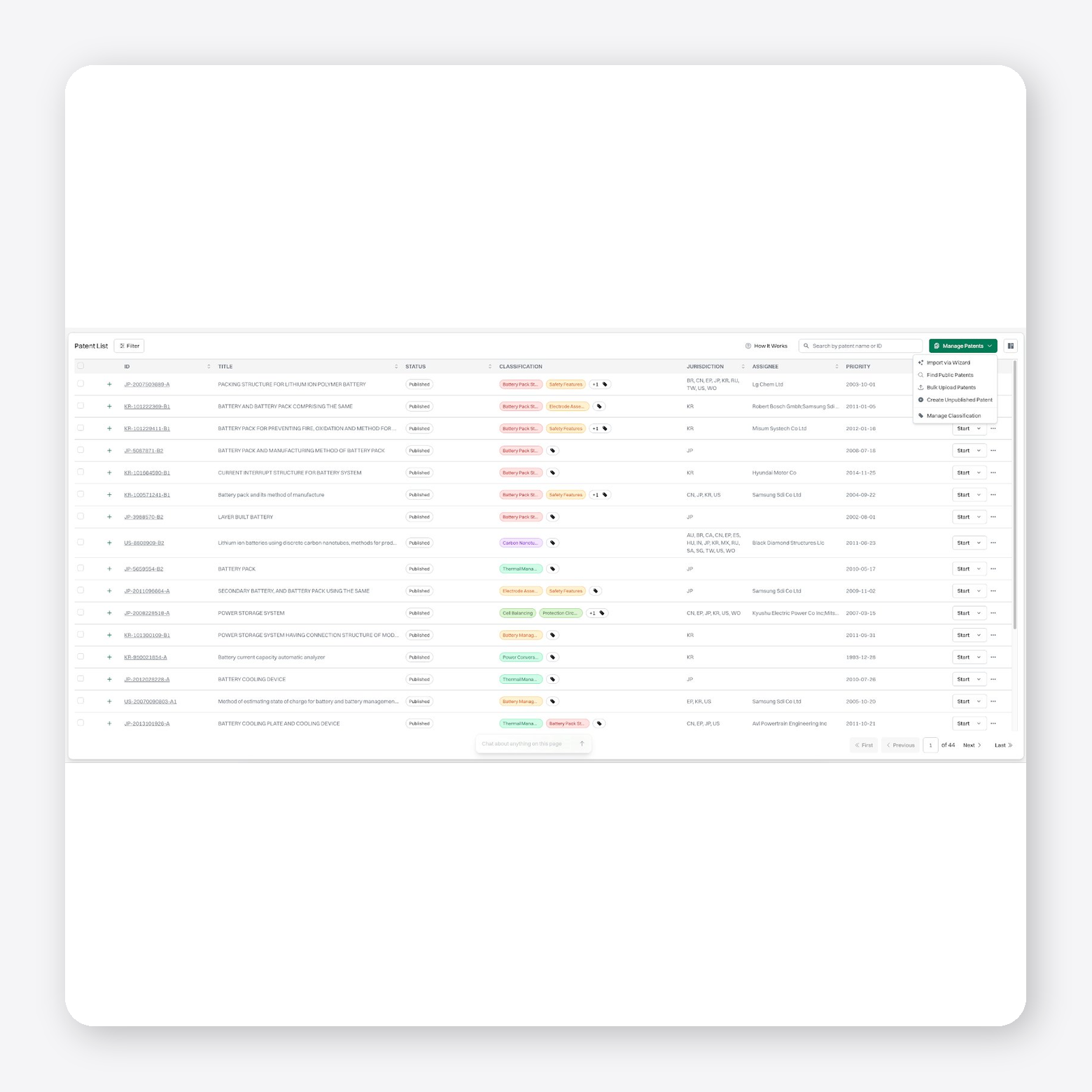
Patlytics is an AI-native platform designed to support patent work across the full lifecycle, from early-stage search to downstream analysis and decision-making. It’s built for patent attorneys, IP teams, and enterprise organizations that need to move from raw inputs to structured outputs without relying on disconnected tools.
The platform is designed around reviewable work product. Search results connect directly to claim limitations, cited references, and downstream analysis. Teams can carry that context into invalidity charts, infringement review, FTO analysis, office action work, and portfolio decisions without rebuilding the analysis in separate tools. That continuity is a key reason customers report significant reductions in project time and claim-charting costs when consolidating workflows into a single platform
Key features:
- Citation-backed outputs: Links analysis to source documents, claims, references, and supporting evidence.
- Claim-level mapping: Maps references and product evidence to specific claim limitations.
- Integrated claim charting: Supports invalidity, infringement, FTO, and enforcement workflows.
- Connected patent workflows: Carries context across search, drafting, prosecution, portfolio review, and pruning.
- Enterprise-grade security: Supports SOC 2 Type 2, ISO 27001, ISO 42001, and GDPR.
User testimonial:
“Patlytics is cutting-edge, very intelligent, fast, dynamic, and flexible. The customer service is top-notch—I'd give it a five out of five. The folks are fair during negotiation and procurement. I enjoy how seamlessly it integrates with other tools through the API end-to-end integration. It provides excellent executive summaries, and the LLM is very smart and well-developed. It's extremely easy to onboard and learn from, which is great. Also, the initial setup was very easy. I highly recommend it, giving it a 10 out of 10.” - G2 user
2. PatentPal: Best for Prosecution attorneys prioritizing visual patent elements
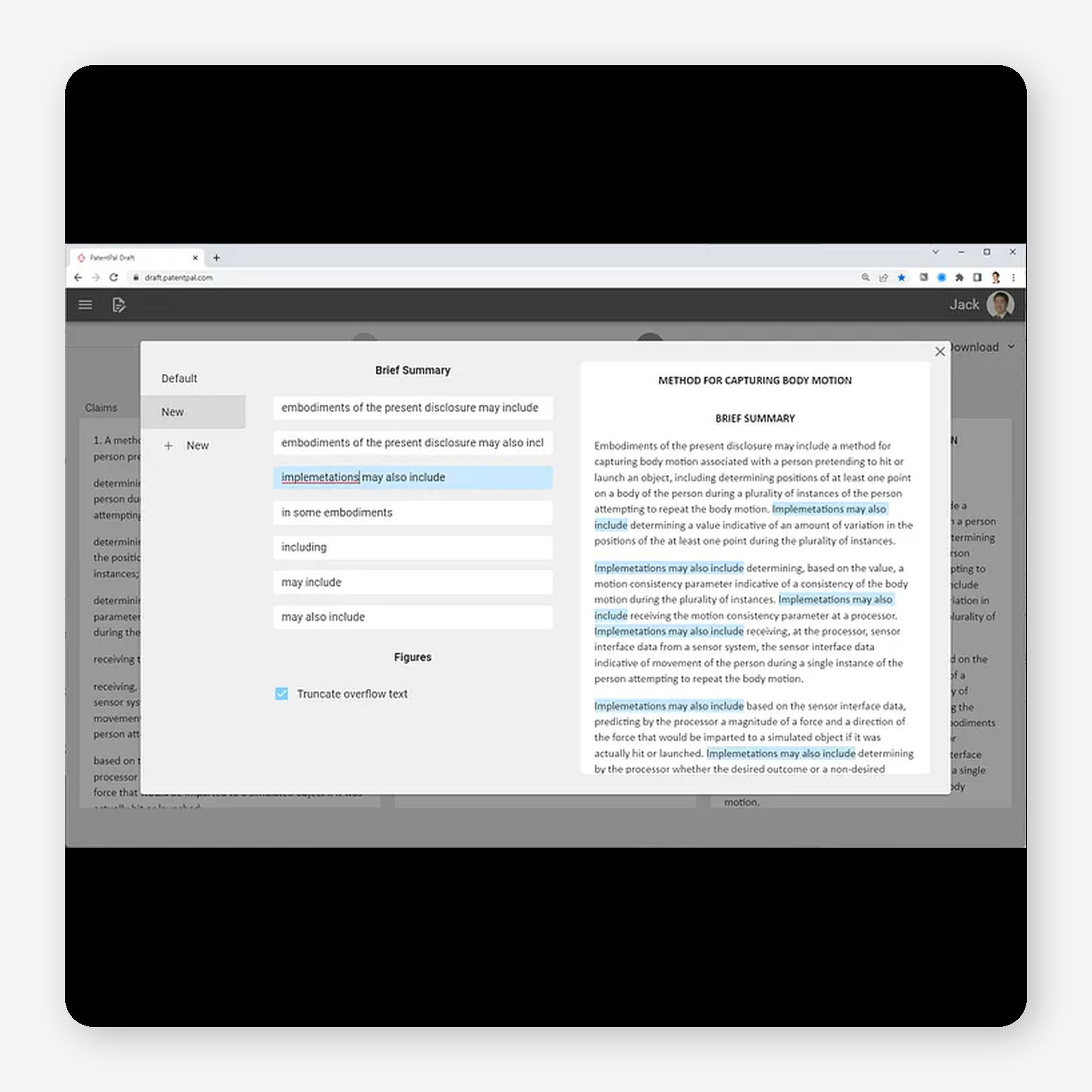
PatentPal is a generative AI tool that supports patent application drafting by generating specification content from input claims. It produces materials such as abstracts, summaries, detailed descriptions, flowcharts, and system diagrams, and allows users to export drafts into formats like Word, Visio, or PowerPoint. PatentPal also supports phrase customization, where users can adjust generated language based on their preferred writing style and apply those changes across the document.
Key features:
- Claim-based draft generation: Uses input claims to generate supporting specification content
- Automated figure creation: Produces flowcharts for methods and block diagrams for systems and devices
- Specification drafting support: Generates abstracts, summaries, and detailed descriptions aligned to claims
- Document upload workflow: Accepts uploaded files to initiate drafting inputs
User testimonial: Not available publicly
3. Deep IP: Best for Practitioners handling chemistry or biotech inventions
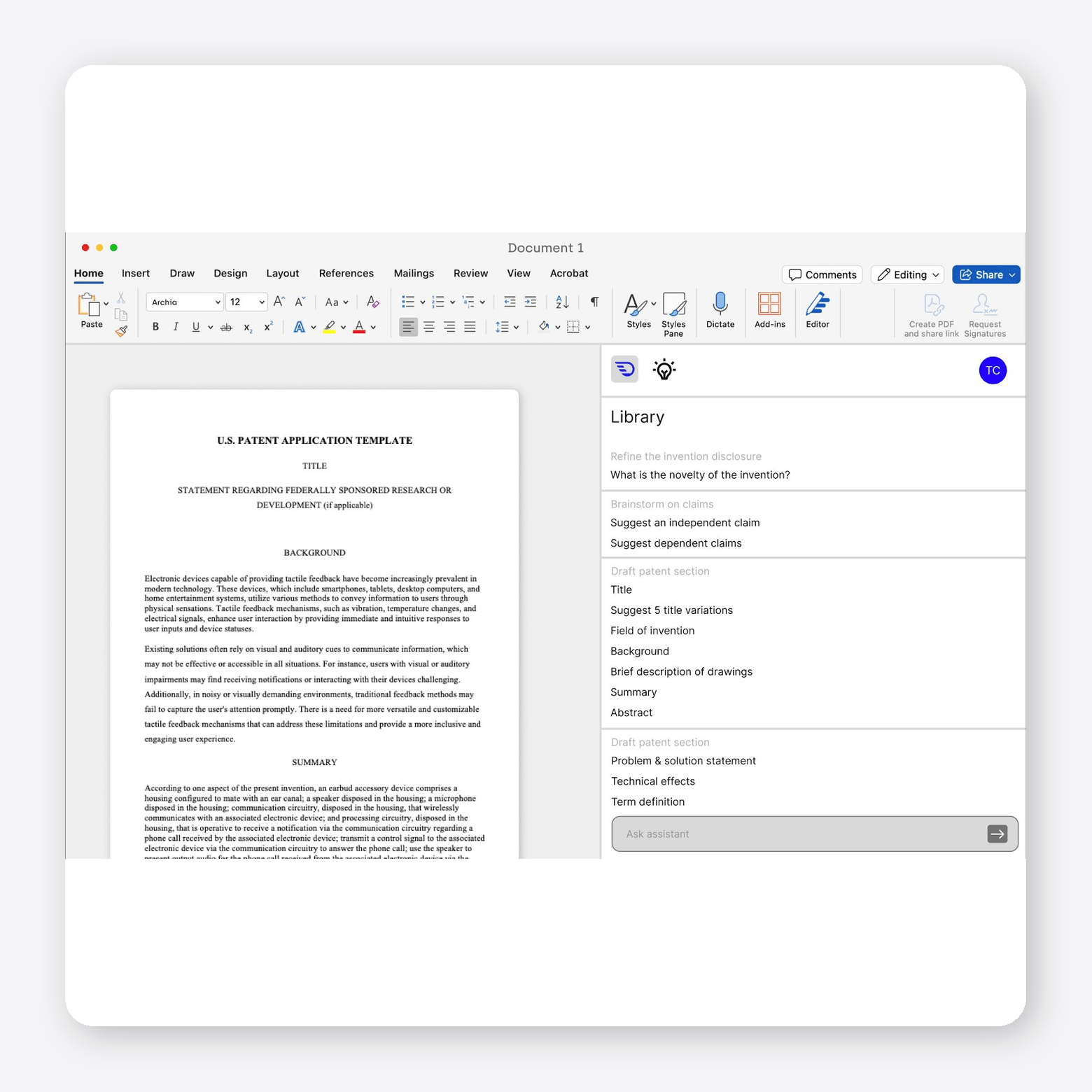
DeepIP is an AI platform designed for patent drafting, prosecution, and analysis across the patent lifecycle. It supports workflows such as invention capture, patentability assessment, drafting, office action response, and portfolio analysis within a connected system. DeepIP integrates with tools like Microsoft Word and IP management systems, allowing teams to work within existing environments while applying AI to tasks such as claim analysis, prior art review, and document preparation.
Key features:
- Patent drafting: Generates and edits patent applications based on structured inputs
- Patent prosecution support: Assists with office action responses, amendments, and argument development
- Patentability and novelty analysis: Maps claims to prior art with traceable outputs
- Agentic search: Explores and refines prior art search queries within context
User testimonial: Not available publicly
4. ClaimMaster: Best for Attorneys seeking automated proofreading within existing Word workflows

ClaimMaster is a Microsoft Word add-in that supports patent proofreading, drafting, and document analysis within the prosecution workflow. It checks patent claims, specifications, and figures for errors, including antecedent basis issues, incorrect dependencies, inconsistent terminology, and formatting problems. The tool also includes features for generating drafting sections, office action response shells, and downloading patent data, while allowing users to work within local or on-premise environments.
Key features:
- Automated patent proofreading: Detects errors in claims, specifications, and figures using customizable rules
- Claim validation checks: Identifies antecedent basis issues, dependencies, and claim inconsistencies
- Specification review: Flags issues with part names, acronyms, typos, and document structure
- Figure analysis: Reviews drawings for numbering, formatting, and consistency with the specification

User testimonial:
“I haven't run into anything that I dislike. They periodically send updates that fix issues usually caused by changes at the USPTO. I wish it would allow 2 users per subscription so my paralegal can do some of the tasks without me having to buy her own subscription.” User review
5. IP Rally: Best For Teams prioritizing prior art search over drafting automation

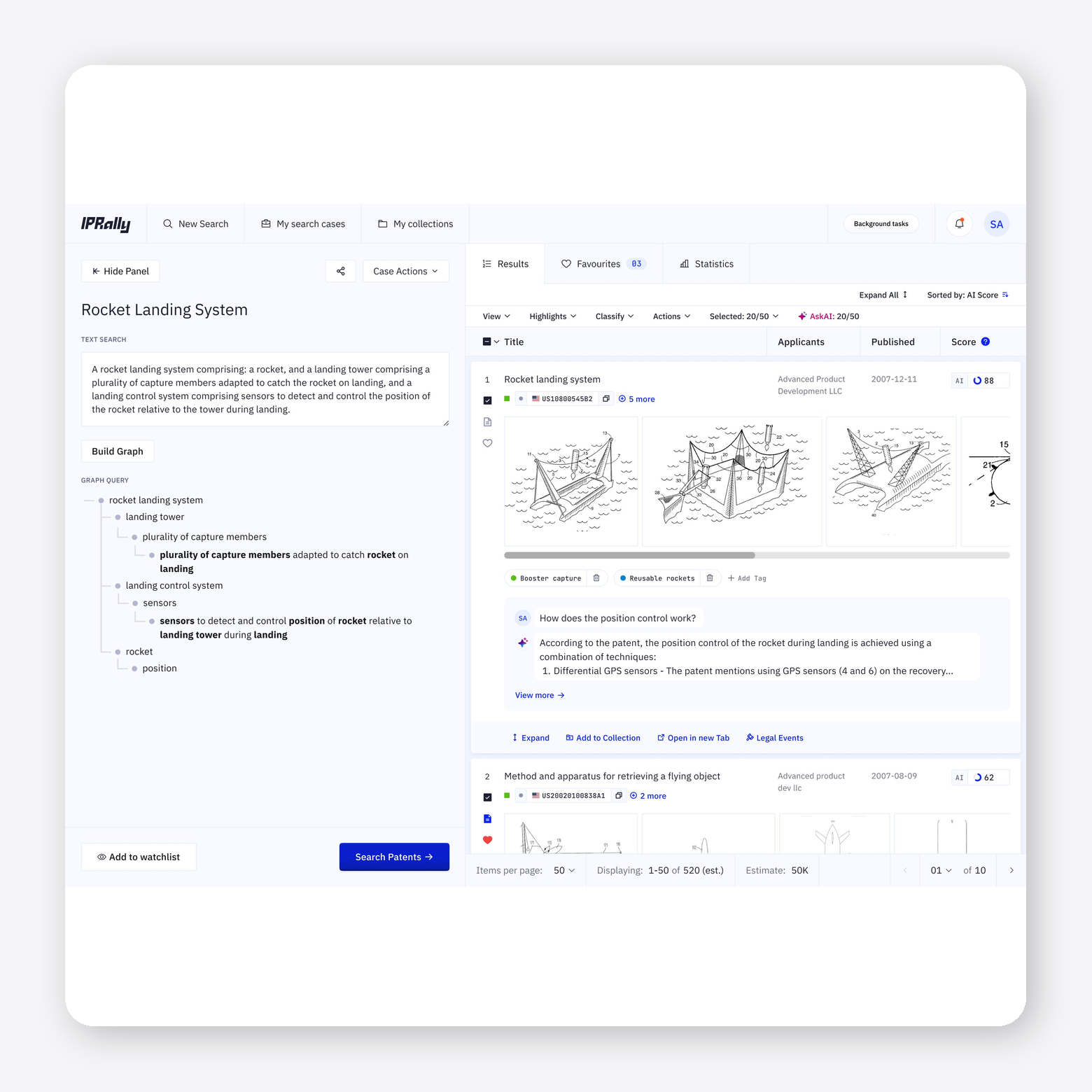
IPRally is an AI-based patent search and analysis platform designed for IP and R&D teams working on prior art, patentability, and portfolio review. It applies graph-based AI models trained on patent data to analyze invention disclosures, run searches, and return structured results with mapped features and cited sources. The platform supports workflows such as search, review, monitoring, and portfolio analysis, with outputs that include feature charts and evidence-linked reports.
Key features:
- AI-driven patent search: Uses graph-based models to analyze disclosures and retrieve relevant prior art
- Feature-level result mapping: Links search results to specific technical features with supporting citations
- Agentic search workflows: Automates steps from disclosure input to structured novelty reports
- Multi-format input support: Accepts text, PDFs, images, and Office documents for search queries
User testimonial:
“Citation screening and searching are not so straightforward as other searches." — User review
6. Quartet: Patent Searchers and Analysts Who Want AI-Augmented Results

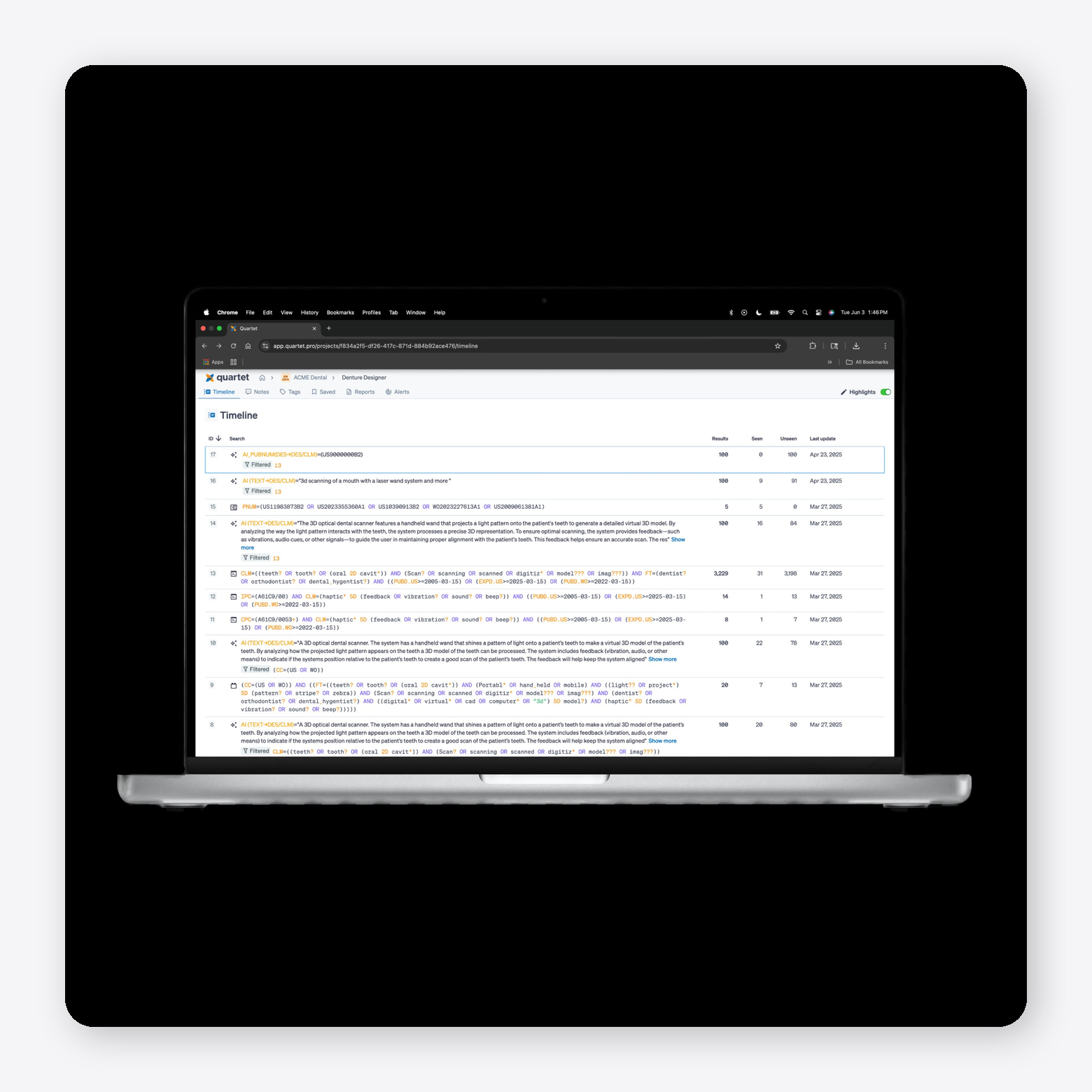
Quartet is an AI-based patent search platform designed to support prior art discovery and analysis. It uses search algorithms and AI models to retrieve and rank patent results by relevance, enabling users to explore global patent data and review related documents within a single system. Quartet is built for patent professionals who need structured search workflows and access to patent datasets across jurisdictions.
Key features:
- AI-powered patent search: Uses AI models and search algorithms to retrieve prior art based on technical concepts and query inputs
- Global patent coverage: Provides access to patent data across multiple jurisdictions for broader prior art discovery
- Search result ranking: Orders results by relevance so users can review the most applicable references first
- Prior art discovery workflows: Supports structured exploration and review of patent documents within a single interface
Quartet is an AI-based patent search platform designed to support prior art discovery and analysis. It uses search algorithms and AI models to retrieve and rank patent results by relevance, enabling users to explore global patent data and review related documents within a single system. Quartet is built for patent professionals who need structured search workflows and access to patent datasets across jurisdictions.
Key features:
- AI-powered patent search: Uses AI models and search algorithms to retrieve prior art based on technical concepts and query inputs
- Global patent coverage: Provides access to patent data across multiple jurisdictions for broader prior art discovery
- Search result ranking: Orders results by relevance so users can review the most applicable references first
- Prior art discovery workflows: Supports structured exploration and review of patent documents within a single interface
User testimonial: Not publicly available
7. Rowan Patents: Best For Solo practitioners or small firms seeking streamlined drafting

Clarivate Rowan Patents is a patent drafting software tool designed to support application preparation, review, and prosecution within a single desktop environment. It combines drafting components such as claims, specifications, and drawings, while allowing users to manage terminology, apply templates, and maintain consistency across documents.
Key features:
- Integrated patent drafting: Combines claims, specifications, and drawings in one system
- GenAI-assisted drafting: Supports drafting tasks using local or cloud-based language models
- Terms management: Maintains consistent terminology across the application
- Built-in drawing tools: Creates and manages patent drawings with synchronized numbering
User testimonial: Not available publicly
How to Choose the Best Solve Intelligence Alternative for Your Workflow
Start with the workflow gap you need to solve. If your team only needs drafting support, a drafting-focused tool may be enough. But as IP workflows become more connected, it’s worth considering how your needs may evolve over time. If you expect search, prosecution, invalidity, infringement, FTO, claim charting, and portfolio decisions to intersect across teams or matters, prioritizing an end-to-end platform can provide more long-term flexibility and continuity.
Evaluate each tool against four standards:
- Workflow coverage: Does it connect search, drafting, analysis, and portfolio work?
- Verifiability: Are outputs citation-backed and tied to source materials?
- Configurability: Can it adapt to your jurisdiction, drafting style, review process, and team workflow?
- Security: Does it meet enterprise requirements such as SOC 2 Type 2, ISO 27001, ISO 42001, encryption, access controls, and no training on customer data?
What AI Patent Drafting Tools Cannot Replace
Even though 44% of tasks are technically automatable, it does not replace the judgment that defines patent practice.
No AI tool replaces:
- Claim strategy: Deciding what to claim, how broad to go, and how to preserve downstream value.
- Prosecution judgment: Choosing when to argue, amend, appeal, or narrow claim scope.
- Client counseling: Aligning filing decisions with business priorities, budgets, and risk tolerance.
- Portfolio and litigation strategy: Evaluating enforcement, licensing, FTO, and competitive positioning.
- Attorney accountability: Final responsibility for every filing remains with the practitioner.
The best tools shift time away from mechanical work and toward the decisions attorneys are trained to make. Platforms like Patlytics focus on handling research, drafting, and analysis so attorneys can spend more time on strategy, client guidance, and decision-making.
Why an End-to-End AI Patent Platform Accelerates IP Outcomes
Patent work breaks down when search, drafting, claim analysis, and portfolio review sit in separate systems. Teams spend time moving information, rechecking outputs, and rebuilding context.
The gap worth optimizing for is the handoff between search and the analysis search is actually for. Look for platforms that connect search to citation-backed outputs, claim-level mapping, integrated charting, invalidity, FTO, infringement, prosecution, and portfolio workflows.
Patlytics brings these steps into one system. It supports work from early-stage disclosure through enforcement, so teams can manage prosecution and litigation-related tasks without switching between tools.
Solve Intelligence Alternatives FAQs
How do AI patent tools prevent hallucinations in legal outputs?
AI patent tools reduce hallucinations by grounding outputs in source material. Many platforms link generated text to cited patents, file histories, or technical documents, so users can verify each statement. Some also apply rules-based checks, structured prompts, and human-in-the-loop review to catch unsupported claims before they move forward.
Can AI patent software automate claim chart creation?
Yes. Many tools generate claim charts by mapping claim elements to supporting evidence in prior art or product documentation. These charts often include citations, excerpts, and side-by-side comparisons, which helps teams review infringement, invalidity, or freedom-to-operate positions.
Do Solve Intelligence alternatives support patent-to-product mapping?
Some alternatives support patent-to-product mapping by linking claim limitations to product features, technical documents, or market data. This is commonly used in infringement analysis and licensing workflows, where teams need to compare patents against real-world implementations.
Which AI patent tools are best for litigation versus prosecution workflows?
Tools built for prosecution typically focus on drafting, office action responses, and claim refinement. Platforms used for litigation tend to emphasize claim charts, prior art analysis, and patent-to-product mapping. End-to-end platforms can support both by connecting drafting outputs to downstream analysis and enforcement workflows.
How do AI patent platforms ensure client data is never used for model training?
Most enterprise platforms define strict data handling policies that separate customer data from model training. This can include encryption, isolated environments, and contractual guarantees that uploaded data is not retained or reused. Certifications such as SOC 2 and ISO 27001 also support these controls.
Can AI patent platforms classify and value entire patent portfolios?
Yes. Some platforms analyze large patent sets to identify trends, group related assets, and assess factors like infringement risk or technology coverage. These insights help teams decide which patents to maintain, license, enforce, or abandon based on their strategic value.
Best Solve Intelligence Alternatives: 7 AI Patent Tools Compared
If you’re evaluating AI patent tools in 2026, Solve Intelligence is likely on your list. It is an established platform for patent drafting and prosecution, with capabilities for figure generation and claim charting.
But many IP teams need more than drafting-centered workflows. They need platforms that connect prior art search, claim analysis, drafting, prosecution, claim charting, and portfolio decisions without forcing attorneys to rebuild context across separate tools.
This guide explores the best alternatives to Solve Intelligence and compares them across the factors that matter most in practice: pricing, ease of use, onboarding time, core functionality, and fit for different types of IP teams.
Key takeaways:
- Patent teams are moving beyond drafting tools toward platforms that connect search, claim analysis, prosecution, and portfolio decisions.
- The strongest alternatives provide citation-backed outputs, claim-level mapping, and integrated charting — not just generated text.
- Connected workflows reduce manual handoffs and preserve context across drafting, invalidity, infringement, FTO, and portfolio review.
- Enterprise-grade security is a baseline requirement. SOC 2 Type 2 and ISO 27001 should be table stakes; ISO 42001 is the emerging benchmark for AI management.
- AI outputs still require attorney review. The tool accelerates the work; the practitioner remains responsible for strategy and final decisions.
What Is Solve Intelligence?
Solve Intelligence is an AI-powered patent platform that supports drafting, prosecution, and related IP workflows. It’s designed for patent attorneys and IP teams working on applications, office actions, and claim analysis.
The platform includes tools for generating patent drafts, preparing office action responses, and creating claim charts for tasks like infringement or invalidity analysis. It also supports invention disclosure workflows, enabling teams to collect and manage inventor inputs in a structured format.
Solve Intelligence focuses on document creation and analysis within the prosecution process. It allows teams to apply templates, reference source materials, and track reasoning through cited outputs.
Why Patent Teams Seek Solve Intelligence Alternatives
Solve Intelligence supports drafting and prosecution workflows, but many patent teams need AI to connect more of the lifecycle.
But drafting is only one part of the work. Attorneys also need prior art search, claim-level analysis, invalidity review, infringement analysis, FTO, portfolio decisions, and secure collaboration.
The most common gaps are:
- Limited workflow coverage: Drafting tools can leave teams switching systems for search, claim charting, invalidity, infringement, and portfolio work.
- Output traceability: Patent teams need citation-backed outputs they can verify, not unsupported generated text.
- Integration and configurability: The platform should fit existing workflows, jurisdictions, drafting styles, and review processes.
- Enterprise security: Invention disclosures, unpublished applications, and legal strategy require strong access controls, clear data-use policies, and certifications such as SOC 2 Type 2, ISO 27001, and ISO 42001.
AI Patent Drafting Tools Compared
Patent drafting tools vary in how they support the broader IP workflow. Some focus on generating application text, while others connect drafting with search, analysis, and portfolio decisions. The differences show up in how well each tool fits into day-to-day work.
This list compares Solve Intelligence alternatives based on workflow coverage, output traceability, integration with existing systems, and security standards. We also looked at how each platform supports tasks beyond drafting, such as claim analysis, prior art searches, and cross-team collaboration.
1. Patlytics: Best for Law Firms and In-House Teams Needing End-to-End Patent Intelligence and Analytics
Patlytics is an AI-native platform designed to support patent work across the full lifecycle, from early-stage search to downstream analysis and decision-making. It’s built for patent attorneys, IP teams, and enterprise organizations that need to move from raw inputs to structured outputs without relying on disconnected tools.
The platform is designed around reviewable work product. Search results connect directly to claim limitations, cited references, and downstream analysis. Teams can carry that context into invalidity charts, infringement review, FTO analysis, office action work, and portfolio decisions without rebuilding the analysis in separate tools. That continuity is a key reason customers report significant reductions in project time and claim-charting costs when consolidating workflows into a single platform
Key features:
- Citation-backed outputs: Links analysis to source documents, claims, references, and supporting evidence.
- Claim-level mapping: Maps references and product evidence to specific claim limitations.
- Integrated claim charting: Supports invalidity, infringement, FTO, and enforcement workflows.
- Connected patent workflows: Carries context across search, drafting, prosecution, portfolio review, and pruning.
- Enterprise-grade security: Supports SOC 2 Type 2, ISO 27001, ISO 42001, and GDPR.
User testimonial:
“Patlytics is cutting-edge, very intelligent, fast, dynamic, and flexible. The customer service is top-notch—I'd give it a five out of five. The folks are fair during negotiation and procurement. I enjoy how seamlessly it integrates with other tools through the API end-to-end integration. It provides excellent executive summaries, and the LLM is very smart and well-developed. It's extremely easy to onboard and learn from, which is great. Also, the initial setup was very easy. I highly recommend it, giving it a 10 out of 10.” - G2 user
2. PatentPal: Best for Prosecution attorneys prioritizing visual patent elements
PatentPal is a generative AI tool that supports patent application drafting by generating specification content from input claims. It produces materials such as abstracts, summaries, detailed descriptions, flowcharts, and system diagrams, and allows users to export drafts into formats like Word, Visio, or PowerPoint. PatentPal also supports phrase customization, where users can adjust generated language based on their preferred writing style and apply those changes across the document.
Key features:
- Claim-based draft generation: Uses input claims to generate supporting specification content
- Automated figure creation: Produces flowcharts for methods and block diagrams for systems and devices
- Specification drafting support: Generates abstracts, summaries, and detailed descriptions aligned to claims
- Document upload workflow: Accepts uploaded files to initiate drafting inputs
User testimonial: Not available publicly
3. Deep IP: Best for Practitioners handling chemistry or biotech inventions
DeepIP is an AI platform designed for patent drafting, prosecution, and analysis across the patent lifecycle. It supports workflows such as invention capture, patentability assessment, drafting, office action response, and portfolio analysis within a connected system. DeepIP integrates with tools like Microsoft Word and IP management systems, allowing teams to work within existing environments while applying AI to tasks such as claim analysis, prior art review, and document preparation.
Key features:
- Patent drafting: Generates and edits patent applications based on structured inputs
- Patent prosecution support: Assists with office action responses, amendments, and argument development
- Patentability and novelty analysis: Maps claims to prior art with traceable outputs
- Agentic search: Explores and refines prior art search queries within context
User testimonial: Not available publicly
4. ClaimMaster: Best for Attorneys seeking automated proofreading within existing Word workflows
ClaimMaster is a Microsoft Word add-in that supports patent proofreading, drafting, and document analysis within the prosecution workflow. It checks patent claims, specifications, and figures for errors, including antecedent basis issues, incorrect dependencies, inconsistent terminology, and formatting problems. The tool also includes features for generating drafting sections, office action response shells, and downloading patent data, while allowing users to work within local or on-premise environments.
Key features:
- Automated patent proofreading: Detects errors in claims, specifications, and figures using customizable rules
- Claim validation checks: Identifies antecedent basis issues, dependencies, and claim inconsistencies
- Specification review: Flags issues with part names, acronyms, typos, and document structure
- Figure analysis: Reviews drawings for numbering, formatting, and consistency with the specification
User testimonial:
“I haven't run into anything that I dislike. They periodically send updates that fix issues usually caused by changes at the USPTO. I wish it would allow 2 users per subscription so my paralegal can do some of the tasks without me having to buy her own subscription.” User review
5. IP Rally: Best For Teams prioritizing prior art search over drafting automation
IPRally is an AI-based patent search and analysis platform designed for IP and R&D teams working on prior art, patentability, and portfolio review. It applies graph-based AI models trained on patent data to analyze invention disclosures, run searches, and return structured results with mapped features and cited sources. The platform supports workflows such as search, review, monitoring, and portfolio analysis, with outputs that include feature charts and evidence-linked reports.
Key features:
- AI-driven patent search: Uses graph-based models to analyze disclosures and retrieve relevant prior art
- Feature-level result mapping: Links search results to specific technical features with supporting citations
- Agentic search workflows: Automates steps from disclosure input to structured novelty reports
- Multi-format input support: Accepts text, PDFs, images, and Office documents for search queries
User testimonial:
“Citation screening and searching are not so straightforward as other searches." — User review
6. Quartet: Patent Searchers and Analysts Who Want AI-Augmented Results
Quartet is an AI-based patent search platform designed to support prior art discovery and analysis. It uses search algorithms and AI models to retrieve and rank patent results by relevance, enabling users to explore global patent data and review related documents within a single system. Quartet is built for patent professionals who need structured search workflows and access to patent datasets across jurisdictions.
Key features:
- AI-powered patent search: Uses AI models and search algorithms to retrieve prior art based on technical concepts and query inputs
- Global patent coverage: Provides access to patent data across multiple jurisdictions for broader prior art discovery
- Search result ranking: Orders results by relevance so users can review the most applicable references first
- Prior art discovery workflows: Supports structured exploration and review of patent documents within a single interface
Quartet is an AI-based patent search platform designed to support prior art discovery and analysis. It uses search algorithms and AI models to retrieve and rank patent results by relevance, enabling users to explore global patent data and review related documents within a single system. Quartet is built for patent professionals who need structured search workflows and access to patent datasets across jurisdictions.
Key features:
- AI-powered patent search: Uses AI models and search algorithms to retrieve prior art based on technical concepts and query inputs
- Global patent coverage: Provides access to patent data across multiple jurisdictions for broader prior art discovery
- Search result ranking: Orders results by relevance so users can review the most applicable references first
- Prior art discovery workflows: Supports structured exploration and review of patent documents within a single interface
User testimonial: Not publicly available
7. Rowan Patents: Best For Solo practitioners or small firms seeking streamlined drafting
Clarivate Rowan Patents is a patent drafting software tool designed to support application preparation, review, and prosecution within a single desktop environment. It combines drafting components such as claims, specifications, and drawings, while allowing users to manage terminology, apply templates, and maintain consistency across documents.
Key features:
- Integrated patent drafting: Combines claims, specifications, and drawings in one system
- GenAI-assisted drafting: Supports drafting tasks using local or cloud-based language models
- Terms management: Maintains consistent terminology across the application
- Built-in drawing tools: Creates and manages patent drawings with synchronized numbering
User testimonial: Not available publicly
How to Choose the Best Solve Intelligence Alternative for Your Workflow
Start with the workflow gap you need to solve. If your team only needs drafting support, a drafting-focused tool may be enough. But as IP workflows become more connected, it’s worth considering how your needs may evolve over time. If you expect search, prosecution, invalidity, infringement, FTO, claim charting, and portfolio decisions to intersect across teams or matters, prioritizing an end-to-end platform can provide more long-term flexibility and continuity.
Evaluate each tool against four standards:
- Workflow coverage: Does it connect search, drafting, analysis, and portfolio work?
- Verifiability: Are outputs citation-backed and tied to source materials?
- Configurability: Can it adapt to your jurisdiction, drafting style, review process, and team workflow?
- Security: Does it meet enterprise requirements such as SOC 2 Type 2, ISO 27001, ISO 42001, encryption, access controls, and no training on customer data?
What AI Patent Drafting Tools Cannot Replace
Even though 44% of tasks are technically automatable, it does not replace the judgment that defines patent practice.
No AI tool replaces:
- Claim strategy: Deciding what to claim, how broad to go, and how to preserve downstream value.
- Prosecution judgment: Choosing when to argue, amend, appeal, or narrow claim scope.
- Client counseling: Aligning filing decisions with business priorities, budgets, and risk tolerance.
- Portfolio and litigation strategy: Evaluating enforcement, licensing, FTO, and competitive positioning.
- Attorney accountability: Final responsibility for every filing remains with the practitioner.
The best tools shift time away from mechanical work and toward the decisions attorneys are trained to make. Platforms like Patlytics focus on handling research, drafting, and analysis so attorneys can spend more time on strategy, client guidance, and decision-making.
Why an End-to-End AI Patent Platform Accelerates IP Outcomes
Patent work breaks down when search, drafting, claim analysis, and portfolio review sit in separate systems. Teams spend time moving information, rechecking outputs, and rebuilding context.
The gap worth optimizing for is the handoff between search and the analysis search is actually for. Look for platforms that connect search to citation-backed outputs, claim-level mapping, integrated charting, invalidity, FTO, infringement, prosecution, and portfolio workflows.
Patlytics brings these steps into one system. It supports work from early-stage disclosure through enforcement, so teams can manage prosecution and litigation-related tasks without switching between tools.
Solve Intelligence Alternatives FAQs
How do AI patent tools prevent hallucinations in legal outputs?
AI patent tools reduce hallucinations by grounding outputs in source material. Many platforms link generated text to cited patents, file histories, or technical documents, so users can verify each statement. Some also apply rules-based checks, structured prompts, and human-in-the-loop review to catch unsupported claims before they move forward.
Can AI patent software automate claim chart creation?
Yes. Many tools generate claim charts by mapping claim elements to supporting evidence in prior art or product documentation. These charts often include citations, excerpts, and side-by-side comparisons, which helps teams review infringement, invalidity, or freedom-to-operate positions.
Do Solve Intelligence alternatives support patent-to-product mapping?
Some alternatives support patent-to-product mapping by linking claim limitations to product features, technical documents, or market data. This is commonly used in infringement analysis and licensing workflows, where teams need to compare patents against real-world implementations.
Which AI patent tools are best for litigation versus prosecution workflows?
Tools built for prosecution typically focus on drafting, office action responses, and claim refinement. Platforms used for litigation tend to emphasize claim charts, prior art analysis, and patent-to-product mapping. End-to-end platforms can support both by connecting drafting outputs to downstream analysis and enforcement workflows.
How do AI patent platforms ensure client data is never used for model training?
Most enterprise platforms define strict data handling policies that separate customer data from model training. This can include encryption, isolated environments, and contractual guarantees that uploaded data is not retained or reused. Certifications such as SOC 2 and ISO 27001 also support these controls.
Can AI patent platforms classify and value entire patent portfolios?
Yes. Some platforms analyze large patent sets to identify trends, group related assets, and assess factors like infringement risk or technology coverage. These insights help teams decide which patents to maintain, license, enforce, or abandon based on their strategic value.
The Premier AI-Powered Patent Platform
Reduce cycle times. Increase margins. Deliver winning IP outcomes.
Book a DemoThe Premier AI-Powered
Patent Platform
Reduce cycle times. Increase margins. Deliver winning IP outcomes.