專利律師的 AI 工具:現代智慧財產權工作流程實務指南
June 8, 2026

Introduction
Most AI tools for patent attorneys optimize a single task: drafting, search, or analytics. But patent work rarely happens in isolation. Prior art informs drafting, prosecution shapes claim strategy, and litigation analysis feeds portfolio decisions. When those workflows live in separate systems, attorneys spend time rebuilding context instead of advancing the work.
AI can reduce that friction when it supports the workflow, not just isolated tasks. In fact, according to Thomson Reuters, AI could free up four hours per week for lawyers in the near term, and up to 12 hours per week within five years. For patent teams, that time matters most when it reduces repetitive review, drafting setup, and manual movement of information between systems.
This guide explains how AI fits across the patent lifecycle and why more teams are moving toward connected, patent-specific platforms.
Key takeaways:
- AI tools can support prior art search, drafting, prosecution, claim analysis, and portfolio review.
- Disconnected tools create handoffs, duplicated work, and lost context across the patent lifecycle.
- Stronger platforms connect workflows with citation-backed outputs, claim-level mapping, and reviewable analysis.
- General-purpose AI can help with early drafting and summarization, but it lacks patent-specific structure and traceability.
What are AI Tools for Patent Attorneys?
AI tools for patent attorneys support core patent tasks such as prior art search, drafting, claim analysis, prosecution, and portfolio review.
They can analyze patent data, technical documents, office actions, and claim language to surface relevant references, generate draft text, compare claims, and identify potential gaps.
The output is a starting point. Attorneys still control legal judgment, claim scope, strategy, and final work product.
How AI Supports the Patent Workflow (and the Tools Behind It)
AI in patent practice is best understood not as a collection of standalone features, but as support across a connected workflow. From early-stage discovery through prosecution and portfolio strategy, different tools address different stages of the lifecycle. The real challenge is that these stages are often handled in separate systems, which breaks continuity and forces attorneys to repeatedly rebuild context.
Below is a practical view of how AI maps to each stage of patent work, along with the types of tools typically used at each step.
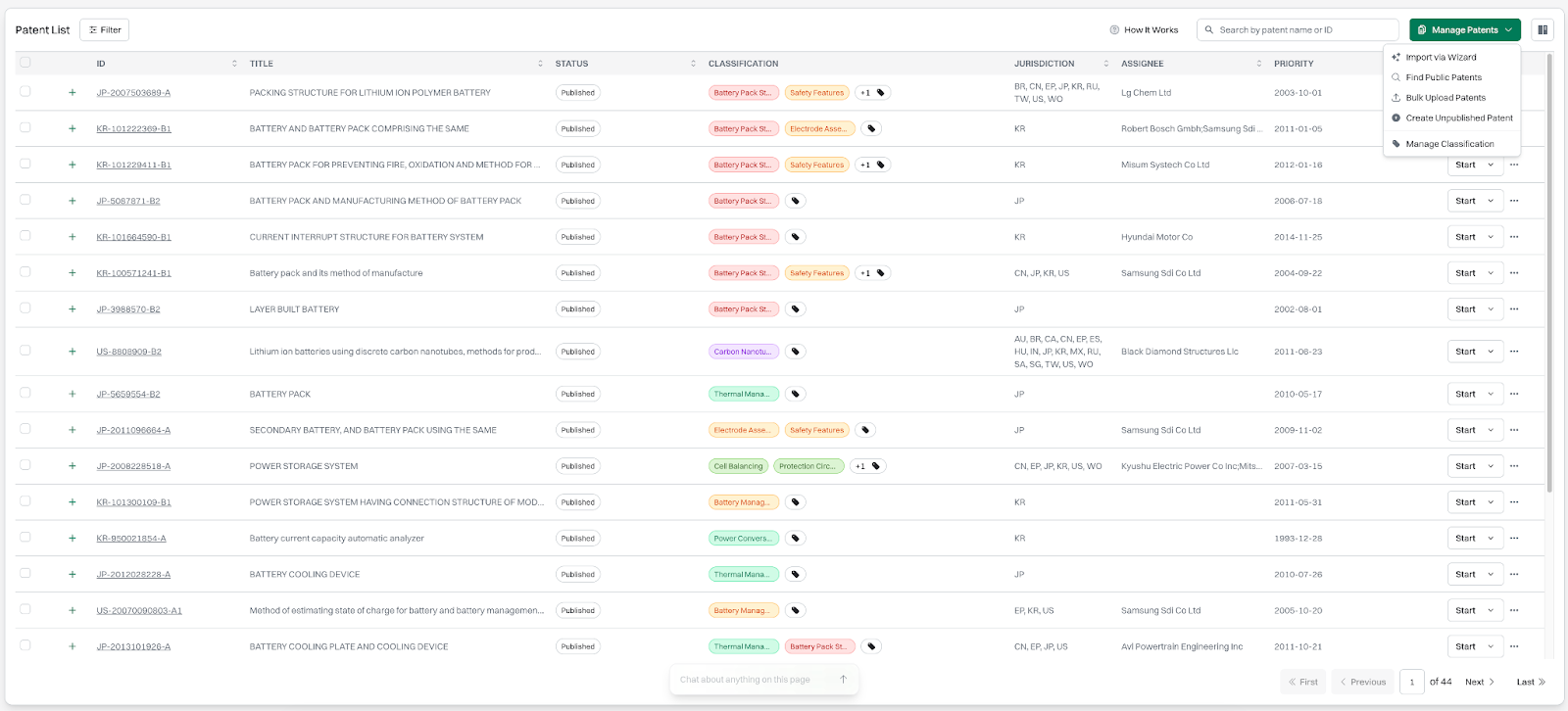
1. Discovery & Prior Art Search
At the earliest stage of the workflow, prior art search helps attorneys identify relevant patents and non-patent literature before drafting, during prosecution, or for FTO and invalidity work. Stronger tools support semantic search, classification filters, citation tracking, family review, legal status data, and jurisdictional coverage.
Typical tools in this stage: AI search platforms, patent analytics tools, landscape analysis systems
However, most tools in this category focus primarily on retrieval and ranking. The output often still needs to be reinterpreted or manually carried into drafting, claim analysis, or prosecution workflows.
Rather than treating prior art search as a one-off task, patent attorneys benefit from having a platform that captures the entire patent lifecycle from invention intake to litigation. Look for tools that support:
- Semantic and claim-based searching
- Global patent coverage
- Non-patent literature (NPL)
- Relevance ranking and evidence tracking
Patlytics can help your team through every stage of the patent process, even after prior art search has concluded.
2. Patent Drafting and Application Prepartion
AI drafting tools support the creation of early patent application content, including specifications, summaries, and embodiments. Inputs such as invention disclosures, technical notes, or preliminary claims can be transformed into structured draft material.
This accelerates the early drafting process and improves consistency in format and structure.
Typical tools in this stage: Patent drafting assistants, general-purpose LLMs, document generation tools
Used carefully, it helps attorneys test scope, flag inconsistencies, and identify potential weaknesses earlier. The attorney still decides what claim language preserves the right balance of breadth, support, and defensibility.
3. Claim Analysis and Validation
Once claims are developed, AI can help break them down into elements, compare them against prior art or products, and highlight potential gaps or inconsistencies. AI prosecution tools can parse office actions, identify rejection grounds, link issues to affected claims and cited references, and generate editable response drafts.
Typical tools in this stage: Claim charting tools, infringement/invalidity analysis platforms, semantic comparison systems
In many cases, claim analysis is still performed in isolation from drafting and prosecution data, requiring manual coordination across tools and documents.
Stronger platforms tie arguments back to source materials so attorneys can verify the basis for each response.
When you’re evaluating AI patent validity search tools, consider these key factors:
- Data Coverage: The breadth, depth, and recency of patent and non-patent literature on the platform.
- AI Sophistication: The quality of semantic search capabilities and the specialization of models for patent analysis.
- Usability and Workflow Integration: How seamlessly the tool fits into existing processes and complements human expertise
- Reporting Capabilities: Flexibility and clarity of generated reports and analytics
- Provider Expertise: The vendor's understanding of patent law nuances and technical domain knowledge.
The ideal solution combines advanced AI technology with deep patent expertise to deliver actionable insights that enhance decision-making.
4. Prosecution Support
AI tools can assist with office action analysis by identifying rejection grounds, linking cited prior art to specific claim elements, and generating draft responses for attorney review. This reduces the time required to structure arguments and organize supporting materials.
Typical tools in this stage: Prosecution support platforms, office action analysis tools, legal drafting assistants
The key limitation is that prosecution insights often remain disconnected from earlier search and drafting work, making it harder to maintain continuity in claim strategy over time.
5. Portfolio and Strategic Intelligence
At the portfolio level, AI is used to analyze large patent sets to identify coverage gaps, competitive activity, licensing opportunities, and maintenance decisions. These insights support long-term IP strategy and business alignment.
Typical tools in this stage: Patent analytics platforms, portfolio management systems, competitive intelligence tools
These systems are strongest at aggregation and visualization, but often operate separately from the underlying claim, prosecution, and drafting context that produced the patents in the first place.
6. FTO Analysis
AI supports Freedom-to-Operate (FTO) analysis by identifying patents that may be relevant to a product or feature and mapping their claims against technical descriptions or product components. This helps attorneys quickly surface potential risk areas and organize large volumes of patent data into structured comparisons.
Typical tools in this stage: AI patent search platforms (i.e. prior art databases), claim charting tools, patent analytics platforms, spreadsheet-based tracking, document review tools, and general-purpose LLMs for summarization and drafting
Used effectively, AI can accelerate the early stages of FTO by linking search results to claim-level breakdowns and highlighting areas of possible overlap between existing patents and a proposed product.
Platforms like Patlytics support this by keeping prior art, claim analysis, and product mappings connected in a single workflow, so FTO analysis can evolve without rebuilding charts from scratch at each stage.
An End-to-End AI-Native Platform That Does it All
Most AI tools in the patent space are built around individual tasks—search, drafting, prosecution, or analytics. While each solves a specific problem, they rarely share context with one another. This forces attorneys to move data manually between systems and rebuild analysis at every stage of the workflow.
End-to-end AI-native platforms take a different approach. Instead of optimizing a single step in isolation, they connect the entire patent lifecycle into a continuous workflow where search, drafting, prosecution, and analysis are linked through shared data, claims, and citations. Claims stay tied to supporting evidence. Prosecution insights can carry into invalidity, FTO, infringement, and portfolio workflows.
Patlytics is an example of this approach. It supports the full patent lifecycle in one platform, from invention disclosure and drafting to infringement analysis and portfolio decisions. Patlytics is designed for patent practitioners, with connected workflows, configurable outputs, and enterprise-grade security.
See how Patlytics supports end-to-end patent workflows in a single system.
Best Practices for Using AI in Patent Work
AI can support patent work across the lifecycle, but results depend on how it’s used. Most teams follow a few consistent practices to get value while keeping control.
- Keep a human-in-the-loop at all stages: Maintains legal judgment, oversight, and accountability across every step
- Use AI for first drafts, not final outputs: Allows faster early-stage work while keeping final decisions with the attorney
- Validate prior art results manually: Reduces the risk of missed references or incomplete search results
- Protect sensitive data: Keeps client and invention information secure when using AI tools
- Develop internal AI workflows: Creates consistency across teams and standardizes how AI is used
When Should Patent Attorneys Use AI (and When Not To)?
AI 最適合用於支援結構化且可重複的任務。專利律師常利用 AI 來審閱大型數據集、整理資訊並產出初步草稿。
在以下情況使用 AI:
- 大規模審閱先前技術: 協助從大型數據集中找出相關參考文獻
- 撰寫初步內容: 產出說明書、請求項或摘要的初稿
- 摘要複雜資料: 將技術文件或審查意見通知書拆解為重點
- 比對請求項與參考文獻: 協助識別重疊處、缺漏或風險
在以下情況避免依賴 AI:
- 做出最終法律判斷: 關於專利性、請求項範圍及策略的決策,必須由律師親自把關
- 定稿申請文件內容: 草稿需經審閱以確保準確性、清晰度及法律效力
- 評估細微的技術差異: AI 可能會遺漏影響請求項解釋的背景資訊
- 在缺乏防護措施的情況下處理高度敏感資訊: 使用前必須確認資料安全與保密性
AI 能輔助工作流程,但無法取代法律專業。律師仍需對策略、解釋及最終產出負起責任。
專利律師的 AI 工具正轉向整合式工作流程
專利律師鮮少只依賴單一工具。檢索、撰寫、權利要求分析、審查及專利組合管理往往分散在不同系統中。雖然每個工具都能解決特定問題,但系統間的銜接卻會造成阻礙:資訊需要重複複製、輸出格式需重新調整,且前期工作的脈絡也無法完整延續。
這就是為什麼越來越多團隊開始轉向 整合式專利工作流程。在端到端的平台上,前案檢索的結果可直接用於撰寫,權利要求能與佐證資料保持連結,審查意見分析可回溯至引證案,而審查洞察則能延續至專利組合審查中。
其價值不在於為了使用 AI 而使用 AI,而在於減少重複工作、降低手動銜接的繁瑣,並在整個專利生命週期中提供更易於審閱的分析。
Patlytics 將發明揭露、撰寫、審查、無效性分析、侵權分析、FTO(自由實施)、權利要求對照表及專利組合分析整合在單一專利專用平台中,並提供具備引證支援的輸出、可配置的工作流程以及企業級安全性。
探索 Patlytics 如何透過單一平台支援整合式專利工作流程。
關於專利律師 AI 工具的常見問題
AI 可以撰寫專利申請書嗎?
AI 可以撰寫專利申請書的部分內容,包括說明書、摘要,甚至是初步的權利要求架構。當從發明揭露書或前案等結構化輸入開始時,效果最佳。
律師在提交前仍需審閱並潤飾所有內容。AI 可以產出初稿,但律師仍需對論點、權利要求範圍及審查策略負責。
專利律師需要 AI 工具嗎?
專利律師並非必須使用 AI 工具才能工作,但許多律師利用這些工具來應對日益繁重的工作量並減少重複性任務。AI 可協助研究、撰寫與分析,特別是在同時管理多項申請案時。
根據 美國律師協會的資料,54% 的法律專業人士已使用 AI 來撰寫信函。
有些團隊仍依賴傳統工作流程,另一些團隊則在特定環節(如前案檢索或初步撰寫)使用 AI。選擇取決於工作量、團隊結構以及工作管理方式。
AI 在進行先前技術檢索時可靠嗎?
AI 可以透過掃描龐大的資料集,並根據概念而非僅僅是關鍵字來識別相關參考文獻,從而輔助先前技術檢索。它有助於快速篩選出文件,並在流程早期釐清檢索方向。
檢索結果仍需人工審核。AI 可能會遺漏上下文、誤解技術術語,或提供關聯性較低的文件。律師需負責檢查結果、調整查詢條件,並在採信輸出內容前確認其相關性。
在專利法中使用 AI 有哪些風險?
若將 AI 的輸出結果視為最終定論或未經核實即直接使用,便會產生風險。常見風險包括引用錯誤、先前技術分析不完整、申請專利範圍用語缺乏依據、無意間限縮專利範圍,以及洩露機密發明或客戶資料。
律師應使用具備引用來源、清晰連結、嚴格安全控管及明確審核流程的 AI 工具。對於準確性、策略制定及申請決策,最終責任仍由執業律師承擔。
專利律師的 AI 工具:現代智慧財產權工作流程實務指南
Introduction
Most AI tools for patent attorneys optimize a single task: drafting, search, or analytics. But patent work rarely happens in isolation. Prior art informs drafting, prosecution shapes claim strategy, and litigation analysis feeds portfolio decisions. When those workflows live in separate systems, attorneys spend time rebuilding context instead of advancing the work.
AI can reduce that friction when it supports the workflow, not just isolated tasks. In fact, according to Thomson Reuters, AI could free up four hours per week for lawyers in the near term, and up to 12 hours per week within five years. For patent teams, that time matters most when it reduces repetitive review, drafting setup, and manual movement of information between systems.
This guide explains how AI fits across the patent lifecycle and why more teams are moving toward connected, patent-specific platforms.
Key takeaways:
- AI tools can support prior art search, drafting, prosecution, claim analysis, and portfolio review.
- Disconnected tools create handoffs, duplicated work, and lost context across the patent lifecycle.
- Stronger platforms connect workflows with citation-backed outputs, claim-level mapping, and reviewable analysis.
- General-purpose AI can help with early drafting and summarization, but it lacks patent-specific structure and traceability.
What are AI Tools for Patent Attorneys?
AI tools for patent attorneys support core patent tasks such as prior art search, drafting, claim analysis, prosecution, and portfolio review.
They can analyze patent data, technical documents, office actions, and claim language to surface relevant references, generate draft text, compare claims, and identify potential gaps.
The output is a starting point. Attorneys still control legal judgment, claim scope, strategy, and final work product.
How AI Supports the Patent Workflow (and the Tools Behind It)
AI in patent practice is best understood not as a collection of standalone features, but as support across a connected workflow. From early-stage discovery through prosecution and portfolio strategy, different tools address different stages of the lifecycle. The real challenge is that these stages are often handled in separate systems, which breaks continuity and forces attorneys to repeatedly rebuild context.
Below is a practical view of how AI maps to each stage of patent work, along with the types of tools typically used at each step.
1. Discovery & Prior Art Search
At the earliest stage of the workflow, prior art search helps attorneys identify relevant patents and non-patent literature before drafting, during prosecution, or for FTO and invalidity work. Stronger tools support semantic search, classification filters, citation tracking, family review, legal status data, and jurisdictional coverage.
Typical tools in this stage: AI search platforms, patent analytics tools, landscape analysis systems
However, most tools in this category focus primarily on retrieval and ranking. The output often still needs to be reinterpreted or manually carried into drafting, claim analysis, or prosecution workflows.
Rather than treating prior art search as a one-off task, patent attorneys benefit from having a platform that captures the entire patent lifecycle from invention intake to litigation. Look for tools that support:
- Semantic and claim-based searching
- Global patent coverage
- Non-patent literature (NPL)
- Relevance ranking and evidence tracking
Patlytics can help your team through every stage of the patent process, even after prior art search has concluded.
2. Patent Drafting and Application Prepartion
AI drafting tools support the creation of early patent application content, including specifications, summaries, and embodiments. Inputs such as invention disclosures, technical notes, or preliminary claims can be transformed into structured draft material.
This accelerates the early drafting process and improves consistency in format and structure.
Typical tools in this stage: Patent drafting assistants, general-purpose LLMs, document generation tools
Used carefully, it helps attorneys test scope, flag inconsistencies, and identify potential weaknesses earlier. The attorney still decides what claim language preserves the right balance of breadth, support, and defensibility.
3. Claim Analysis and Validation
Once claims are developed, AI can help break them down into elements, compare them against prior art or products, and highlight potential gaps or inconsistencies. AI prosecution tools can parse office actions, identify rejection grounds, link issues to affected claims and cited references, and generate editable response drafts.
Typical tools in this stage: Claim charting tools, infringement/invalidity analysis platforms, semantic comparison systems
In many cases, claim analysis is still performed in isolation from drafting and prosecution data, requiring manual coordination across tools and documents.
Stronger platforms tie arguments back to source materials so attorneys can verify the basis for each response.
When you’re evaluating AI patent validity search tools, consider these key factors:
- Data Coverage: The breadth, depth, and recency of patent and non-patent literature on the platform.
- AI Sophistication: The quality of semantic search capabilities and the specialization of models for patent analysis.
- Usability and Workflow Integration: How seamlessly the tool fits into existing processes and complements human expertise
- Reporting Capabilities: Flexibility and clarity of generated reports and analytics
- Provider Expertise: The vendor's understanding of patent law nuances and technical domain knowledge.
The ideal solution combines advanced AI technology with deep patent expertise to deliver actionable insights that enhance decision-making.
4. Prosecution Support
AI tools can assist with office action analysis by identifying rejection grounds, linking cited prior art to specific claim elements, and generating draft responses for attorney review. This reduces the time required to structure arguments and organize supporting materials.
Typical tools in this stage: Prosecution support platforms, office action analysis tools, legal drafting assistants
The key limitation is that prosecution insights often remain disconnected from earlier search and drafting work, making it harder to maintain continuity in claim strategy over time.
5. Portfolio and Strategic Intelligence
At the portfolio level, AI is used to analyze large patent sets to identify coverage gaps, competitive activity, licensing opportunities, and maintenance decisions. These insights support long-term IP strategy and business alignment.
Typical tools in this stage: Patent analytics platforms, portfolio management systems, competitive intelligence tools
These systems are strongest at aggregation and visualization, but often operate separately from the underlying claim, prosecution, and drafting context that produced the patents in the first place.
6. FTO Analysis
AI supports Freedom-to-Operate (FTO) analysis by identifying patents that may be relevant to a product or feature and mapping their claims against technical descriptions or product components. This helps attorneys quickly surface potential risk areas and organize large volumes of patent data into structured comparisons.
Typical tools in this stage: AI patent search platforms (i.e. prior art databases), claim charting tools, patent analytics platforms, spreadsheet-based tracking, document review tools, and general-purpose LLMs for summarization and drafting
Used effectively, AI can accelerate the early stages of FTO by linking search results to claim-level breakdowns and highlighting areas of possible overlap between existing patents and a proposed product.
Platforms like Patlytics support this by keeping prior art, claim analysis, and product mappings connected in a single workflow, so FTO analysis can evolve without rebuilding charts from scratch at each stage.
An End-to-End AI-Native Platform That Does it All
Most AI tools in the patent space are built around individual tasks—search, drafting, prosecution, or analytics. While each solves a specific problem, they rarely share context with one another. This forces attorneys to move data manually between systems and rebuild analysis at every stage of the workflow.
End-to-end AI-native platforms take a different approach. Instead of optimizing a single step in isolation, they connect the entire patent lifecycle into a continuous workflow where search, drafting, prosecution, and analysis are linked through shared data, claims, and citations. Claims stay tied to supporting evidence. Prosecution insights can carry into invalidity, FTO, infringement, and portfolio workflows.
Patlytics is an example of this approach. It supports the full patent lifecycle in one platform, from invention disclosure and drafting to infringement analysis and portfolio decisions. Patlytics is designed for patent practitioners, with connected workflows, configurable outputs, and enterprise-grade security.
See how Patlytics supports end-to-end patent workflows in a single system.
Best Practices for Using AI in Patent Work
AI can support patent work across the lifecycle, but results depend on how it’s used. Most teams follow a few consistent practices to get value while keeping control.
- Keep a human-in-the-loop at all stages: Maintains legal judgment, oversight, and accountability across every step
- Use AI for first drafts, not final outputs: Allows faster early-stage work while keeping final decisions with the attorney
- Validate prior art results manually: Reduces the risk of missed references or incomplete search results
- Protect sensitive data: Keeps client and invention information secure when using AI tools
- Develop internal AI workflows: Creates consistency across teams and standardizes how AI is used
When Should Patent Attorneys Use AI (and When Not To)?
AI 最適合用於支援結構化且可重複的任務。專利律師常利用 AI 來審閱大型數據集、整理資訊並產出初步草稿。
在以下情況使用 AI:
- 大規模審閱先前技術: 協助從大型數據集中找出相關參考文獻
- 撰寫初步內容: 產出說明書、請求項或摘要的初稿
- 摘要複雜資料: 將技術文件或審查意見通知書拆解為重點
- 比對請求項與參考文獻: 協助識別重疊處、缺漏或風險
在以下情況避免依賴 AI:
- 做出最終法律判斷: 關於專利性、請求項範圍及策略的決策,必須由律師親自把關
- 定稿申請文件內容: 草稿需經審閱以確保準確性、清晰度及法律效力
- 評估細微的技術差異: AI 可能會遺漏影響請求項解釋的背景資訊
- 在缺乏防護措施的情況下處理高度敏感資訊: 使用前必須確認資料安全與保密性
AI 能輔助工作流程,但無法取代法律專業。律師仍需對策略、解釋及最終產出負起責任。
專利律師的 AI 工具正轉向整合式工作流程
專利律師鮮少只依賴單一工具。檢索、撰寫、權利要求分析、審查及專利組合管理往往分散在不同系統中。雖然每個工具都能解決特定問題,但系統間的銜接卻會造成阻礙:資訊需要重複複製、輸出格式需重新調整,且前期工作的脈絡也無法完整延續。
這就是為什麼越來越多團隊開始轉向 整合式專利工作流程。在端到端的平台上,前案檢索的結果可直接用於撰寫,權利要求能與佐證資料保持連結,審查意見分析可回溯至引證案,而審查洞察則能延續至專利組合審查中。
其價值不在於為了使用 AI 而使用 AI,而在於減少重複工作、降低手動銜接的繁瑣,並在整個專利生命週期中提供更易於審閱的分析。
Patlytics 將發明揭露、撰寫、審查、無效性分析、侵權分析、FTO(自由實施)、權利要求對照表及專利組合分析整合在單一專利專用平台中,並提供具備引證支援的輸出、可配置的工作流程以及企業級安全性。
探索 Patlytics 如何透過單一平台支援整合式專利工作流程。
關於專利律師 AI 工具的常見問題
AI 可以撰寫專利申請書嗎?
AI 可以撰寫專利申請書的部分內容,包括說明書、摘要,甚至是初步的權利要求架構。當從發明揭露書或前案等結構化輸入開始時,效果最佳。
律師在提交前仍需審閱並潤飾所有內容。AI 可以產出初稿,但律師仍需對論點、權利要求範圍及審查策略負責。
專利律師需要 AI 工具嗎?
專利律師並非必須使用 AI 工具才能工作,但許多律師利用這些工具來應對日益繁重的工作量並減少重複性任務。AI 可協助研究、撰寫與分析,特別是在同時管理多項申請案時。
根據 美國律師協會的資料,54% 的法律專業人士已使用 AI 來撰寫信函。
有些團隊仍依賴傳統工作流程,另一些團隊則在特定環節(如前案檢索或初步撰寫)使用 AI。選擇取決於工作量、團隊結構以及工作管理方式。
AI 在進行先前技術檢索時可靠嗎?
AI 可以透過掃描龐大的資料集,並根據概念而非僅僅是關鍵字來識別相關參考文獻,從而輔助先前技術檢索。它有助於快速篩選出文件,並在流程早期釐清檢索方向。
檢索結果仍需人工審核。AI 可能會遺漏上下文、誤解技術術語,或提供關聯性較低的文件。律師需負責檢查結果、調整查詢條件,並在採信輸出內容前確認其相關性。
在專利法中使用 AI 有哪些風險?
若將 AI 的輸出結果視為最終定論或未經核實即直接使用,便會產生風險。常見風險包括引用錯誤、先前技術分析不完整、申請專利範圍用語缺乏依據、無意間限縮專利範圍,以及洩露機密發明或客戶資料。
律師應使用具備引用來源、清晰連結、嚴格安全控管及明確審核流程的 AI 工具。對於準確性、策略制定及申請決策,最終責任仍由執業律師承擔。
頂尖 AI 驅動的
專利平台
縮短週期時間。提高利潤率。實現卓越的智慧財產權成果。