November 27, 2026
Ex parte reexamination vs IPR: evidence and timing in 2026
Compare US ex parte reexamination and IPR grounds, evidence, participation, filing clocks, and procedural consequences, with a counsel-review checklist.
Which proceeding fits your evidence and litigation calendar? Ex parte reexamination is examiner-led; inter partes review (IPR) is a contested trial before the Patent Trial and Appeal Board (PTAB). Both need a supported opening submission, but only IPR gives the challenger a continuing trial role. Compare the grounds, clock triggers, and participation under the US Patent and Trademark Office’s Manual of Patent Examining Procedure (MPEP §2209 ↗) and 35 U.S.C. §316 ↗.
Scope: ordinary US ex parte reexamination under §302 and IPR, November 2026.
Ex parte reexamination vs IPR at a glance
Compare the legal basis and procedural record together. A technically persuasive reference can still face a filing bar, an unresolved publication date, or earlier-proceeding constraints.
| Decision point | Ex parte reexamination | IPR |
|---|---|---|
| Who can initiate | Any person, including the patent owner, subject to applicable restrictions. 35 U.S.C. §302 ↗ | A person other than the owner; the petition identifies real parties in interest. §311(a) ↗ and §312(a) ↗ |
| Available grounds | Generally §§102/103 grounds based on patents or printed publications. Patent-based double patenting is also within the stated scope. MPEP §2258 ↗ | Only §§102/103 grounds based on prior-art patents or printed publications. §311(b) ↗ |
| Opening evidence package | Identify each substantial new question of patentability (SNQ), every requested claim, and how the cited documents apply. Include required copies and pertinent translations. 37 C.F.R. §1.510 ↗ | Identify claims, grounds, constructions, source passages, and exhibit relevance with particularity; supply relied-on expert evidence. §312(a) ↗ and 37 C.F.R. §42.104 ↗ |
| Initial merits threshold | An SNQ: a teaching important to a reasonable examiner, subject to the new-question requirement. This need not establish a prima facie rejection. MPEP §2242 ↗ | A reasonable likelihood that the petitioner would prevail on at least 1 challenged claim. Meeting this statutory floor does not compel institution. §314(a) ↗ |
| Challenger participation | Limited. A requester may reply to a post-order owner statement; ordinary active merits participation then ends. 37 C.F.R. §1.550 ↗ | Continuing party participation, with briefing, limited discovery, testimony, and an oral-hearing opportunity. §316(a) ↗ |
| Filing availability | During the patent’s enforceability period, subject to estoppel and other applicable restrictions. Expiration and enforceability are different. 37 C.F.R. §1.510(a) ↗ | Opening-date rules, earlier validity actions, and the 1-year complaint-service bar apply, with a joinder exception. §315(a)–(c) ↗ and 37 C.F.R. §42.102 ↗ |
| Initial decision clock | SNQ determination within 3 months after the complete request’s filing date. §303(a) ↗ and 37 C.F.R. §1.510(d) ↗ | Institution decision within 3 months after the preliminary response or its deadline. The response is normally due 3 months after the filing-date notice. §314(b) ↗ and 37 C.F.R. §42.107 ↗ |
| Completion framework | Special dispatch, without a fixed overall certificate deadline in §305. 35 U.S.C. §305 ↗ | Final determination normally within 1 year after institution notice; a good-cause extension can add up to 6 months, with adjustment for joinder. §316(a)(11) ↗ |
| Construction and amendments | Broadest reasonable interpretation generally applies to unexpired claims, with an expired-claim exception. Amendments cannot enlarge scope. MPEP §2258 ↗ and §305 ↗ | Civil-action claim-construction standard; amendments proceed through a constrained motion process and cannot enlarge scope or introduce new matter. 37 C.F.R. §42.100 ↗ and §316(d) ↗ |
| Estoppel and prior challenges | No equivalent Chapter 30 requester estoppel triggered by a final written decision. Prior challenges and repeat-art discretion still matter; record both reexamination request and order dates. 37 C.F.R. §1.510 ↗ and §325(d)–(e) ↗ | After a final written decision, §315(e) restricts specified later challenges by the petitioner, real parties in interest, and privies on grounds raised or reasonably capable of being raised during that IPR. §315(e) ↗ |
| Decision and appeal | A certificate confirms, cancels, or incorporates amended/new claims after the appeal period or appeals. The owner has the merits-appeal right. §306 ↗ and §307 ↗ | A final written decision precedes the later certificate. Parties have a statutory appeal route. §318 ↗ and §319 ↗ |
Separate the prior-art basis from supporting evidence
Start with 2 questions: what legal ground challenges the claim, and what role does each exhibit play? Neither procedure opens a general challenge based on a physical product, public use, or sale merely because that evidence is compelling. Ordinary reexamination also excludes freestanding original-claim §101 and §112 challenges. Its treatment of amended or new claims has a different scope. MPEP §2258 ↗ and §311(b) ↗ supply the relevant boundaries.
For non-patent literature (NPL), such as a manual, paper, or technical standard, preserve the exact version, relevant passages, and evidence supporting public availability by the legally relevant date. A date printed on a document and evidence of public access answer different questions. MPEP §2128 ↗ explains public accessibility; the NPL source and date guide ↗ develops the evidence record.
Declarations can explain a cited document’s teachings or pertinent dates in reexamination. In IPR, expert evidence can support the technical explanation, and cross-examination can test that testimony. Expert testimony that does not disclose its underlying facts or data receives little or no weight under the PTAB rules. These supporting roles leave the permitted prior-art basis unchanged. See MPEP §2217, part II ↗, 37 C.F.R. §42.51 ↗, and 37 C.F.R. §42.65 ↗.
That distinction affects preparation. A requester considering reexamination needs a documentary explanation that can stand after its participation ends. A prospective IPR petitioner needs an equally developed petition plus a plan for defending the technical reasoning through the trial schedule. Keep the claim mapping, date foundation, and expert explanation identifiable as separate parts of the package. The invalidity contentions evidence guide ↗ covers the broader litigation handoff.
Participation changes how the evidence will be tested
In reexamination, the post-order owner statement is optional. If the owner files one, the requester has 2 months after service to reply. Without that statement, the ordinary reply opportunity never arises. The Office serves actions on the requester, but the proceeding then runs between the owner and the examiner, subject to specified procedural exceptions. 35 U.S.C. §304 ↗, 37 C.F.R. §1.535 ↗, and §1.550 ↗ define that role.
The 2026 pre-order procedure adds an optional, limited owner paper for requests filed on or after April 5, 2026. The paper may be up to 30 pages and is due within a non-extendable 30 days after service of the request. It addresses the specified SNQ issues. Challenges to whether the teaching is new, and requests for §325(d) discretion, belong outside that paper. A requester response is exceptional and requires the prescribed petition, fee, and deadline. See the April pre-order notice ↗, parts II–III.
IPR provides a different evidence-testing environment. Routine discovery includes cross-examination of affidavit testimony; additional discovery generally requires agreement or an interests-of-justice showing. Evaluate whether disputed technical explanations need that continuing adversarial process, while accounting for its staffing and schedule demands. 37 C.F.R. §42.51 ↗ sets the discovery framework.
Compare clock triggers before comparing speed
The 3-month reexamination determination and the IPR institution timetable start from different events. An incomplete reexamination request can affect its filing date. The IPR preliminary-response period normally starts with the filing-date notice, followed by the institution-decision period. A simple “3 months versus 6 months” comparison hides those triggers. The relevant provisions are 37 C.F.R. §1.510(d) ↗, §42.107(b) ↗, and 35 U.S.C. §314(b) ↗.
In a synthetic calendar example, a complete reexamination request filed January 6, 2026, gives an April 6 nominal SNQ-determination date. An IPR filing-date notice dated January 6 gives an April 6 preliminary-response deadline; if that deadline supplies the institution trigger, the next 3-month date is July 6. January 6–April 6 spans 90 days; April 6–July 6 spans 91 days. Compare each clock’s trigger before comparing speed.
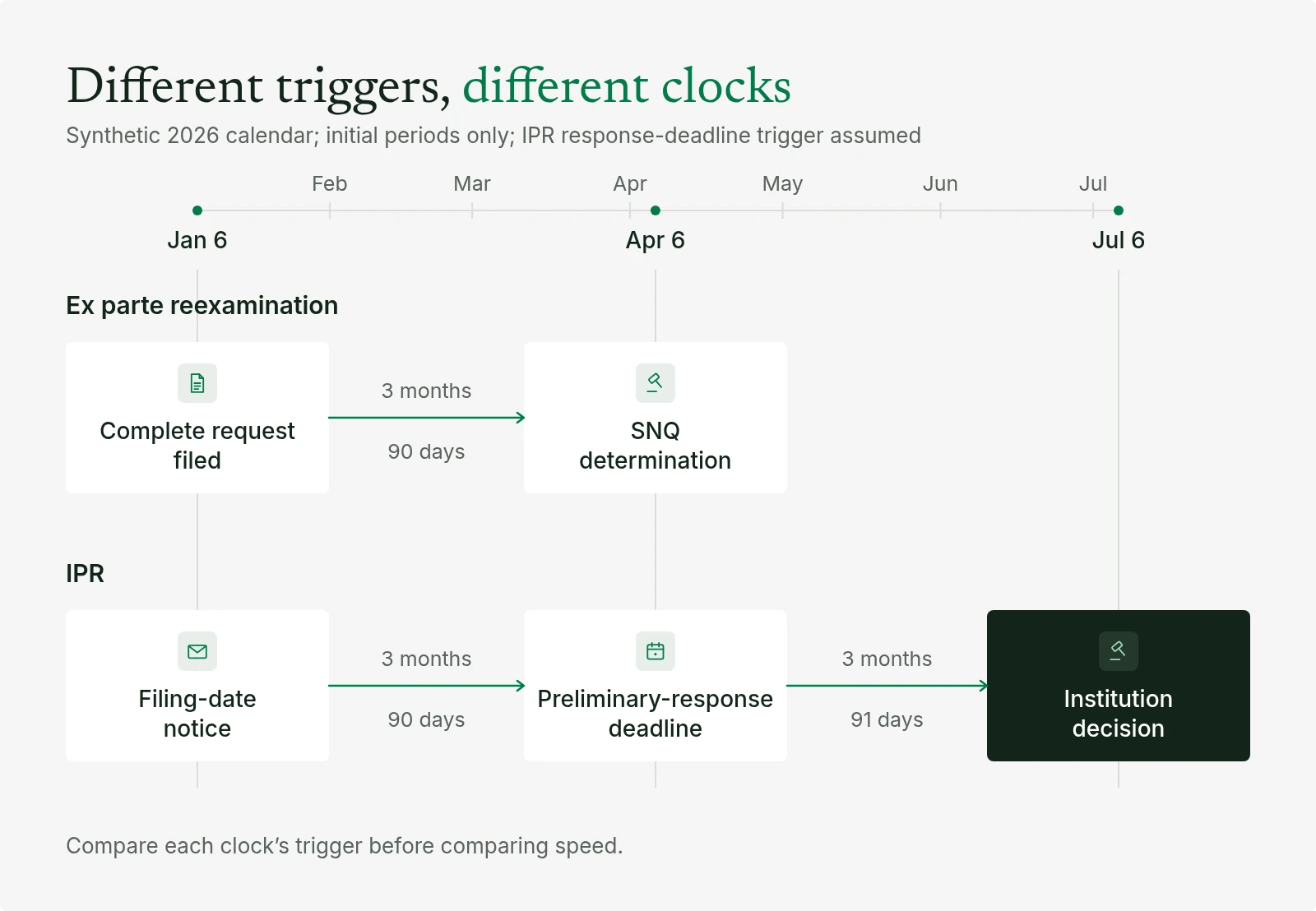
Counsel must separately calendar service, filing completeness, applicable extensions, and orders for the actual matter. IPR’s normal 1-year post-institution determination period excludes the preceding petition stage and the later appeal/certificate sequence. Reexamination’s special-dispatch requirement supplies no fixed overall completion date. §316(a)(11) ↗, §318 ↗, and §305 ↗ keep those stages distinct.
Earlier proceedings can change which route remains available
For IPR, counsel must resolve the applicable opening date, any earlier petitioner or real-party-in-interest validity action, and complaint service on the petitioner, real party in interest, or privy. The service bar generally applies more than 1 year after service. America Invents Act (AIA) status also matters: the 9-month opening restriction has a non-AIA-patent exception, so patent age alone is an incomplete screen. §311 and its statutory note ↗, §315(a)–(b) ↗, and 37 C.F.R. §42.102 ↗ govern those gates.
After an IPR final written decision, a later reexamination request can encounter §315(e)(1) estoppel. In In re Gesture Technology Partners, the reexamination request was filed in November 2021 and the Office ordered reexamination in January 2022, both before the November 2022 IPR final written decisions. The Federal Circuit held on December 1, 2025, that the Office maintains the reexamination, so §315(e)(1) did not require its termination. For a request still awaiting an order when an IPR final written decision issues, counsel must analyze estoppel separately. See the Gesture opinion ↗, pp. 4, 6–7. The separate IPR estoppel ground audit ↗ addresses claim, party, and ground reconciliation.
Reexamination also faces repeat-art and repeat-argument review under §325(d). Previously considered art can still raise an SNQ, yet that finding and discretionary treatment are separate inquiries. In re Vivint illustrates why a denied IPR supplies no automatic clearance for a serial reexamination request. 35 U.S.C. §303(a) ↗, §325(d) ↗, and the Vivint opinion ↗, pp. 10–18, support that separate review.
November 2026 IPR institution practice
The November 10, 2026 memorandum, effective November 16, retains the Director’s initial non-merits review. Petitions that pass that review go to a 3-member PTAB panel for merits-based institution consideration. A different panel conducts any instituted trial. The transition applies where a merits-referral notice has not yet been entered.
Its guidelines require the requisite showing for a substantial majority of challenged claims. When arguments for and against a particular claim’s unpatentability are both reasonably supported, the panel treats that claim’s showing as insufficient. Those are agency institution guidelines; §314(a) still states the statutory at-least-1-claim threshold. Counsel’s institution assessment must address both. See the November institution memorandum ↗, pp. 6–12.
Litigation and claim changes require separate planning
Neither filing supplies a blanket automatic stay of an infringement case. Section 315(a)(2)’s automatic stay concerns a narrower petitioner-filed validity-action situation. Court stay analysis and patent-office coordination are separate workstreams. 35 U.S.C. §315(a), (d) ↗ and MPEP §2286 ↗ distinguish them.
Plan for the commercial effect of surviving, canceled, or changed claims as well. Amended or new claims can carry intervening-rights consequences under the statutes’ incorporation of §252. Counsel must assess those consequences against past conduct and future product plans. 35 U.S.C. §307(b) ↗ and §318(c) ↗ supply the starting point.
Synthetic counsel-review checklist
Fictional matter: In November 2026, Aster’s counsel is assessing claims 1 and 7 of a battery-management patent. The file contains Patent A, Manual B with a disputed public-availability date, an expert declaration, and observations of an earlier device. A complaint and a related IPR also appear in the record.
Use the following as a review record, with the legal screens above applied to the actual facts.
| Counsel-review item | Aster’s unresolved record | Decision to document |
|---|---|---|
| Claim scope and status | Current text of claims 1 and 7, amendments, expiration, and enforceability | The claims and construction assumptions each proposed ground addresses |
| Evidence role | Patent A’s qualifying date; Manual B’s exact version and public access; the declaration’s factual foundation | Which documents supply the ground and which exhibits only support an explanation |
| Filing gates | Complaint-service records, applicable IPR opening date, and any earlier validity action | Which routes remain procedurally available and their actual docket dates |
| Prior proceedings | Related IPR parties, claims, grounds, disposition, and final written decision dates; reexamination request and order dates; repeated art or arguments | Estoppel, §325(d), and the sequence of reexamination requests, orders, and IPR final written decisions |
| Participation | Whether Manual B’s date or the technical interpretation needs testimony tested through cross-examination | The value of continuing party participation relative to the proposed evidence package |
| Parallel consequences | Court schedule, existing stays or orders, possible claim changes, and product plans | Separate stay, coordination, and intervening-rights analyses |
The completed record should explain counsel’s route choice and the unresolved facts that could change it. Neither a strong reference nor a single calendar fact supplies that judgment.
Where Patlytics fits
Patlytics supports the substantive evidence preparation behind this decision: finding candidate references, mapping claims, and developing technical explanations for counsel’s route assessment.
- Patent & NPL Search ↗ uses claim-focused technical concepts to find candidate patent and non-patent literature references.
- Invalidity produces source-linked, limitation-level claim charts from selected claims and retained references.
- §103 Combination Builder proposes reference combinations from the invalidity analysis, each linked to the cited passages.
- Claim Construction produces editable proposed constructions with pinpoint citations to the specification.
Attorneys retain authority over source qualification, legal grounds, the final work product, and the procedural choice.
Build a claim-mapped evidence package for a reexamination-or-IPR assessment. Book a Demo → to see candidate-reference search, source-linked charts, and combination analysis on a representative patent.

See it on your own patents
Reduce cycle times. Increase margins. Deliver winning IP outcomes.