November 18, 2026
Patent citation analysis: build a licensing-prospect shortlist
Turn a supplied patent citation dataset into an assignee shortlist with deduplicated relationships, technical relevance, evidence gaps, and review handoffs.
Which companies in a patent citation export deserve the next block of product-research and counsel time? Patent citation analysis supports your intellectual property (IP) team's decision by tracing forward citations through 3 layers: document evidence, family relationships, and organization leads. Prioritize assignees by their recorded technical connection and a defined next investigation, preserving the underlying records and open questions.
Scope: citation-derived assignee triage from a supplied dataset, before public-product investigation and selected-claim review.
What patent citation analysis contributes to licensing
Patent citation analysis examines references between patent documents. Relative to a seed patent you start from, backward citations are the documents it cites; forward citations are later documents that cite it. For prospective licensee discovery, start with the forward relationships in the supplied dataset and identify the organizations associated with the citing documents.
The output should be a small set of assignee leads with review assignments. An assignee is the entity recorded as receiving patent rights. Keep the dataset's actual field label, such as applicant or assignee, because those records answer different questions about the organization.
Use citation relationships to decide where to investigate. Determine any licensing position through subsequent product evidence, relevant patent rights, claim analysis, and commercial review. The broader licensing target workflow ↗ covers that next stage.
The most useful shortlist separates 3 layers:
- Document evidence: the exact citing and cited publications.
- Family relationships: grouped links between related patent filings.
- Organization leads: reconciled names, technical reasons for inclusion, and an assigned next question.
Keeping those layers separate makes a lead explainable even when its headline citation count changes.
1. Fix the question and preserve the supplied input
Start with a brief that identifies the technology and the licensing program's intended markets. A seed set might contain selected patents relating to consumer-device account synchronization. Keep that technology boundary consistent as you review the citing documents.
Save an unchanged copy of the supplied dataset. Alongside it, record:
- The source or supplied-file label, export date, and version.
- Seed publication identifiers and the seed-selection rationale.
- Included jurisdictions, publication cutoff, and observation window.
- Citation direction and generation, such as direct forward citations only.
- Applicant- or examiner-origin fields, where supplied.
- Family identifiers and the family convention used.
Treat an unavailable field as unknown and assign any necessary follow-up. Record which seed-family members the export actually covers. A file containing citations to 1 publication supports a different review from a file covering its wider family.
Keep publication timing visible when comparing leads. Older documents generally have had longer to accumulate citations, a pattern discussed in the patent analytics handbook ↗. A low count for a recent publication can still justify technical review.
Work product: a scope record attached to an unchanged input file.
2. Deduplicate relationships without losing their source members
Create a working table with 1 citing-document/cited-document pair per row. Preserve the original row reference and citation origin. Normalize spacing and identifiers while retaining country and publication kind codes. Keep application identifiers separate from publication identifiers.
Remove exact duplicate pairs from the analytical count. Then calculate distinct citing documents separately from distinct document-to-document relationships. A single citing document can reference several seed publications.
Next, group those links by the declared family convention. The European Patent Office distinguishes simple patent families ↗, based on its same-priority grouping rules, from extended patent families ↗, which connect members through shared priorities directly or indirectly. Use 1 convention consistently. The wider patent family analysis ↗ workflow addresses member-level differences and family strategy.
For each grouped relationship, retain every supporting document pair. Count each unique citing-family/seed-family pair once. Separately show how many distinct citing families and seed families the assignee touches.
Synthetic counting example, 2026
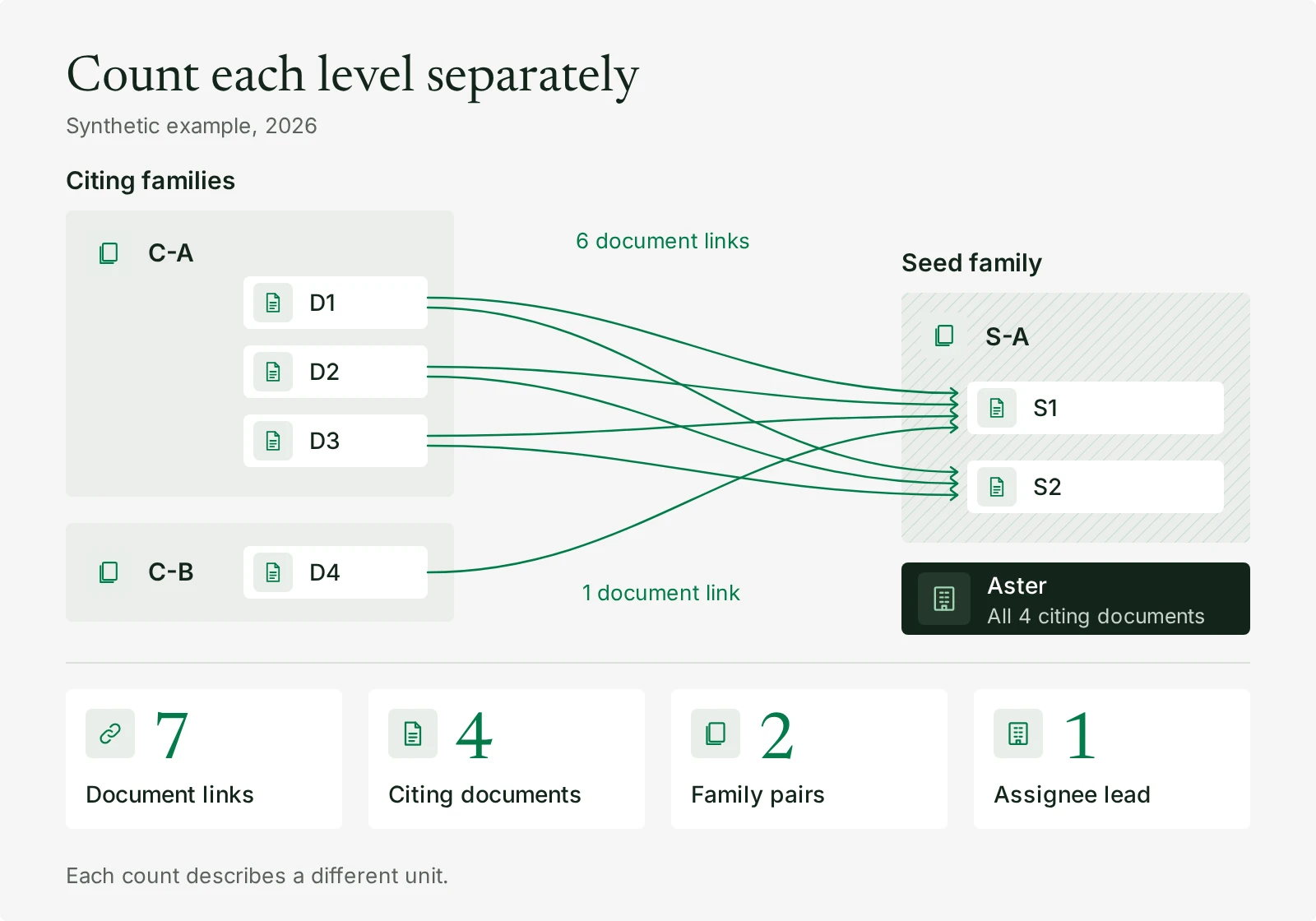
Assume publications D1, D2, and D3 in citing family C-A each cite 2 publications in seed family S-A. That produces 6 distinct document links. A fourth publication, D4 in citing family C-B, cites 1 of those seed publications, adding 1 link. All 4 citing publications carry the same reconciled assignee.
The result is 7 document links, 4 distinct citing documents, 2 family-to-family relationships, and 1 assignee lead. Each count describes a different unit. Preserve all 4 rather than presenting the 7 links as 7 independent prospects.
Work product: grouped relationship records with a trace back to the original publications and source rows.
3. Reconcile assignees before combining their activity
Standardize obvious name variations, then document the evidence behind each merge. “Aster Device Systems, Inc.” and “ASTER DEVICE SYSTEMS INC” may be a formatting difference. A similarly named subsidiary, a former applicant, and an acquired business need separate identity work.
Maintain these fields:
| Identity field | What to retain |
|---|---|
| Name as supplied | Exact applicant or assignee string and source publication |
| Normalized entity | Consistent name plus the reason aliases were combined |
| Ownership or group evidence | Source, relevant date, and basis for any parent/subsidiary grouping |
| Unresolved identity question | Historic applicant, recorded assignee, current owner, or corporate relationship needing resolution |
| Product-entity question | Which organization would be associated with the product investigated next? |
Keep same-group citations in a separate bucket for an external-prospect brief. Retain unresolved group relationships as open questions. This prevents internal activity from silently inflating an external lead while preserving the evidence for another analytical purpose.
Work product: an entity map that explains both merged names and names kept separate.
4. Read the technical connection before assigning priority
Open the citing and seed documents and identify the passages that explain the connection to the scoped technology. Record the document identifiers, paragraph or claim locations, and a short relevance rationale. Distinguish a connection to the feature you care about from a citation concerning a peripheral feature.
Citation context deserves this attention. Schuster and Valentine's citation relevance research ↗ found that relevance added information beyond aggregate counts in their study of backward citations.
Preserve applicant or examiner origin where available. In the United States, the information-disclosure rules in 37 Code of Federal Regulations §1.97(g)–(h), reproduced in the patent office's guidance ↗, separate filing an information disclosure statement from representing that a search occurred or admitting materiality to patentability. Describe the recorded citation and its technical context rather than assigning the applicant an unstated admission.
Use 3 practical dispositions:
- Investigate: the document connection fits the brief and supports a defined product-research question.
- Resolve an evidence gap: a relevant possibility remains, with a specific missing identity, document, or scope fact.
- Set aside for this brief: the reviewed connection falls outside the technology or counterparty scope. Retain the reason and any condition for reopening it.
Counts can organize the review queue. The disposition should explain the substantive reason for spending time on the lead.
Work product: a relevance note and disposition tied to the source passages.
5. Build the shortlist around the next unanswered question
Synthetic shortlist, 2026
A fictional consumer-electronics IP team is reviewing direct forward citations to its account-synchronization seed families. Its supplied export has a publication cutoff of October 31, 2026 and uses a single declared simple-family convention. All companies, document labels, passage locations, counts, and findings below are fictional.
| Assignee lead | Distinct document links / family pairs | Recorded technical connection | Disposition and next assignment |
|---|---|---|---|
| Aster Device Systems | 7 / 2 | D1, paragraph 42, and D4, paragraph 27: account settings synchronized across household devices | Investigate. Product researcher to identify a current product and documentation addressing synchronization behavior. |
| Brindle Connected Products | 16 / 1 | D5, paragraph 19: display rendering, outside the account-synchronization brief | Set aside for this brief. Reopen if the technology scope expands to display rendering. |
| Cobalt Home Computing | 3 / 2 | D6, paragraph 31: account-state transfer; the export records a former applicant name | Resolve an evidence gap. IP analyst to reconcile the entity and relevant dates before assigning product research. |
Brindle has the highest document-link count, yet Aster receives the first research assignment. The decision turns on the recorded technical connection and a question someone can investigate. Cobalt stays visible with a named gap rather than disappearing from the queue or being treated as a confirmed counterparty.
Before allocating deeper work, have the authorized commercial owner record any existing agreement, license, negotiation, or business relationship that changes the assignment. Use authorized internal records for that decision and keep restricted commercial details in the appropriate matter system.
6. Hand off the shortlist with its evidence
Each retained row should let another practitioner reconstruct the selection and start the next assignment without repeating the citation cleanup. Include:
- Input and scope: dataset version, export date, cutoff, jurisdictions, seeds, direction, and family convention.
- Relationship evidence: source rows, document pairs, grouped family pairs, and separately labeled counts.
- Entity evidence: original names, alias decisions, group status, and unresolved ownership or product-company questions.
- Selection rationale: pinpointed technical passages and the reason the lead fits the brief.
- Next assignment: the product question, evidence needed, responsible person, review date, and reopening condition.
- Legal-review handoff: the seed member and candidate claim to examine, with jurisdiction, status, ownership, and intended commercial activity queued for counsel's review.
A useful assignment reads: “Identify public documentation for Aster's current account-sync feature and determine which product entity supplies it.”
This handoff also gives the IP leader a bounded outside-counsel instruction: investigate the selected leads and their recorded questions rather than commissioning the same depth of review for every citing organization.
Where Patlytics fits
Patlytics picks up once the shortlist names the leads worth investigating: organizing the seed assets, then mapping them to the products behind each lead.
- Classification applies your team's own taxonomy ↗ to organize the seed assets, with proposed categories that can be approved, edited, or removed.
- Clustering groups related technical themes ↗ to help define focused patent sets for follow-on work.
- Portfolio Heatmaps group the seed set by your classification and show where it maps against the target products or companies ↗ selected for investigation.
- Portfolio Analysis supports portfolio-wide patent-to-product mapping ↗, connecting selected assets to the product questions in the handoff.
- Patent Pruning uses patent-to-product mapping ↗ to surface assets with weak or no current product coverage.
For the next claim-level assignment, Infringement researches public product sources ↗ and indexed product documentation. Claim Charting maps evidence to claim limitations in editable charts. Claim Construction proposes editable claim constructions ↗ with pin cites, or pinpoint references, to the specification; charts can be re-run using revised terms. Exhaustive mode provides deeper coverage ↗ on selected priority claims.
Attorneys retain review and decision authority over the evidence, claim analysis, and legal conclusions.
See which of your citation leads map to live products and claims. Book a licensing-shortlist demo.

See it on your own patents
Reduce cycle times. Increase margins. Deliver winning IP outcomes.