November 16, 2026
Sequence listing: an ST.26 prefiling checklist
Prepare an ST.26 sequence listing with a practical checklist for metadata, XML, application consistency, validation, and filing handoff, plus a worked example.

Before filing an ST.26 sequence listing, check the applicable standard version, sequence inclusion and metadata, Extensible Markup Language (XML) structure, application consistency, final-file validation, route-specific requirements, and the release package. The World Intellectual Property Organization (WIPO) standard uses XML to record qualifying nucleotide and amino acid sequences disclosed in a patent application.
This checklist covers ST.26 preparation for U.S., Patent Cooperation Treaty (PCT), and European applications; biological retrieval and alignment follow a separate sequence-search workflow ↗.
Which sequence listing standard applies?
The application’s filing date generally determines the ST.25/ST.26 transition, with July 1, 2022 as the cutoff. For U.S. national-stage applications, the international filing date controls. The U.S. Patent and Trademark Office (USPTO) applicability guidance ↗ also distinguishes provisional applications, where submitting a listing is optional.
The practical deliverable is a release package: the final XML, its validation output, a sequence-to-application reconciliation record, and the filing instructions. Give all 4 the same release identifier.
1. Establish the filing route and inclusion rules
Record the application type, filing office or receiving Office, intended filing date, and applicable standard version before preparing the listing. A family’s earliest priority date alone cannot select the format for a new application.
The November 2026 example below uses ST.26 v1.7. European applications may use v1.6 or v1.7, while international applications filed on or after July 1, 2024 use v1.7 under the published version rules ↗. WIPO lists v2.0 with a July 1, 2027 entry-into-force date ↗. Keep the standard version distinct from the XML document type definition (DTD), which specifies the permitted document structure.
Build the inventory from the entire application, including claims, examples, tables, and drawings. Under the U.S. inclusion rule ↗, qualifying sequences include unbranched sequences or linear regions of branched sequences containing at least 10 specifically defined nucleotides or 4 specifically defined amino acids, subject to the stated linkage and peptide-backbone conditions. Count specifically defined residues rather than raw characters. Below-threshold sequences must remain outside separate listing entries.
For ambiguous symbols, modified residues, mixed molecules, and branched structures, assign the inclusion and representation decision to a sequence specialist. Record the decision against the disclosed sequence so it survives later drafting changes.
2. Collect sequence metadata before authoring
Create 1 master sequence register. Preserve the original scientific files alongside it, with a named scientific owner for each sequence.
| Input | What the preparation record should contain |
|---|---|
| Sequence identity | Internal research label, proposed sequence identifier (SEQ ID NO), source filename, and source version |
| Exact residues | Complete string, reported length, molecule type, and orientation or biological boundaries where relevant |
| Scientific annotations | Origin, modifications, ambiguous positions, feature locations, and the source supporting each annotation |
| Application locations | Every claim, paragraph, example, table, or figure that identifies or reproduces the sequence |
| General information | Applicant, invention title and language, applicant file reference or assigned application details, and earliest priority details where applicable |
| Review control | Preparer, scientific reviewer, patent practitioner, revision identifier, and disposition of open questions |
Keep scientific names, internal labels, and filing identifiers in separate fields. A laboratory label such as “construct B” needs an explicit mapping to its assigned SEQ ID NO.
Record transformations, including removal of line numbers or extraction from an image. Compare the resulting string with the source before it becomes the authoring input. For an existing ST.25 listing, retain the original and the conversion record, then reconcile converted entries and annotations with the application.
3. Inspect the XML’s structure and sequence records
An ST.26 listing contains general information and sequence data in a single XML file. For U.S. submissions, XML 1.0 and UTF-8 (8-bit Unicode Transformation Format) encoding apply. Inspect the XML declaration, document type (DOCTYPE) declaration, root element, and DTD reference, then the general-information and per-sequence records. ST.26 v1.7 uses the ST26SequenceListing root and DTD v1.3. The USPTO’s XML requirements ↗ explain these constituent parts.
Use an ST.26-capable authoring application, then inspect the generated output. WIPO Sequence supports preparation and validation; WIPO’s implementation guidance ↗ also permits other editors that produce compliant XML.
For each ordinary sequence entry, review:
- Identity and count: The sequence identifier matches the register, and the total quantity reconciles with the identifier inventory, including any intentionally skipped identifiers.
- Length and type: The recorded length matches the residues. Molecule type and patent division are correctly populated.
- Annotations: Feature locations fit the sequence, and mandatory qualifiers are present. The
sourcefeature carriesorganismandmol_typequalifiers. - Residues: The string uses permitted symbols without embedded numbering or formatting. Modification annotations preserve the scientific disclosure.
- Languages: Titles, language attributes, and language-dependent free text match the filing route. Controlled vocabulary retains its prescribed form. PCT language-related requirements ↗ distinguish these categories.
A small preparation example
Fictional input record, November 11, 2026. Example Biologics Ltd. is preparing an application titled “Synthetic DNA teaching example,” with file reference EXAMPLE-2026-001. Application number and filing date are unassigned. The following fields illustrate an inspection record; generating and validating the complete filing XML remain separate steps.
| Field | Example value | Inspection point |
|---|---|---|
| Sequence identifier | 1 |
The application uses SEQ ID NO: 1 for this sequence |
| Sequence string | acgtacgtacgt |
12 specifically defined residues match the source record |
INSDSeq_length |
12 |
Count agrees with the string |
INSDSeq_moltype |
DNA |
Molecule-type element |
INSDSeq_division |
PAT |
Patent division |
source location |
1..12 |
Source feature spans the complete sequence |
organism qualifier |
synthetic construct |
Matches the fictional synthetic origin |
mol_type qualifier |
other DNA |
Separate qualifier from INSDSeq_moltype |
The distinction between DNA and other DNA follows the element and qualifier definitions in ST.26 v1.7 ↗. Choosing an organism or molecule qualifier requires the actual scientific source information.
Use the editable sequence reconciliation template ↗ to carry these fields into review. Its first row contains this fictional record, labeled as unvalidated preparation data; replace it with the matter’s own entries.
4. Reconcile the listing with the application
Run this review against the exact specification, claims, and drawings intended for filing. Work in both directions: every qualifying disclosed sequence maps to the listing, and every listing entry maps back to the disclosure.
- Identifiers: Each SEQ ID NO refers to the same sequence wherever it appears. Resolve missing references and obsolete identifiers after renumbering.
- Residues: Reproduced strings match character for character. Separate precursors, mature proteins, fragments, and fusion constructs rather than treating their labels as interchangeable.
- Features: Modification positions, source information, and feature descriptions agree with the scientific record and application.
- Claim references: Claims identify the intended sequence and any relevant boundaries or alternatives. Counsel addresses support for the proposed claim scope in the disclosure.
- General information: Names, title, file reference, and applicable priority information agree across the submission documents.
The PCT identifier requirements ↗ call for references using “SEQ ID NO:” in the description, claims, and drawings for listed sequences.
In the fictional example, an application sentence calling acgtacgtacgt “SEQ ID NO: 2” conflicts with register entry 1. Resolve the identifier against the approved register and every affected application location, then regenerate affected outputs. This mismatch is a cross-document finding, independent of whether the XML is structurally valid.
5. Validate the final exported XML and retain the output
WIPO Sequence validates project data before generation. The USPTO also recommends validating the exported XML file ↗ before filing. Run that check on the exact file released to the filing specialist.
Use this release sequence:
- Generate the XML and retain the authoring project.
- Validate the exported file and save the completed Verification Report.
- Correct errors. For each remaining warning, record the issue, reviewer’s disposition, and reason.
- Generate a human-readable display and reconcile it with the master register and application.
- Freeze the XML, application documents, and review record under 1 release identifier. Repeat affected checks after any edit.
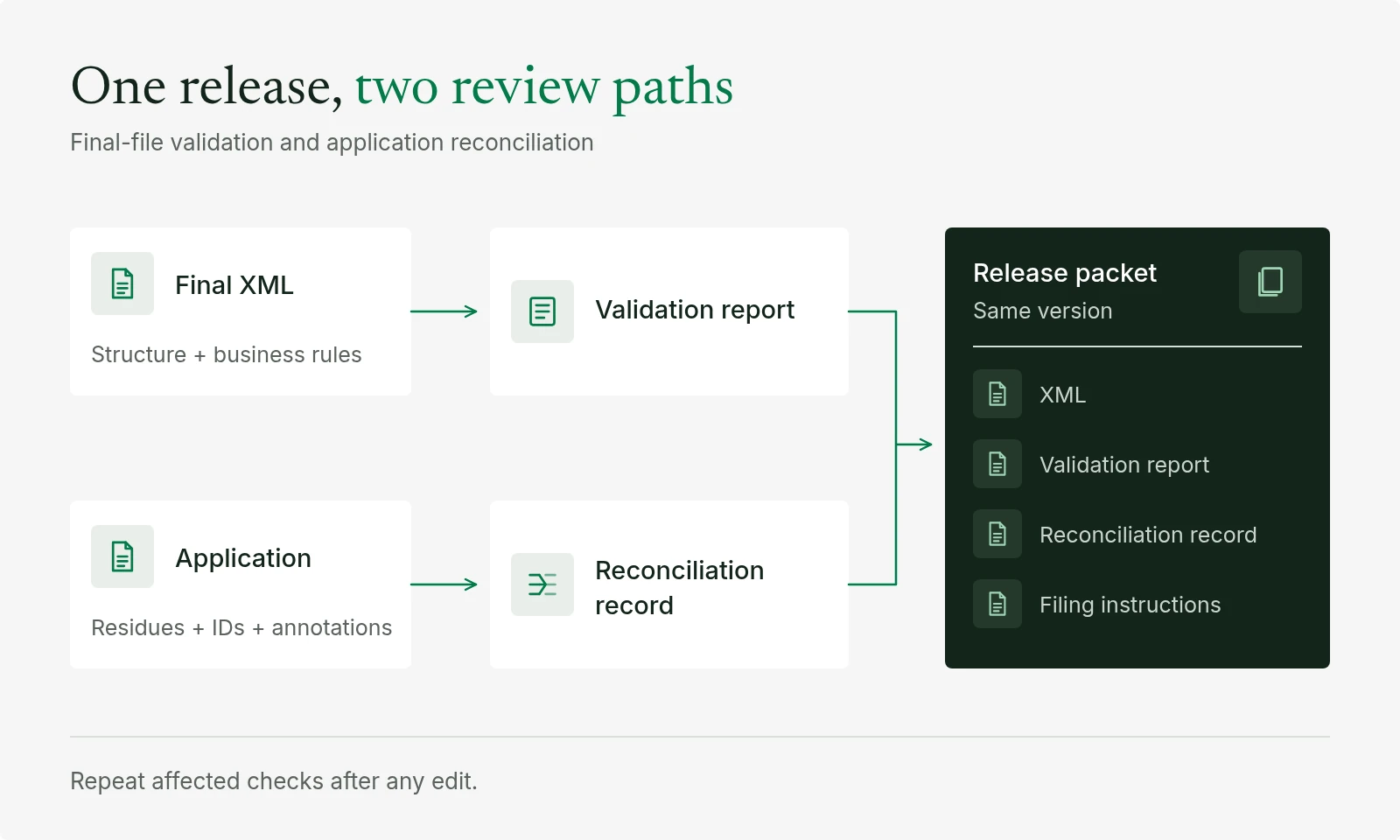
The WIPO Sequence manual ↗ distinguishes errors and warnings and explains the human-readable display. Keep that display as a review aid; submit the required XML as the listing artifact.
Record the validation application and version, run date, applicable standard/DTD, report filename, and exact XML filename. Add a 256-bit Secure Hash Algorithm (SHA-256) checksum, a digital fingerprint of the file’s bytes, to distinguish the reviewed file from a later file with the same name.
Separate applicant-side checks from office processing. WIPO Sequence is the applicant desktop application; WIPO Sequence Validator is an office web service. Its formality validation checks XML and DTD validity. Full validation adds ST.26 business rules and produces a final report, as the Validator operations manual ↗ explains.
Assign scientific review of source identity, organism names, and modifications separately. The USPTO explains that a modification omitted from the input annotation can escape automated detection. Its validation review guidance ↗ places accurate and complete sequence description with the applicant.
6. Apply the submission requirements for the selected route
The same reviewed sequence data can support different routes, but transmission requirements and procedural statements depend on the filing.
| Route | Filing-preparation gate |
|---|---|
| U.S. direct filing | Use an .xml filename of up to 60 characters before the extension, containing only letters, numbers, hyphens, or underscores. Electronic XML submissions have a 100 MB limit without compression. Prepare the incorporation-by-reference paragraph identifying the XML filename, creation date, and byte size. The U.S. filing requirements ↗ distinguish international-stage submissions. |
| PCT international filing | Include the required listing as the sequence-listing part of the description, with language-dependent free text accepted by the receiving Office. Distinguish it from a listing supplied later solely for international search or examination under PCT Annex C ↗. |
| European filing | Use an accepted channel for the procedural act. Since January 1, 2026, options include Online Filing 2.0 and the Contingency Upload Service, with ePCT or MyEPO where applicable. The European Patent Office (EPO) submission notice ↗ states a 50 MB upload setting and accepted data-carrier options for larger listings. |
Treat a post-filing correction as a separate procedural review. Counsel must identify original support and the applicable amendment or no-added-matter statements. Under PCT Rule 13ter ↗, a listing furnished solely for search generally stays outside the application as filed, subject to the rule’s Article 34 amendment qualification. Preparing the application-part listing before filing preserves the intended disclosure record.
7. Release a reviewer and filing handoff package
Name the person responsible for each release decision. The scientific reviewer signs off on residues, origin, boundaries, and annotations. The patent practitioner signs off on application consistency, disclosure support, and route-specific requirements. The filing specialist receives the released files and submission instructions.
The handoff package should contain:
- Final artifacts: XML, authoring project, human-readable display, and the exact application documents reviewed together.
- Reconciliation record: Sequence register, application locations, changes since the previous revision, and closed discrepancies.
- Validation evidence: Final report, run details, and dispositions for retained warnings.
- Release manifest: Release identifier, filenames, byte sizes, checksums, reviewer names, and approval dates.
- Submission instructions: Office, application type, channel, document designation, required statements, and the authorized filing version.
- Receipt record: After submission, retain the office acknowledgment and reconcile its document inventory with the release manifest. Assign any later validation notice to a named practitioner.
Keep the prefiling approval and post-submission receipt as separate records. That preserves both what the team authorized and what the office received.
Where Patlytics fits
Patlytics supports the disclosure and drafting work that feeds a sequence-listing filing package:
- Invention Disclosures (IDF) ↗: Turns inventor documents, presentations, and spoken input into structured disclosures with follow-up questions and export for collaboration.
- Patent Drafting ↗: Supports sequence import by paste or document upload, locked-object sequence handling, propagation to the specification when sequence IDs change, and ST.26 XML export for U.S., EPO, and PCT filings.
- §112 Check: Analyzes terms and phrases for written-description, enablement, and indefiniteness issues alongside the application’s substantive support review.
Life-sciences drafting also supports a structure editor, chemical image-to-SMILES (simplified molecular input line entry system) conversion, Markush/R-group generation for variable chemical groups, and sequence uploads with complementarity-determining-region (CDR) detection.
Carry the exported listing through the final-file validation and route-specific release checks above. Patent counsel retains review and approval authority over disclosures, drafts, sequence representations, and legal positions.
Prepare a sequence-consistent application from inventor intake through drafting and XML export with Patlytics. Book a Demo → focused on your life-sciences filing preparation.

See it on your own patents
Reduce cycle times. Increase margins. Deliver winning IP outcomes.