November 20, 2026
Markman hearing: prepare the record behind each disputed term
Prepare disputed terms, exact claim language, intrinsic evidence, and competing constructions for a Markman hearing, with a worked example and worksheet.

What should be ready when the judge asks why your construction follows from the patent record? Prepare a term-by-term record connecting exact claim language, competing interpretations, and pinpoint evidence to the scope question the court must resolve.
A Markman hearing is a claim-construction proceeding where the judge considers disputed patent-claim meanings. The Supreme Court assigned claim construction to the court in Markman v. Westview ↗, 517 U.S. 370, 372 (1996).
Scope: U.S. district-court preparation for disputed terms in utility-patent claims.
Start with the court’s required submissions
Read the assigned judge’s standing orders, the operative scheduling order, and applicable local patent rules together. Record deadlines, term limits, meet-and-confer requirements, expert disclosures, briefing limits, tutorial arrangements, and the permitted hearing format. Add the governing source and responsible attorney beside each requirement.
Even similar local-rule systems use different triggers and intervals. Under the ordinary invalidity-contention trigger, Northern District of California Patent L.R. 4-1(a) allows 14 days for exchanging proposed terms; Eastern District of Texas P. R. 4-1(a) allows 10. California also specifies alternative triggers for certain cases. Both courts permit case-specific modifications. Use the applicable California patent rules ↗, rules 1-3 and 4-1, or Texas patent rules ↗, rules 1-2 and 4-1, rather than a generic complaint-to-hearing countdown.
Plan separately for the joint statement, briefs, supporting evidence, and demonstratives. Their contents and disclosure requirements can differ. For example, both districts’ rule 4-3 calls for agreed constructions and each side’s disputed constructions with supporting evidence. A preparation worksheet supplies the underlying organization; counsel adapts the served and filed documents to the governing requirements.
Identify the actual scope dispute
Create one term record for each distinct dispute. Start with:
- The asserted patent, operative claim text, and claim numbers containing the disputed phrase.
- The exact phrase and its full surrounding limitation, preserving punctuation and antecedents.
- Relevant claim dependencies and other uses of the phrase in the patent.
- Each party’s proposed wording, including any stated plain-meaning position.
- A sentence identifying the difference in scope and why it matters.
“Plain and ordinary meaning” can conceal a disagreement. In O2 Micro ↗, 521 F.3d 1351, 1360-62 (Fed. Cir. 2008), the Federal Circuit required resolution of an actual scope dispute even though the words had a familiar meaning. The court also recognized that every limitation need not receive a separate construction.
Replace a vague issue such as “meaning of acknowledgment” with a precise question such as “Must the acknowledgment confirm integrity verification, or may it confirm receipt?” That question directs evidence collection and gives the meet-and-confer a concrete issue to resolve.
Keep the construction question distinct from applying a construction to an accused implementation. The separate infringement analysis workflow ↗ addresses limitation-to-product evidence.
Build an intrinsic-evidence record with traceable pinpoints
Intrinsic evidence comprises the claims, specification, and prosecution history, the patent examination record. Under Phillips v. AWH ↗, 415 F.3d 1303, 1312-19 (Fed. Cir. 2005) (en banc), claim terms take their ordinary meaning to a person of ordinary skill in the art in the context of the patent and relevant time. The specification informs that meaning; prosecution history can explain how the applicant used or limited the language.
Organize the material by source type:
- Claims: the disputed limitation, surrounding language, dependencies, and relevant differences among claims.
- Specification: definitions, repeated usage, relevant figures, described alternatives, and passages supporting or challenging each proposed restriction.
- Prosecution history: the actual amendment, rejection, response, or other relevant document, with the claim version and surrounding exchange.
This is a preparation sequence. Phillips prescribes no mandatory order for consulting sources and cautions against allowing extrinsic material to contradict unambiguous intrinsic meaning. See 415 F.3d at 1323-24.
For each item, keep three separate fields: what the source says, how each side uses it, and counsel’s assessment. A quotation and a proposed inference should remain distinguishable when copied into a brief or slide.
Evidence fieldWhat to retainIdentityEvidence ID, term ID, patent or application identity, document title, type, and dateOriginal locationPatent column and lines, numbered paragraph, figure, or prosecution-document page and sectionMatter locationRetained file, exhibit or production identifier, Bates number where applicable, and PDF-viewer page as a secondary locatorText and contextExact excerpt, surrounding passage, and whether the working text is original, optical character recognition (OCR), translation, or paraphraseProvenanceSource URL or matter-file reference, collection date, collector, and any conversion or annotationCompeting useSupport for each proposed construction, contrary material, claimed definition or disclaimer, and unresolved questionReview statusPassage compared with the original, reviewer, date, and approved use in the joint statement, brief, or hearing material
Retain the original separately from annotated working copies. A file hash helps identify retained bytes; assess authentication, admissibility, and preservation obligations separately. Avoid replacing a source-native citation such as “col. 6, ll. 12-19” with an unexplained PDF page number.
Give alleged definitions and disclaimers their own analysis
Record the exact language said to define the term or surrender scope, the proposed restriction, and the context supporting that reading. Distinguish an express definition from a description of one implementation.
Thorner v. Sony ↗, 669 F.3d 1362, 1365-67 (Fed. Cir. 2012), explains the exacting requirements for patentee lexicography and disavowal. Repetition of a feature across embodiments, by itself, does not supply the necessary limiting definition or disclaimer.
Prosecution statements deserve the same contextual treatment. In VLSI v. Intel ↗, No. 2024-1772, slip op. at 9-12 (Fed. Cir. Apr. 14, 2026), the Federal Circuit rejected the asserted disclaimer after examining the claim language and multiple reasonable readings of the cited statements. Preserve a plausible competing reading beside the alleged surrender so counsel can address it directly.
Worked example: what must an acknowledgment confirm?
Fictional example: Archive P, a file-archiving patent. Counsel is preparing the term record on November 17, 2026.
Claim 1 reads:
A method for archiving a file, comprising: transmitting the file from a local device to a remote archive; receiving an acknowledgment message from the remote archive; and deleting a local copy of the file after receiving the acknowledgment message.
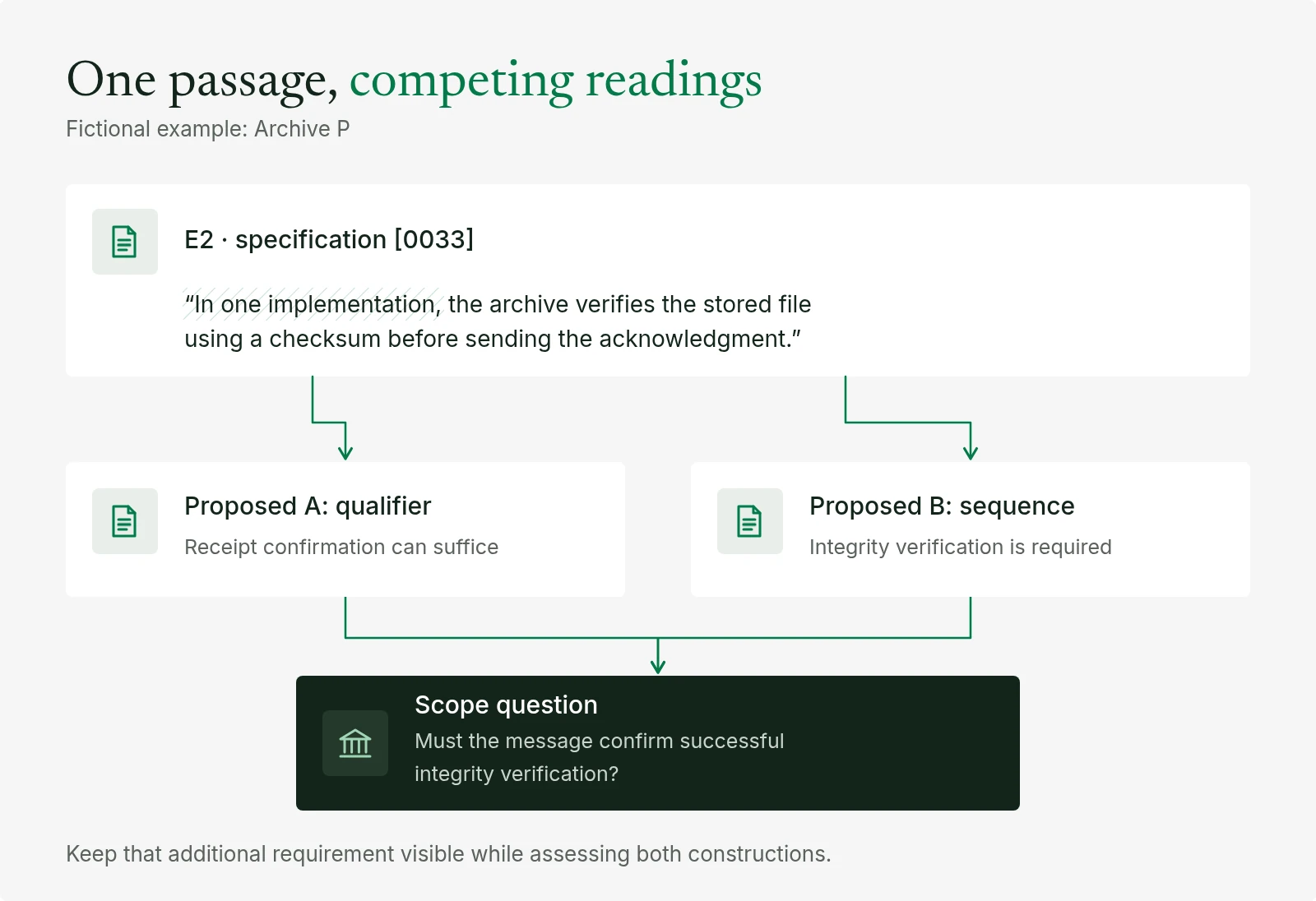
The disputed phrase is “acknowledgment message.” The parties propose:
PositionProposed constructionScope consequenceProposed AA message confirming receipt of the filePermits a receipt-confirming message without integrity verificationProposed BA message confirming successful integrity verification of the stored fileRequires integrity verification before the confirming message
The scope question is whether the message must confirm successful integrity verification. Keep that additional requirement visible while assessing both constructions.
The evidence record preserves the exact text before recording advocacy:
Evidence ID and pinpointExact fictional source textCompeting uses to addressE1, Archive P, specification [0032]“The archive returns an acknowledgment after storing the uploaded file.”A relies on the general acknowledgment description. B argues that the surrounding description explains what successful storage entails.E2, Archive P, specification [0033]“In one implementation, the archive verifies the stored file using a checksum before sending the acknowledgment.”B relies on the verification sequence. A relies on the qualification “In one implementation.”E3, Archive P, claim 7“The method of claim 1, wherein the acknowledgment message includes a checksum of the stored file.”A points to an expressly added checksum requirement. B distinguishes a message containing a checksum from a message confirming integrity verification.E4, Archive P, applicant response, June 12, 2026, p. 6“The cited reference deletes the local file when transmission ends. Claim 1 instead requires the remote archive’s acknowledgment before deletion.”A reads the distinction as timing and message origin. B argues that “acknowledgment” carries the specification’s assurance of successful storage.
E4’s provenance entry identifies Archive P’s application record, the June 12 response, page 6, its retained original, and the November 17 collection and review dates. E1-E3 identify the issued patent text and their native locators. Each evidence ID links back to its source file, so a later excerpt can be traced without guessing which document supplied it.
Counsel’s working assessment records the distinctions: E2 describes a qualified implementation; E3 adds message content, a different requirement from performing verification; E4 addresses acknowledgment before deletion. The remaining argument concerns why claim 1’s acknowledgment should carry an integrity requirement. Counting favorable excerpts would miss those differences.
Use the term-and-evidence worksheet ↗ to keep one term row linked to multiple evidence rows. It is a preparation aid; use the court’s required format for each submission.
Separate technical premises from the legal construction
Extrinsic evidence, such as technical dictionaries, treatises, and expert testimony, can explain relevant technology and historical usage. Identify the specific technical premise, its relevant date, the supporting material, and the competing position. Then state how that premise bears on the proposed construction.
Teva v. Sandoz ↗, 574 U.S. 318, 331-33 (2015), distinguishes the ultimate legal construction from subsidiary factual findings about disputed extrinsic evidence. The ultimate construction receives de novo appellate review; those subsidiary findings receive clear-error review. Submitting an expert declaration does not automatically convert the construction into a factual issue.
For Archive P, “what a checksum measures” and “whether claim 1 requires integrity verification” belong in separate fields. One concerns a technical premise; the other concerns the scope of this claim in its patent record. Record any proposed testimony and its disclosed purpose, then align the hearing presentation with the court’s witness and evidence directions.
Turn the record into hearing-ready arguments
Build a compact hearing map for each disputed term: exact claim text, both proposed constructions, the scope question, strongest supporting pinpoint, strongest contrary passage, and the requested ruling. Link each statement to the evidence record and its location in the permitted hearing materials.
Before an AI-suggested construction enters a brief, counsel should complete four substantive reviews:
- Text: reconcile the proposed wording with the operative claim, dependencies, and relevant uses throughout the patent.
- Support: compare every quoted passage and pinpoint with the original, including surrounding context and contrary evidence.
- Reasoning: address alleged definitions, disclaimers, embodiment restrictions, and any disputed technical premise under the applicable authority.
- Submission: reconcile the final position with served disclosures, court orders, evidence requirements, confidentiality restrictions, and any applicable AI-use directions.
Federal Rule of Civil Procedure 11(b)’s certifications ↗ apply when counsel presents a paper to the court after reasonable inquiry. Record the responsible attorney’s final proposed wording and source decisions before carrying them into the filing.
Keep advocacy additions visibly distinct from source text on demonstratives. After the court issues its construction, record the exact adopted language, order citation, affected claims, and unresolved issues. Use that language in subsequent claim application and identify analyses requiring revision.
Where Patlytics fits
Patlytics supports the substantive construction and chart work behind hearing preparation:
- Claim Construction proposes constructions for disputed terms with specification pin citations. The proposed wording is editable.
- Infringement and Invalidity support chart analysis. An infringement or invalidity chart can be rerun against an edited construction, giving counsel a revised mapping to assess.
- Claim Charting supports source-linked work product and Word, Excel, and PDF export for continued preparation in the team’s working documents. The claim-charting workflow ↗ connects construed limitations to supporting evidence.
Counsel retains review and decision authority over the proposed constructions, cited evidence, chart mappings, and hearing submissions.
Bring disputed terms and specification-backed construction work into a Patlytics walkthrough focused on editable proposals and revised claim charts. Book a Demo →.

See it on your own patents
Reduce cycle times. Increase margins. Deliver winning IP outcomes.