November 24, 2026
Polymorph patent evidence: identity, preparation, and comparison
Review polymorph patent evidence for form identity, reproducible preparation, and meaningful comparisons before filing or challenging solid-form claims.
Before filing or challenging a polymorph patent, can you trace the claimed form to the sample actually made and tested? Review three connected records: solid-state characterization, reproducible preparation conditions, and form-specific comparative results. Together, they expose where a claimed distinction or advantage needs stronger evidence.
The focus is pharmaceutical solid forms under U.S. and European Patent Office (EPO) practice, with counsel and solid-state scientists working from the same experimental record.
Define the claimed form before assessing the evidence
Crystalline polymorphs differ in the arrangement or conformation of molecules within a crystal lattice. Amorphous material lacks a distinguishable crystal lattice; solvates incorporate solvent, with water-containing forms called hydrates. Keep those categories explicit, even where pharmaceutical guidance groups them under polymorphism. The U.S. Food and Drug Administration (FDA) explains these distinctions and their characterization in its solid-state guidance ↗, sections II–III.
Start with the exact claim version and its dependencies. Separate molecular identity, salt or solvation state, crystalline-form identity, and any form-content limitation. Carry the original disclosure forward from the chemical retrieval workflow ↗, then map each solid-form limitation to its experimental support.
For a parameter-defined claim, record the measurement method and the basis for its accuracy and tolerance. The April 2026 EPO Guidelines require physical-structure parameters to be clearly and reliably determinable through objective procedures. Their measurement-method requirements include specified exceptions for common general knowledge and equivalent results. Apply that parameter-clarity framework ↗ to the actual claim, rather than adopting a standard peak count or tolerance for every material.
Build a claim-linked evidence table
Give every experiment a sample identifier, preparation-record link, analytical-file locator, and claim or property proposition. Use a separate row for each tested batch and comparator. A form name such as “Form A” needs that underlying record to remain meaningful across laboratories and documents.
| Review unit | Evidence counsel should have | Discrepancy to resolve |
|---|---|---|
| Claimed form | Complete claim and dependencies; chemical and solvation identity; each analytical parameter, tolerance, and form-content limitation | The claim combines features reported for different samples, or “purity” has several meanings |
| Characterization | Full diffraction patterns and supporting analytical files; acquisition and processing methods; sample preparation; scientist's assignment of the form | A selected peak list obscures a mixture, unexplained signal, or mismatch with the claimed parameters |
| Preparation and seeds | Batch instructions and observations; solvent composition and water content; concentration, temperature history, agitation, aging, isolation, and drying; seed identity and origin | A successful preparation relies on an unrecorded condition or on seeds whose first preparation is unexplained |
| Prior-art reproduction | Original example beside the executed protocol; every deviation and its rationale; intermediate and final sample identities; successful and unsuccessful runs | The claimed form appears only after additional concentration, standing, seeding, or other treatment |
| Comparator identity | Reason for selecting the comparator; its preparation, form assignment, form fraction, chemical purity, and solvent or water content | A label substitutes for evidence of what was actually compared |
| Comparative experiment | Matched protocols; handling history; relevant particle-size or formulation differences; starting and recovered solid-state data where transformation matters | Several variables changed together, or the measured material changed form during the experiment |
| Result and claim coverage | Raw observations, repeat runs, variability, practical significance, expected behavior, and the relationship between tested samples and claim breadth | A result for one batch or condition is generalized without a scientific basis |
Treat this as a review structure. Select the analytical methods and experimental detail needed for the particular form, claim, and asserted effect.
Trace the analyzed sample through its treatment
X-ray powder diffraction (XRPD) provides evidence of crystalline-form identity. Differential scanning calorimetry (DSC), thermogravimetric analysis (TGA), microscopy, and spectroscopy provide complementary characterization. The FDA's characterization discussion ↗, section III.B, describes their roles.
Read the complete analytical record with the scientist who assigned the form. For XRPD, retain the radiation source, acquisition settings, sample preparation, full pattern, and explanation for the selected characteristic peaks. For thermal results, retain the heating program and the interpretation of each relevant event. Distinguish a reported onset from a peak maximum wherever that distinction affects the claimed parameter.
Reconcile chemical purity, crystalline-form fraction, and solvent or water content separately. A chemical assay and a measurement of the proportion of a particular crystalline phase answer different questions. Give each reported percentage its method, denominator, and sample identifier.
Also establish when the form assignment was made. Drying, milling, storage, and the characterization experiment itself belong in the sample history whenever they affect the interpretation. Keep the initial form, treatment, and identified endpoint in separate entries.
The EPO's June 2026 decision in T 0889/24 shows why that sequence matters. Compound-specific DSC and TGA evidence showed conversion of other screened forms into the claimed stable darolutamide forms upon heating. Routine thermal characterization supported the Board's finding of lack of inventive step on that record. Its reasoning concerned what the relevant investigation would produce and identify. See T 0889/24 ↗, Reasons 1.1.2 and 1.2–1.8.
The practical question is precise: which form existed at the point relevant to the claim or comparative result?
Reconstruct preparation without silently improving it
A preparation record should let the scientist distinguish essential conditions from choices left open by the disclosure. Preserve actual values and observations, including oils, gels, delayed crystallization, and alternative forms. Record the endpoint before any additional treatment and explain why a repetition departed from the disclosed procedure.
Resolve the first-seed problem
When the preparation uses seeds, trace their identity, source, and preparation. Separate the first access to the form from later seeded manufacture. Record whether a seed-free route works and which conditions make it work.
In T 1066/03, a process depended on crystalline atorvastatin form I, whose preparation required seeds without sufficient teaching to obtain that starting form. Generic instructions left a research program, and later experiments relied on conditions that could not be derived from the disclosure. The Board found the disclosure insufficient. See T 1066/03 ↗, Reasons 2.2–2.6.
Preserve the latitude in the prior-art instructions
The January 2026 decision in T 0479/24 turned partly on concentration and subsequent handling. Reasonable repetitions yielded an oil or gel. More stringent concentration or additional standing could produce the claimed roxadustat form, but those extra steps could not simply be read into the prior-art instruction. See T 0479/24 ↗, Reasons 6.4–6.8.
For a U.S. inherency position, identify the factual and technical basis for saying a limitation necessarily follows from the prior art. The United States Patent and Trademark Office (USPTO) distinguishes necessary presence from a result that may occur in its inherency guidance ↗, section 2112(IV). A reproduction log should expose every intervention between the disclosed process and the asserted inherent product.
Separate making the form from characterizing it
U.S. obviousness decisions also turn on that factual distinction. In Grünenthal v. Alkem, the Federal Circuit affirmed findings that the evidence lacked a reasonable expectation of successfully producing the claimed tapentadol form. The record lacked preparation-specific guidance on variables such as solvents, temperature, and agitation. See Grünenthal v. Alkem ↗, pages 13–19.
In Salix v. Norwich, the court distinguished that production problem from characterization of crystalline rifaximin obtained through prior-art preparations. Expert evidence and preparation conditions supported the obviousness finding. See Salix v. Norwich ↗, pages 13–17. Frame the evidence request around the asserted advance: obtaining the form, identifying an available product, or both.
Make the comparative result form-specific
Write the asserted effect as a testable proposition: stability under specified storage conditions, filtration behavior under a defined process, or dissolution behavior in a stated medium. Then establish the identity and treatment of both sides of the comparison.
For U.S. prosecution, the Manual of Patent Examining Procedure (MPEP), sections 716.02(b), (d), and (e), calls for explained, significant unexpected results, an appropriate closest-prior-art comparison, and evidence commensurate with claim scope. It also addresses deviations from the prior-art preparation. Use the comparative-evidence guidance ↗ to connect the protocol, significance, and tested coverage.
For each comparison, resolve three questions:
- Why this comparator? Identify the relevant prior-art disclosure and the actual form used to represent it. Explain any substitutions or preparation changes.
- What else differs? Record particle-size distribution, chemical purity, form fraction, residual solvent or water, handling, and formulation variables where relevant to the property. Explain how the design isolates the contribution attributed to the form.
- What existed during measurement? For a transformation-sensitive experiment, connect starting-form data, exposure conditions, and recovered-solid characterization. Explain whether the result concerns the original form, a conversion, or a mixture.
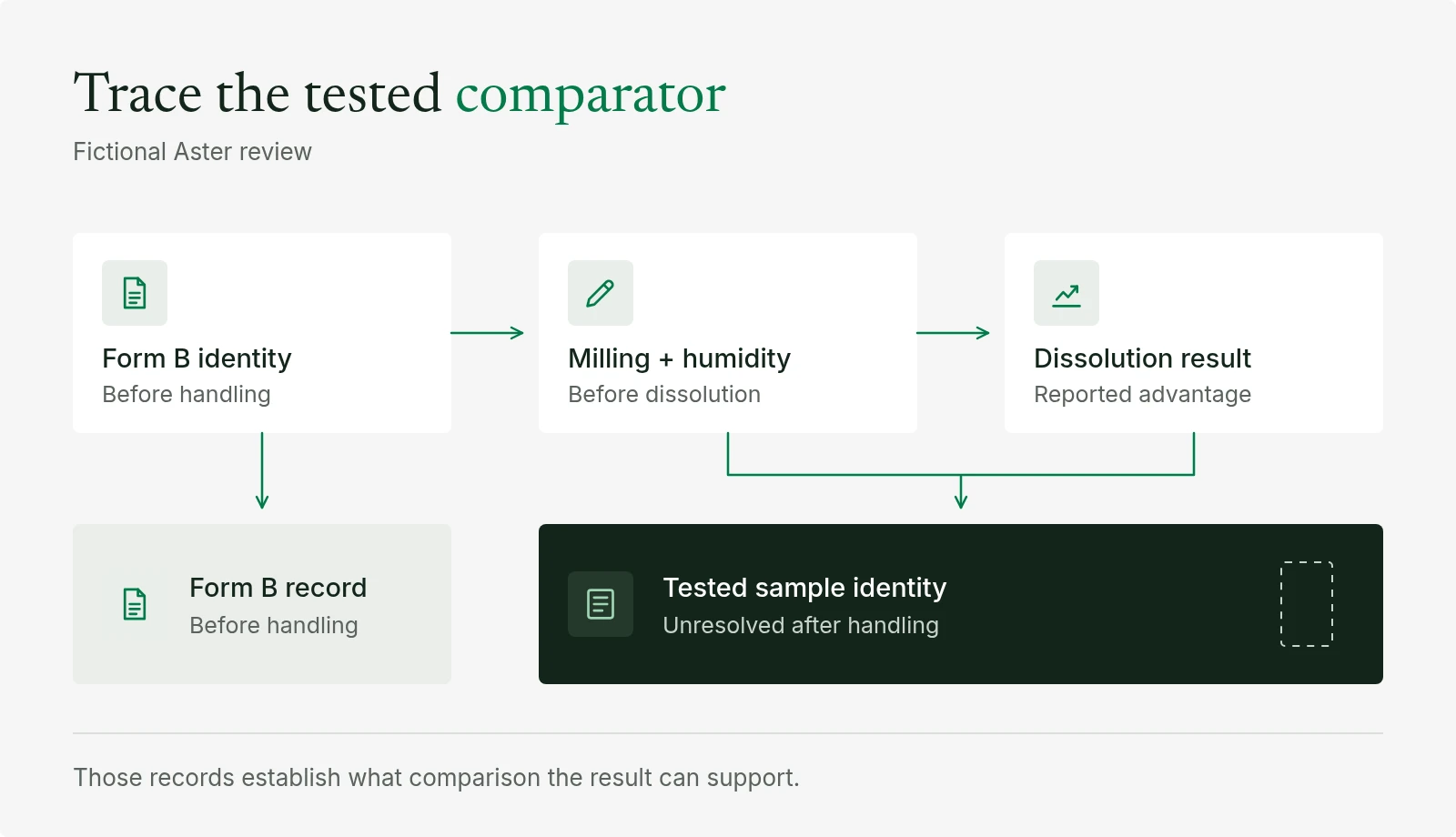
Fictional review example: Aster's proposed claim defines Form A through XRPD parameters. Its comparative report describes a dissolution advantage over Form B. The Form B identity record predates milling and humidity exposure, while the result file contains no form assignment for the material after that handling. Counsel's next evidence request is the comparator's preparation and handling history, the tested sample's identity, and any recovered-solid characterization relevant to conversion. Those records establish what comparison the result can support.
Keep difference and unexpected advantage separate. In T 777/08, evidence supported novelty over amorphous material, while improved filtration and drying remained expected advantages on that record. See T 777/08 ↗, Reasons 4 and 5.1–5.3.
A useful comparison may concern a combination of properties. In T 0479/24, the Board accepted an improved combination demonstrated against forms B–D, where the closest prior art specified no particular solid form. It distinguished purposeful selection from arbitrary selection. See T 0479/24 ↗, Reasons 7.3–7.6. Explain comparator selection in the context of the actual prior art and technical problem.
For EPO inventive step, align the effect with substantially all claimed embodiments, as required by Guidelines G-VII, 5.2 ↗. For the separate U.S. question of connecting objective evidence to the claimed invention, use the nexus evidence framework ↗.
Turn unresolved gaps into specific decisions
Before filing, map the claimed form and proposed fallback limitations to the original disclosure. U.S. written description asks whether the disclosure conveys possession of the claimed invention; enablement asks whether its full scope can be made and used without undue experimentation. Keep those inquiries separate under MPEP section 2163 ↗ and MPEP section 2164 ↗.
For later comparative evidence at the EPO, preserve the connection to the original technical teaching. The April 2026 Guidelines allow consideration of post-published evidence, while requiring the relied-on effect to be encompassed by that teaching and embodied by the same originally disclosed invention. See Guidelines G-VII, 11 ↗.
Before advancing a challenge, classify each gap by the proposition it affects: form identity, reproducible access, prior-art outcome, or comparative effect. Give the scientist a bounded question and give counsel the claim language, source pinpoint, observations, competing explanation, and unresolved assumption. That creates a usable basis for choosing additional experiments, revising a claim position, or developing a challenge.
Frequently asked questions
Is an XRPD peak list enough to identify a claimed polymorph?
Its adequacy depends on the claim and analytical record. Read the peak list with the full pattern, measurement method, tolerances, and any form-content limitation. Guidelines F-IV, 4.11 ↗ require objective, reliable determination of physical-structure parameters. Keep the scientist's form assignment and supporting characterization linked to the tested sample.
Can a “Form B” label establish the comparator's identity?
A label alone leaves the comparison unanchored. Retain the comparator's preparation record, analytical assignment, form fraction, and handling history, linked to the batch actually tested. Where milling, humidity, or the experiment may cause conversion, establish the form at the relevant measurement stage before attributing the result to Form B.
Does a successful seeded batch explain first access to the form?
It explains a seeded preparation, while first access remains a separate evidence question. Trace where the seeds came from and how their form was established. T 1066/03 ↗, Reasons 2.2–2.6, illustrates the sufficiency problem when obtaining the necessary starting form depended on seeds without adequate teaching of their preparation.
Can post-published comparative data support inventive step at the EPO?
Yes, if the effect falls within the original technical teaching and belongs to the same invention disclosed at filing. Under Guidelines G-VII, 11 ↗, qualifying evidence receives free evaluation even when published later. Connect the tested forms, comparative protocol, and asserted effect to the original disclosure.
Where Patlytics fits
Patlytics connects retrieved patent evidence and inventor materials to reviewable disclosures, drafts, and invalidity charts:
- Invalidity ↗ searches patents and non-patent literature (NPL) against each claim and produces source-linked claim charts.
- Invention Disclosures (IDF) turns inventor materials, including slides and figures, into a reviewable disclosure.
- Patent Drafting supports application drafting, with chemistry inputs including ChemDraw input, a structure editor, conversion of chemical images into simplified molecular-input line-entry system (SMILES) notation, and Markush/R-group generation.
- §112 Check flags written description, enablement, and definiteness issues, with citations back to the specification.
Attorneys retain review and decision authority over the generated work product and legal analysis.
Connect your form-specific evidence to a reviewable disclosure, patent draft, or invalidity chart in Patlytics. Book a demo →

See it on your own patents
Reduce cycle times. Increase margins. Deliver winning IP outcomes.